End-of-Chapter Exercises

 You are here
End-of-Chapter Exercises
Last updated at August 14, 2026 by Teachoo
Transcript
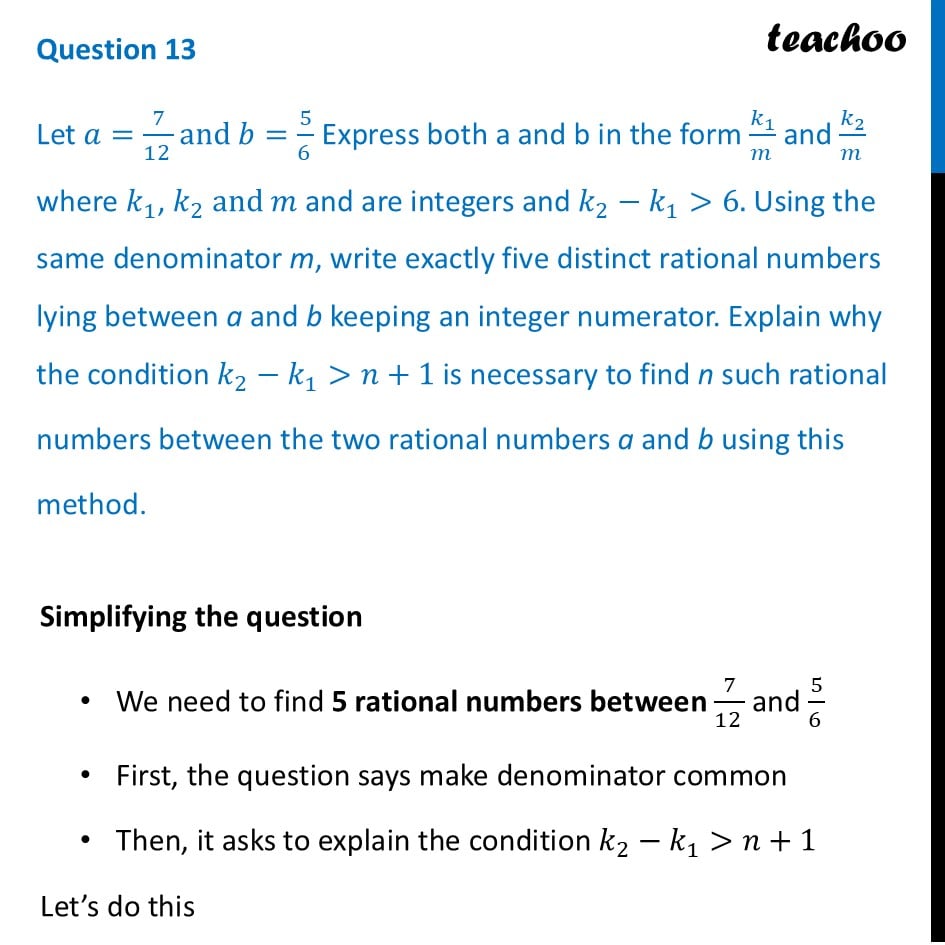
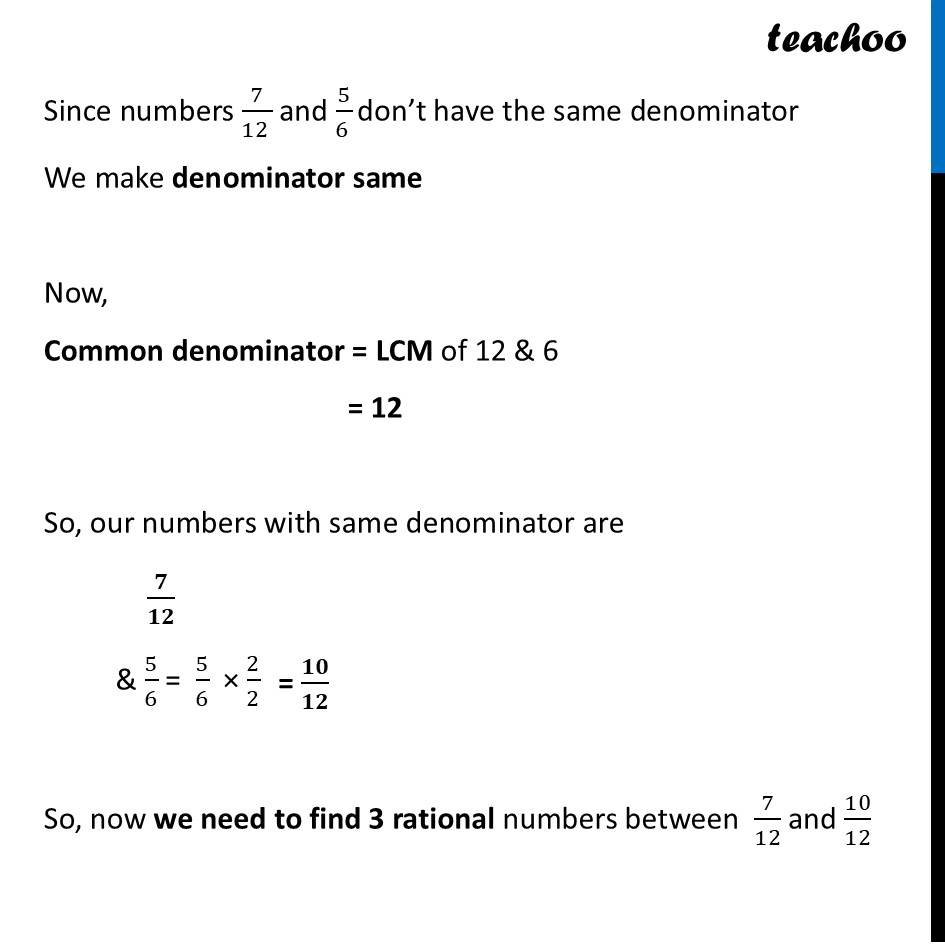
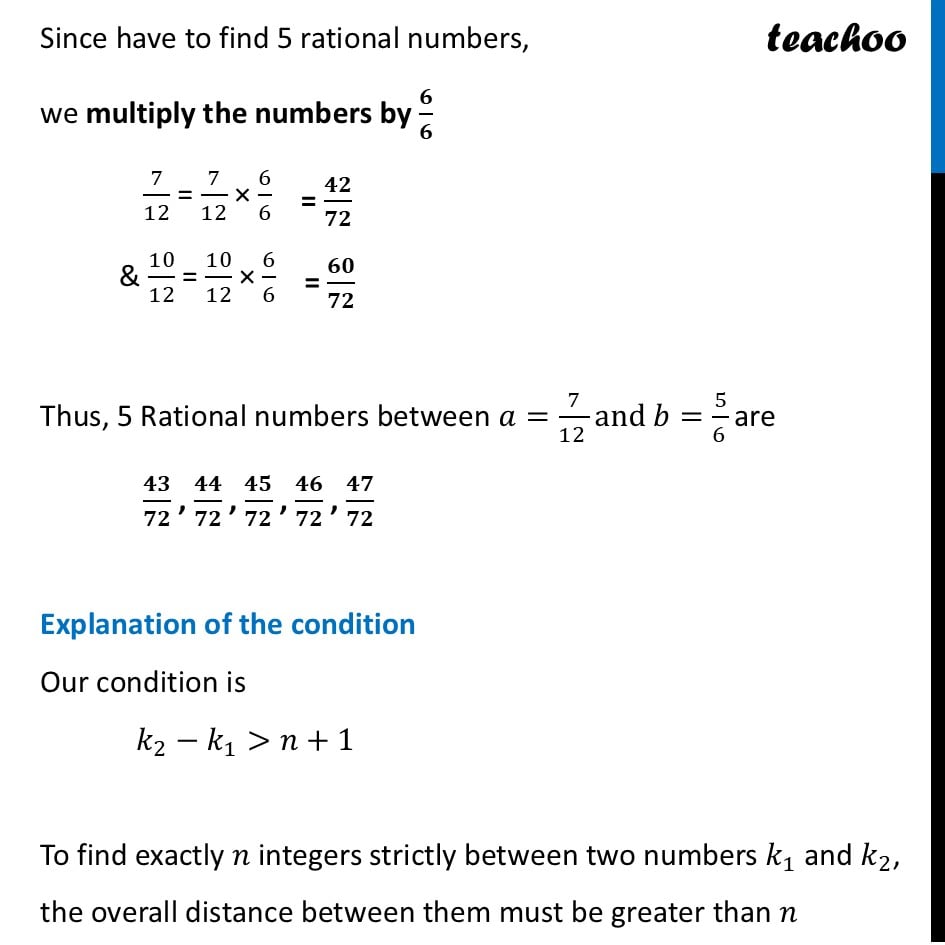
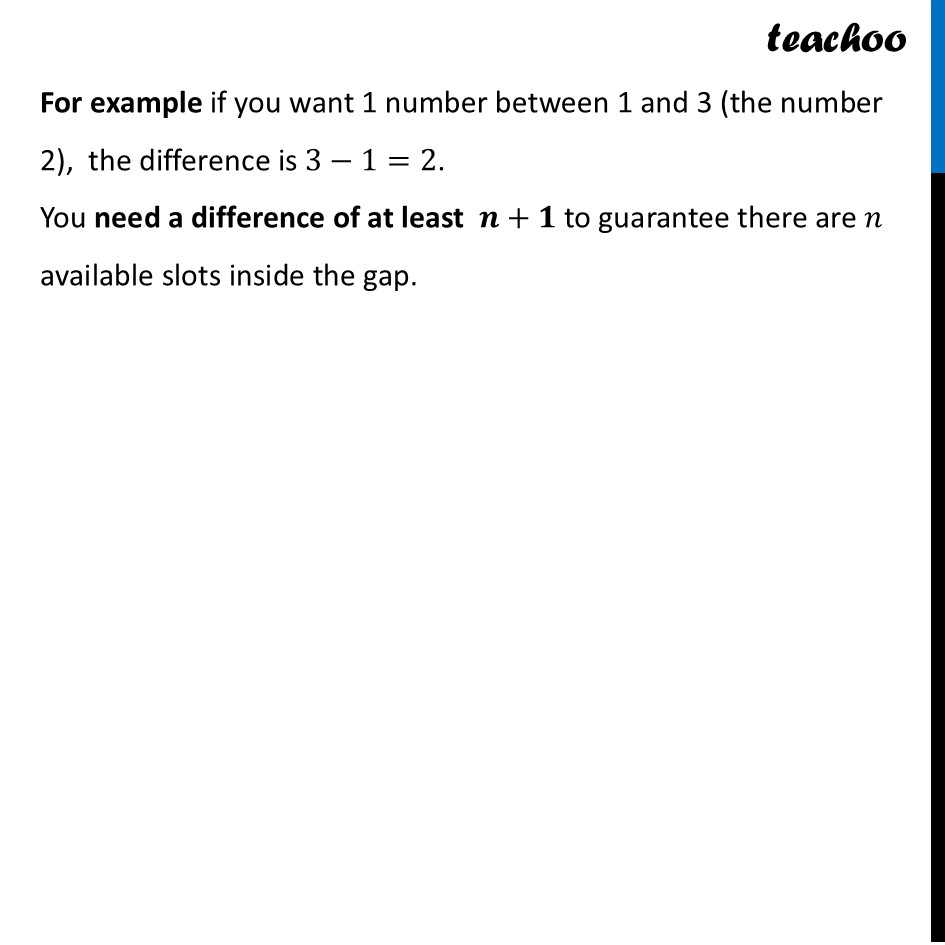
Question 13 Let 𝑎=7/(12 ) and 𝑏=5/(6 ) Express both a and b in the form 𝑘_1/(𝑚 ) and 𝑘_2/(𝑚 ) where 𝑘_1, 𝑘_2 and 𝑚 and are integers and 𝑘_2−𝑘_1>6. Using the same denominator m, write exactly five distinct rational numbers lying between a and b keeping an integer numerator. Explain why the condition 𝑘_2−𝑘_1>𝑛+1 is necessary to find n such rational numbers between the two rational numbers a and b using this method. Simplifying the question We need to find 5 rational numbers between 7/(12 ) and 5/(6 ) First, the question says make denominator common Then, it asks to explain the condition 𝑘_2−𝑘_1>𝑛+1 Let’s do this Since numbers 7/(12 ) and 5/(6 ) don’t have the same denominator We make denominator same Now, Common denominator = LCM of 12 & 6 = 12 So, our numbers with same denominator are 𝟕/𝟏𝟐 & 5/6 = 5/6 × 2/2 So, now we need to find 3 rational numbers between 7/12 and 10/12 Since have to find 5 rational numbers, we multiply the numbers by 𝟔/𝟔 7/12 = 7/12 × 6/6 & 10/12 = 10/12 × 6/6 Thus, 5 Rational numbers between 𝑎=7/(12 ) and 𝑏=5/(6 ) are 𝟒𝟑/𝟕𝟐 , 𝟒𝟒/𝟕𝟐 , 𝟒𝟓/𝟕𝟐 , 𝟒𝟔/𝟕𝟐 , 𝟒𝟕/𝟕𝟐 Explanation of the condition Our condition is 𝑘_2−𝑘_1>𝑛+1 To find exactly 𝑛 integers strictly between two numbers 𝑘_1 and 𝑘_2, the overall distance between them must be greater than 𝑛 For example if you want 1 number between 1 and 3 (the number 2), the difference is 3−1=2. You need a difference of at least 𝒏+𝟏 to guarantee there are 𝑛 available slots inside the gap.