End-of-Chapter Exercises

 You are here
End-of-Chapter Exercises
Last updated at August 14, 2026 by Teachoo
Transcript
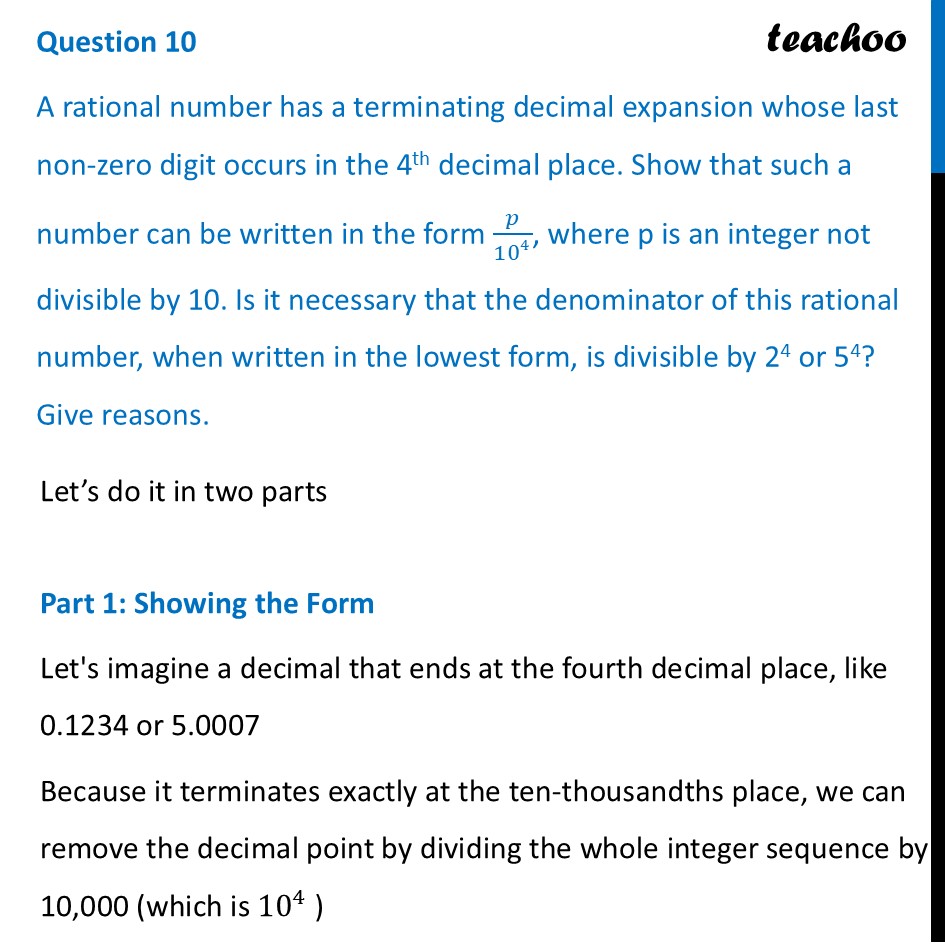
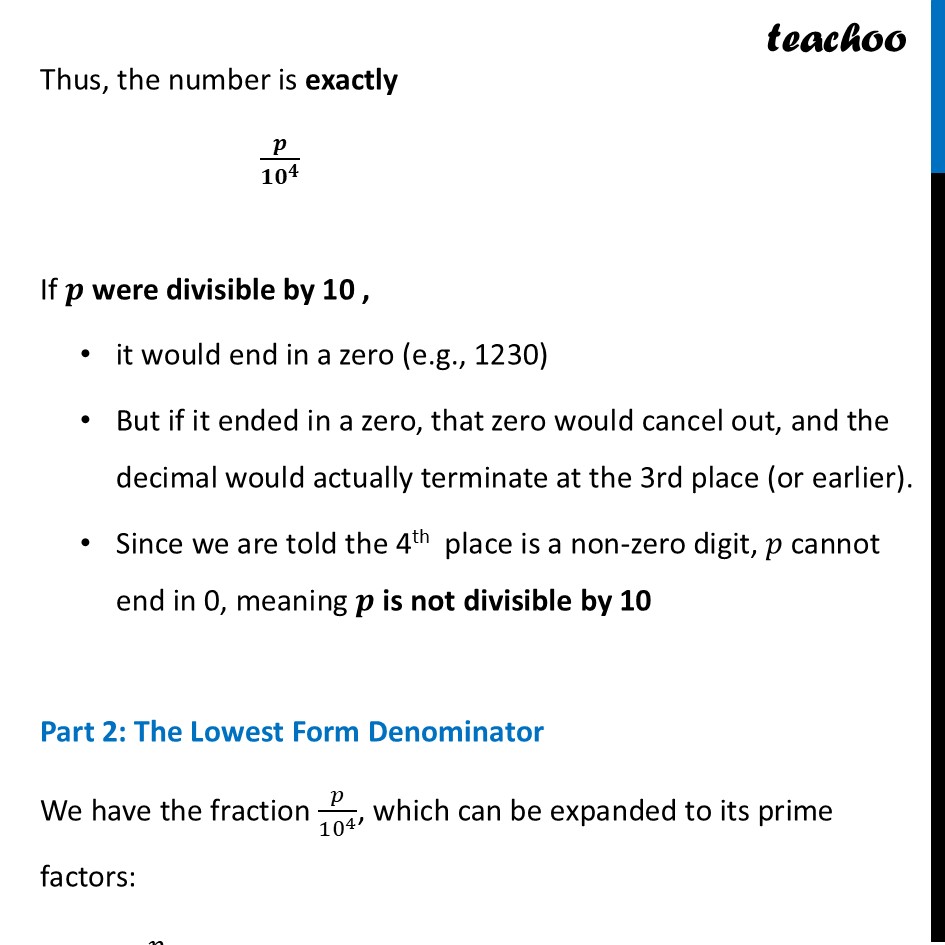
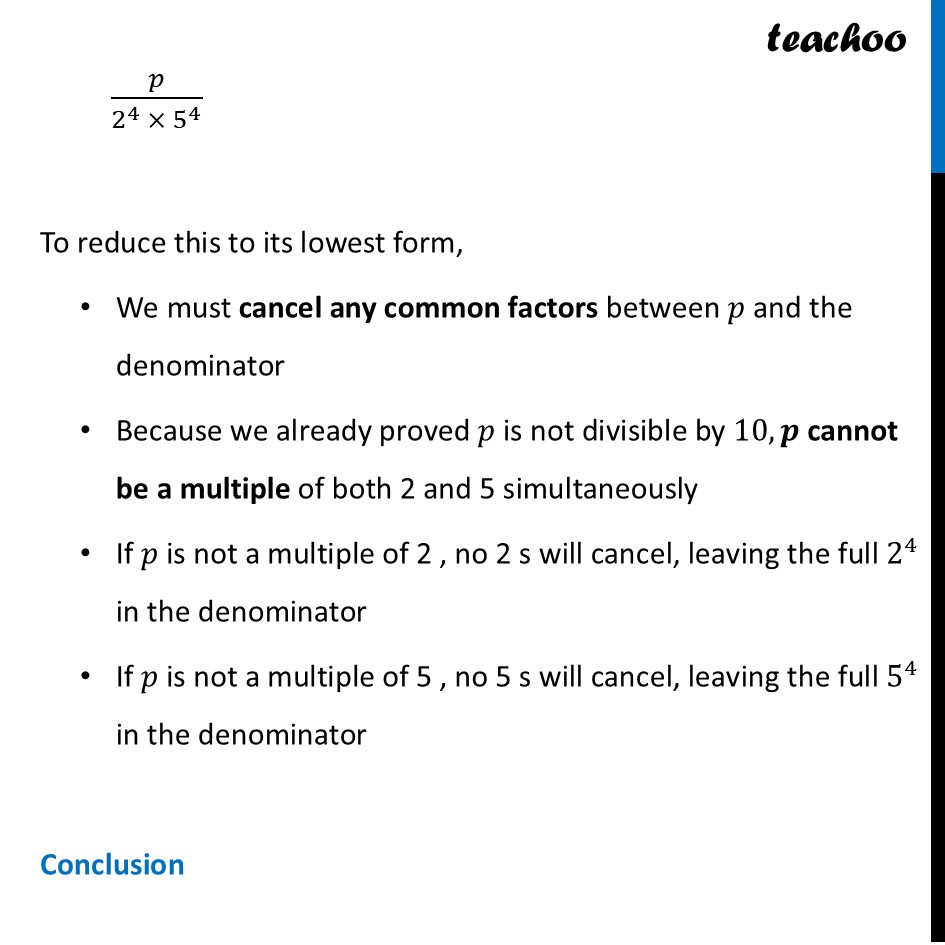
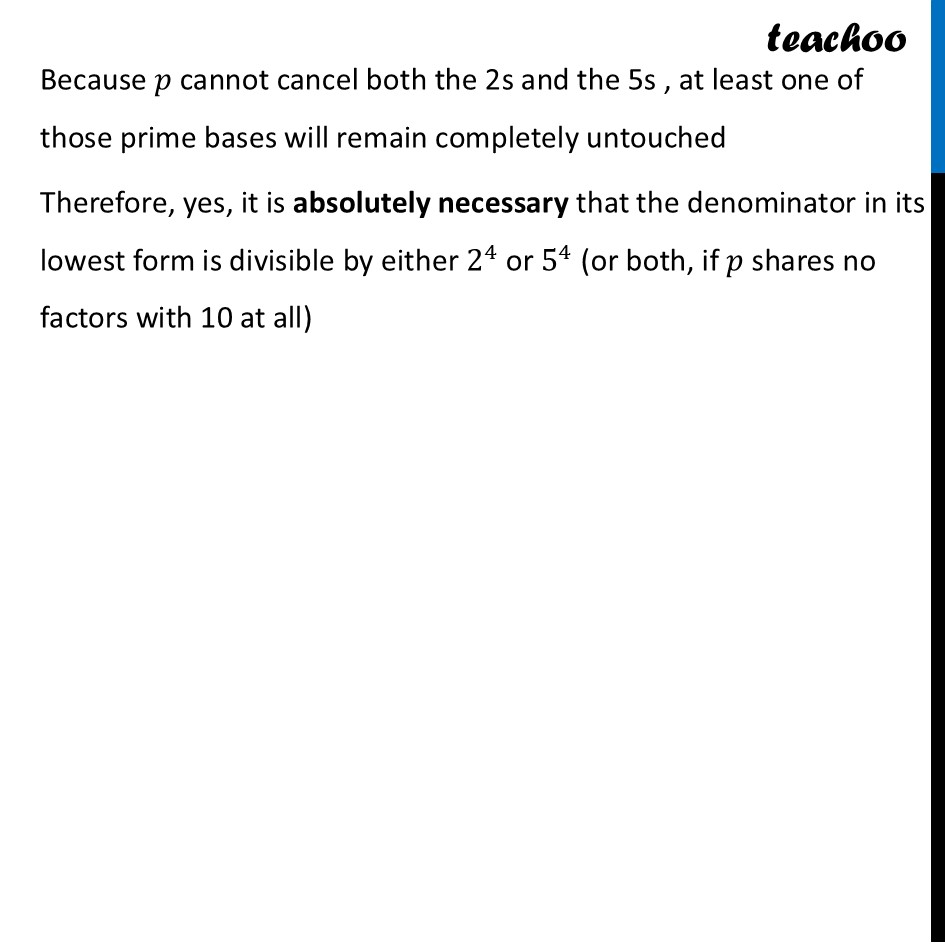
Question 10 A rational number has a terminating decimal expansion whose last non-zero digit occurs in the 4th decimal place. Show that such a number can be written in the form 𝑝/(104 ), where p is an integer not divisible by 10. Is it necessary that the denominator of this rational number, when written in the lowest form, is divisible by 24 or 54? Give reasons. Let’s do it in two parts Part 1: Showing the Form Let's imagine a decimal that ends at the fourth decimal place, like 0.1234 or 5.0007 Because it terminates exactly at the ten-thousandths place, we can remove the decimal point by dividing the whole integer sequence by 10,000 (which is 10^4 ) Thus, the number is exactly 𝒑/〖𝟏𝟎〗^𝟒 If 𝒑 were divisible by 10 , it would end in a zero (e.g., 1230) But if it ended in a zero, that zero would cancel out, and the decimal would actually terminate at the 3rd place (or earlier). Since we are told the 4th place is a non-zero digit, 𝑝 cannot end in 0, meaning 𝒑 is not divisible by 10 Part 2: The Lowest Form Denominator We have the fraction 𝑝/10^4 , which can be expanded to its prime factors: 𝑝/(2^4 × 5^4 ) To reduce this to its lowest form, We must cancel any common factors between 𝑝 and the denominator Because we already proved 𝑝 is not divisible by 10,𝒑 cannot be a multiple of both 2 and 5 simultaneously If 𝑝 is not a multiple of 2 , no 2 s will cancel, leaving the full 2^4 in the denominator If 𝑝 is not a multiple of 5 , no 5 s will cancel, leaving the full 5^4 in the denominator Conclusion Because 𝑝 cannot cancel both the 2s and the 5s , at least one of those prime bases will remain completely untouched Therefore, yes, it is absolutely necessary that the denominator in its lowest form is divisible by either 2^4 or 5^4 (or both, if 𝑝 shares no factors with 10 at all)