You are here

![The Story of Pi (π) and Madhava’s Infinite Series [Class 9 Ganita] - The Story of Pi (π) and Madhava’s Infinite Series](https://cdn.teachoo.com/8e66fc55-827a-4d09-95df-d84061b3eff3/slide18.jpg)
The Story of Pi (π) and Madhava’s Infinite Series
The Story of Pi (π) and Madhava’s Infinite Series
Last updated at August 14, 2026 by Teachoo
Transcript
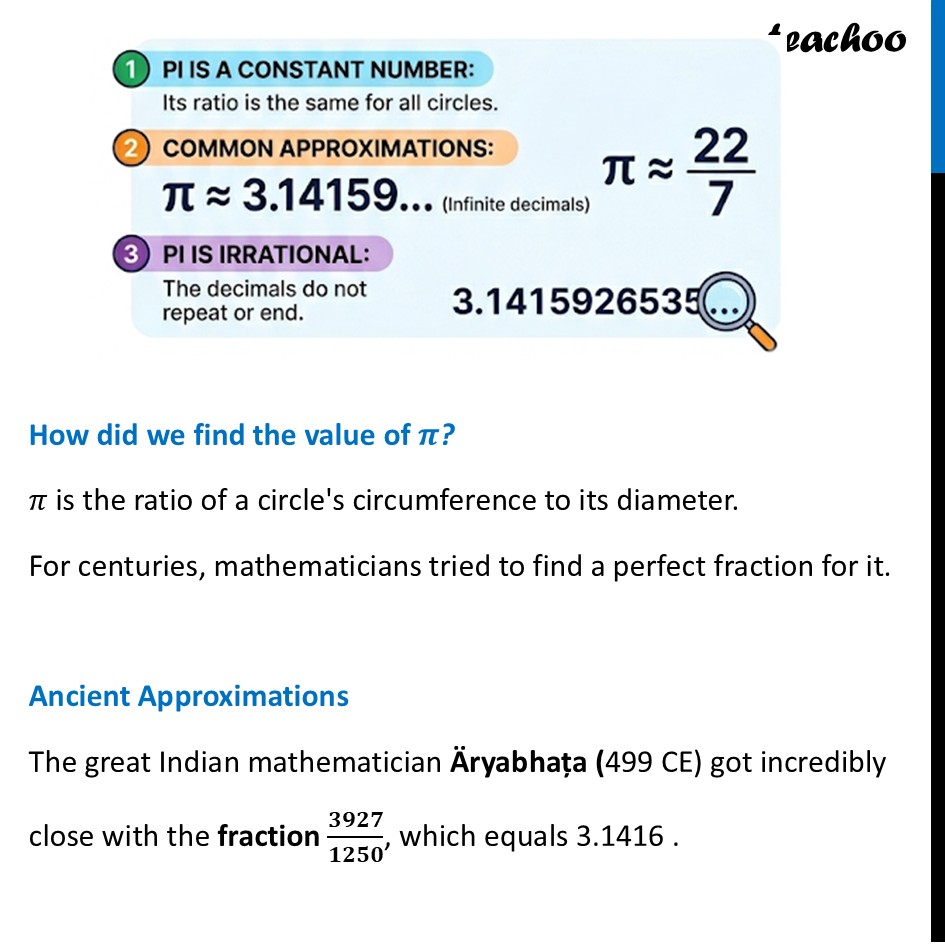
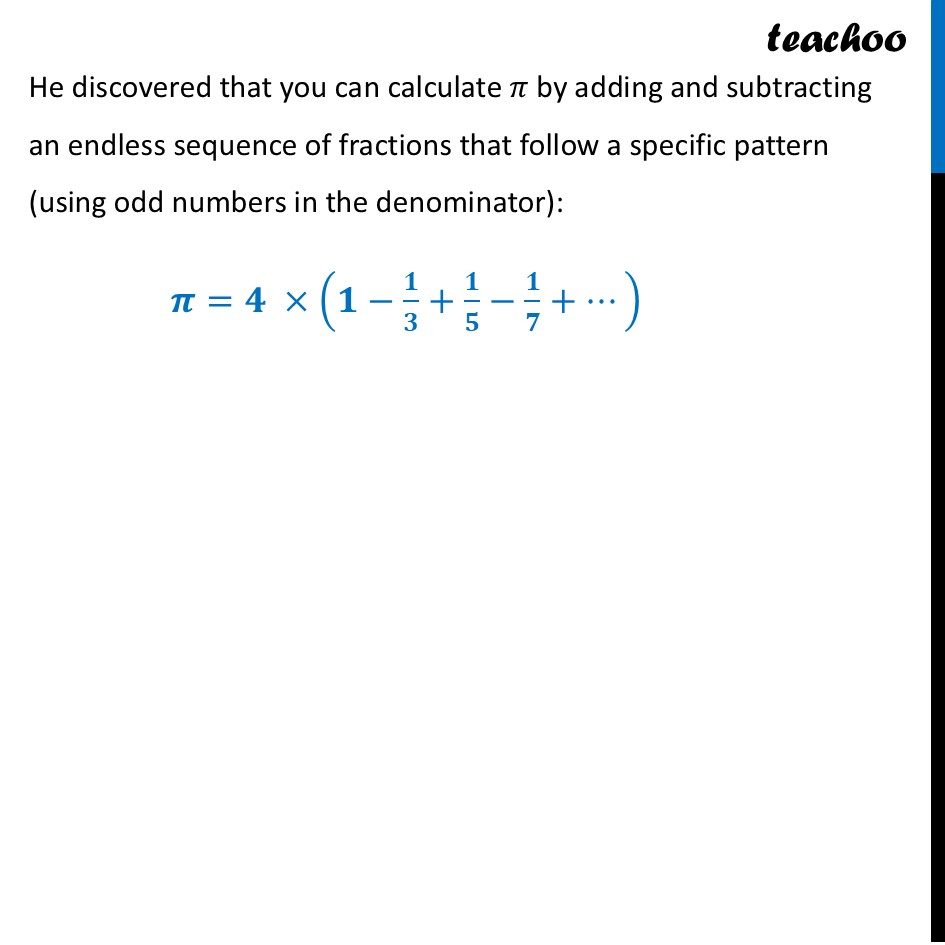
The Story of Pi (π) Pi is the constant RATIO of a circle's CIRCUMFERENCE to its DIAMETER. π=c/d CIRCUMFERENCE/DIAMETER (1) PIIS A CONSTANT NUMBER: Its ratio is the same for all circles. (2) COMMON APPROXIMATIONS: (3) PI IS IRRATIONAL: The decimals do not repeat or end. 3.1415926535 ...How did we find the value of 𝝅? 𝜋 is the ratio of a circle's circumference to its diameter. For centuries, mathematicians tried to find a perfect fraction for it. Ancient Approximations The great Indian mathematician Äryabhața (499 CE) got incredibly close with the fraction 𝟑𝟗𝟐𝟕/𝟏𝟐𝟓𝟎, which equals 3.1416 . However, he was a genius who recognized this was only an āsanna (an approximation), hinting that a perfect fraction might be impossible to find. The Proof Much later, in 1761, a mathematician named Lambert finally proved formally what Āryabhața suspected: 𝝅 is irrational. No single fraction will ever perfectly equal 𝝅. Mādhava's Breakthrough So, how do you write an exact formula for an irrational number if you can't use a fraction? In the 14th century, Mādhava of Sangamagrama unlocked the secret: you use an infinite series. He discovered that you can calculate 𝜋 by adding and subtracting an endless sequence of fractions that follow a specific pattern (using odd numbers in the denominator): 𝝅=𝟒 ×(𝟏−𝟏/𝟑+𝟏/𝟓−𝟏/𝟕+…)