End-of-Chapter Exercises

 You are here
End-of-Chapter Exercises
Last updated at August 14, 2026 by Teachoo
Transcript
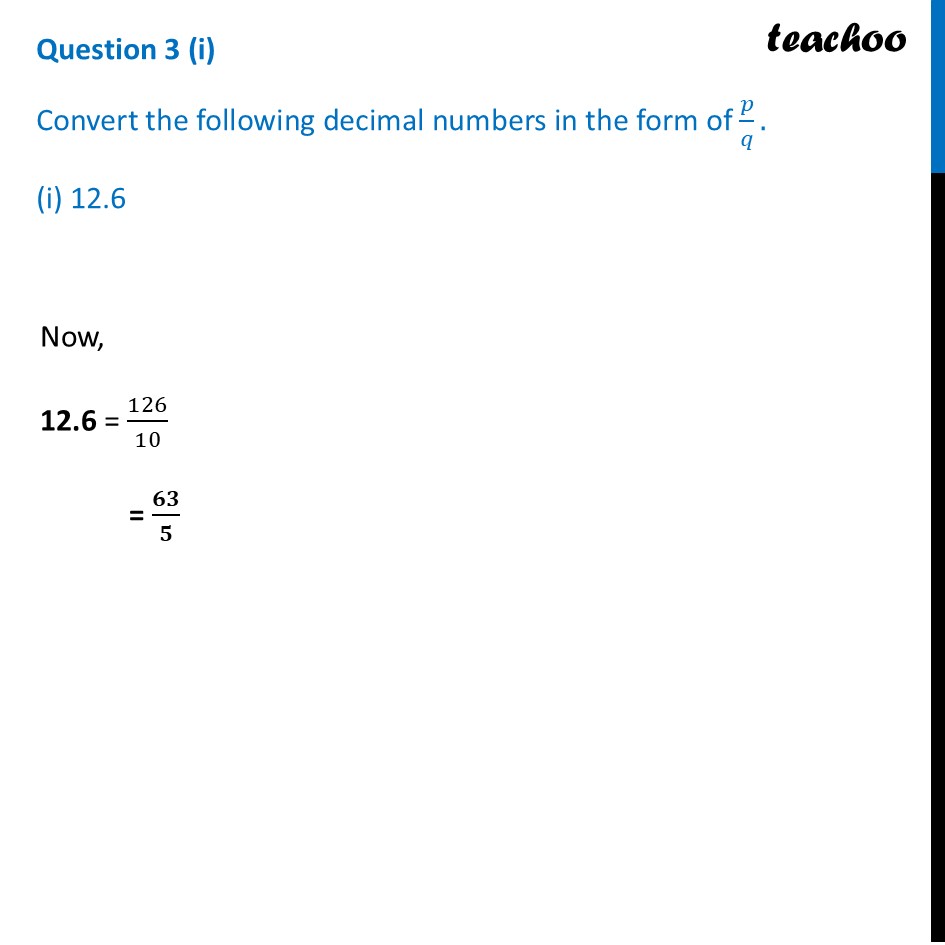
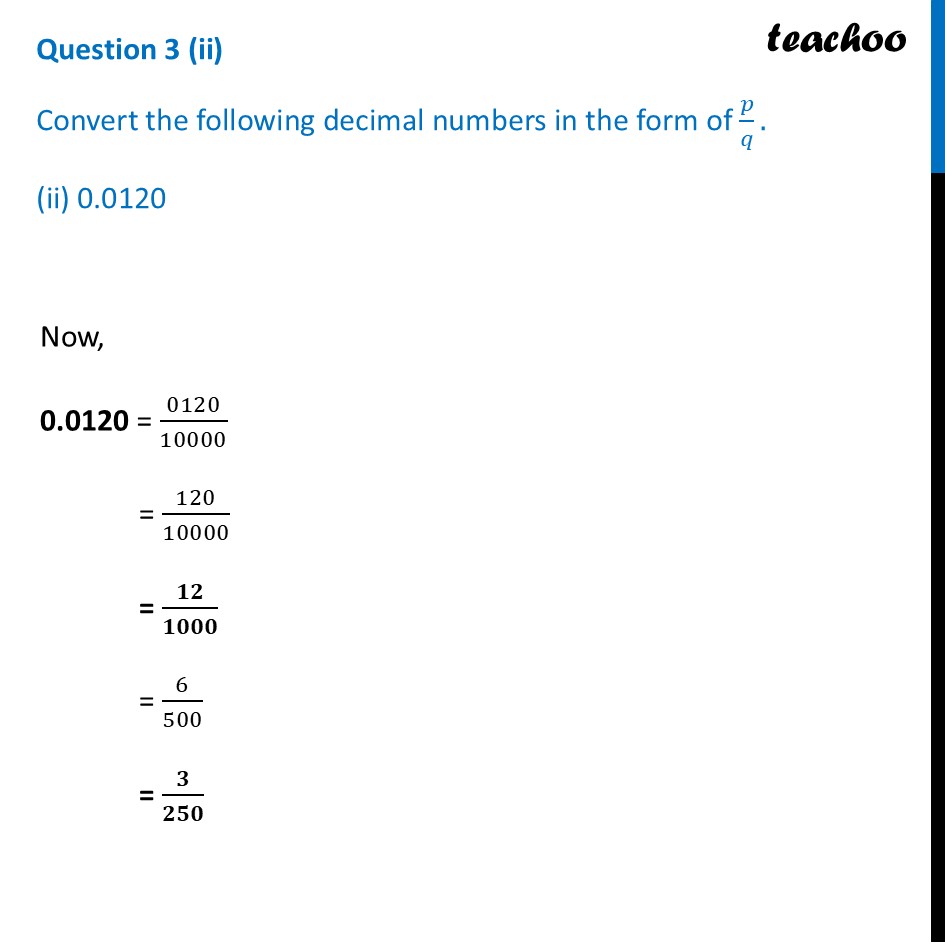
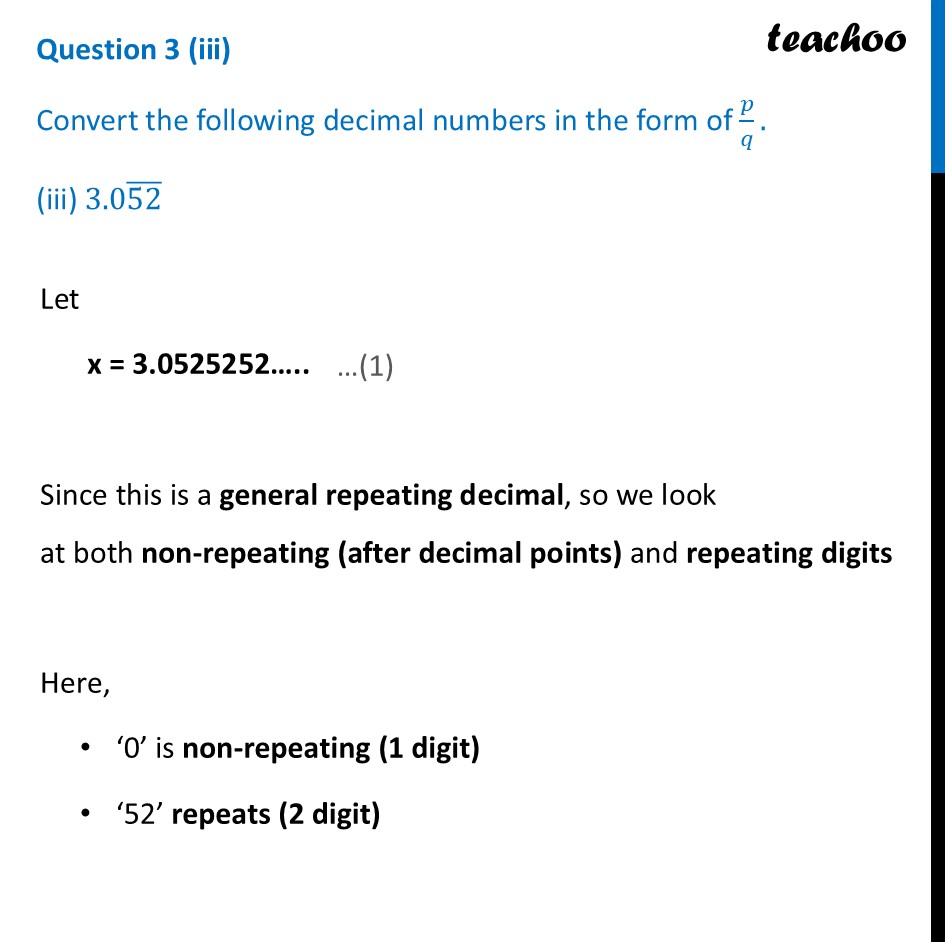
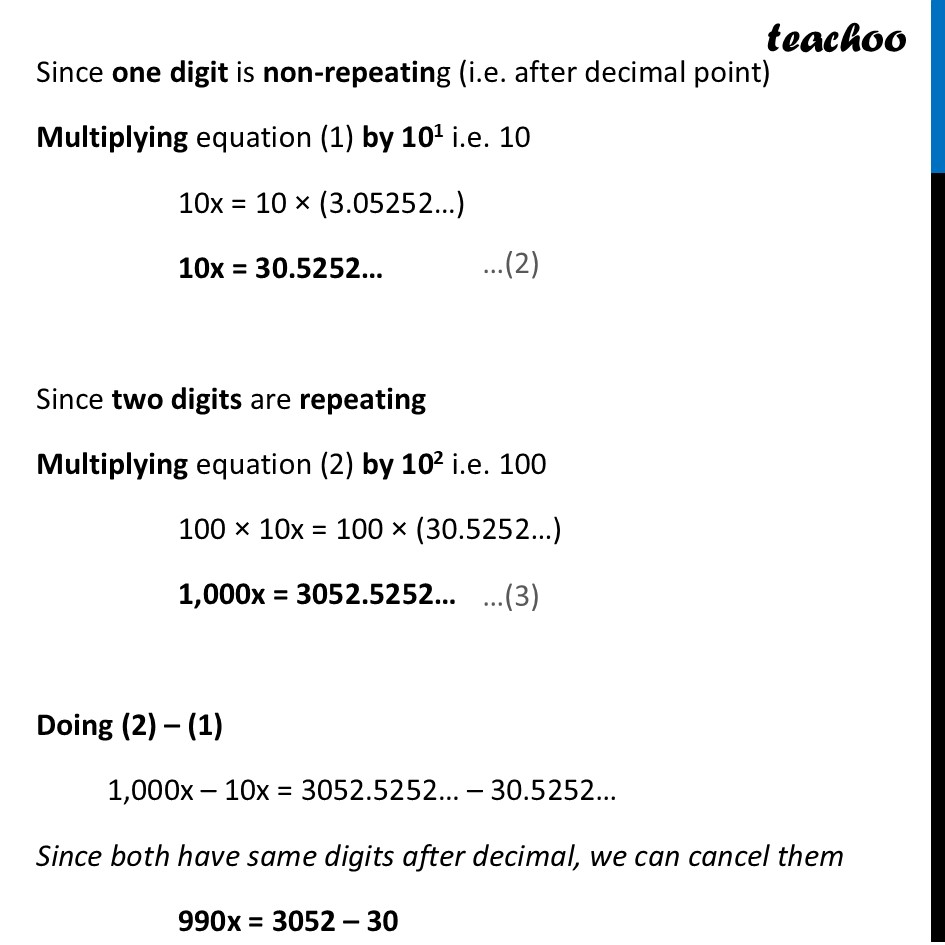
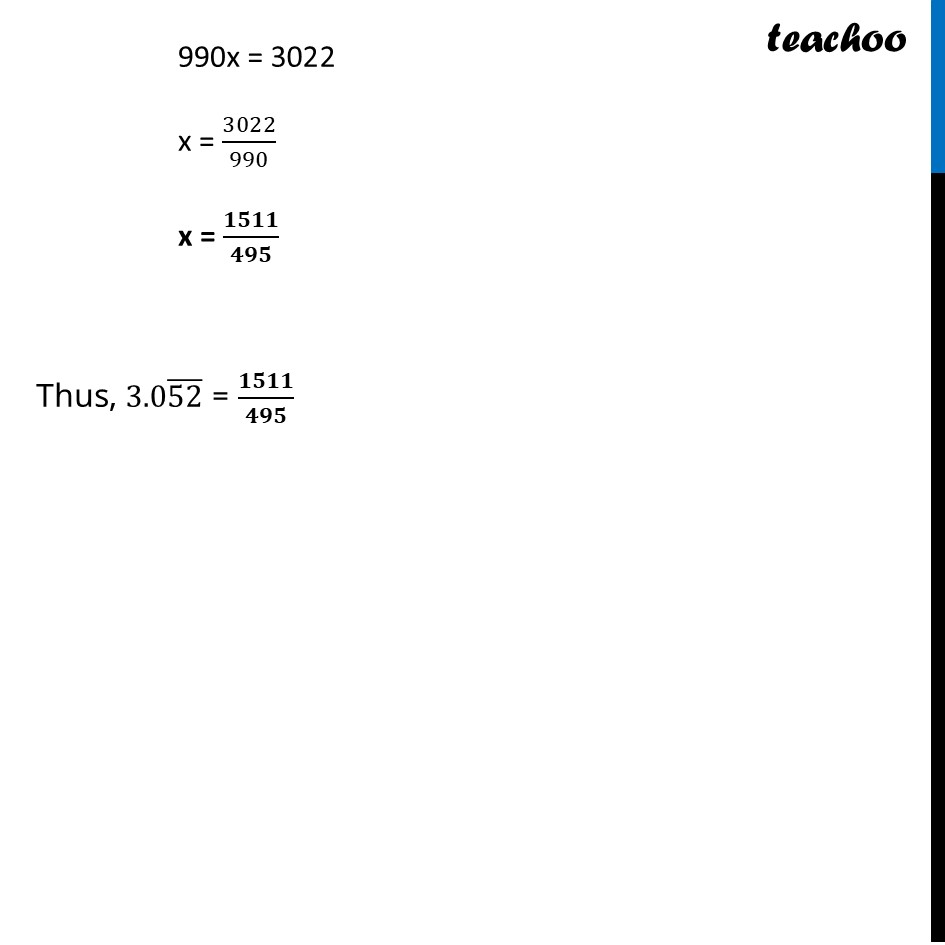
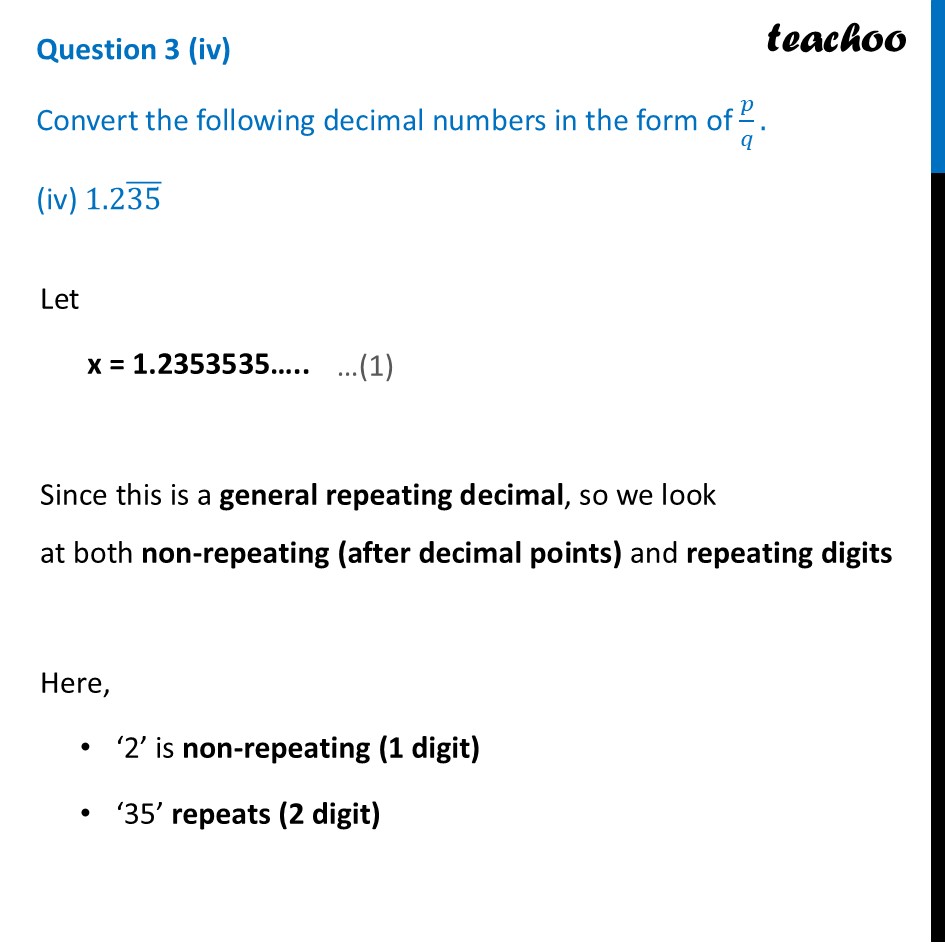
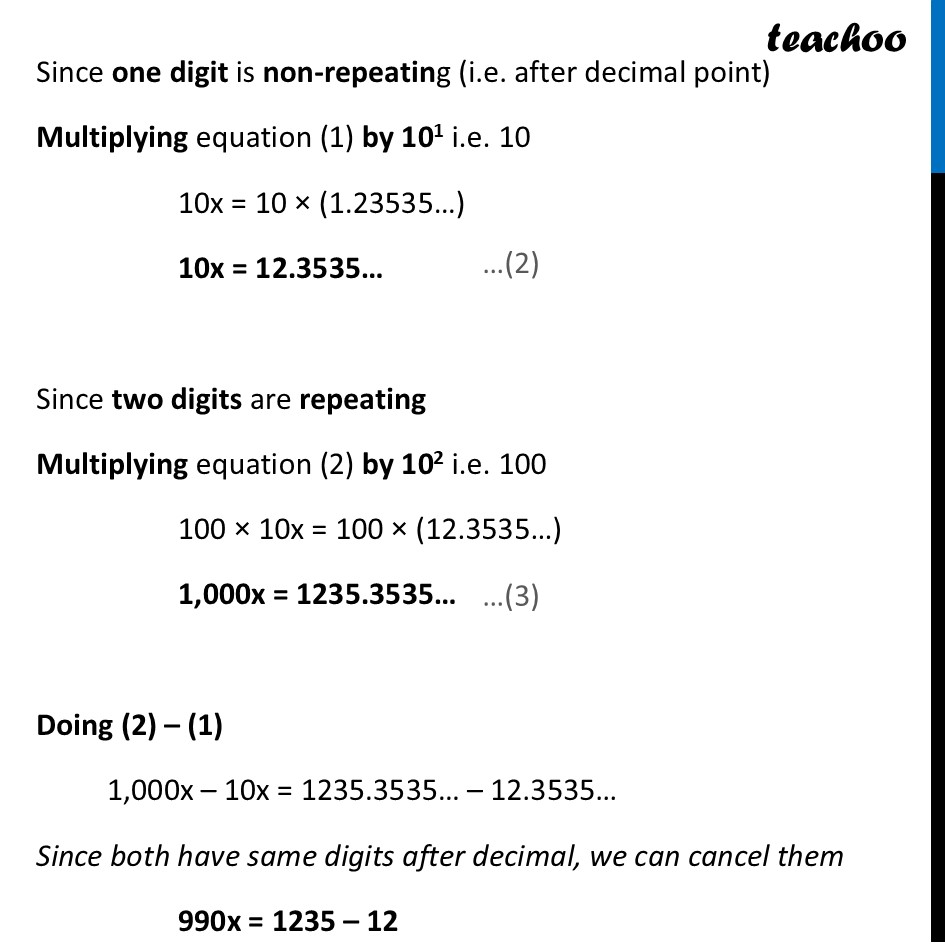
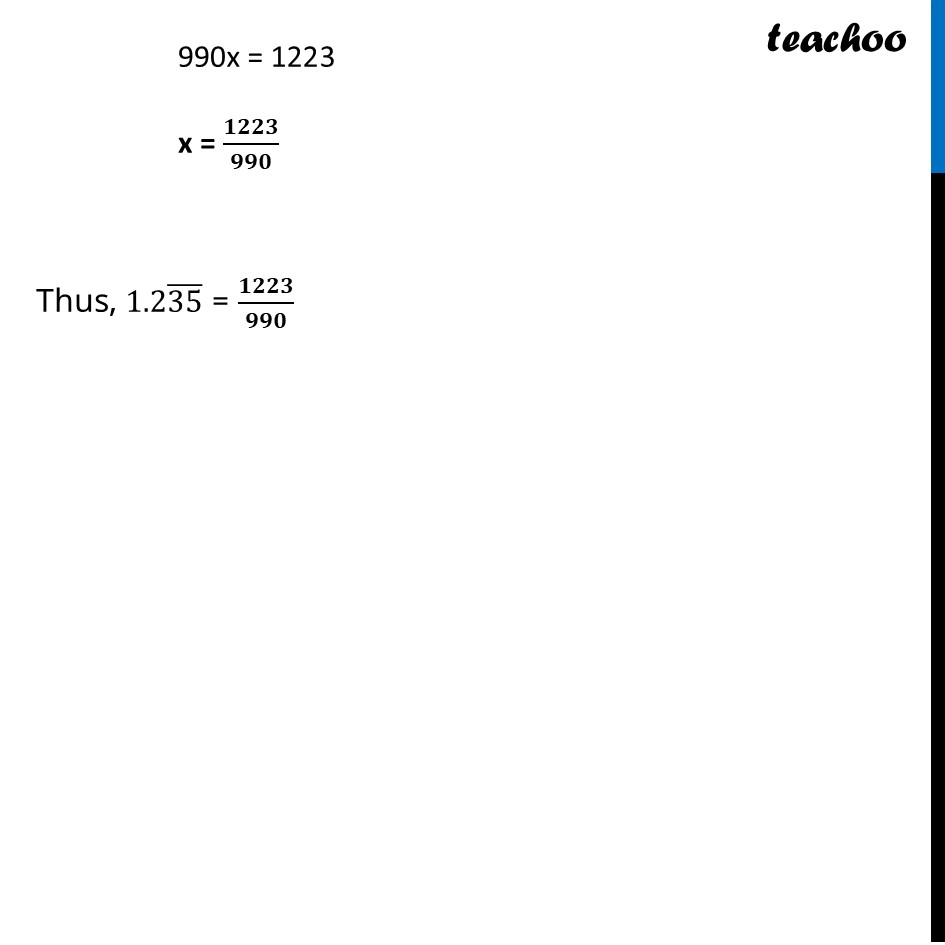
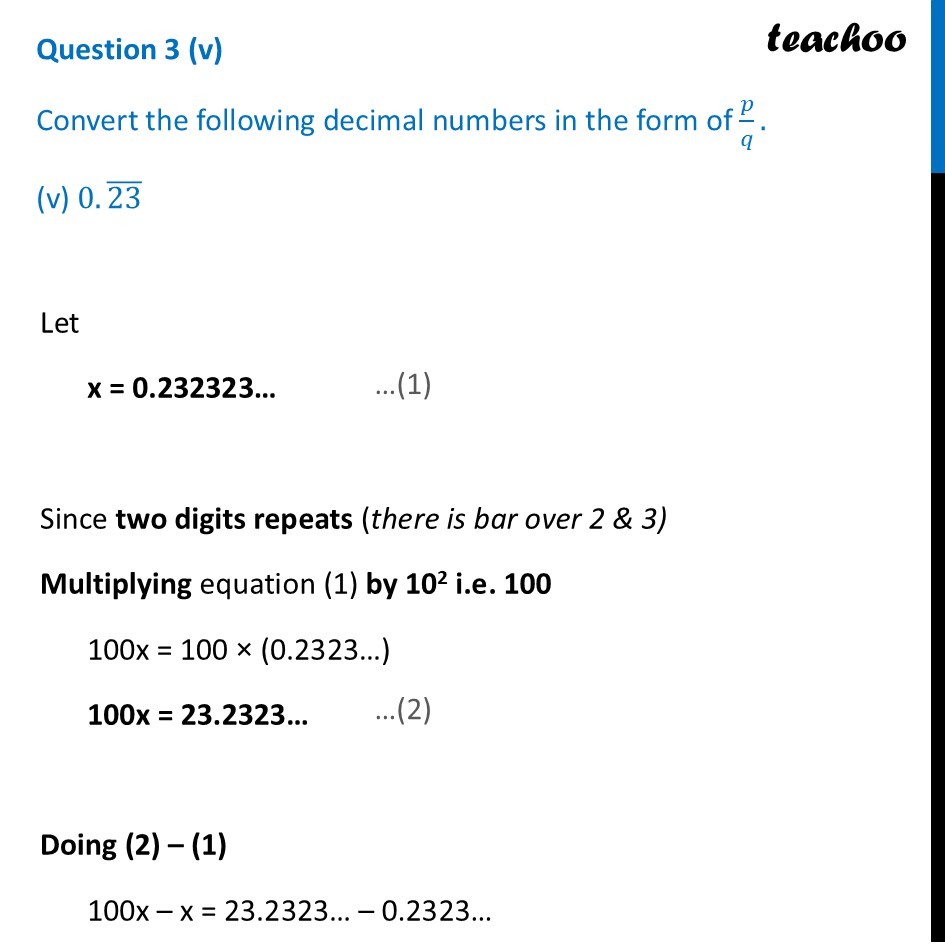
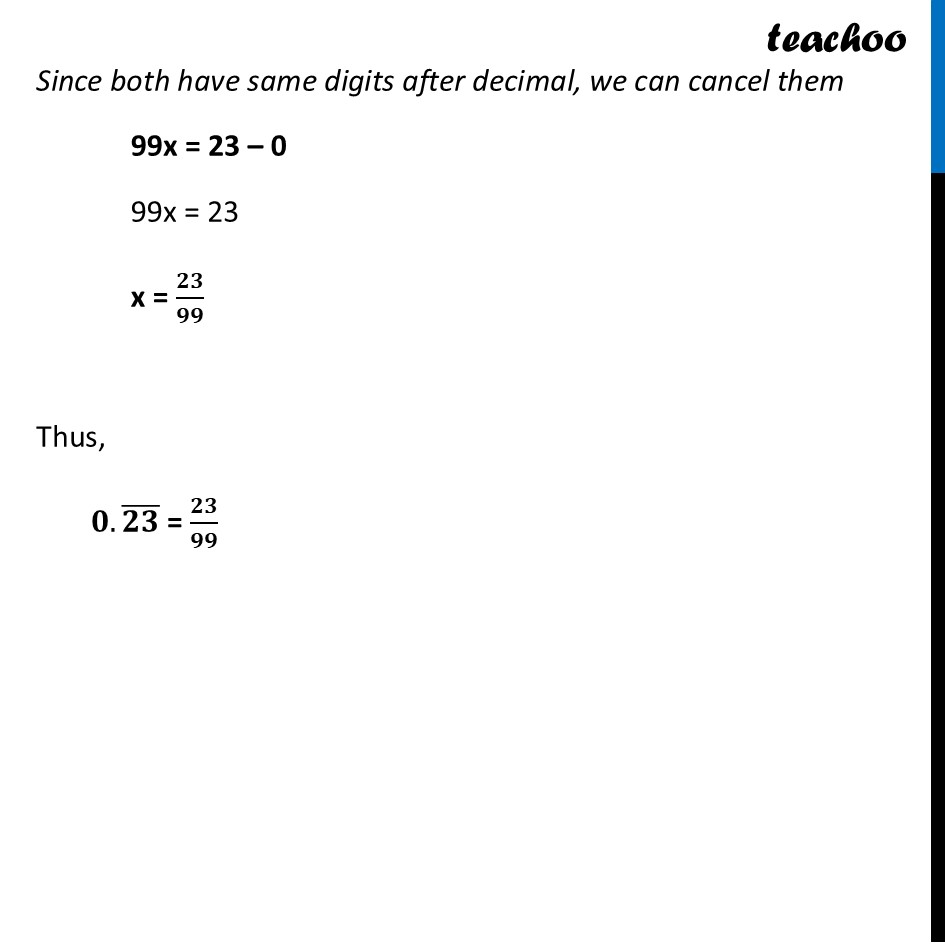
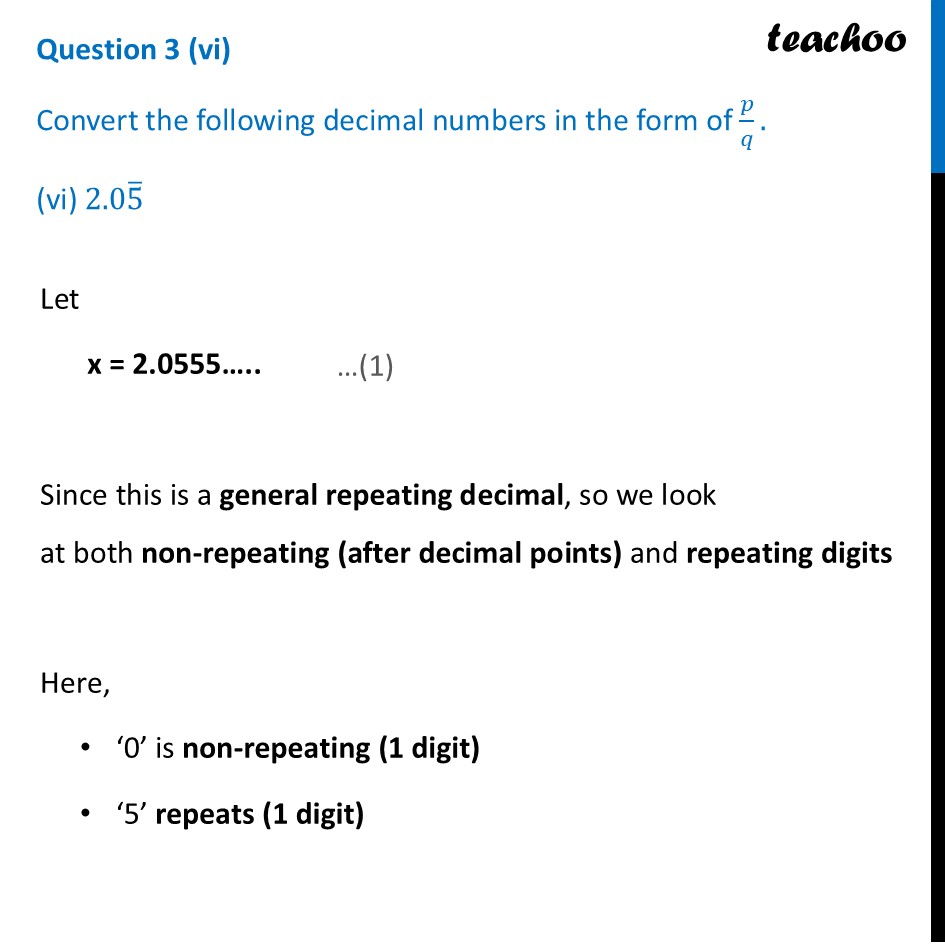
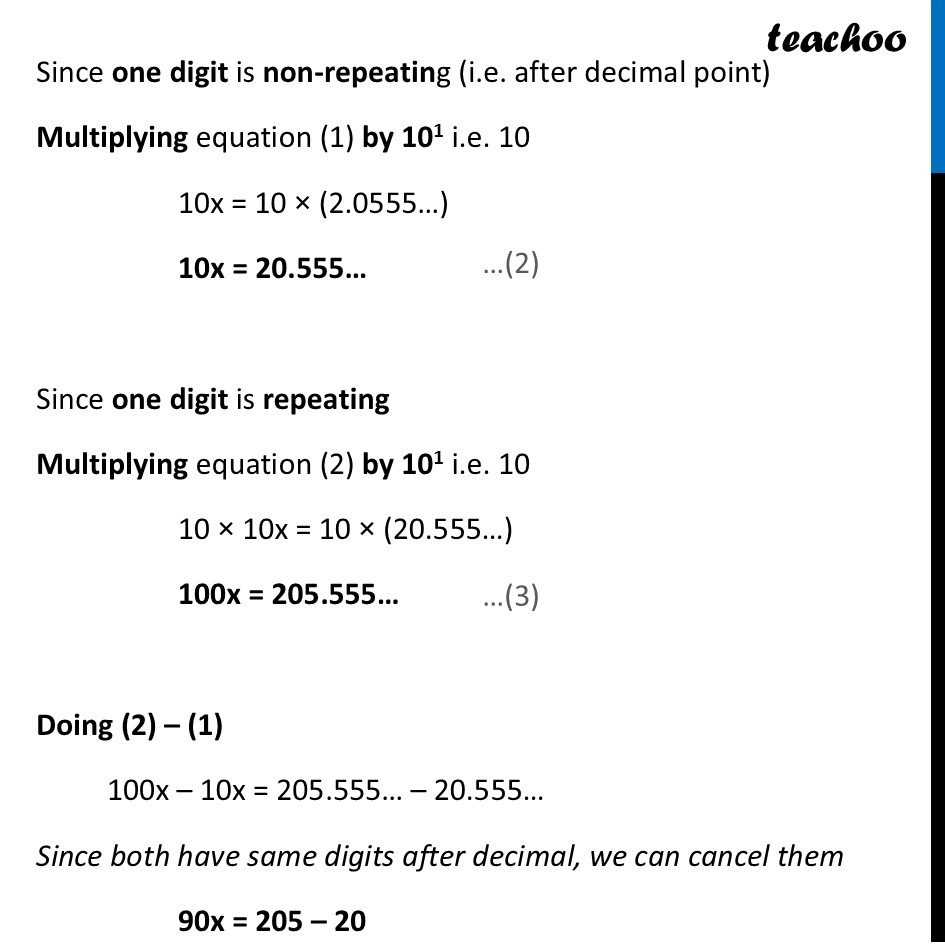
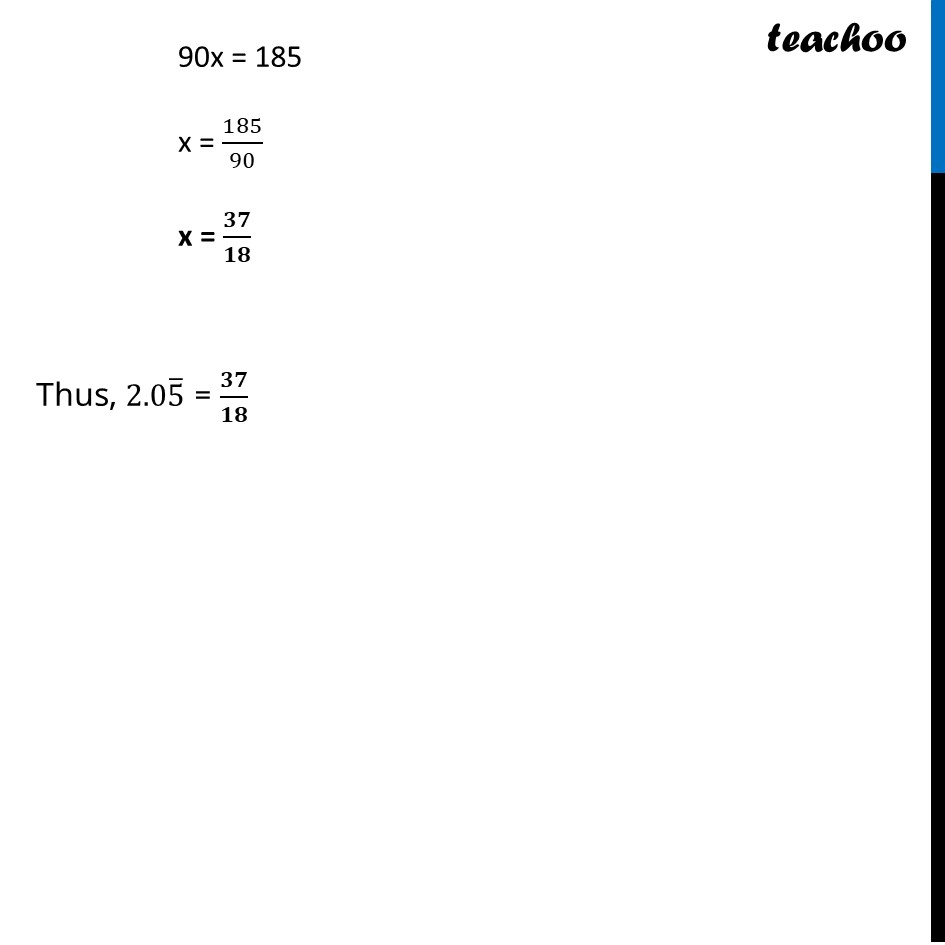
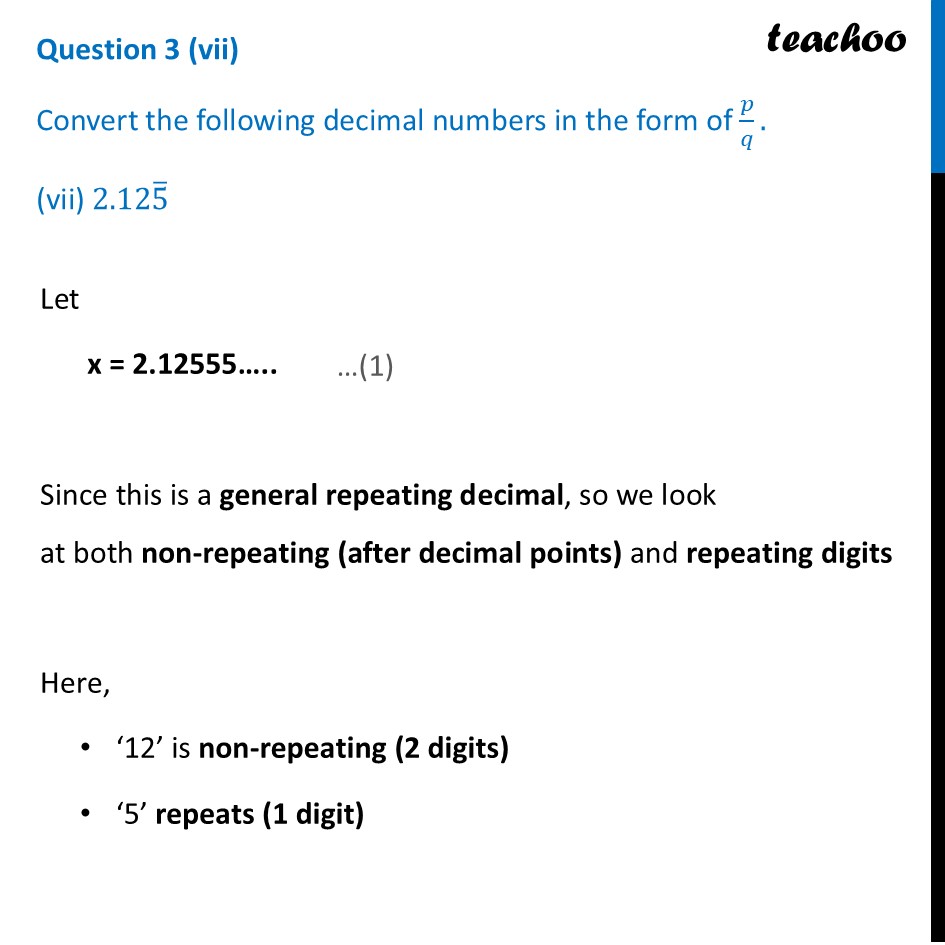
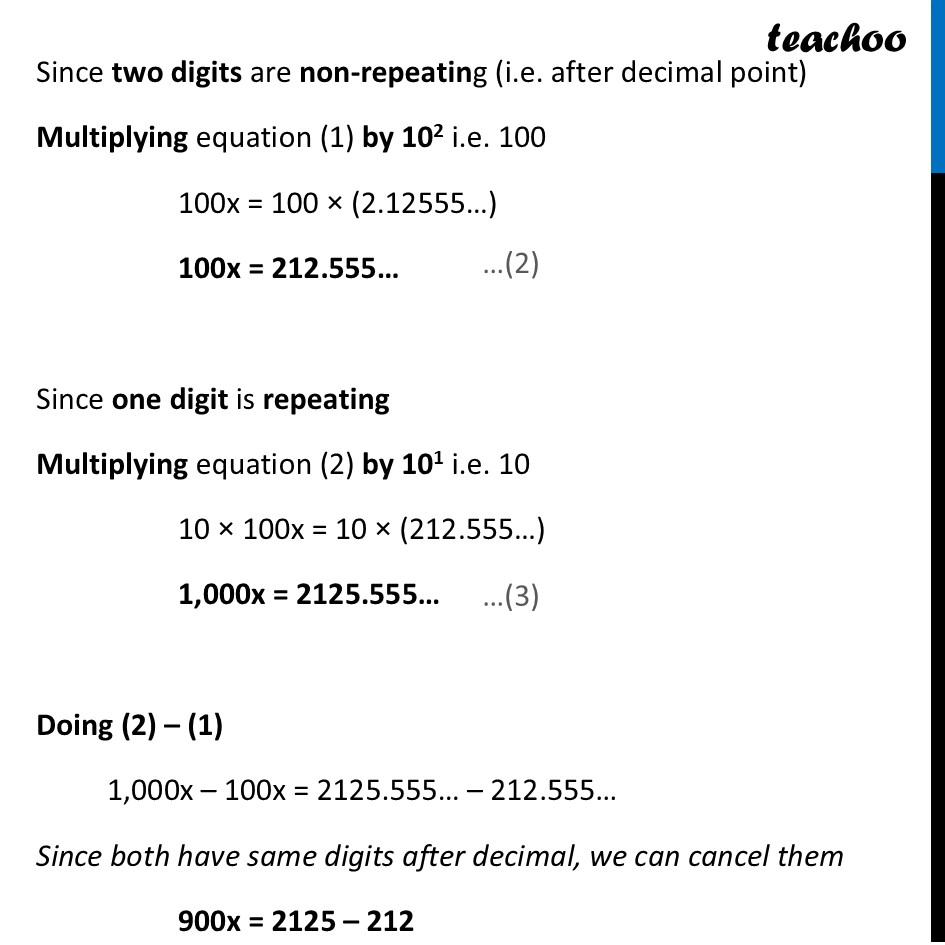
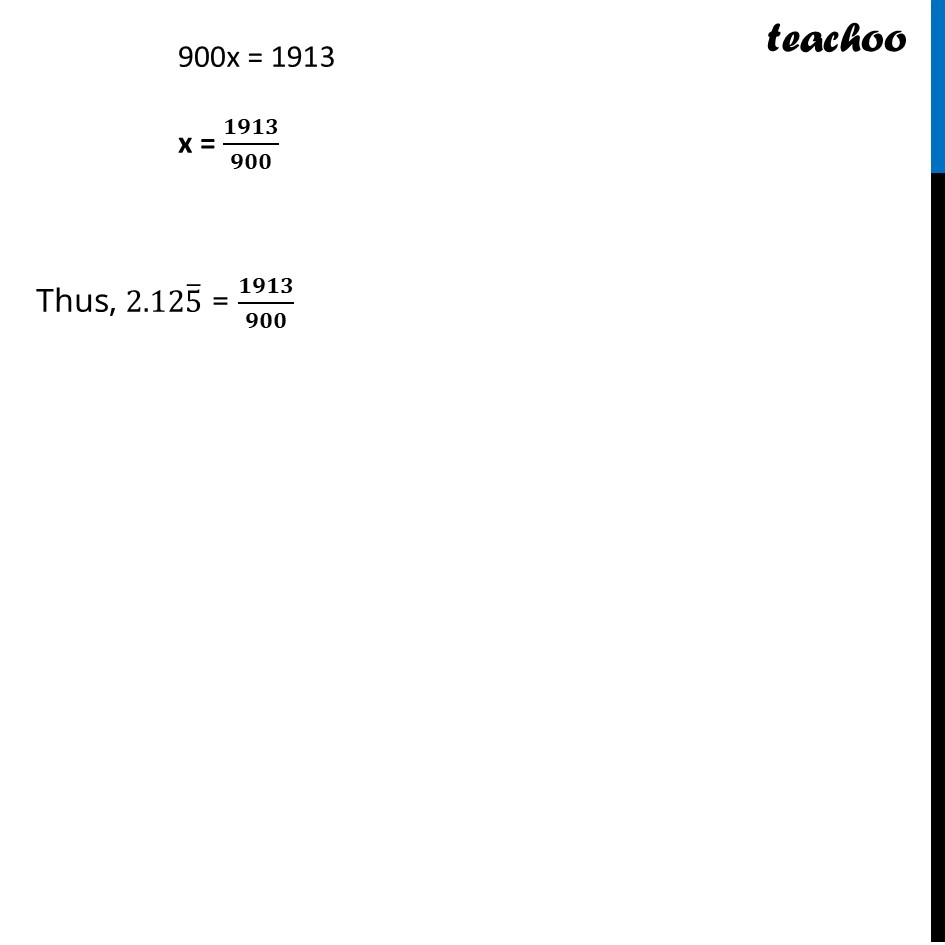
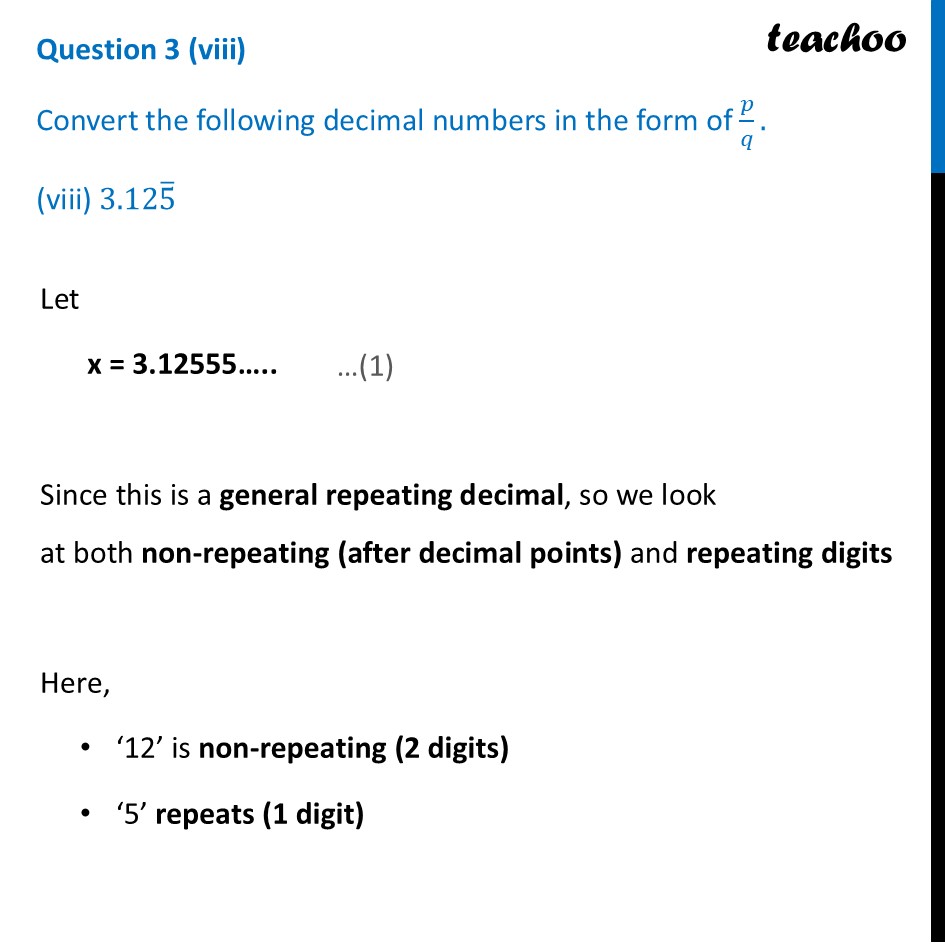
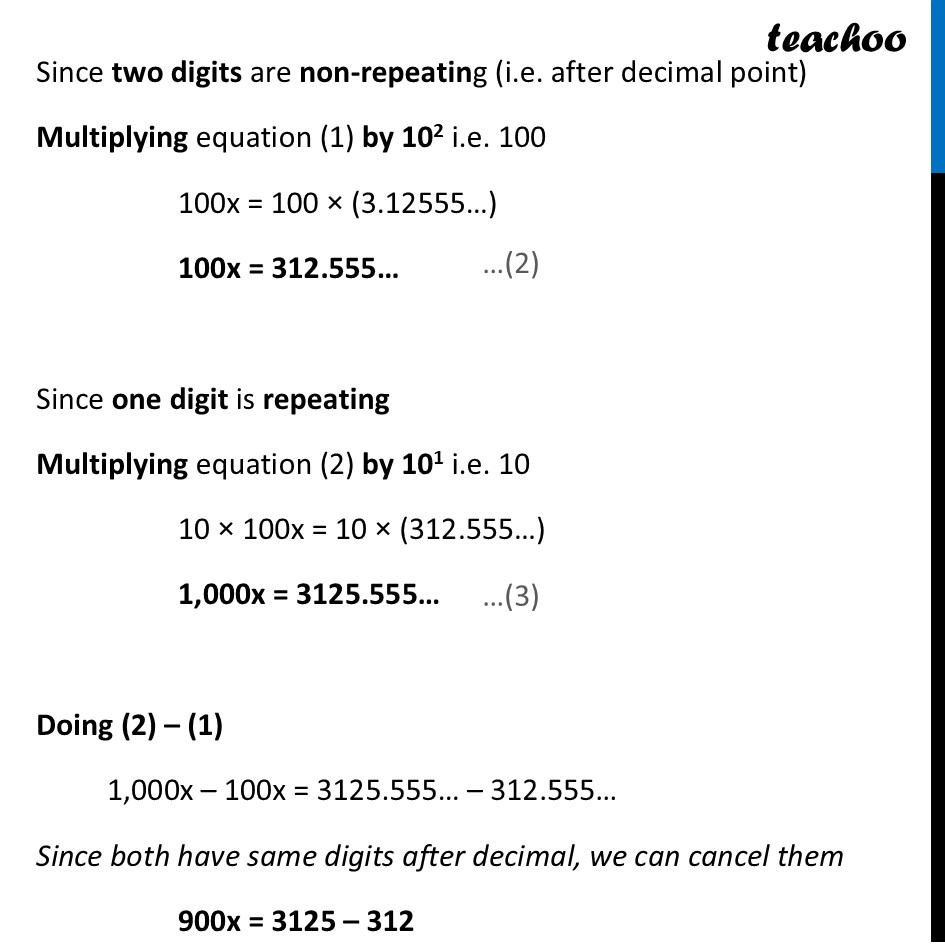
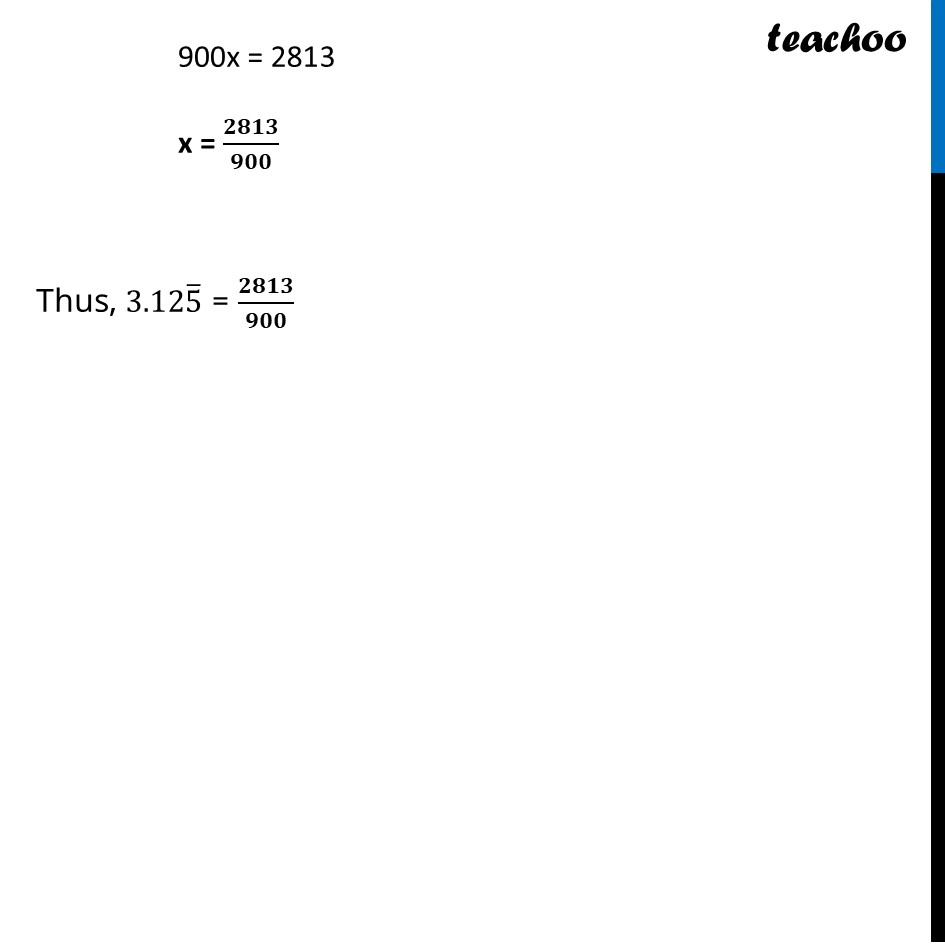
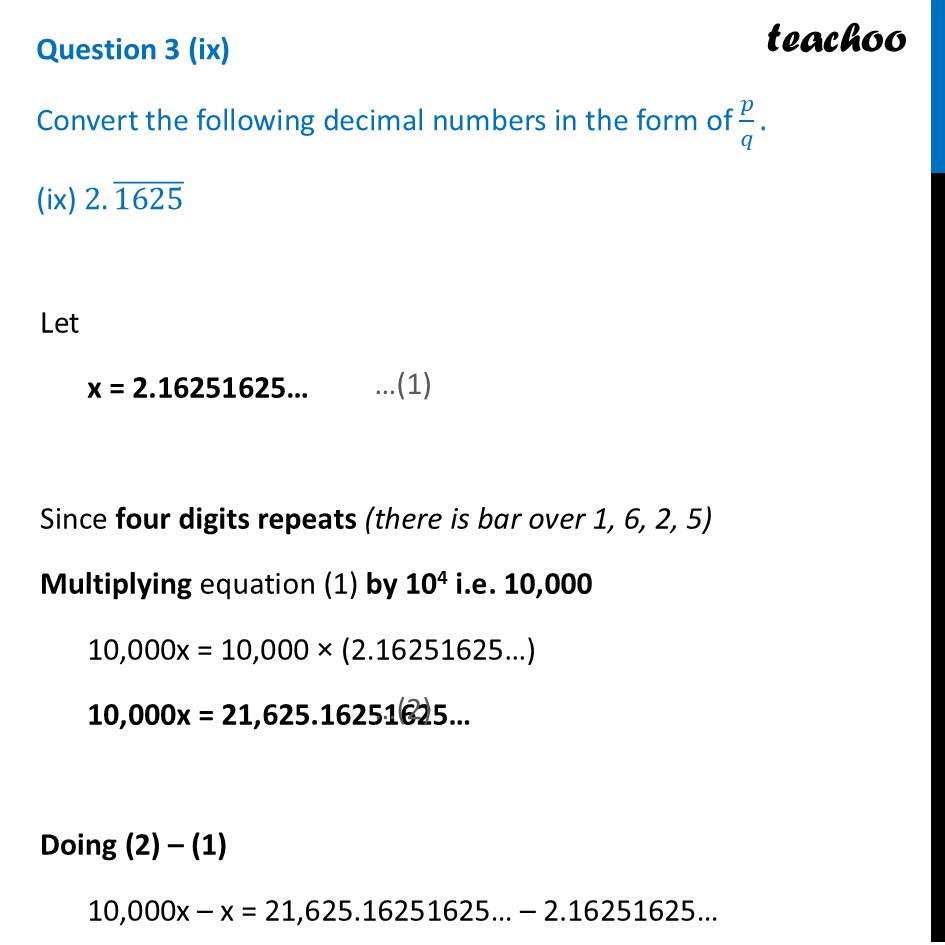
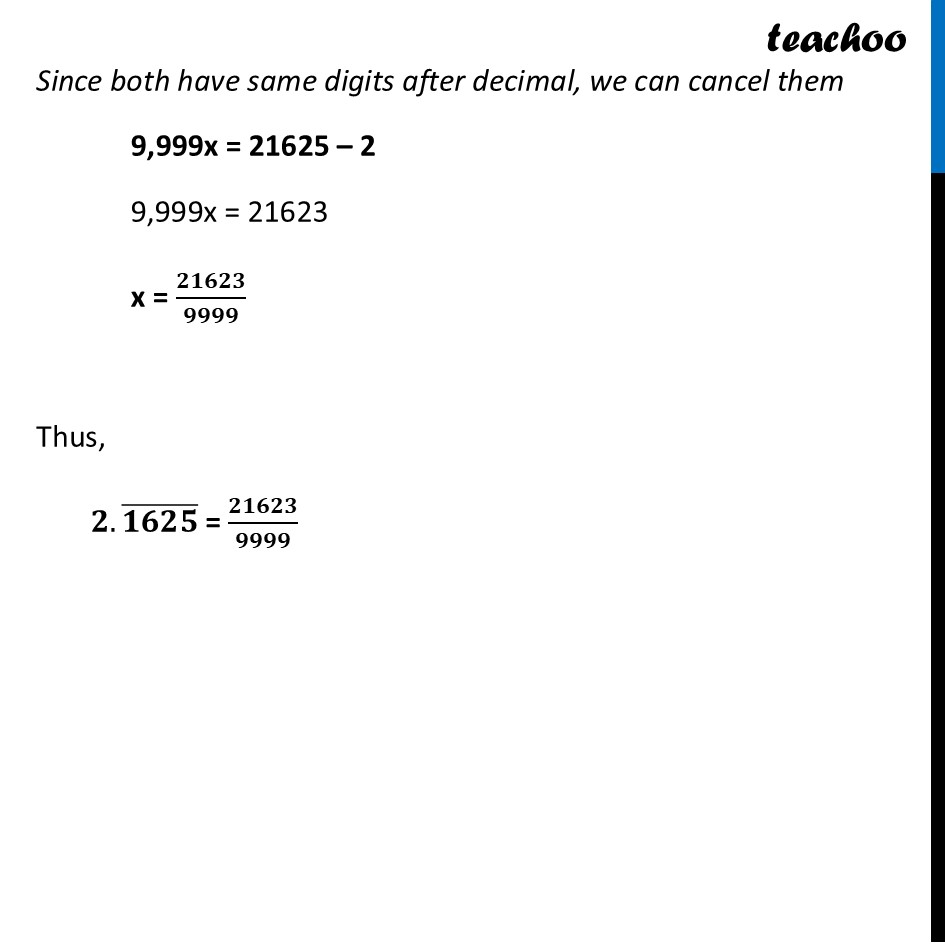
Question 3 (i) Convert the following decimal numbers in the form of 𝑝/𝑞. (i) 12.6 Now, 12.6 = 126/10 = 𝟔𝟑/𝟓 Question 3 (ii) Convert the following decimal numbers in the form of 𝑝/𝑞. (ii) 0.0120 Now, 0.0120 = 0120/10000 = 120/10000 = 𝟏𝟐/𝟏𝟎𝟎𝟎 = 6/500 = 𝟑/𝟐𝟓𝟎 Question 3 (iii) Convert the following decimal numbers in the form of 𝑝/𝑞. (iii) 3.0(52) ̅ Let x = 3.0525252….. Since this is a general repeating decimal, so we look at both non-repeating (after decimal points) and repeating digits Here, ‘0’ is non-repeating (1 digit) ‘52’ repeats (2 digit) Since one digit is non-repeating (i.e. after decimal point) Multiplying equation (1) by 101 i.e. 10 10x = 10 × (3.05252…) 10x = 30.5252… Since two digits are repeating Multiplying equation (2) by 102 i.e. 100 100 × 10x = 100 × (30.5252…) 1,000x = 3052.5252… Doing (2) – (1) 1,000x – 10x = 3052.5252… – 30.5252… Since both have same digits after decimal, we can cancel them 990x = 3052 – 30 990x = 3022 x = 3022/990 x = 𝟏𝟓𝟏𝟏/𝟒𝟗𝟓 Thus, 3.0(52) ̅ = 𝟏𝟓𝟏𝟏/𝟒𝟗𝟓 Question 3 (iv) Convert the following decimal numbers in the form of 𝑝/𝑞. (iv) 1.2(35) ̅ Let x = 1.2353535….. Since this is a general repeating decimal, so we look at both non-repeating (after decimal points) and repeating digits Here, ‘2’ is non-repeating (1 digit) ‘35’ repeats (2 digit) Since one digit is non-repeating (i.e. after decimal point) Multiplying equation (1) by 101 i.e. 10 10x = 10 × (1.23535…) 10x = 12.3535… Since two digits are repeating Multiplying equation (2) by 102 i.e. 100 100 × 10x = 100 × (12.3535…) 1,000x = 1235.3535… Doing (2) – (1) 1,000x – 10x = 1235.3535… – 12.3535… Since both have same digits after decimal, we can cancel them 990x = 1235 – 12 990x = 1223 x = 𝟏𝟐𝟐𝟑/𝟗𝟗𝟎 Thus, 1.2(35) ̅ = 𝟏𝟐𝟐𝟑/𝟗𝟗𝟎 Question 3 (v) Convert the following decimal numbers in the form of 𝑝/𝑞. (v) 0.(23) ̅ Let x = 0.232323… Since two digits repeats (there is bar over 2 & 3) Multiplying equation (1) by 102 i.e. 100 100x = 100 × (0.2323…) 100x = 23.2323… Doing (2) – (1) 100x – x = 23.2323… – 0.2323… Since both have same digits after decimal, we can cancel them 99x = 23 – 0 99x = 23 x = 𝟐𝟑/𝟗𝟗 Thus, 𝟎.(𝟐𝟑) ̅ = 𝟐𝟑/𝟗𝟗 Question 3 (vi) Convert the following decimal numbers in the form of 𝑝/𝑞. (vi) 2.05 ̅ Let x = 2.0555….. Since this is a general repeating decimal, so we look at both non-repeating (after decimal points) and repeating digits Here, ‘0’ is non-repeating (1 digit) ‘5’ repeats (1 digit) Since one digit is non-repeating (i.e. after decimal point) Multiplying equation (1) by 101 i.e. 10 10x = 10 × (2.0555…) 10x = 20.555… Since one digit is repeating Multiplying equation (2) by 101 i.e. 10 10 × 10x = 10 × (20.555…) 100x = 205.555… Doing (2) – (1) 100x – 10x = 205.555… – 20.555… Since both have same digits after decimal, we can cancel them 90x = 205 – 20 90x = 185 x = 185/90 x = 𝟑𝟕/𝟏𝟖 Thus, 2.05 ̅ = 𝟑𝟕/𝟏𝟖 Question 3 (vii) Convert the following decimal numbers in the form of 𝑝/𝑞. (vii) 2.125 ̅ Let x = 2.12555….. Since this is a general repeating decimal, so we look at both non-repeating (after decimal points) and repeating digits Here, ‘12’ is non-repeating (2 digits) ‘5’ repeats (1 digit) Since two digits are non-repeating (i.e. after decimal point) Multiplying equation (1) by 102 i.e. 100 100x = 100 × (2.12555…) 100x = 212.555… Since one digit is repeating Multiplying equation (2) by 101 i.e. 10 10 × 100x = 10 × (212.555…) 1,000x = 2125.555… Doing (2) – (1) 1,000x – 100x = 2125.555… – 212.555… Since both have same digits after decimal, we can cancel them 900x = 2125 – 212 900x = 1913 x = 𝟏𝟗𝟏𝟑/𝟗𝟎𝟎 Thus, 2.125 ̅ = 𝟏𝟗𝟏𝟑/𝟗𝟎𝟎 Question 3 (viii) Convert the following decimal numbers in the form of 𝑝/𝑞. (viii) 3.125 ̅ Let x = 3.12555….. Since this is a general repeating decimal, so we look at both non-repeating (after decimal points) and repeating digits Here, ‘12’ is non-repeating (2 digits) ‘5’ repeats (1 digit) Since two digits are non-repeating (i.e. after decimal point) Multiplying equation (1) by 102 i.e. 100 100x = 100 × (3.12555…) 100x = 312.555… Since one digit is repeating Multiplying equation (2) by 101 i.e. 10 10 × 100x = 10 × (312.555…) 1,000x = 3125.555… Doing (2) – (1) 1,000x – 100x = 3125.555… – 312.555… Since both have same digits after decimal, we can cancel them 900x = 3125 – 312 900x = 2813 x = 𝟐𝟖𝟏𝟑/𝟗𝟎𝟎 Thus, 3.125 ̅ = 𝟐𝟖𝟏𝟑/𝟗𝟎𝟎 Question 3 (ix) Convert the following decimal numbers in the form of 𝑝/𝑞. (ix) 2.(1625) ̅ Let x = 2.16251625… Since four digits repeats (there is bar over 1, 6, 2, 5) Multiplying equation (1) by 104 i.e. 10,000 10,000x = 10,000 × (2.16251625…) 10,000x = 21,625.16251625… Doing (2) – (1) 10,000x – x = 21,625.16251625… – 2.16251625… Since both have same digits after decimal, we can cancel them 9,999x = 21625 – 2 9,999x = 21623 x = 𝟐𝟏𝟔𝟐𝟑/𝟗𝟗𝟗𝟗 Thus, 𝟐.(𝟏𝟔𝟐𝟓) ̅ = 𝟐𝟏𝟔𝟐𝟑/𝟗𝟗𝟗𝟗