This question is similar to Chapter 5 Class 12 Continuity and Differentiability - Ex 5.6
Please check the question here
![[SQP] If 𝑥=𝑎(𝜃−sin 𝜃), 𝑦=𝑎(1−cos 𝜃) find (𝑑^2 𝑦)/(𝑑𝑥^2) - CBSE Class 1 - CBSE Class 12 Sample Paper for 2026 Boards](https://cdn.teachoo.com/6832186e-7720-4fd9-a374-95cd2c4e3208/slide32.jpg)
CBSE Class 12 Sample Paper for 2026 Boards

 You are here
CBSE Class 12 Sample Paper for 2026 Boards
Last updated at August 14, 2026 by Teachoo
This question is similar to Chapter 5 Class 12 Continuity and Differentiability - Ex 5.6
Please check the question here
Transcript
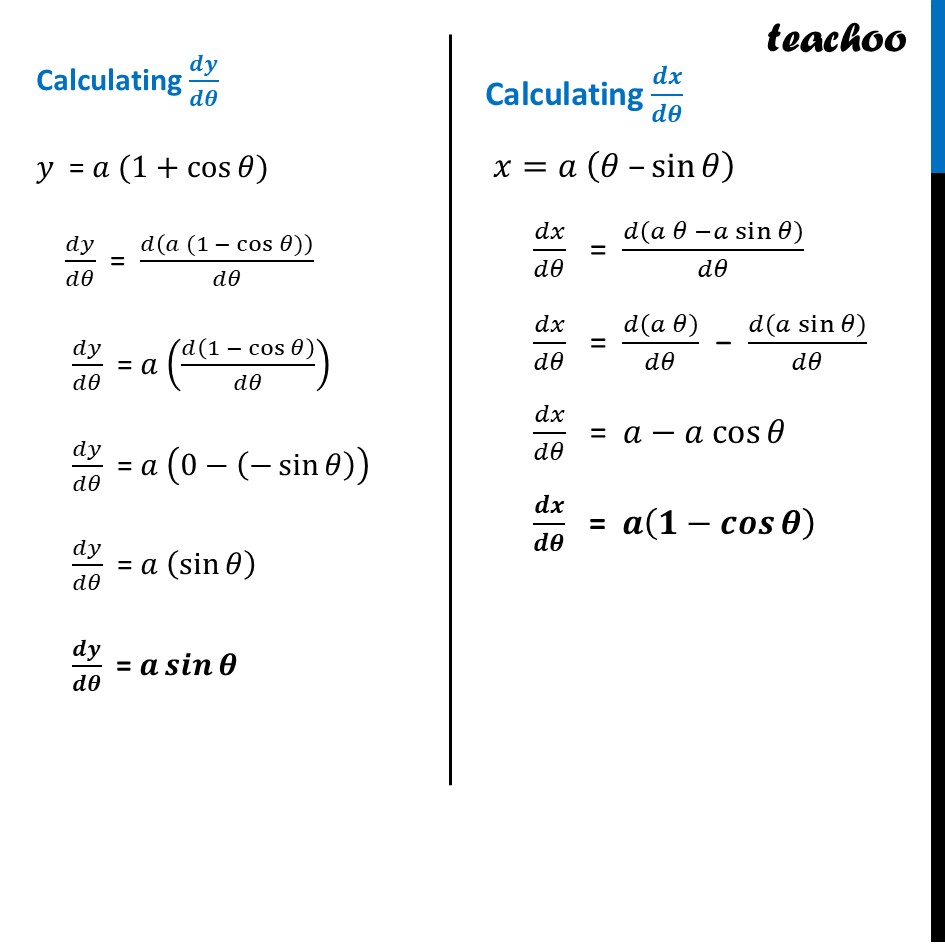
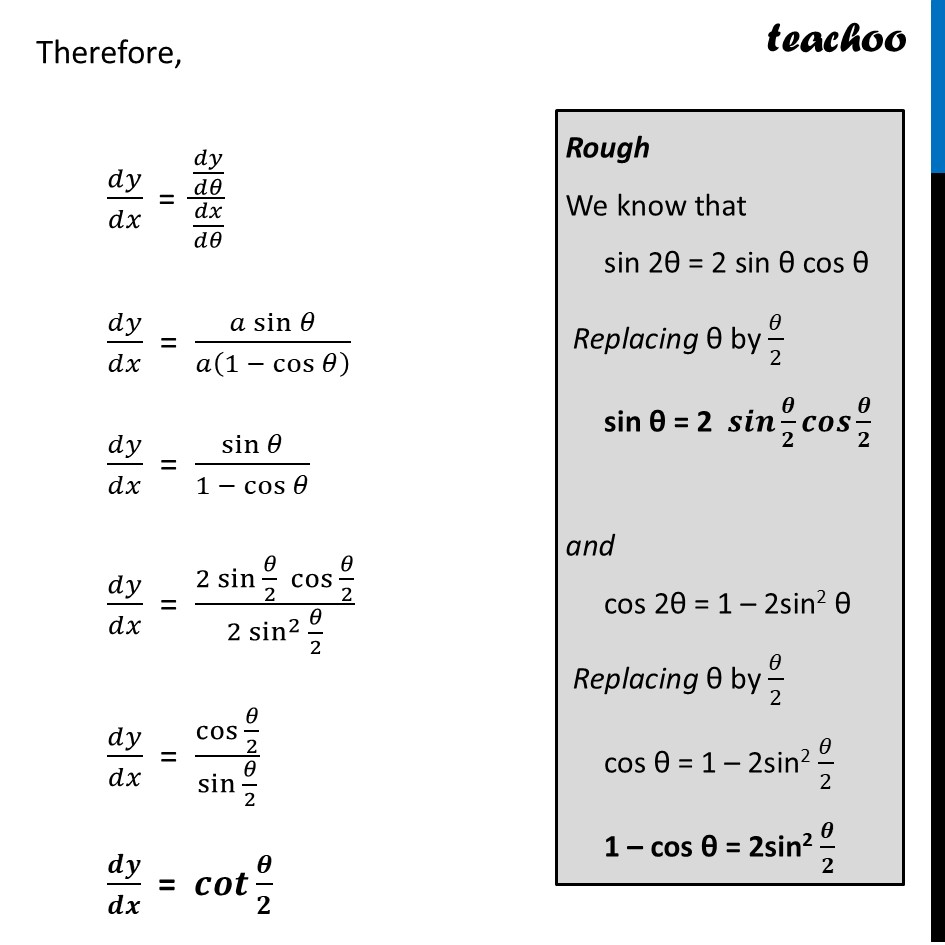
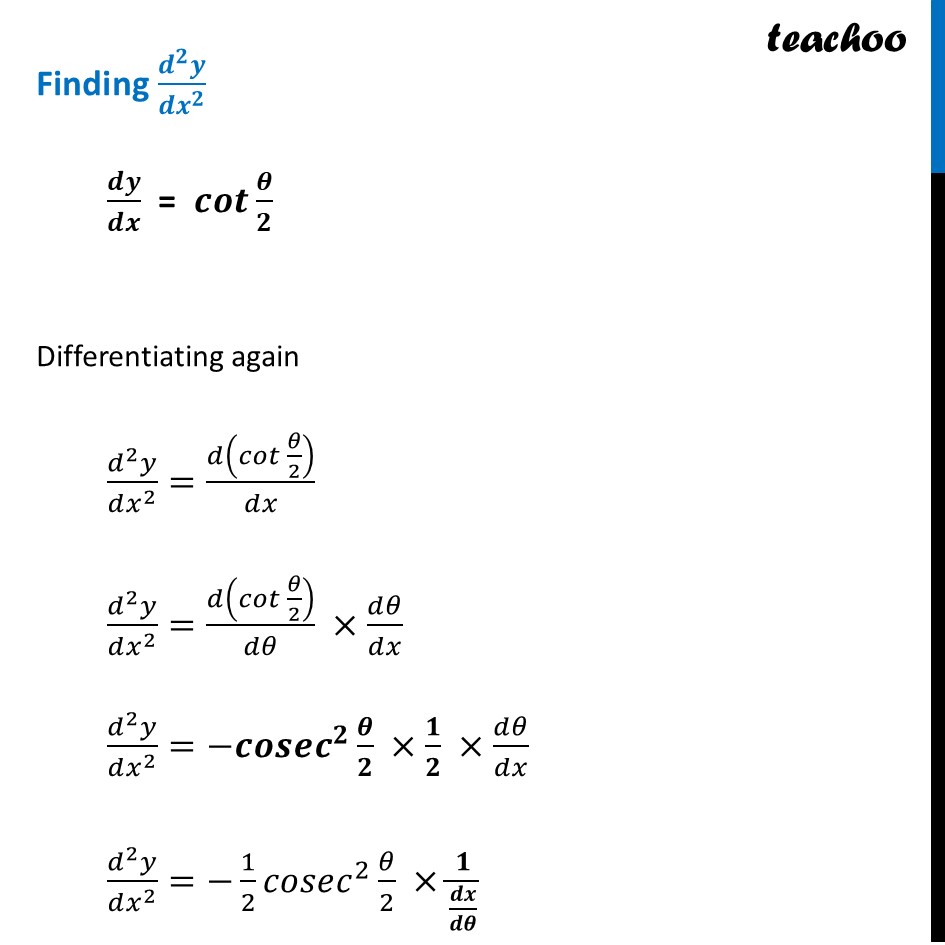
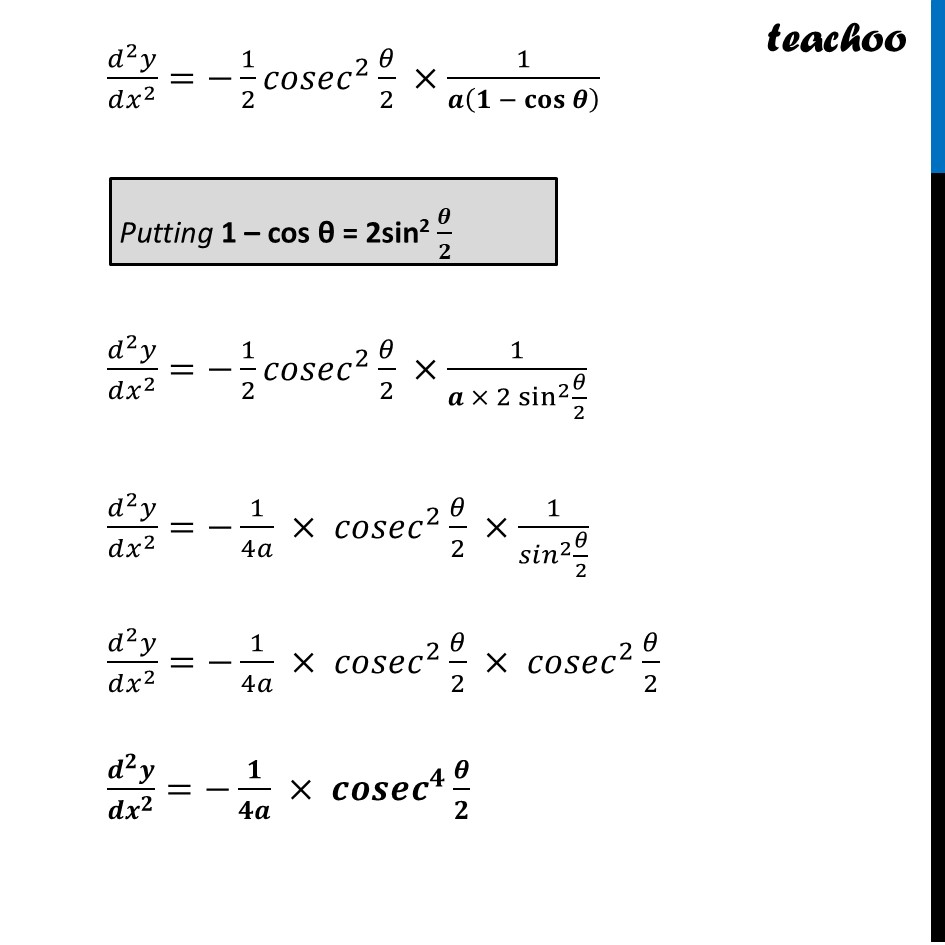
Question 26 (B) If 𝑥=𝑎(𝜃−sin 𝜃), 𝑦=𝑎(1−cos 𝜃) find (𝑑^2 𝑦)/(𝑑𝑥^2 ).Here 𝑑𝑦/𝑑𝑥 = (𝑑𝑦/𝑑𝜃)/(𝑑𝑥/𝑑𝜃) Finding 𝒅𝒚/𝒅𝜽 and 𝒅𝒙/𝒅𝜽 separately Calculating 𝒅𝒚/𝒅𝜽 𝑦 = 𝑎 (1+cos𝜃) 𝑑𝑦/𝑑𝜃 = 𝑑(𝑎 (1 − cos𝜃))/𝑑𝜃 𝑑𝑦/𝑑𝜃 = 𝑎 (𝑑(1 − cos𝜃 )/𝑑𝜃) 𝑑𝑦/𝑑𝜃 = 𝑎 (0−(−sin𝜃 )) 𝑑𝑦/𝑑𝜃 = 𝑎 (sin𝜃 ) 𝒅𝒚/𝒅𝜽 = 𝒂 𝒔𝒊𝒏𝜽 Calculating 𝒅𝒙/𝒅𝜽 𝑥=𝑎 (𝜃 –sin𝜃 ) 𝑑𝑥/𝑑𝜃 = 𝑑(𝑎 𝜃 −𝑎 sin𝜃 )/𝑑𝜃 𝑑𝑥/𝑑𝜃 = 𝑑(𝑎 𝜃)/𝑑𝜃 − 𝑑(𝑎 sin𝜃 )/𝑑𝜃 𝑑𝑥/𝑑𝜃 = 𝑎−〖𝑎 cos〗𝜃 𝒅𝒙/𝒅𝜽 = 𝒂(〖𝟏−𝒄𝒐𝒔〗𝜽 ) Therefore, 𝑑𝑦/𝑑𝑥 = (𝑑𝑦/𝑑𝜃)/(𝑑𝑥/𝑑𝜃) 𝑑𝑦/𝑑𝑥 = (𝑎 sin𝜃)/𝑎(〖1 − cos〗𝜃 ) 𝑑𝑦/𝑑𝑥 = sin𝜃/〖1 − cos〗𝜃 𝑑𝑦/𝑑𝑥 = (2 〖sin 〗〖𝜃/2〗 〖cos 〗〖𝜃/2〗)/(2 〖sin^2 〗〖𝜃/2〗 ) 𝑑𝑦/𝑑𝑥 = 〖cos 〗〖𝜃/2〗/(sin 𝜃/2) 𝒅𝒚/𝒅𝒙 = 𝒄𝒐𝒕〖𝜽/𝟐〗 Rough We know that sin 2θ = 2 sin θ cos θ Replacing θ by 𝜃/2 sin θ = 2 𝒔𝒊𝒏〖𝜽/𝟐〗 𝒄𝒐𝒔〖𝜽/𝟐〗 and cos 2θ = 1 – 2sin2 θ Replacing θ by 𝜃/2 cos θ = 1 – 2sin2 𝜃/2 1 – cos θ = 2sin2 𝜽/𝟐 Finding (𝒅^𝟐 𝒚)/(𝒅𝒙^𝟐 ) 𝒅𝒚/𝒅𝒙 = 𝒄𝒐𝒕〖𝜽/𝟐〗 Differentiating again (𝑑^2 𝑦)/(𝑑𝑥^2 )=𝑑(〖𝑐𝑜𝑡 〗〖𝜃/2〗 )/𝑑𝑥 (𝑑^2 𝑦)/(𝑑𝑥^2 )=𝑑(〖𝑐𝑜𝑡 〗〖𝜃/2〗 )/𝑑𝜃 ×𝑑𝜃/𝑑𝑥 (𝑑^2 𝑦)/(𝑑𝑥^2 )=−〖𝒄𝒐𝒔𝒆𝒄〗^𝟐 𝜽/𝟐 ×𝟏/𝟐 ×𝑑𝜃/𝑑𝑥 (𝑑^2 𝑦)/(𝑑𝑥^2 )=−1/2 〖𝑐𝑜𝑠𝑒𝑐〗^2 𝜃/2 ×𝟏/(𝒅𝒙/𝒅𝜽) (𝑑^2 𝑦)/(𝑑𝑥^2 )=−1/2 〖𝑐𝑜𝑠𝑒𝑐〗^2 𝜃/2 ×1/𝒂(𝟏 − 𝐜𝐨𝐬𝜽 ) (𝑑^2 𝑦)/(𝑑𝑥^2 )=−1/2 〖𝑐𝑜𝑠𝑒𝑐〗^2 𝜃/2 ×1/(𝒂 × 2 sin^2〖𝜃/2〗 ) (𝑑^2 𝑦)/(𝑑𝑥^2 )=−1/4𝑎 × 〖𝑐𝑜𝑠𝑒𝑐〗^2 𝜃/2 ×1/〖𝑠𝑖𝑛〗^2〖𝜃/2〗 (𝑑^2 𝑦)/(𝑑𝑥^2 )=−1/4𝑎 × 〖𝑐𝑜𝑠𝑒𝑐〗^2 𝜃/2 × 〖𝑐𝑜𝑠𝑒𝑐〗^2 𝜃/2 (𝒅^𝟐 𝒚)/(𝒅𝒙^𝟐 )=−𝟏/𝟒𝒂 × 〖𝒄𝒐𝒔𝒆𝒄〗^𝟒 𝜽/𝟐