
 You are here
What is echolocation?
This ability to locate objects using reflected sound waves is called echolocation.
Important points:
- Ec holocation uses ultrasonic waves .
- B ats, dolphins, whales and some birds use echolocation.
- It is used for sonar , navigation (finding the way) and hunting .
How do bats find their way in the dark?
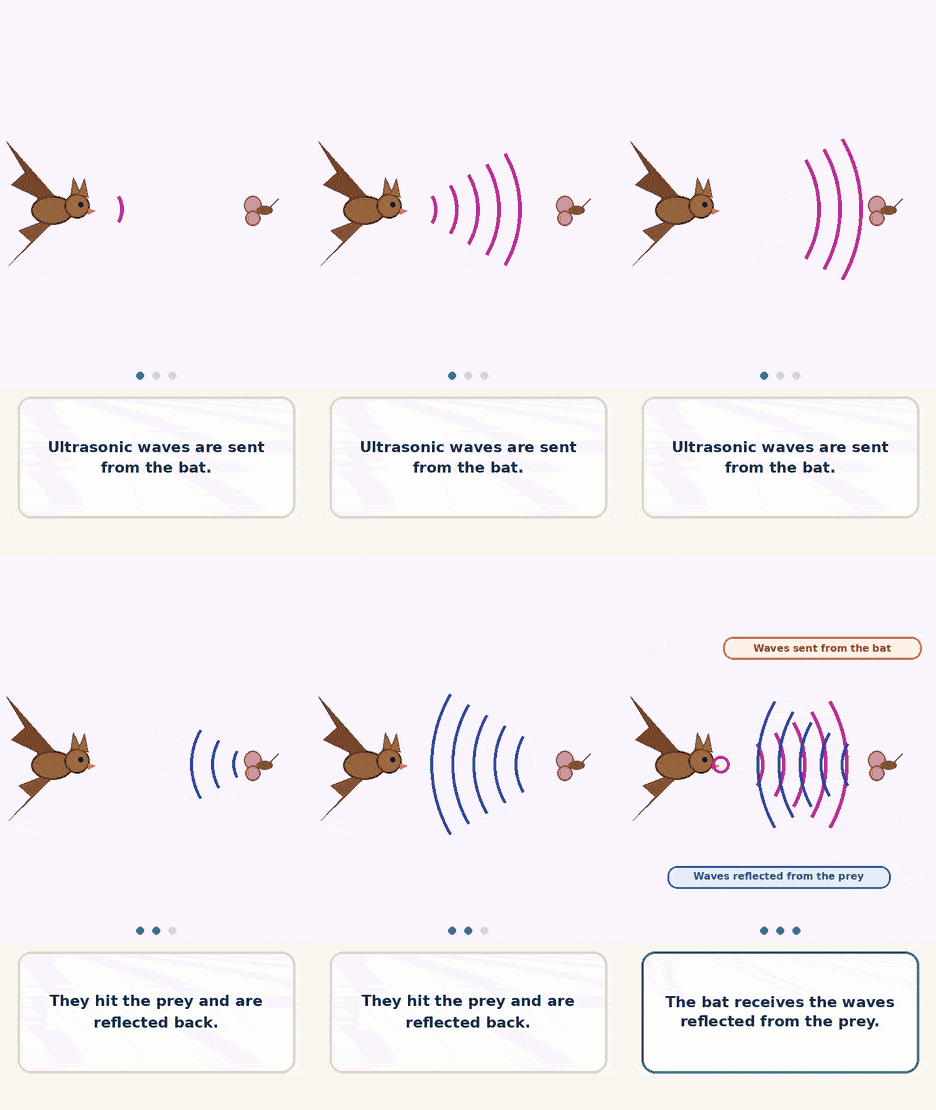
- Bats are nocturnal creatures. Nocturnal means active at night .
- They fly and search for prey in the dark without bumping into things.
- Most bats send out short bursts of ultrasonic waves .
- These waves reflect (bounce back) from nearby objects .
- By sensing these echoes , the bat can find the position of obstacles and prey .
What is sonar?
- Humans use the same idea as echolocation to explore under water .
- This is called sonar .
How does sonar work?
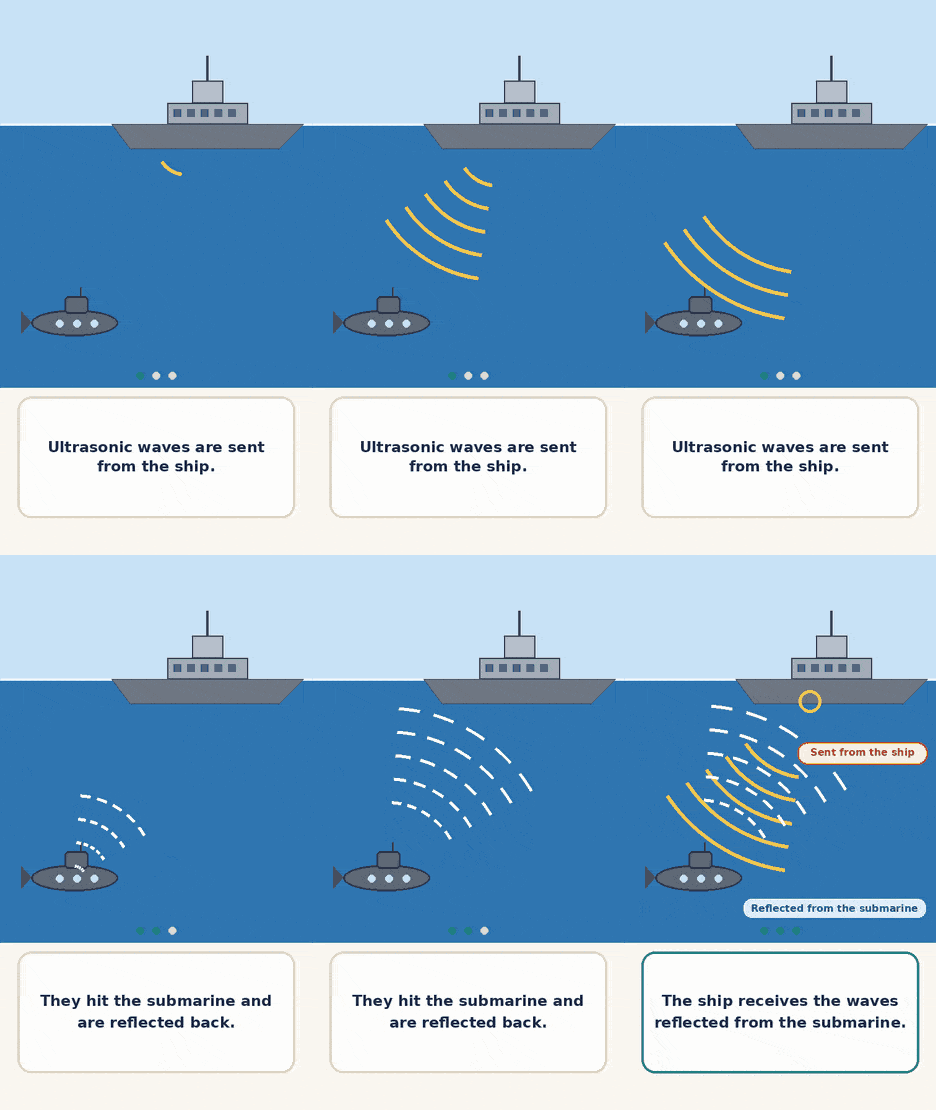
- A ship sends ultrasonic waves into the water .
- The waves hit an underwater object and reflect back .
- The reflected waves are received and studied .
- This tells us the distance , direction and speed of the object.
Important points:
- Full form: SO und N avigation A nd R anging
- Waves used: Ultrasonic waves
- Used to find: Submarines , shipwrecks and the depth of the sea
- Formula: Distance of the object = (Speed × Time) / 2
- We divide by 2 because the signal goes to the object and comes back .
What is the difference between echolocation and sonar?
| Echolocation | Sonar | |
|---|---|---|
| Used by | Animals (bats, dolphins, whales, some birds) | Humans |
| Waves used | Ultrasonic | Ultrasonic |
| Where | Air and water | Under water |
| Idea | Send sound, listen to the echo | Send sound, study the echo |
Questions from the book for this section
-
📘 Example 10.6
A naval sonar signal sent into seawater returns after 0.90 s. The speed of sound in seawater is 1530 m s⁻¹. How far is the object?View answer
AnswerGiven:- Speed of sound in seawater, v = 1530 m s⁻¹
- Time for signal to go and come back = 0.90 s
Time taken to reach the object = 0.90 s / 2 = 0.45 sDistance = Speed × Time
= 1530 m s⁻¹ × 0.45 s
= 688.5 mSo, the object is 688.5 m away.
-
🤔 Pause and Ponder 13
Sound travels much farther in water than light, and thus, is used for various underwater applications. A sonar signal sent to find the depth of ocean takes 4 s to return. What is the depth of the ocean at that location if the speed of sound in seawater is 1500 m s⁻¹?View answer
AnswerGiven:- Speed of sound in seawater, v = 1500 m s⁻¹
- Time for signal to go and come back = 4 s
Time to reach the ocean floor = 4 s / 2 = 2 sDepth = Speed × Time
= 1500 m s⁻¹ × 2 s
= 3000 mSo, the depth of the ocean is 3000 m (3 km).
Bridging Science and Society: How can sound help find drones?
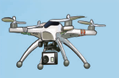
- Drones and aircraft make a characteristic sound from their motors and engines .
- Characteristic means special to that object , so we can recognise it.
- Even when they are hard to see , their low frequency humming can be picked up by sensitive sound sensors .
- This method is called audio surveillance . Surveillance means keeping a close watch .
- It helps monitor the sky for safety and security .
-
💭 What if...
What if humans could detect ultrasonic waves like dogs can? What would be the advantages and disadvantages?View answer
AnswerAdvantages Disadvantages We could hear bats, dolphins and other animals that use ultrasound We would hear many more sounds , which could be distracting We might sense obstacles using echoes, like bats do Machines that give out ultrasound could make our surroundings feel noisy We could hear ultrasonic machines and know when they are working Ultrasonic pest repellers and dog whistles would disturb us
The Quest Continues
Sound helps us explore
places and events
that are
beyond human hearing
.
- Space probes have recorded the first sounds from Mars .
- Scientists time the sound of distant earthquakes to measure tiny changes in ocean temperature . This helps us understand Earth's changing climate .
- Biologists use the buzz of mosquitoes to identify disease carrying mosquitoes .
- Researchers listen to the tiny crackles made by microbes in the soil to study soil health and biodiversity (the variety of living things).
- As technology improves , sound is becoming an even more powerful tool to explore planets , living things and the hidden activities of nature .
