 You are here

📌 Task from the book
Many people use earphones extensively these days. Find out the research studies that might have been done to understand the impact of excessive use of earphones on hearing (if any). Also, find out how hearing is tested and what are the decibel ranges for defining mild, moderate and severe hearing loss. What are the government schemes for purchasing or fitting of aids or appliances and free cochlear implants? Write an article on your findings.
What to do:
GIF
Watch: new GIF
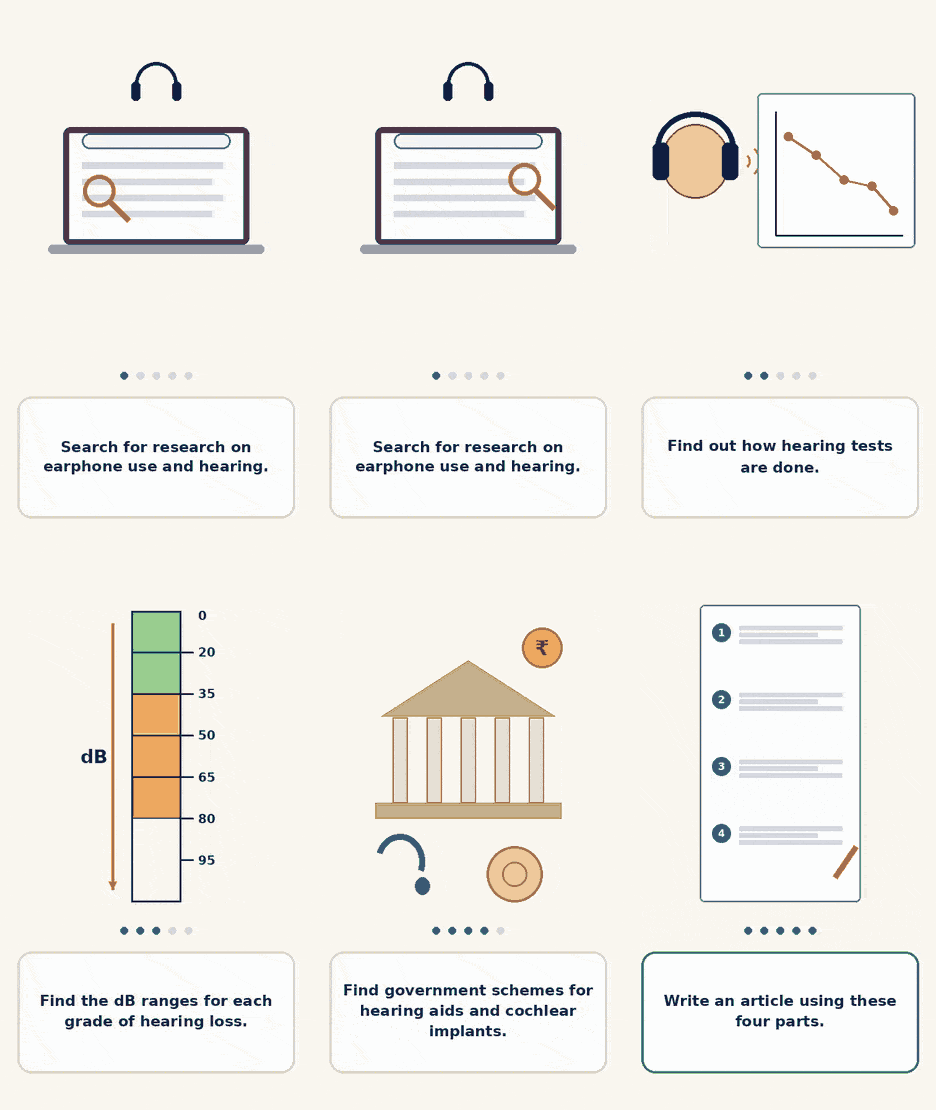
- Search for research on earphone use and hearing .
- Find out how hearing tests are done.
- Find the dB ranges for each grade of hearing loss.
- Find government schemes for hearing aids and cochlear implants.
- Write an article using these four parts.
Suggested answer (main points for the article):
GIF
Watch: new GIF
1. What research says
- A study in BMJ Global Health (2022) looked at more than 30 studies , covering about 20,000 young people aged 12 to 34 .
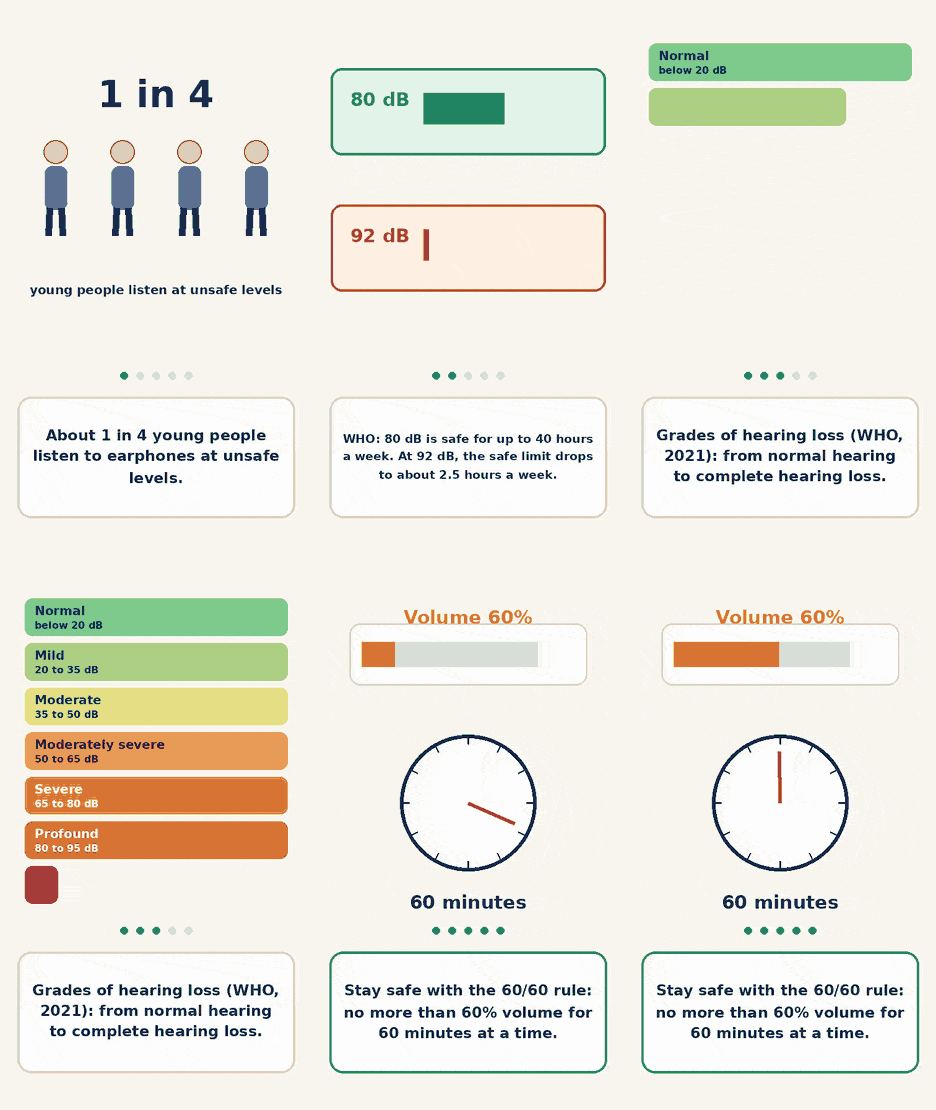
- About 1 in 4 (24%) young people listened to their earphones or headphones at unsafe levels .
- It estimated that between 670 million and 1.35 billion young people around the world may be at risk of hearing loss .
- The WHO says listening at 80 dB is safe for up to 40 hours a week . At 92 dB , the safe limit drops to about 2.5 hours a week .
2. How hearing is tested
- Hearing is tested by an audiologist (a hearing specialist).
- In a hearing test , the person wears headphones and hears beeps of different frequencies (pitch) and loudness .
- The person signals each time they hear a beep.
- The results are drawn on a chart called an audiogram .
- The audiogram shows the softest sound (in dB) the person can hear at each frequency.
3. Grades of hearing loss (WHO, 2021)
| Grade | Softest sound heard (in the better ear) |
|---|---|
| Normal hearing | Less than 20 dB |
| Mild hearing loss | 20 to 35 dB |
| Moderate hearing loss | 35 to 50 dB |
| Moderately severe hearing loss | 50 to 65 dB |
| Severe hearing loss | 65 to 80 dB |
| Profound hearing loss | 80 to 95 dB |
| Complete hearing loss | 95 dB or more |
4. Government scheme: ADIP
- ADIP stands for Assistance to Persons with Disabilities for Purchase/Fitting of Aids and Appliances .
- It is run by the Ministry of Social Justice and Empowerment (Department of Empowerment of Persons with Disabilities).
| What it covers | Details |
|---|---|
| Hearing aids | Full help for aids costing up to ₹15,000 |
| Cochlear implants | Free for children aged 1 to 5 with hearing loss from birth (up to ₹7 lakh ), and children aged 5 to 18 with hearing loss that came later (up to ₹6 lakh ) |
| Income limit | Full help if family income is up to ₹22,500 a month . 50% help from ₹22,501 to ₹30,000 |
5. How to stay safe (conclusion for the article)
- Keep earphone volume below 60% of the maximum.
- Follow the 60/60 rule : no more than 60% volume for 60 minutes at a time.
- Take breaks to rest your ears.
- Use noise cancelling earphones, so you don't need to turn the volume up in noisy places.
