
 You are here
📌 Task from the book
Carry out a simple activity to measure the speed of sound, along with a friend in a large open ground of size 200 m or more. (This activity is to be facilitated by the teacher.)
(i) Your friend stands at one end of the open ground with the balloons, while you stand at the other end with the stopwatch.
(ii) Signal your friend to burst one balloon. When you see the balloon burst, start the stopwatch. As soon as you hear the 'pop' sound of the bursting balloon, stop the timer and note down the reading.
(iii) Repeat this experiment multiple times and take the average value of the times noted.
(iv) Note the approximate distance between you and your friend using a map application on a mobile phone.
(v) Divide the distance measured with the average time to get the average speed of sound. What value of speed did you get from the experiment? Compare it with the speed of sound in air, which is typically about 346 m s⁻¹ at 25 °C.
(vi) Why did you measure the time between 'seeing' and 'hearing' the balloon burst?
How to keep it a fair test:
GIF
Watch: new GIF
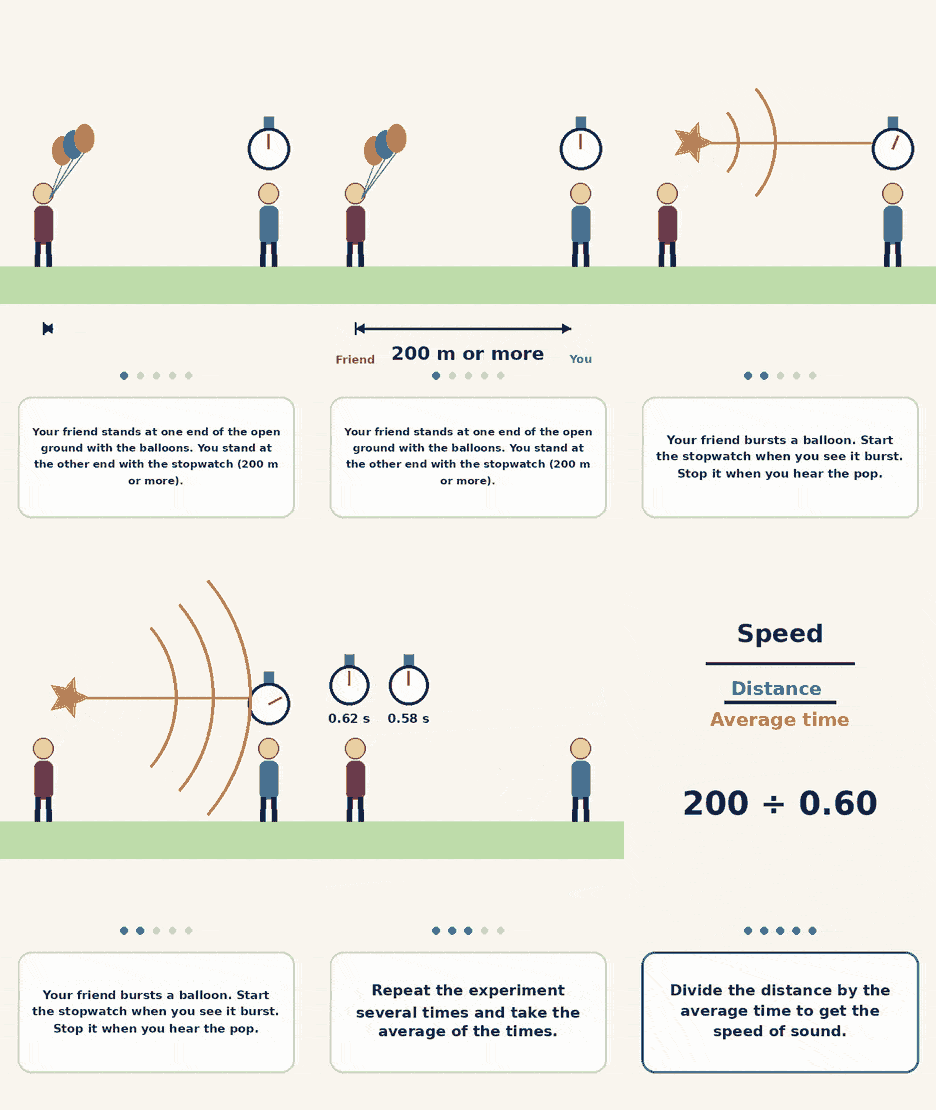
- Keep the same distance for every burst.
- Use the same person on the stopwatch.
- Repeat at least 5 times and take the average .
- Do it on a calm day (no strong wind).
What the student will typically find:
GIF
Watch: new GIF
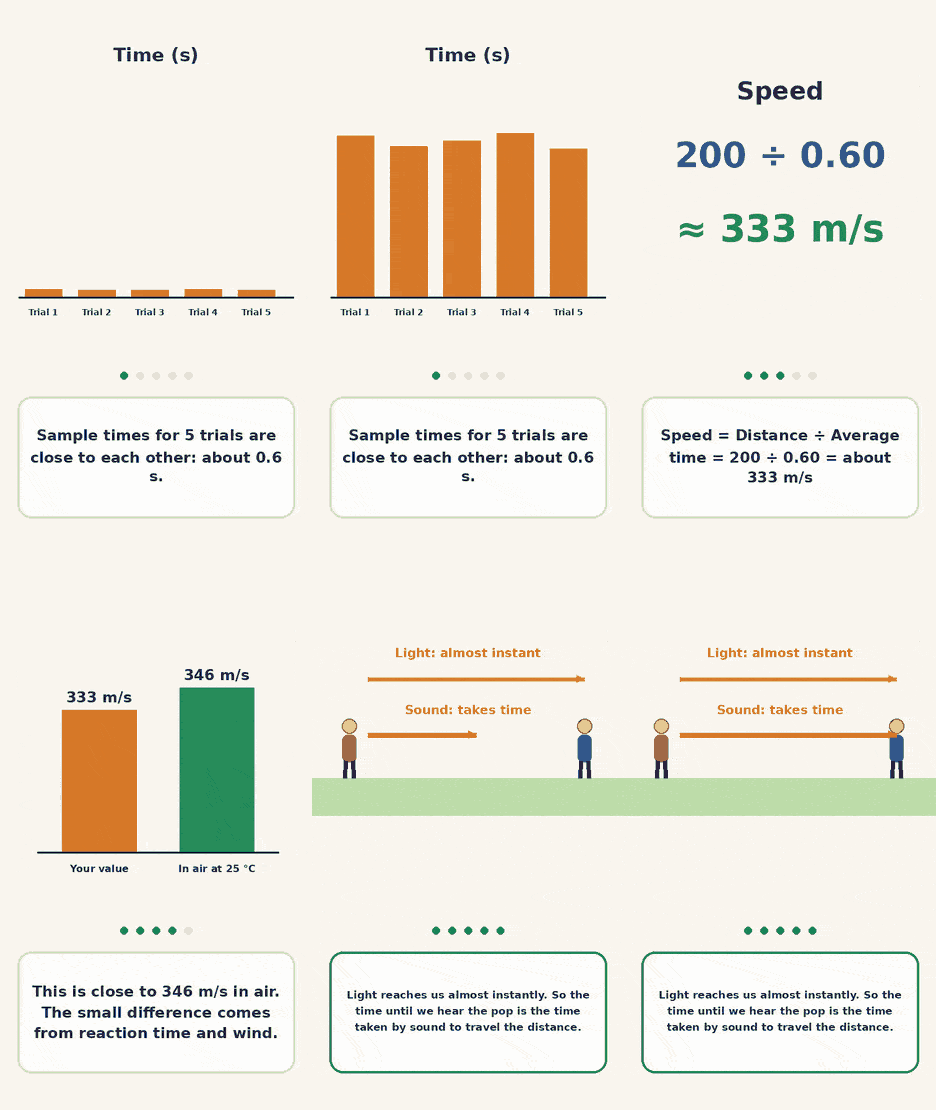
- For 200 m , the time is about 0.6 s .
- Speed = 200 / 0.6 ≈ 333 m s⁻¹
- Most students get a value between about 300 and 380 m s⁻¹ . This is close to 346 m s⁻¹ .
- The answer is not exact , because our reaction time (in starting and stopping the stopwatch) adds a small error. That is why we repeat and take the average .
Recording table (sample readings):
| Trial | Time (s) |
|---|---|
| 1 | 0.62 |
| 2 | 0.58 |
| 3 | 0.60 |
| 4 | 0.63 |
| 5 | 0.57 |
| Average time | (0.62 + 0.58 + 0.60 + 0.63 + 0.57) / 5 = 0.60 s |
| Distance (m) | 200 m |
| Speed = Distance / Average time | 200 / 0.60 = 333 m s⁻¹ (about) |
📝 Note
These are
sample values
. Your own readings will be a little different.
(v) Answer:
In the sample, the speed is about
333 m s⁻¹
. This is
close to 346 m s⁻¹
. The small difference comes from
reaction time
and
wind
.
(vi) Answer:
- Light travels much faster than sound. It reaches us almost instantly .
- So the moment we see the burst is almost the moment it happens .
- The time until we hear the pop is the time taken by sound to travel the distance.
