
 You are here
What is wavelength?
- We have studied the graph of a sound wave .
- On this graph, the wave goes up to a crest and down to a trough , again and again.
-
GIF Watch: new GIF
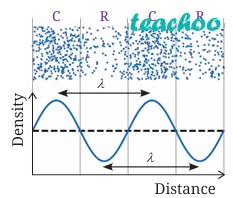
The distance between the two consecutive crests or two consecutive troughs is called the wavelength of a wave.
Important points:
- Symbol: λ (Greek letter lambda )
- SI unit: metre (m)
What are long wavelengths?
GIF
Watch: new GIF
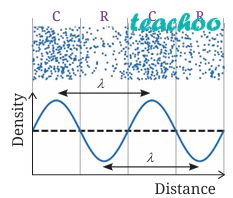
- In a long wavelength, the crests are far apart .
- The compressions and rarefactions are spread out .
- Fewer waves fit in the same distance.
What are short wavelengths?
GIF
Watch: new GIF
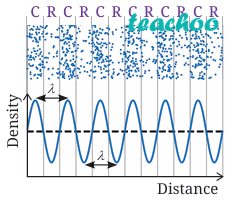
- In a short wavelength, the crests are close together .
- The compressions and rarefactions are packed close .
- More waves fit in the same distance.
Difference between long and short wavelength
| Long wavelength | Short wavelength | |
|---|---|---|
| Crests | Far apart | Close together |
| Compressions and rarefactions | Spread out | Packed close |
| Waves in the same distance | Fewer | More |
What is one complete oscillation?
The change in the density of the medium at a fixed point, from maximum to minimum and then again to maximum (or vice versa), makes one complete oscillation.
💡 Good to know
Vice versa
means
the other way round
: from
minimum to maximum and back to minimum
.
What is time period?
- Time period is the time taken for one full oscillation at one place.
Important points:
- Symbol: T
- SI unit: second (s)
What is frequency?
- Frequency tells us how many full oscillations happen in one second at one place. It tells us how often the wave repeats.
Example:
- Suppose a sound wave makes 40 oscillations in 4 seconds .
- So, number of oscillations in 1 second = 40 / 4 = 10
- It means the frequency of the sound wave is 10 per second , or 10 hertz (10 Hz) .
Important points:
- Symbol: ν (Greek letter nu )
- SI unit: per second (s⁻¹) , also called hertz (Hz)
- Formula: Frequency (ν) = Number of oscillations / Total time taken
How are frequency and time period related?
- Frequency and time period are inversely related .
- Inversely related means when one goes up , the other goes down .
- A shorter time period means a higher frequency.
Formula:
ν = 1 / T (Equation 10.1)
So,
- If one oscillation takes 1 second , then the frequency of the sound wave is 1 hertz .
- So, 1 Hz means 1 oscillation every second .
More examples:
| Time period (T) | Frequency (ν = 1 / T) | Meaning |
|---|---|---|
| 1 s | 1 Hz | 1 oscillation every second |
| 0.5 s | 2 Hz | 2 oscillations every second |
| 0.1 s | 10 Hz | 10 oscillations every second |
| Frequency (ν) | Time period (T) | |
|---|---|---|
| Meaning | Oscillations in one second | Time for one oscillation |
| Unit | Hertz (Hz) | Second (s) |
| If one increases | Time period decreases | Frequency decreases |
Do everyday sounds have a single frequency?
- No. Everyday sounds usually contain a mixture of many frequencies .
-
Nearly single frequency
sounds can be made by:
- striking a tuning fork
- whistling with the mouth
Activity 10.7: How does frequency change for different musical notes?
This activity is done as a
classroom group activity
, with the
teacher’s help
.
What do we need?
- A mobile phone with a frequency app , such as Phyphox (use its ‘Audio Spectrum’ option)
- Optional: another phone with a music or tone app
What do we do?
- Open the app. The Audio Spectrum option shows the frequency of a sound, as a graph or in hertz (Hz) .
- Sing the notes ‘Sa, Re, Ga, Ma, Pa, Dha, Ni, Sa’ one after another. Or play them using a tone app on another phone.
- Note down the approximate frequency of each note.
- Divide the frequency of each note by the frequency of ‘Sa’ . Look for a pattern .
- If you used both voice and phone , compare their frequencies for the same note.
What do we observe?
| Book question | What we observe |
|---|---|
| How does the frequency change as each note is produced? | Frequency is lowest for ‘Sa’ and gradually increases for the next notes |
| Do you observe any pattern? (ratio with ‘Sa’) | Each ratio is more than the one before . The last ‘Sa’ is about double the first ‘Sa’ |
What does this tell us?
- Each musical note has its own frequency .
- That is why each note sounds different .
- We can use the app to compare the frequencies of other sounds too, like our friends’ voices .
Summary
Each musical note has its own frequency, which makes it sound different.
Questions from the book for this section
-
📘 Example 10.1
If there are 10 density oscillations in 2 seconds at a given position, then calculate the (i) frequency of sound wave, and (ii) its time period.View answer
AnswerGiven:- Number of oscillations = 10
- Time taken = 2 s
(i) Frequency- Frequency = Number of oscillations / Time taken
- = 10 / 2 s
- = 5 Hz
(ii) Time period- Time for one oscillation = Time taken / Number of oscillations
- = 2 s / 10
- = 0.2 s
- Check: ν = 1 / T = 1 / 0.2 = 5 Hz ✓
-
🤔 Pause and Ponder 7
Conduct Activity 10.1 once again with a thick rubber band and then with a thin rubber band. Does the thin rubber band vibrate faster than the thick rubber band? If yes, how do the frequency and time period of the sound produced by the thin rubber band differ from that of the thick rubber band?View answer
Answer- Yes , the thin rubber band vibrates faster than the thick one.
- The rubber band is the source. The air around it vibrates at the same rate as the band.
Thin rubber band Thick rubber band Vibrates Faster Slower Frequency Higher Lower Time period Shorter Longer - Since ν = 1 / T , a higher frequency always means a shorter time period .
-
🤔 Pause and Ponder 8
If the frequency of a sound wave produced by an oscillating piston of a long tube filled with air is 20 Hz, then how many oscillations does the piston complete per minute?View answer
Answer- Given: Frequency = 20 Hz , so the piston makes 20 oscillations in 1 second .
- 1 minute = 60 s
- Oscillations in 1 minute = 20 × 60
- = 1200 oscillations
-
🤔 Pause and Ponder 9
For the sound wave represented by the graph shown in Figure, what is half of its wavelength?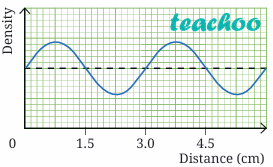
View answer
Answer- From the graph, the curve starts at 0 cm and completes one full wave (one crest and one trough) at 3.0 cm .
- So, wavelength (λ) = 3.0 cm .
- Half of the wavelength = 3.0 / 2 = 1.5 cm .
Threads of Curiosity: Can a phone show a single frequency sound?
- Some free apps can produce and identify sounds of different frequencies.
- Phyphox is one such app.
- If you use the ‘Audio Scope’ in Phyphox and whistle carefully.
- This shows that a whistle is almost a single frequency sound.
