
 You are here
What are the human perceptions of sound?
- Human perception means how we hear and feel a sound.
- It is subjective , which means it can differ from person to person .
-
We describe it using two words:
- Pitch: how high or low a sound seems
- Loudness: how loud or soft a sound seems
- Pitch and loudness are linked to physical properties, but not in a simple way .
| Physical properties | Human perception | |
|---|---|---|
| Examples | Frequency , amplitude , wavelength, time period, speed | Pitch , loudness |
| Can be measured exactly? | Yes | No , it depends on the listener |
| Same for everyone? | Yes | No |
| Physical property | Perceived by humans as |
|---|---|
| Frequency | Pitch |
| Amplitude | Loudness |
What is pitch?
How frequency is perceived by humans is called pitch.
- Pitch is how high or low a sound seems to us.
| High pitch | Low pitch | |
|---|---|---|
| Sounds | Shrill (sharp) | Deep |
| Frequency | Higher (in general) | Lower (in general) |
| Examples | Whistle , siren | Thunder , aircraft rumble |
- In general, high pitch means higher frequency , and low pitch means lower frequency .
- But the exact mathematical relation between them is complicated .
Examples from this chapter:
- Activity 10.1: A tighter rubber band gave a sharper sound. It vibrates faster, so it has a higher frequency and a higher pitch .
- Pause and Ponder 7: A thin rubber band vibrates faster than a thick one. So its sound has a higher pitch .
- Activity 10.7: From 'Sa' to the next 'Sa' , the frequency rises, so the pitch rises too.
Can humans hear all sounds?
- No. Humans can hear only a limited range of frequencies.
- This range is called the audible range , or the human hearing range .
Important points:
- Audible range: 20 Hz to 20,000 Hz (20 kHz)
- This range varies from person to person .
- It decreases with age .
What are infrasonic and ultrasonic waves?
Sound waves with frequency below 20 Hz are called infrasonic waves,
while sound waves with frequency above 20 kHz are called ultrasonic waves.
| Infrasonic waves (infrasound) | Audible sound | Ultrasonic waves (ultrasound) | |
|---|---|---|---|
| Frequency | Below 20 Hz | 20 Hz to 20 kHz | Above 20 kHz |
| Can humans hear it? | No | Yes | No |
| Animals that can hear it | Elephants | Humans and most animals | Dogs , cats , bats , dolphins |
💡 Good to know
Infra
means
below
,
ultra
means
above (beyond)
, and
sonic
means
related to sound
.
What is loudness?
Humans perceive the amplitude of a sound wave as loudness.
- Loudness is how loud or soft a sound seems to us.
| Larger amplitude | Smaller amplitude | |
|---|---|---|
| Sound is heard | Louder | Softer |
| Example | Shouting | Whispering |
- Loudness decreases as we move farther away from the source.
What is the difference between loudness and intensity?
- In everyday language, people often use loudness and intensity to mean the same thing .
- But they are different .
| Intensity | Loudness | |
|---|---|---|
| Type | Physical property | Human perception |
| Can be measured? | Yes , it is a measurable quantity | No , it depends on the listener's hearing ability |
| Same for all listeners? | Yes | No |
Activity 10.8: Let us experiment (demonstration activity)
This activity is done as a
classroom group activity
, with the
teacher's help
.
What do we need?
- A mobile phone with an app that can generate sounds of a chosen frequency
What do we do?
- Open the app.
- Set the frequency to 100 Hz . Tap 'play' and listen carefully .
- Increase the frequency in steps of 100 Hz , up to 1000 Hz . Notice how the sound changes.
- Now set the frequency to 50 Hz . Reduce it slowly till about 20 Hz , or till you cannot hear the sound anymore.
What do we observe?
| Step | What we observe |
|---|---|
| 100 Hz to 1000 Hz | The sound becomes shriller (higher pitch) as the frequency increases |
| 50 Hz down to 20 Hz | The sound becomes deeper and harder to hear . Near 20 Hz , it may not be heard at all |
What does this tell us?
- Higher frequency sounds have a higher pitch .
- Below a certain frequency, we cannot hear the sound.
- So humans can hear only a limited range of frequencies.
Threads of Curiosity: Why do our voices sound different?
- Everyone's voice sounds unique . We can often recognise our teacher or friends just by their voice.
-
Male
,
female
and
children's
voices differ in
two ways
:
- Their frequency is different.
- The sound is shaped differently by the throat , mouth and nasal cavity (the hollow space inside the nose).
- During adolescence (the teenage years), boys' vocal cords become longer and thicker .
- So they vibrate less frequently (lower frequency), and the voice becomes deeper .
Bridging Science and Society: How is loudness measured, and what is noise?
Decibel (dB):
- Sound loudness is commonly measured in decibels (dB) .
| Sound | Loudness |
|---|---|
| Rustling leaves (very soft) | A few dB |
| Normal conversation | About 60 dB |
| Firecrackers (very loud) | More than 100 dB |
- Even a small increase in the dB level means a large increase in sound intensity .
Noise:
- Unwanted or harmful sound is called noise .
- Noise pollution is a severe problem .
-
Hearing sound
above recommended limits
, especially for
long durations
, can affect our:
- health
- sleep
- hearing
- Hearing loud sound for a long time can lead to hearing loss .
- Hearing loss can be tested using audiograms (a hearing test chart).
- People with hearing loss may use hearing aids .
| Part of a hearing aid | What it does |
|---|---|
| Microphone | Picks up sound |
| Amplifier | Makes the sound stronger |
| Speaker | Plays the stronger sound into the ear |
Ready to Go Beyond: How do we hear?
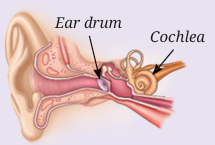
How the ear works:
- Sound enters the ear and makes a thin membrane called the eardrum vibrate .
- Tiny bones in the ear quickly amplify (make stronger) these vibrations.
- The cochlea changes these vibrations into electrical signals .
- These signals rush to the brain , which understands them as sound .
Why do we have two ears?
- Two ears help the brain find the direction a sound is coming from.
- The brain checks which ear hears the sound first .
- The time gap between the two ears is tiny , often less than a thousandth of a second .
How do animals hear?
- Snakes and fish sense vibrations through their bodies .
- Some insects have ear-like organs on parts of their body.
Threads of Curiosity: What is the difference between a tone and a musical note?
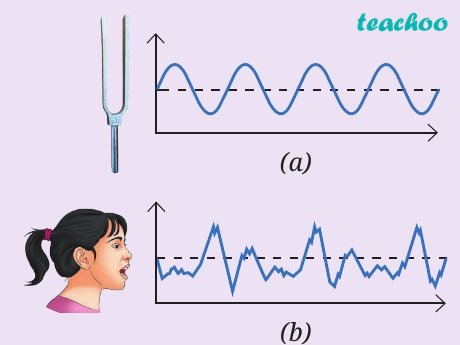
| Tone | Musical note | |
|---|---|---|
| Frequencies | Single frequency | A mix of frequencies |
| Examples | Tuning fork , whistling (a) | Tanpura string , singing (b) |
A musical note is made of:
- Fundamental: the lowest frequency in the note
- Overtones: the higher frequencies in the note
Together, they make a
rich and pleasant
sound.
- Indian string instruments like the sarangi , sitar and veena often have extra strings to make this mix richer .
What is timbre?
- A flute , ektara and tabla sound different from each other, even when they play the same note at the same loudness .
- This quality is called timbre .
- Timbre comes from the instrument's shape , material and construction .
- These decide the pattern and intensity of the overtones .
What is an octave?
- An octave is the gap between two notes where one note has double the frequency of the other.
- This is measured between their fundamental frequencies .
- Example: 200 Hz and 400 Hz are one octave apart.
- In Activity 10.7 , the last 'Sa' is about double the first 'Sa', so the two are one octave apart.
Meet a Scientist: Sir C. V. Raman

- Sir C. V. Raman won India's first Nobel Prize in Science .
- He won it for discovering the Raman Effect in light .
- He also did important work in acoustics (the science of sound).
- He studied Indian percussion instruments (instruments played by striking), like the tabla and mridangam .
- He wanted to understand how they make such rich and nuanced (finely different) sounds.
Threads of Curiosity: Why does a tabla have a black patch?

- Indian drums like the tabla and mridangam have a black patch in the centre of the drum's membrane.
- This patch is called the syaahi .
- The syaahi changes how the membrane vibrates .
- This lets these drums make a rich variety of sounds .
- It also gives a level of tonal control (control over the sound) that few other drums have.
