
 You are here
What is a vacuum?
- A vacuum is completely empty space , with no matter in it at all, not even air.
📖 Book definition
A space where there is no medium (matter) is referred to as vacuum.
Breaking it down:
| Term | Meaning |
|---|---|
| Space | A region or place |
| No medium (matter) | No solid, no liquid, no gas . Nothing at all |
| Vacuum | The name for such an empty space |
Vacuum bell jar experiment
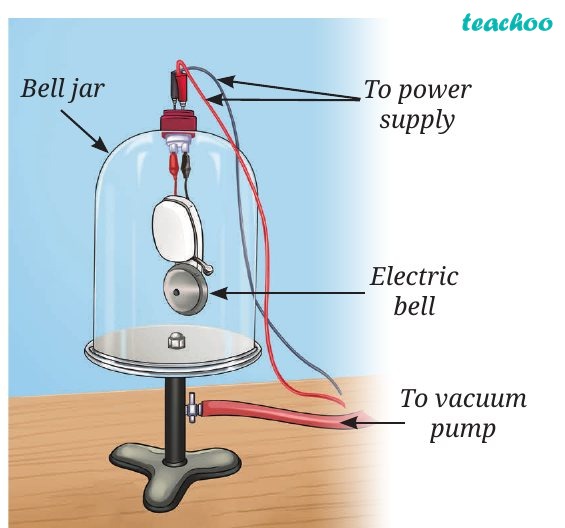
What do we need?
- A bell jar (a glass jar shaped like a bell)
- An electric bell , kept inside the jar and connected to a power supply
- A vacuum pump (a machine that sucks air out )
What do we do?
- Switch on the electric bell inside the jar. Note how loud the sound is.
- Use the vacuum pump to slowly suck the air out of the jar.
- Keep pumping till there is almost no air left (a near vacuum ).
- Now let the air back into the jar.
What do we observe?
| Step | Air inside the jar | What we hear | What we see |
|---|---|---|---|
| Bell switched on | Full of air | Loud sound | Bell ringing |
| Air being sucked out | Less and less air | Sound becomes fainter | Bell ringing |
| Near vacuum | Almost no air | Almost no sound | Bell still ringing |
| Air let back in | Air returns | Sound comes back and becomes as loud as before | Bell ringing |
What does this tell us?
- The bell kept vibrating the whole time. We could see it ringing.
- But when the air was removed , the sound could not reach us .
- So, sound cannot propagate in vacuum .
- Sound needs a medium to propagate. The medium can be a solid , a liquid or a gas .
Summary
Sound cannot propagate in vacuum. Sound needs a medium to propagate.
💡 Good to know
Why do we still hear a little sound at near vacuum?
A
near vacuum
still has a
tiny amount of air
left. So a very faint sound can still pass. That is why the book says
"almost no sound"
.
Why can astronauts not hear each other in space?
- Outer space is a near vacuum . There is almost no air there.
- So sound cannot propagate in space.
-
Astronauts doing
spacewalks
(working outside the spacecraft)
cannot directly hear
:
- each other speak
- sounds like two metal objects clanking together
- Instead, they talk using special devices fitted inside their spacesuits .
| On Earth | In outer space | |
|---|---|---|
| Medium (air) | Present | Almost none (near vacuum) |
| Can sound travel? | Yes | No |
| Can people hear each other directly? | Yes | No , they need special devices |
Questions from the book for this section
-
🤔 Pause and Ponder 3
Assertion (A): We cannot hear the sound of a bell ringing in a closed jar after most of the air is pumped out.
Reason (R): Sound requires a medium to travel.
Choose the correct statement:
(i) Both A and R are true, but R is not the correct explanation of A.
(ii) Both A and R are true, and R is the correct explanation of A.
(iii) A is true, but R is false.
(iv) A is false, but R is true.View answer
AnswerAnswer: (ii) Both A and R are true, and R is the correct explanation of A.- A is true: In the bell jar experiment, once most of the air is pumped out, we cannot hear the bell.
- R is true: Sound needs a medium (solid, liquid or gas) to travel.
- R explains A: We cannot hear the bell because the air (the medium) has been removed, so the sound has nothing to travel through .
Why the other options are wrong:Option Why it is wrong (i) R does explain A. The missing medium is exactly why we cannot hear the bell (iii) R is not false . Sound really does need a medium (iv) A is not false . We really cannot hear the bell once most air is removed
