
 You are here
What is speed?
We have studied in earlier classes that:
Speed = Distance / Time
What is speed of sound?
The speed of sound tells us
how fast sound travels
through a medium.
Formula:
v = λ × ν
Derivation:
Step 1:
Speed = Distance / Time
Step 2:
We know that
wavelength (λ)
is the distance between
two consecutive crests
or
two consecutive troughs
.
So,
Speed = Wavelength / Time period
v = λ / T
Step 3:
We can also write Speed = Wavelength / Time period as:
Speed = Wavelength × 1 / Time period
v = λ × (1 / T)
We know that
frequency = 1 / Time period
(ν = 1 / T, Equation 10.1).
So,
Speed = Wavelength × Frequency
Formula:
v = λ × ν
(Equation 10.2)
| Symbol | Quantity | SI unit |
|---|---|---|
| v | Speed of sound | m s⁻¹ |
| λ | Wavelength | m |
| ν | Frequency | Hz (s⁻¹) |
| T | Time period | s |
Does the speed of sound depend on the medium?
- Yes. The speed of sound depends on the medium it travels through.
- Sound travels fastest in solids , slower in liquids and slowest in gases .
- Sound travels about 4 to 5 times faster in water and usually 15 to 20 times faster in solids than in air.
| Medium | Speed of sound |
|---|---|
| Solid | Fastest |
| Liquid | Slower |
| Gas | Slowest |
Example:
In
Activity 10.3
, the sound of knocking reaches the ear placed on the desk through the
wood
. Wood carries the sound
faster than air
.
Does the speed of sound in air change?
- Yes. The speed of sound in air depends on temperature and humidity .
- Humidity means the amount of water vapour in the air.
- When temperature or humidity increases , the speed of sound increases .
| Condition | Speed of sound in dry air |
|---|---|
| At 0 °C | About 331 m s⁻¹ |
| At 22 °C | Nearly 344 m s⁻¹ |
📝 Note
This is why the book uses slightly different values for the speed of sound in air (
331, 340, 344 m s⁻¹
). In a question, always use the
value given in that question
.
Questions from the book for this section
-
📘 Example 10.2
Human hearing roughly spans 20 Hz to 20 kHz. What are the corresponding wavelengths in air for these two frequencies? Use the speed of sound in air as 344 m s⁻¹.View answer
AnswerGiven: Speed of sound in air, v = 344 m s⁻¹Using v = λ × ν, we get λ = v / ν(i) For ν = 20 Hzλ = 344 m s⁻¹ / 20 s⁻¹
= 17.2 m(ii) For ν = 20 kHz = 20000 Hzλ = 344 m s⁻¹ / 20000 s⁻¹
= 0.0172 m
= 1.72 cm📝 NoteLower frequency gives a longer wavelength. Higher frequency gives a shorter wavelength.
-
📘 Example 10.3
During a thunderstorm, lightning is seen before thunder is heard because sound travels much slower than light. If the time delay between seeing the lightning flash and hearing the thunder is measured to be 5 s, estimate the distance to the lightning strike. Use the speed of sound in air as 340 m s⁻¹. Assume that light (speed = 300000 km s⁻¹) reaches you almost instantaneously.View answer
AnswerGiven:- Speed of sound in air, v = 340 m s⁻¹
- Time delay, t = 5 s
Light reaches us almost instantly , so the 5 s is the time taken by sound .Distance = Speed × Time
= 340 m s⁻¹ × 5 s
= 1700 mSo, the lightning struck about 1.7 km away.
-
📘 Example 10.4
From the graphical representation of a sound wave propagating in steel, find its wavelength. Calculate its frequency and time period if the speed of sound in steel is 5000 m s⁻¹.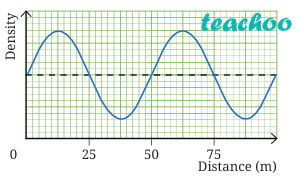
View answer
AnswerGiven: Speed of sound in steel, v = 5000 m s⁻¹(i) WavelengthFrom the graph, one full wave ends at 50 m .So, λ = 50 m(ii) FrequencyUsing v = λ × ν (Equation 10.2),ν = v / λ
= 5000 m s⁻¹ / 50 m
= 100 Hz(iii) Time periodUsing ν = 1 / T (Equation 10.1),T = 1 / ν
= 1 / 100 Hz
= 0.01 s
Ready to Go Beyond: Does the speed of sound depend on its frequency?
- In most media, like air , the speed of sound depends only on the medium .
- It does not depend on the source or the frequency .
- If the frequency of the source changes, the wavelength changes , but the speed stays the same .
- Some special materials , like porous foams (foams full of tiny holes) or engineered structures , can behave differently.
| If frequency increases | What happens (in air) |
|---|---|
| Speed (v) | Stays the same |
| Wavelength (λ) | Decreases (since v = λ × ν) |
-
💭 What if...
What if the speed of sound in air depended on its frequency? Would music still sound pleasant when a singer performs with instruments? Why or why not?View answer
Answer- No , music would not sound pleasant.
- A singer and instruments produce many frequencies at the same time .
- If each frequency travelled at a different speed , the notes would reach our ears at different times .
- High and low notes played together would arrive one after the other .
- The farther away we sit, the bigger this gap would be.
- So the music would sound jumbled and out of time .
-
🤔 Pause and Ponder 10
Table 10.1 shows the speed of sound in a few media at atmospheric pressure.
Table 10.1: Speed of sound in different media at 15 °C
Compare the speeds in different media by finding the ratio ofState Substance/Medium Approximate speed Solid Steel 5000 m s⁻¹ Liquid Water 1500 m s⁻¹ Gas Air 340 m s⁻¹
(i) the speed of sound in water with respect to the speed in the air.
(ii) the speed of sound in steel with respect to the speed in the water.
View answer
Answer(i) Water with respect to airRatio = Speed in water / Speed in air
= 1500 / 340
= 4.4 (about)So, sound travels about 4.4 times faster in water than in air.(ii) Steel with respect to waterRatio = Speed in steel / Speed in water
= 5000 / 1500
= 3.3 (about)So, sound travels about 3.3 times faster in steel than in water.
-
🤔 Pause and Ponder 11
Two friends are standing along a steel fence at a distance of 340 m from each other. Gunjan places her ear over the fence and her friend knocks the fence with a metal object. Using the values of the speed of sound in steel and air given in Table 10.1, calculate the time difference between the sound that reached Gunjan through the air and the steel. Would it have been possible for her to distinguish between the two sounds? (The time interval between two sounds must be at least 0.1 s to be heard separately.)View answer
Answer Given:
- Distance = 340 m
- Speed of sound in air = 340 m s⁻¹
- Speed of sound in steel = 5000 m s⁻¹
Time = Distance / SpeedTime through air
= 340 m / 340 m s⁻¹
= 1 sTime through steel
= 340 m / 5000 m s⁻¹
= 0.068 sTime difference
= 1 s − 0.068 s
= 0.932 sCan she tell the two sounds apart?- Yes. The time difference ( 0.932 s ) is much more than 0.1 s .
- So Gunjan hears two separate sounds : first through the steel , then through the air .
