
 You are here
What is reflection of sound?
Sound waves can bounce off obstacles like solids or liquids and this is known as the reflection of sound.
Examples:
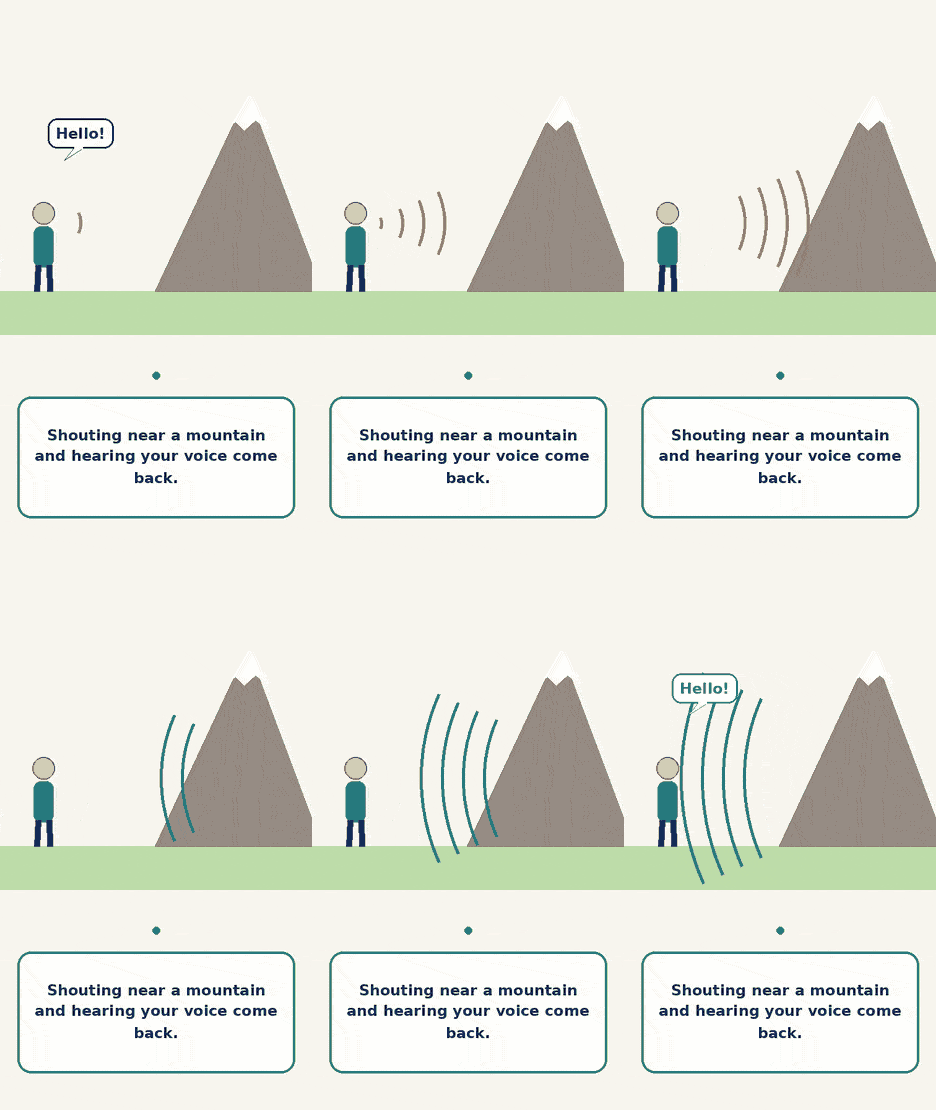
- Shouting near a mountain and hearing your voice come back.
-
GIF Watch: Person shouting near a mountain, sound going to the mountain and coming back
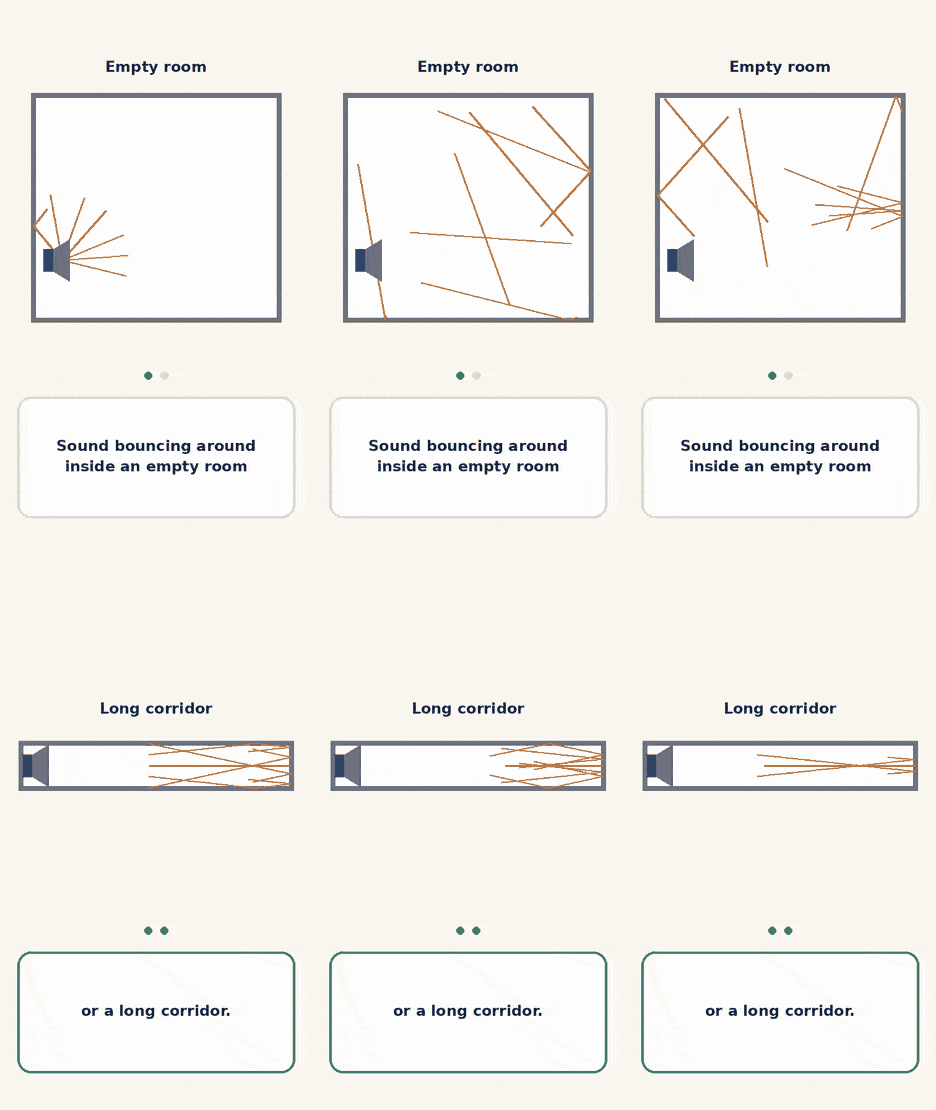
- Sound bouncing around inside an empty room or a long corridor .
-
GIF Watch: Sound bouncing off the walls of an empty room or long corridor
What is an echo?
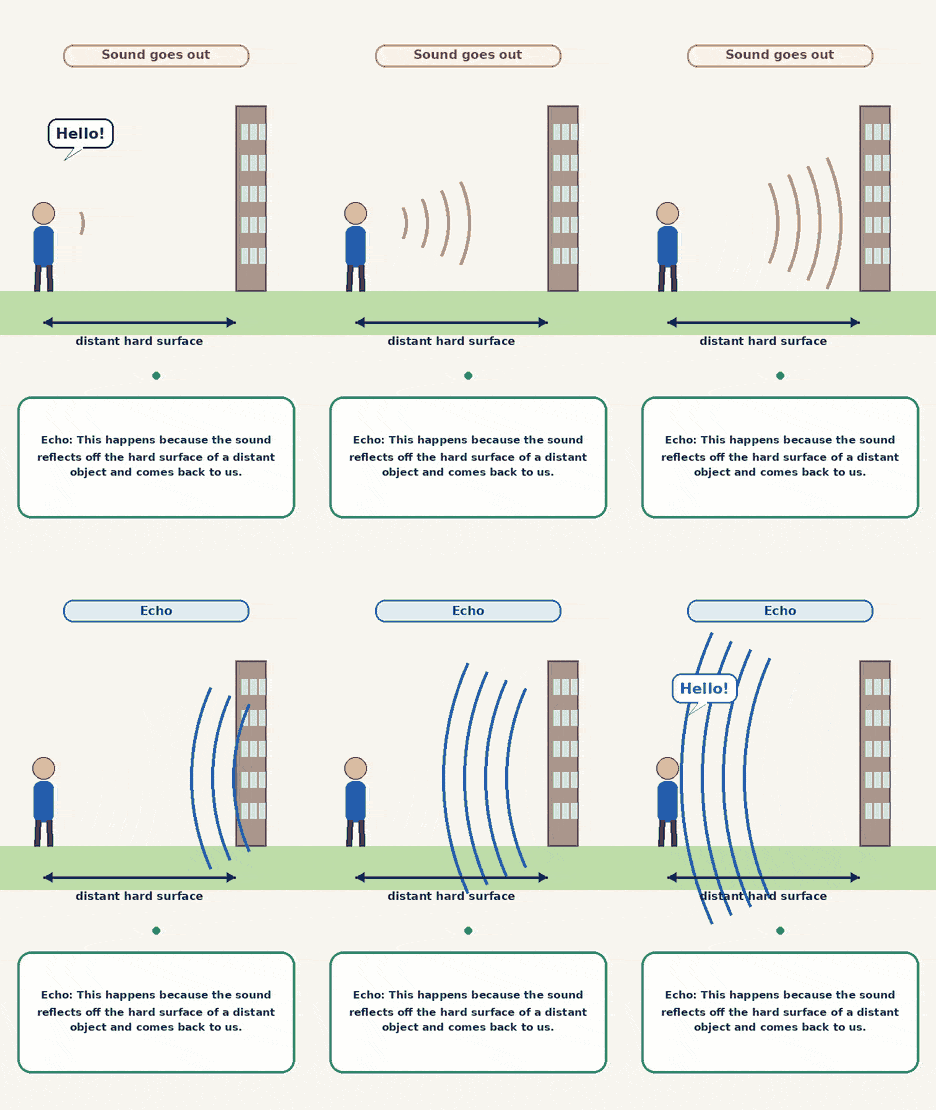
If we shout near a mountain, a cliff, or in a long corridor we may hear our voice again after some time. This is known as an echo.
This happens because the sound
reflects off the hard surface
of a distant object and
comes back
to us.
GIF
Watch: Sound reflecting off a cliff and coming back to the person as an echo
Why don't we hear echoes everywhere?
- In a small room , the walls are very close .
- The reflected sound comes back too quickly .
- The brain cannot separate it from the original sound.
| Time gap between two sounds | What we hear |
|---|---|
| At least 0.1 s | Two separate sounds (we can hear an echo) |
| Less than 0.1 s | Sounds mix together (we cannot clearly tell them apart) |
What is the minimum distance needed to hear an echo?
We can use the
0.1 s rule
to find the minimum distance of the reflecting surface.
Take the speed of sound =
340 m s⁻¹
.
Distance travelled by sound in 0.1 s:
Distance = Speed × Time
= 340 m s⁻¹ × 0.1 s
= 34 m
- But 34 m is the distance to the surface and back .
- So the surface must be at half of this distance.
Minimum echo distance
= 34 / 2 =
17 m
Important points:
- Minimum time gap for an echo: 0.1 s
- Minimum distance of the reflecting surface: 17 m (in air, at 340 m s⁻¹)
- Formula: Distance of the surface = (Speed × Time) / 2
- We divide by 2 because sound travels to the surface and back .
Which surfaces give good echoes?
| Surface | What happens to sound | Echo |
|---|---|---|
| Hard and smooth (wall, cliff) | Reflects sound well | Strong, clear echo |
| Soft (curtains) | Absorbs sound (takes it in) | No clear echo |
| Rough | Scatters sound in different directions | No clear echo |
Questions from the book for this section
-
📘 Example 10.5
You clap in an empty corridor and hear an echo after 0.5 s. If the speed of sound in air is 340 m s⁻¹, calculate your distance from the wall.View answer
AnswerGiven:- Speed of sound, v = 340 m s⁻¹
- Time for echo, t = 0.5 s
Sound travels to the wall and back , soDistance from wall = (v × t) / 2
= (340 m s⁻¹ × 0.5 s) / 2
= 170 / 2
= 85 mSo, you are 85 m from the wall.
-
🤔 Pause and Ponder 12
An experiment is being set up that requires echoes to arrive at least 0.2 s after the emission of sound. What minimum distance should a reflecting surface be placed at? Assume the speed of sound to be 343 m s⁻¹.View answer
AnswerGiven:- Speed of sound, v = 343 m s⁻¹
- Time for echo, t = 0.2 s
Sound travels to the surface and back , soMinimum distance = (v × t) / 2
= (343 m s⁻¹ × 0.2 s) / 2
= 68.6 / 2
= 34.3 mSo, the reflecting surface should be placed at least 34.3 m away.
