
 You are here
What is the propagation of sound?
- Sound is produced by a vibrating object (the source ).
- From the source, sound travels to our ears.
- This travelling of sound from one place to another is called propagation of sound .
What is a medium?
The material through which sound propagates is called a medium.
Breaking it down:
| Term | Meaning |
|---|---|
| Material | Any kind of matter : a solid , a liquid or a gas |
| Through which | The sound passes inside this material |
| Propagates | Travels from the source to the listener |
Let's see how sound travels in each medium in detail.
| Medium | Does sound travel? | Proof |
|---|---|---|
| Solid | Yes | Activity 10.3 (ear on desk) |
| Liquid | Yes | Activity 10.4 (spoons in water) |
| Gas | Yes | Activity 10.4 , step 1 (spoons in air) |
| Vacuum | No | Vacuum bell jar experiment |
Sound travels through solids (Activity 10.3)
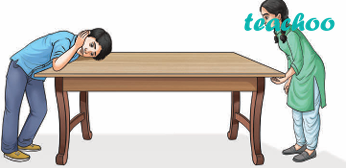
What do we need?
- A desk
- A friend
What do we do?
- You and your friend stand on opposite sides of a desk.
- Your friend gently knocks or scratches the desk.
- First listen with your ear in the air .
- Now place your ear against the desk , close your other ear, and listen again.
What do we observe?
| Book question | What we observe |
|---|---|
| Are you able to hear the sound through the table? | Yes , the sound of knocking or scratching is heard through the desk |
What does this tell us?
- The sound reached our ear through the wood of the desk.
- So, sound can travel through solids .
Summary
Sound can travel through solids.
Examples:
- Knock on a door. A person on the other side hears it through the wooden door .
- We can hear people talking in the next room through the wall .
Sound travels through liquids (Activity 10.4)
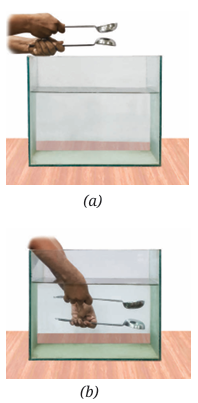
What do we need?
- A large tub or bucket filled to the brim with water
- Two metal spoons
What do we do?
- Tap the spoons against each other in the air and listen (a).
- Now submerge both spoons in water . Do not let them touch the sides or bottom of the bucket.
- Tap them against each other again under water (b).
What do we observe?
| Book question | What we observe |
|---|---|
| Do you again hear the sound produced? | Yes , we hear the sound of the spoons even under water |
| If sound did not travel through liquids, would you have heard this sound? | No . We heard it only because sound travelled through the water |
What does this tell us?
- The sound travelled through water first, and then through air , to reach our ears.
- So, sound can travel through liquids .
Summary
Sound can travel through liquids.
💡 Good to know
Why should the spoons not touch the bucket?
If they touch it, the sound could travel through the
solid bucket
instead. Then we would not know if it came through the
water
.
Examples:
- Swimmers can hear sounds while their head is under water .
- Dolphins and whales call to each other through sea water .
Sound travels through gases
- We hear most sounds every day through air , which is a gas .
- Proof from Activity 10.4, step 1: When we tapped the two spoons in the air , we heard the sound. The sound travelled through air to reach our ears.
- Proof from Activity 10.2: A vibrating tuning fork held near the ear (not touching it) is heard. The sound travels through the air between the fork and the ear.
Examples:
- We hear our friend talking across the room through air .
- We hear birds chirping and vehicles honking through air .
