
 You are here
What is reverberation?
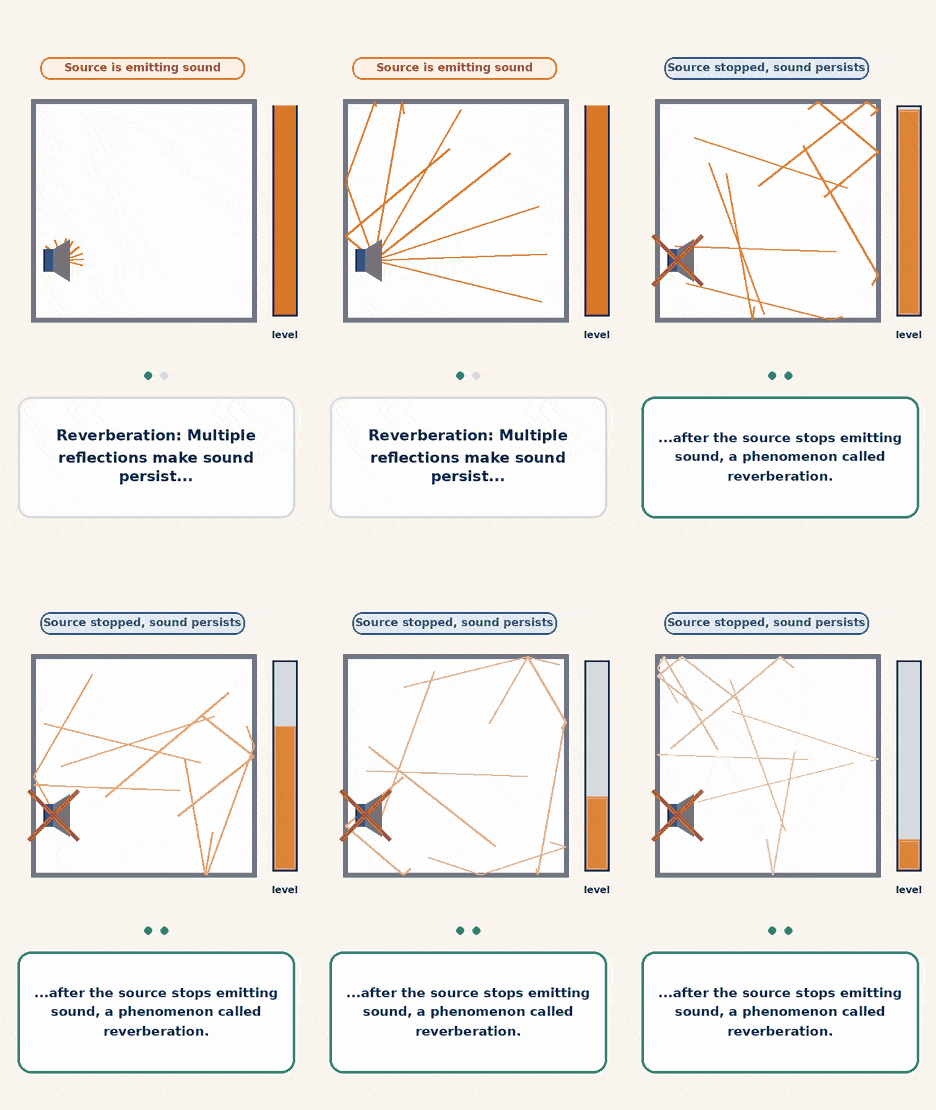
Multiple reflections make sound persist after the source stops emitting sound, a phenomenon called reverberation.
GIF
Watch: new GIF
Important points:
- It happens when sound bounces many times off the walls of a large hall or auditorium .
- So the sound keeps lingering for a while, even after the source has stopped.
- It happens when reflections arrive with a time gap of less than 0.05 s .
How is reverberation controlled?
- Modern auditoriums and large concert halls are designed to have the right amount of reverberation.
- This lets everyone in the audience hear speech, music and other sounds clearly , without distortion (sound getting spoiled).
- Too much unwanted reverberation makes the sound garbled (jumbled and unclear).
-
It is reduced using
soft, porous surfaces
(surfaces with tiny holes) that
absorb
sound:
- Sound absorbing panels
- Upholstered chairs (chairs covered with soft padding and cloth)
- Curtains
What is the difference between echo and reverberation?
| Echo | Reverberation | |
|---|---|---|
| Reflections | One clear reflection | Many reflections |
| Time gap | At least 0.1 s | Less than 0.05 s |
| What we hear | Our sound again, separately | Sound lingering after the source stops |
| Where | Mountains, cliffs, long corridors | Large halls, auditoriums |
Threads of Curiosity: How did old buildings use sound?
- Medieval architects across the world, including in India , designed monuments with a deep understanding of sound .
- The famous Whispering Gallery of the Gol Gumbaz is in Bijapur, Karnataka .
- Its design lets even a faint whisper be heard many times across the large dome.
Laws of reflection of sound
Sound follows the
same laws of reflection as light
.
The directions in which the sound is incident and is thereafter reflected make equal angles with the normal to the reflecting surface at the point of incidence, with all three lying in the same plane.
Important points:
- Angle of incidence = Angle of reflection
- The incident sound , the reflected sound and the normal all lie in the same plane .
