
 You are here
How does sound propagate?
- In the last section, we studied that sound propagates (travels) through a medium.
- Now we will learn how it propagates.
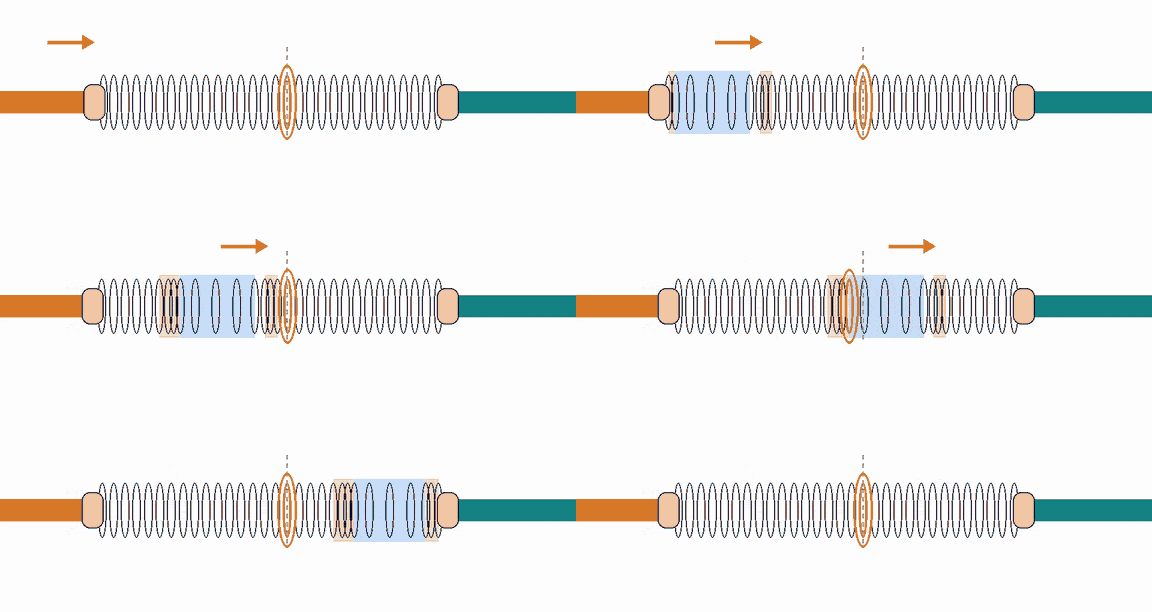
- For this, let's take the example of a slinky .
What is a slinky?
- A slinky is a long, flexible spring toy .
- It is made of metal or plastic .
What happens when we push or pull the slinky?
When we push the slinky forward:
GIF
Watch: PUSH
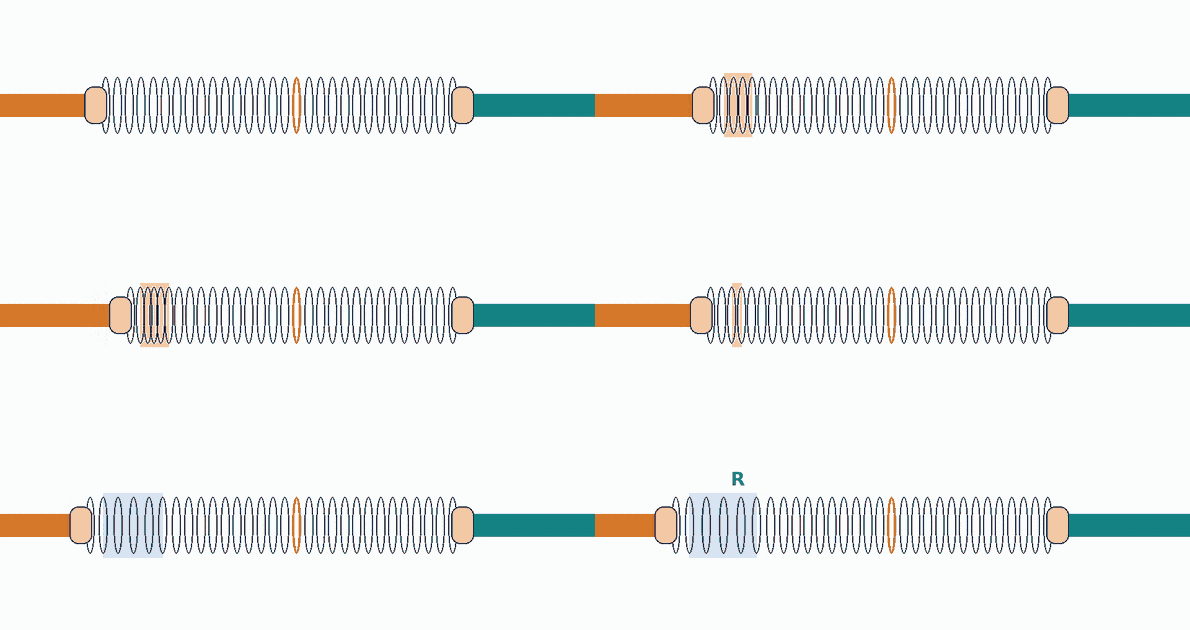
- The turns near our hand get squeezed close together .
- This region of closely packed turns is called a compression (C) .
When we pull the slinky back:
GIF
Watch: PULL
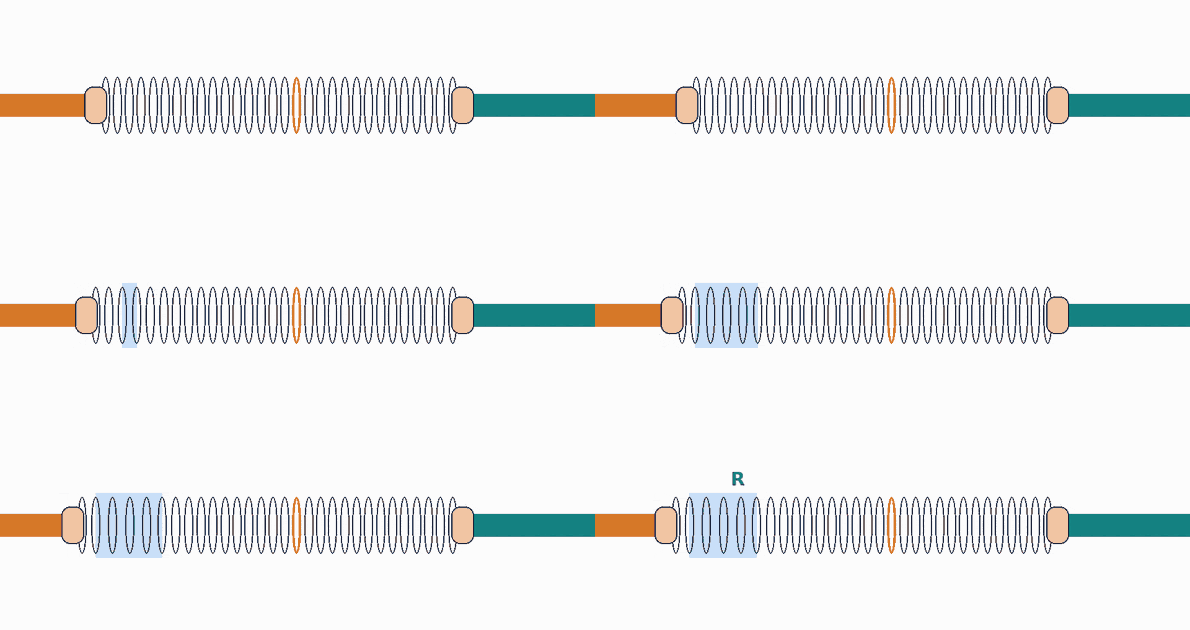
- The turns near our hand get spread far apart .
- This region of widely spaced turns is called a rarefaction (R) .
When we push and pull again and again:
GIF
Watch: PUSH AND PULL
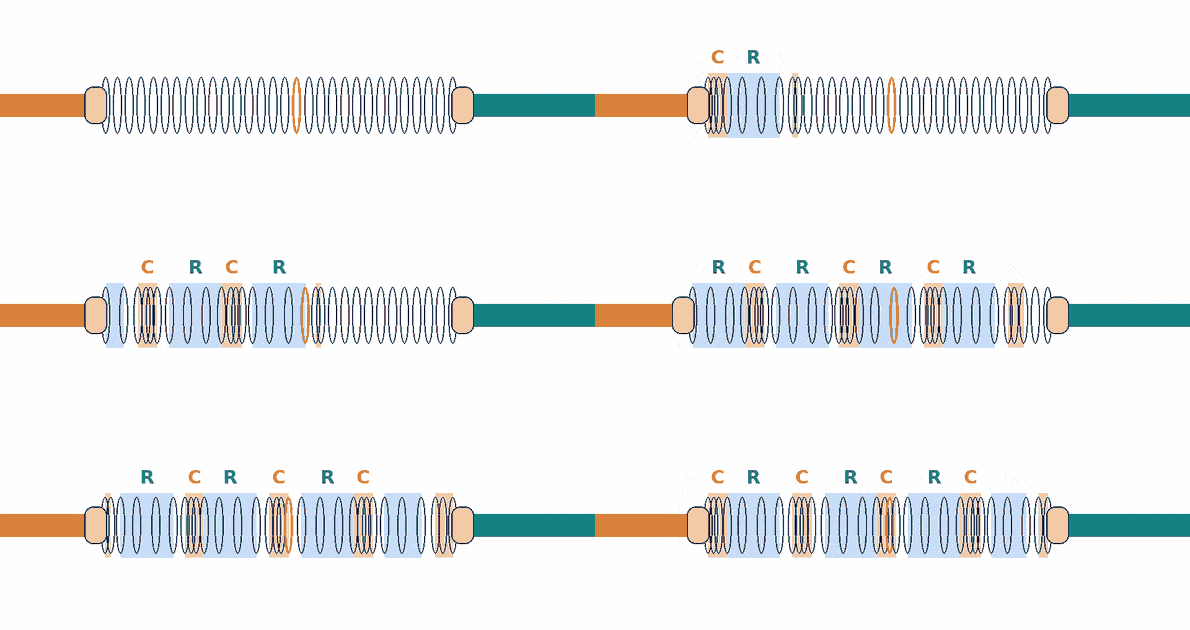
- Compressions and rarefactions form one after another : C, R, C, R...
- They travel along the slinky to the other end.
Activity 10.5 shows this.
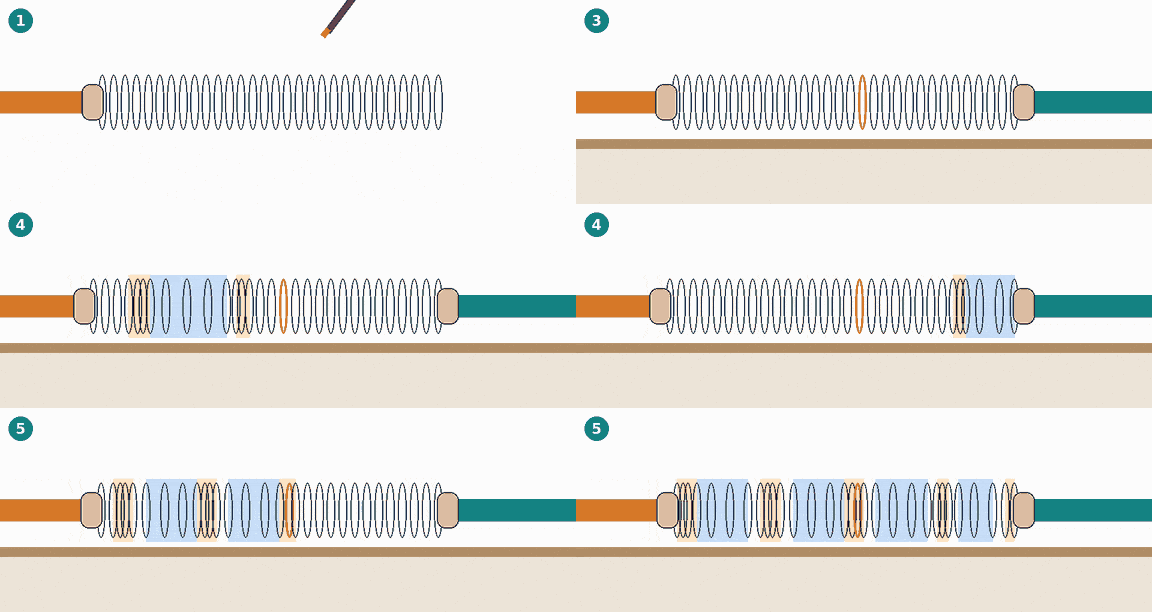
Activity 10.5: What happens in a slinky when we push and pull it?
What do we need?
- A slinky
- A marker
- A friend
What do we do?
- Mark one turn of the slinky with the marker.
- Lay the slinky flat on a table or floor.
- Your friend holds one end fixed . You hold the other end, keeping the slinky slightly stretched .
- Give your end a sharp push towards your friend, then quickly pull it back .
- Now push and pull your end many times quickly . (This is like a source producing sound continuously .)
What do we observe?
| Book question | What we observe |
|---|---|
| Do you observe a disturbance created in the slinky which moves towards your friend? | Yes , a disturbance moves along the slinky towards the friend |
| Are a series of disturbances produced in the slinky? | Yes , many disturbances are produced, one after another |
| Do these disturbances move across the length of slinky? | Yes , they travel from one end to the other |
| Does the mark on the slinky move back and forth parallel to the direction of the disturbance? | Yes . The mark only moves back and forth around its own place. It does not travel along the slinky |
GIF
Watch: OBSERVE
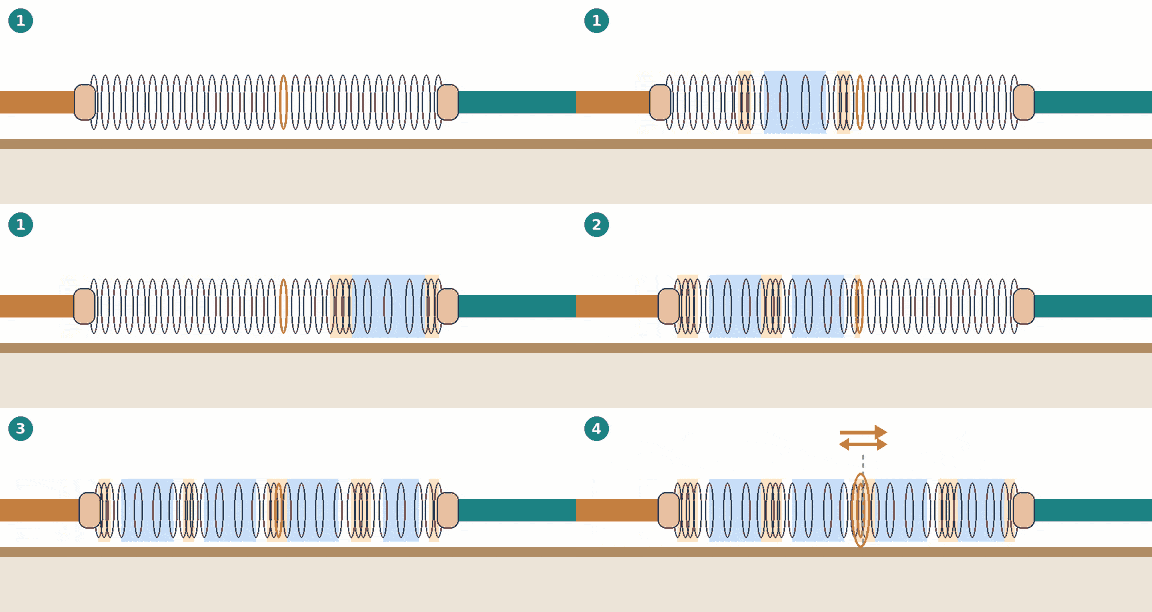
- We see regions where the turns are closer together than usual ( compressions ).
- We also see regions where the turns are more spread out ( rarefactions ).
- These regions travel along the slinky.
What does this tell us?
- The disturbance travels from one end of the slinky to the other.
- But each turn (like the marked one) only oscillates about its own position .
- So the disturbance moves , but the slinky itself does not move along .
Summary
The disturbance travels, but each turn only oscillates about its own position.
📝 Note
(from the book)
The particles of the medium do not travel with the wave. They just vibrate about their mean positions.
What does this mean?
- Mean position is the normal resting place of a particle.
- When a wave passes, each particle moves a little forward and backward around this place.
- It does not leave its place and travel along with the wave.
- Only the disturbance (the compressions and rarefactions) moves forward.
- In the slinky: the marked turn only moved back and forth near its place. It never reached your friend’s hand. But the disturbance did.
Difference between compression and rarefaction
| Compression (C) | Rarefaction (R) | |
|---|---|---|
| Book definition | This region of air with higher density (compared to the average density) is called a compression (C). | This region of air with lower density (compared to the average density) is called a rarefaction (R). |
| Particles | Close together | Spread apart |
| Density | Higher than average density | Lower than average density |
| In the slinky | Turns closer together | Turns more spread out |
| Made when the source moves | Forward (push) | Backward (pull) |
| In diagrams | Shown by C | Shown by R |
💡 Good to know
Density
means
how closely packed
the particles are in a space. Particles close together means
higher density
. Particles spread apart means
lower density
. Normal, undisturbed spacing is the
average density
.
How does the slinky help us understand sound in air?
- Sound moves through a medium in the same way as the disturbance moves through the slinky.
- The slinky is like the medium (air). Each turn of the slinky is like a particle of air .
- Our hand pushing and pulling the slinky is like a vibrating source of sound.
- When the turns come closer together , it is like air with higher density (a compression ).
- When the turns spread out , it is like air with lower density (a rarefaction ).
- Just like the marked turn, the air particles only move back and forth. They do not travel to our ears.
How does sound travel through air? (Piston example)
- Think of a long tube filled with air .
-
GIF Watch: new GIF
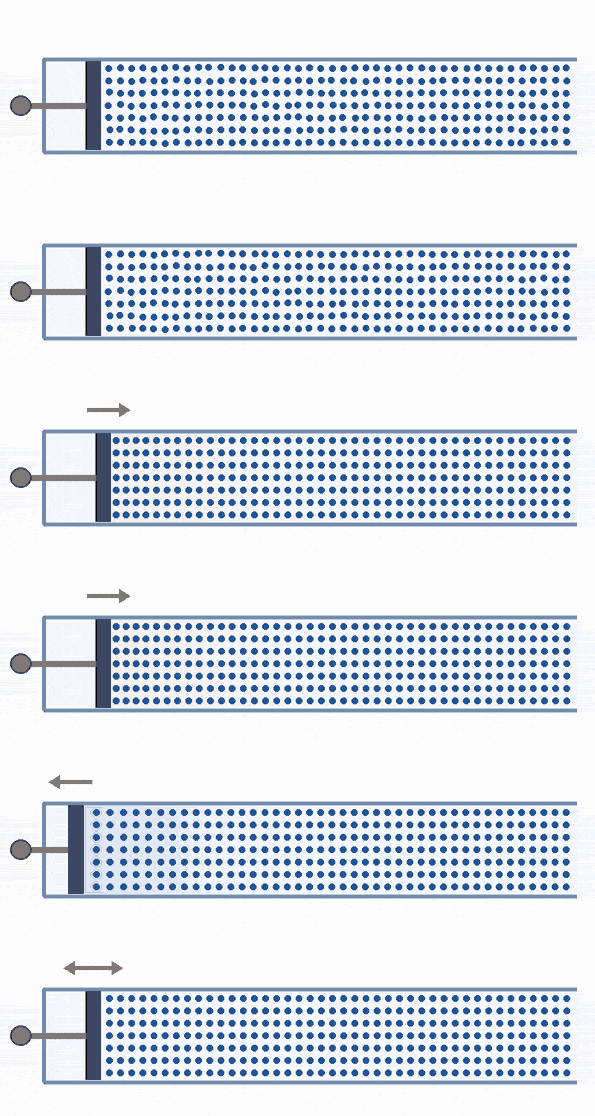
- At one end there is a piston (a disc that fits inside the tube and can slide back and forth). The other end is open .
- The piston oscillates back and forth. It is a simple model of a source of sound .
Step 1: Piston not moving
GIF
Watch: new GIF
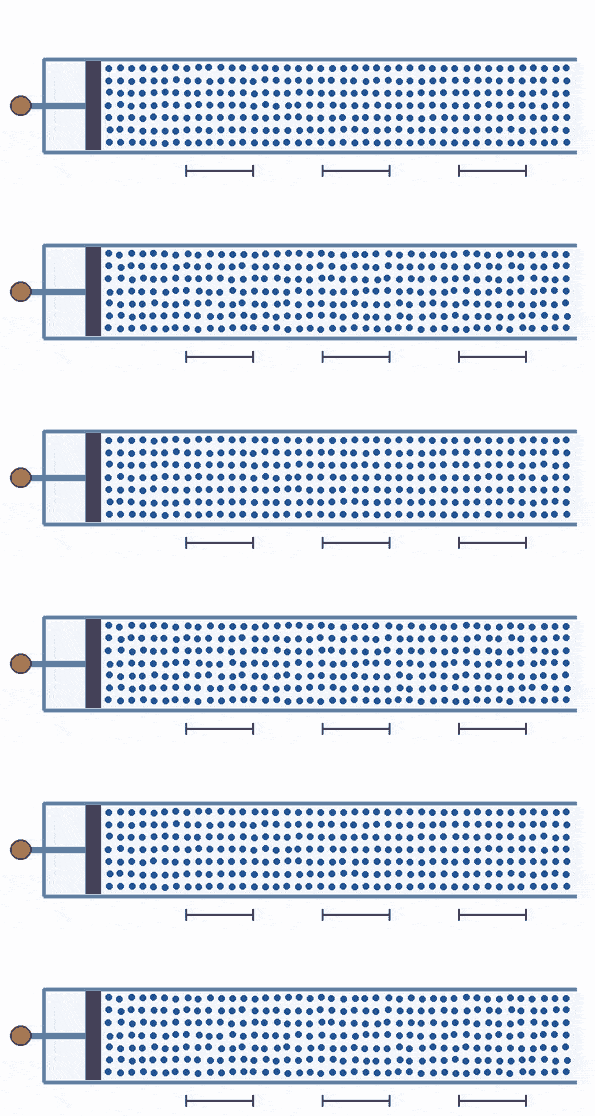
- The air inside the tube has the same density everywhere .
- This is the average density .
Step 2: Piston moves forward
GIF
Watch: new GIF
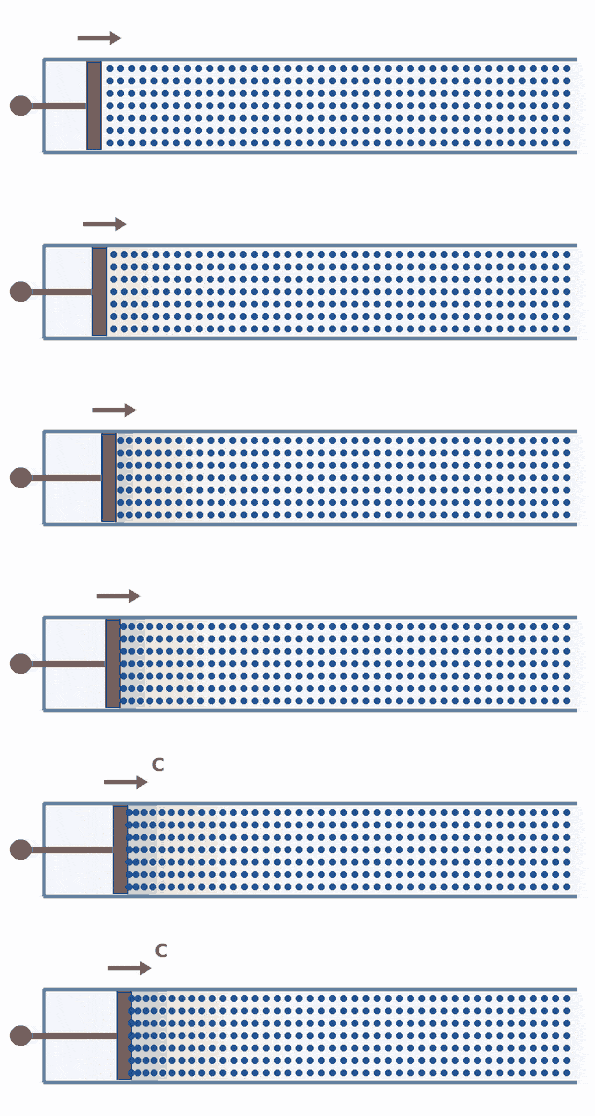
- The piston pushes the nearby air particles forward .
- The air near the piston gets squeezed . Its density increases .
- A compression (C) is formed.
Step 3: Piston moves backward
GIF
Watch: new GIF
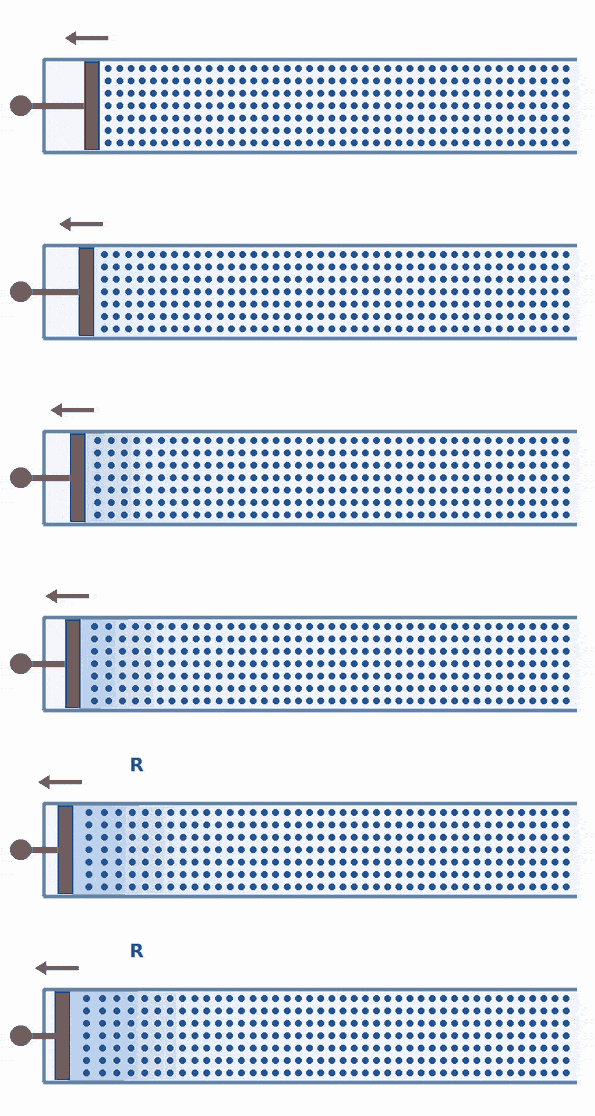
- The air particles near the piston move backward with it.
- The air near the piston becomes less dense .
- A rarefaction (R) is formed.
Step 4: Piston keeps oscillating
GIF
Watch: new GIF
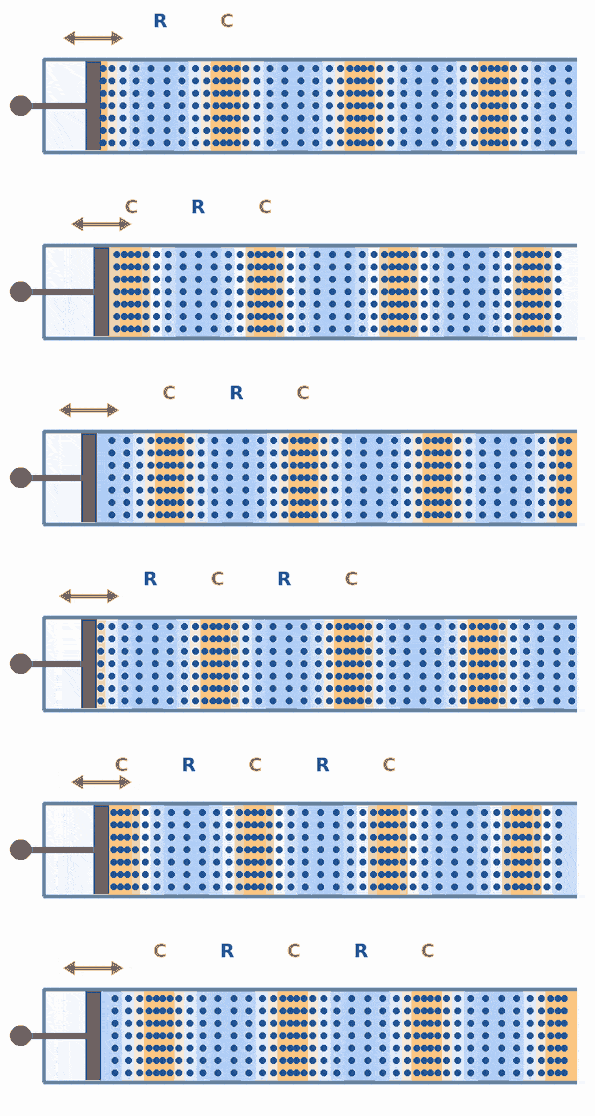
- Compressions and rarefactions are produced one after another (alternately).
- They travel away from the source, as a series of C, R, C, R.
| Piston moves | What happens to air near it | Region formed |
|---|---|---|
| Not moving | Same density everywhere | Average density |
| Forward | Particles pushed together | Compression (C) |
| Backward | Particles spread apart | Rarefaction (R) |
| Back and forth again and again | Squeezed and spread alternately | C, R, C, R... |
How do compressions and rarefactions move forward?
- The squeezed particles collide with the particles just ahead of them.
- These pass the compression forward to their neighbours.
- The neighbours collide with their neighbours, and so on.
- So the compression moves forward through the air.
- A rarefaction also moves ahead in the same way, through collisions with nearby particles.
- But the air particles themselves do not travel with it. They only oscillate about their mean positions .
What is a sound wave?
- A sound wave is a chain of compressions and rarefactions moving through a medium, while the particles themselves stay in their places .
The disturbance consisting of a series of alternating compressions and rarefactions propagating through a medium, without the actual flow of the particles of medium, is called a sound wave.
Examples:
- Slinky: The disturbance travels to the other end, but the marked turn stays near its place.
-
GIF Watch: new GIF
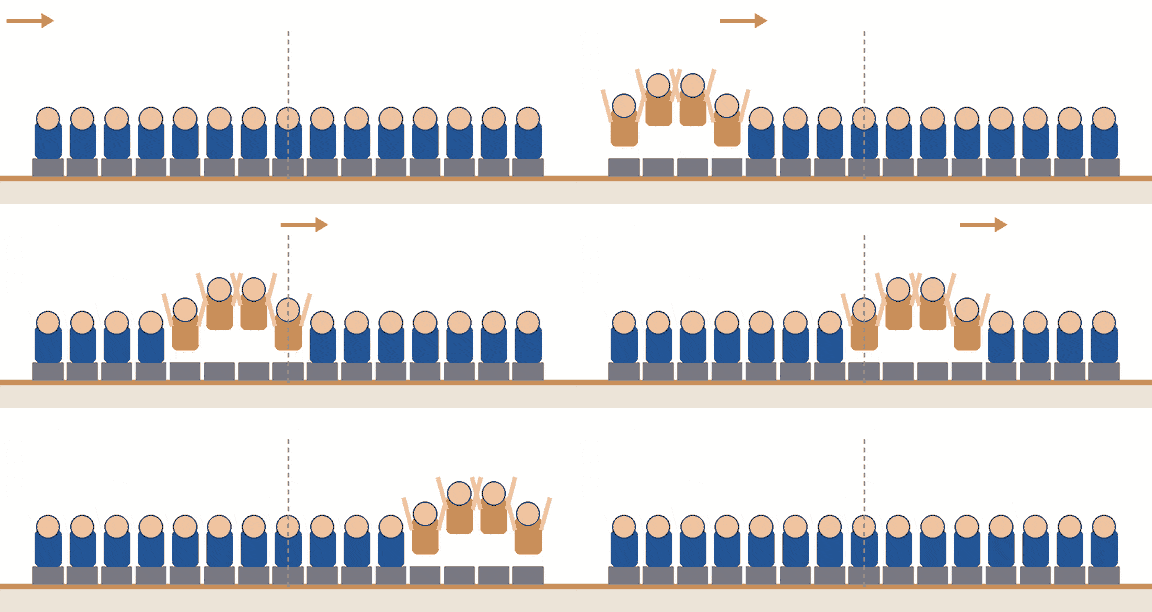
- Stadium wave: In a cricket stadium, people stand up and sit down one after another. The wave goes round the stadium , but each person stays in their seat .
-
GIF Watch: new GIF
What is the direction of propagation of a wave?
- The direction of propagation is simply the way the wave is moving .
📖 Book definition
The direction in which the wave travels is known as the direction of propagation of the wave.
Breaking it down:
| Term | Meaning |
|---|---|
| Direction in which the wave travels | The way the disturbance moves , away from the source |
| Propagation | Travelling |
- Example: In the slinky, the disturbance moves from your hand towards your friend . That is its direction of propagation.
Why is sound a mechanical wave?
- Mechanical waves are waves that need matter (a solid, liquid or gas) to travel.
Waves that require a material medium for propagation are called mechanical waves.
Breaking it down:
| Term | Meaning |
|---|---|
| Require | Need |
| Material medium | A solid , liquid or gas made of particles |
| For propagation | To travel |
Why is sound a mechanical wave?
- Sound travels by forming compressions and rarefactions .
- For this, the medium must have particles that can be squeezed together and spread apart .
- If there is no medium (no particles), there is nothing to squeeze or spread . So no compressions or rarefactions can form.
- So sound needs a material medium to travel.
- That is why sound wave is a type of mechanical wave .
- This is also why sound cannot travel in vacuum (bell jar experiment).
What are the types of mechanical waves?
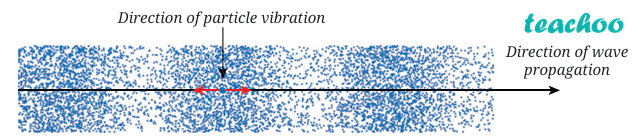
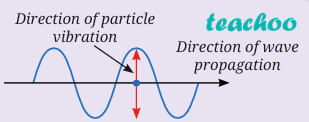
- Mechanical waves are of two types :
- Longitudinal waves
- Transverse waves
1. Longitudinal waves
- In a longitudinal wave, particles move back and forth along the same line in which the wave travels.
Such waves where the particles vibrate in a direction parallel to the direction of the wave propagation are known as longitudinal waves.
Breaking it down:
| Term | Meaning |
|---|---|
| Particles vibrate | Particles of the medium move back and forth |
| Parallel | Along the same line (same direction or exactly opposite) |
| Direction of the wave propagation | The direction in which the wave travels |
2. Transverse waves
- In a transverse wave, particles move up and down , at right angles to the way the wave travels.
In a transverse wave, the particles vibrate in a direction perpendicular to the direction of wave propagation.
Breaking it down:
| Term | Meaning |
|---|---|
| Particles vibrate | Particles of the medium move up and down |
| Perpendicular | At a right angle (90°) |
| Direction of wave propagation | The direction in which the wave travels |
Difference between longitudinal and transverse waves:
| Longitudinal wave | Transverse wave | |
|---|---|---|
| Particles vibrate | Parallel to wave direction (back and forth) | Perpendicular to wave direction (up and down) |
| What forms | Compressions and rarefactions | Ups and downs in the medium |
| Examples | Sound wave , slinky pushed and pulled | Rope shaken up and down |
Seismic waves (earthquakes):
- Earthquakes produce seismic waves that travel through the Earth .
- They can be longitudinal or transverse .
- The longitudinal seismic waves are the first to be detected by seismographs (machines that detect earthquakes).
What type of wave is sound, and why?
Sound is a longitudinal wave.
Why?
- In the piston example, the air particles move forward and backward .
- The wave also moves forward , away from the piston.
- So the particles vibrate along the same line as the wave travels, which means parallel to the direction of propagation.
- The slinky shows the same thing: the marked turn moves back and forth parallel to the direction of the disturbance.
- This back and forth motion along the wave’s path is what creates compressions and rarefactions .
Does sound travel in one direction or many?
- In Activity 10.2 , we heard the tuning fork from every direction around it.
- So sound travels in many directions from its source.
- The directions can depend on the shape of the source .
- In the slinky and piston examples, we showed sound moving in only one direction , just to keep it simple .
Ready to Go Beyond: How does sound spread in all directions?
-
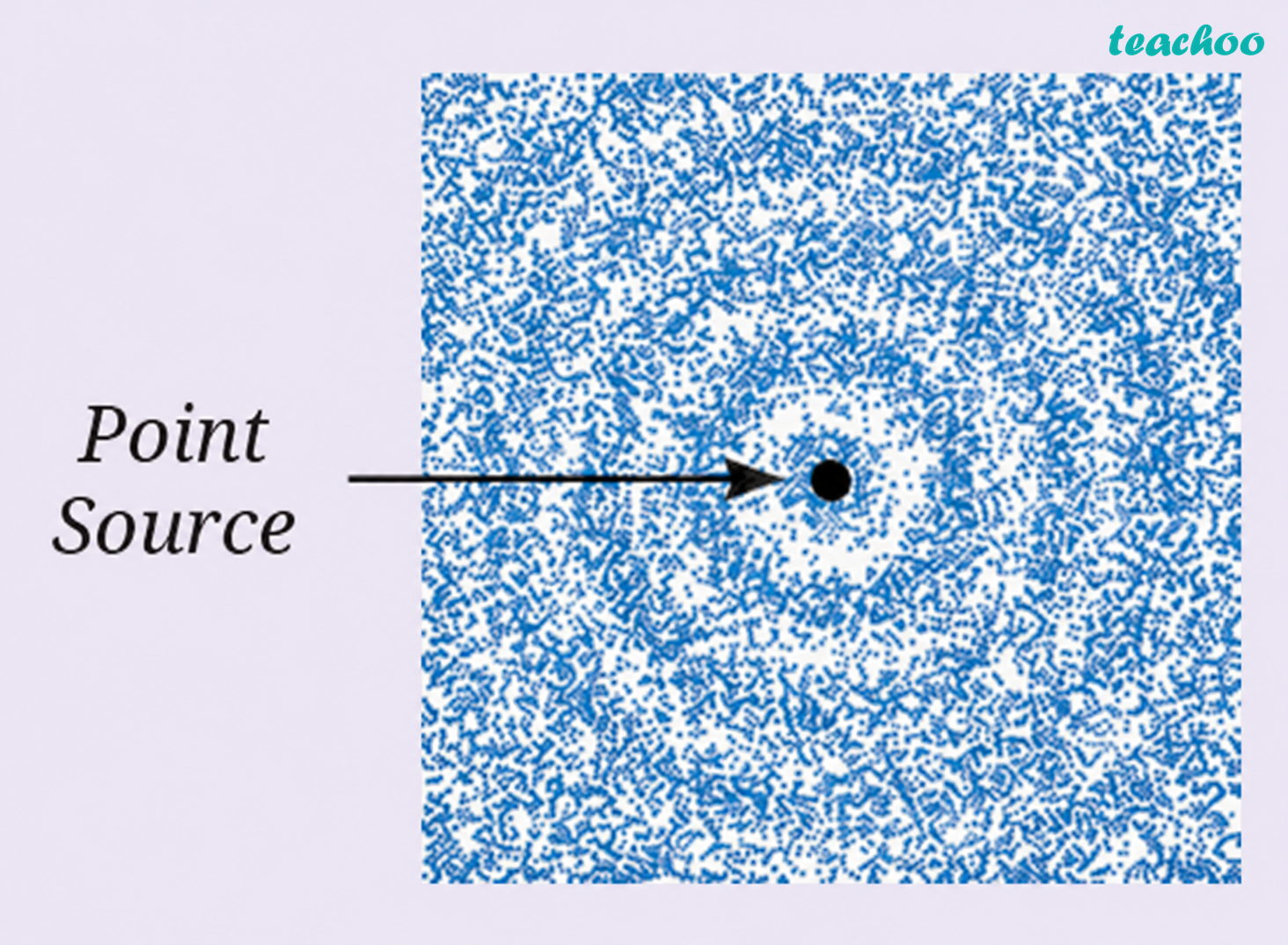
- When the medium is not inside a tube , the vibrating particles collide with particles all around them.
- So the sound wave spreads out in all directions .
- A small source making sound in all directions sends out compressions and rarefactions like growing balls (spheres) .
- These are called spherical waves .
- When they reach the listener , they are heard as sound .
Are all waves mechanical?
- No. Some waves do not need a medium .
- Light is a transverse wave that can travel through vacuum .
- That is why light from the Sun and stars reaches the Earth through empty space .
| Sound | Light | |
|---|---|---|
| Needs a medium? | Yes | No |
| Travels through vacuum? | No | Yes |
| Type | Longitudinal , mechanical | Transverse , not mechanical |
Threads of Curiosity: How are sudden loud sounds produced?
- Firecrackers exploding and claps of thunder make sound in a slightly different way .
- When air or gases are heated very fast , they expand very fast .
- This sudden expansion creates a sudden change in air density that travels outward.
- When it reaches our ears, we hear a loud sound pulse (a single, short burst of sound).
Sonic boom:
-

- A supersonic aircraft flies faster than the speed of sound .
- It produces a similar but more complex disturbance.
- This creates a very loud sound called a sonic boom .
Questions from the book for this section
-
🤔 Pause and Ponder 4
Assertion (A): Compressions and rarefactions move through the medium.
Reason (R): Individual particles of the medium continuously move forward with the wave.
Choose the correct statement:
(i) Both A and R are true, but R is not the correct explanation of A.
(ii) Both A and R are true, and R is the correct explanation of A.
(iii) A is true, but R is false.
(iv) A is false, but R is true.View answer
AnswerAnswer: (iii) A is true, but R is false.- A is true: Compressions and rarefactions do travel through the medium, as seen in the slinky and piston example.
- R is false: The particles do not move forward with the wave. They only vibrate about their mean positions . Only the disturbance moves forward.
Why the other options are wrong:Option Why it is wrong (i) R is not true , so "both are true" is wrong (ii) R is not true , so it cannot explain A (iv) A is not false . Compressions and rarefactions really do move through the medium
