
 You are here
What is a tuning fork?
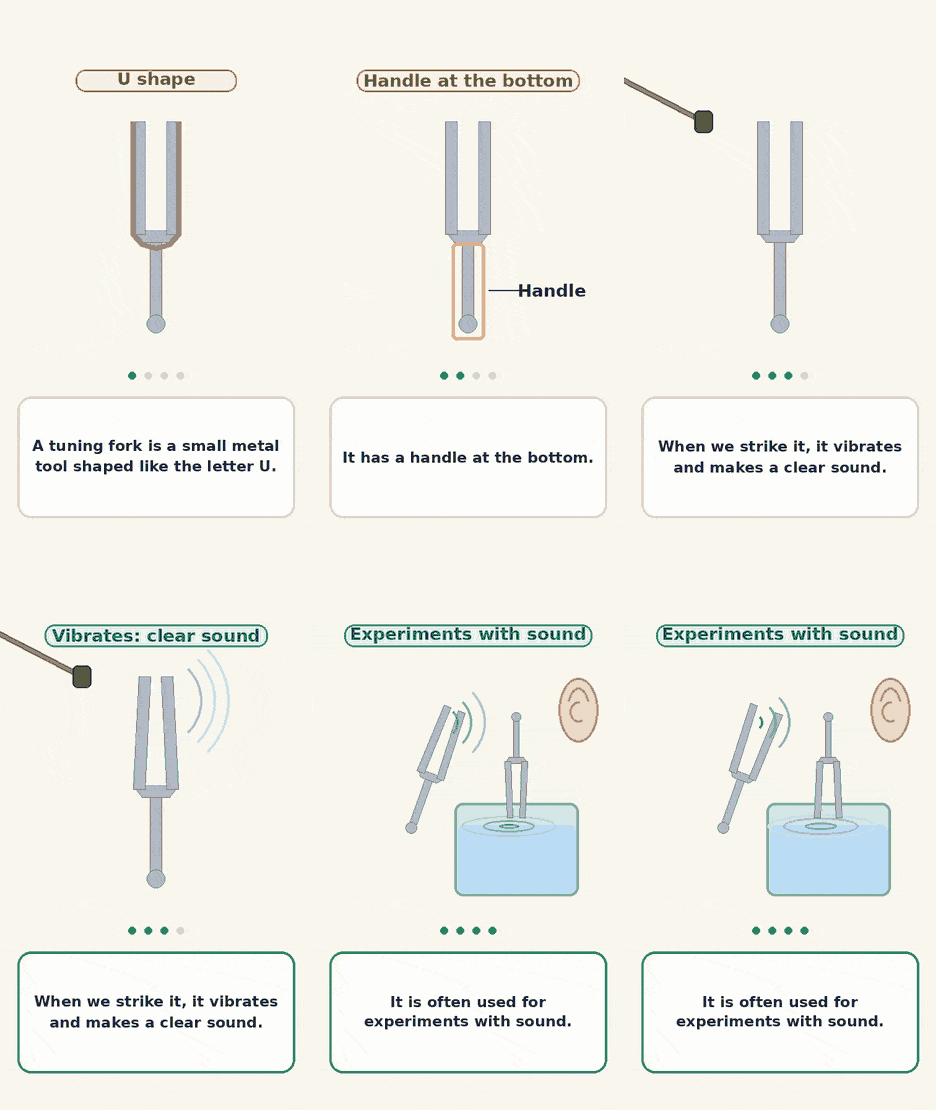
- A tuning fork is a small metal tool shaped like the letter U .
- It has a handle at the bottom.
- When we strike it, it vibrates and makes a clear sound .
- It is often used for experiments with sound .
How does a tuning fork show that sound comes from vibrations?
What do we need?
- A tuning fork
- A soft rubber pad
- A bowl of water
What do we do?
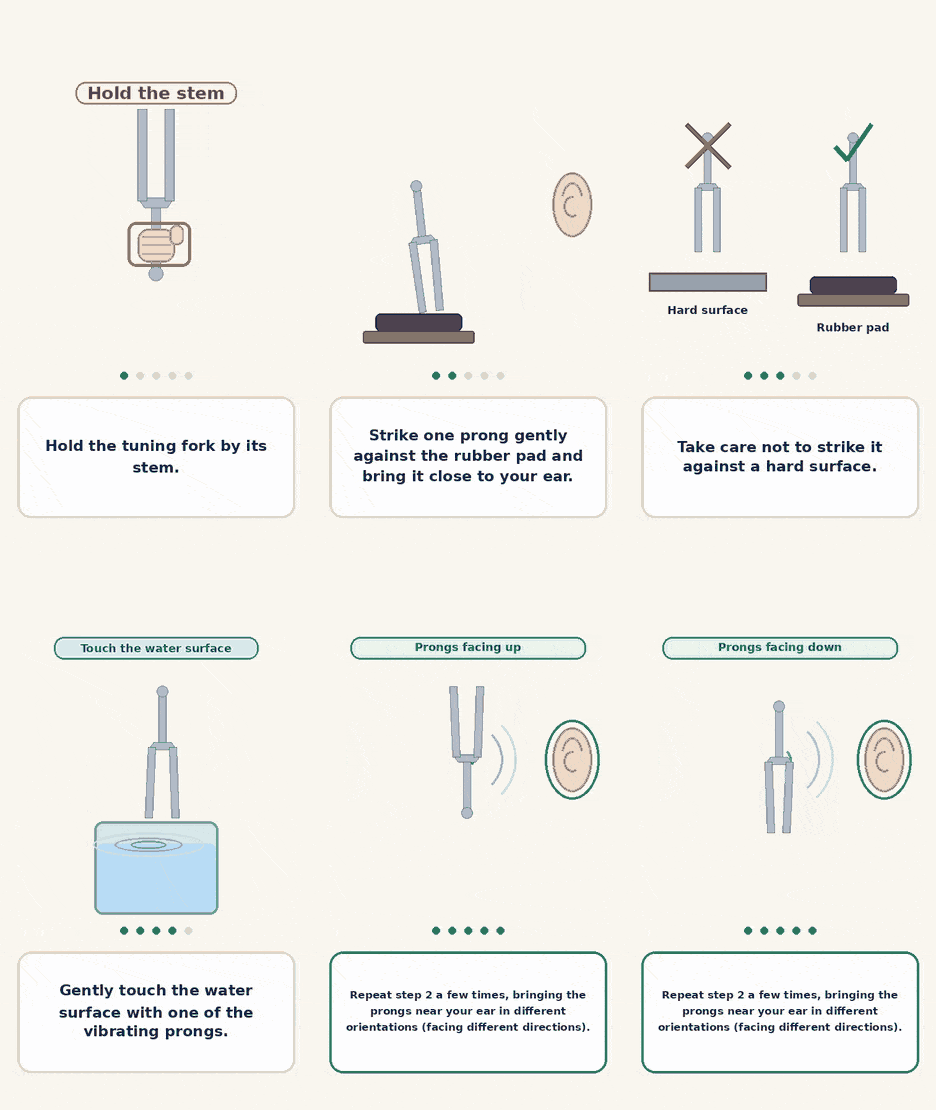
- Hold the tuning fork by its stem .
-
Strike one prong gently
against the rubber pad and bring it
close to your ear
.
- Take care not to strike it against a hard surface .
- Gently touch the water surface with one of the vibrating prongs.
- Repeat step 2 a few times, bringing the prongs near your ear in different orientations (facing different directions).
What do we observe?
| Book question | What we observe |
|---|---|
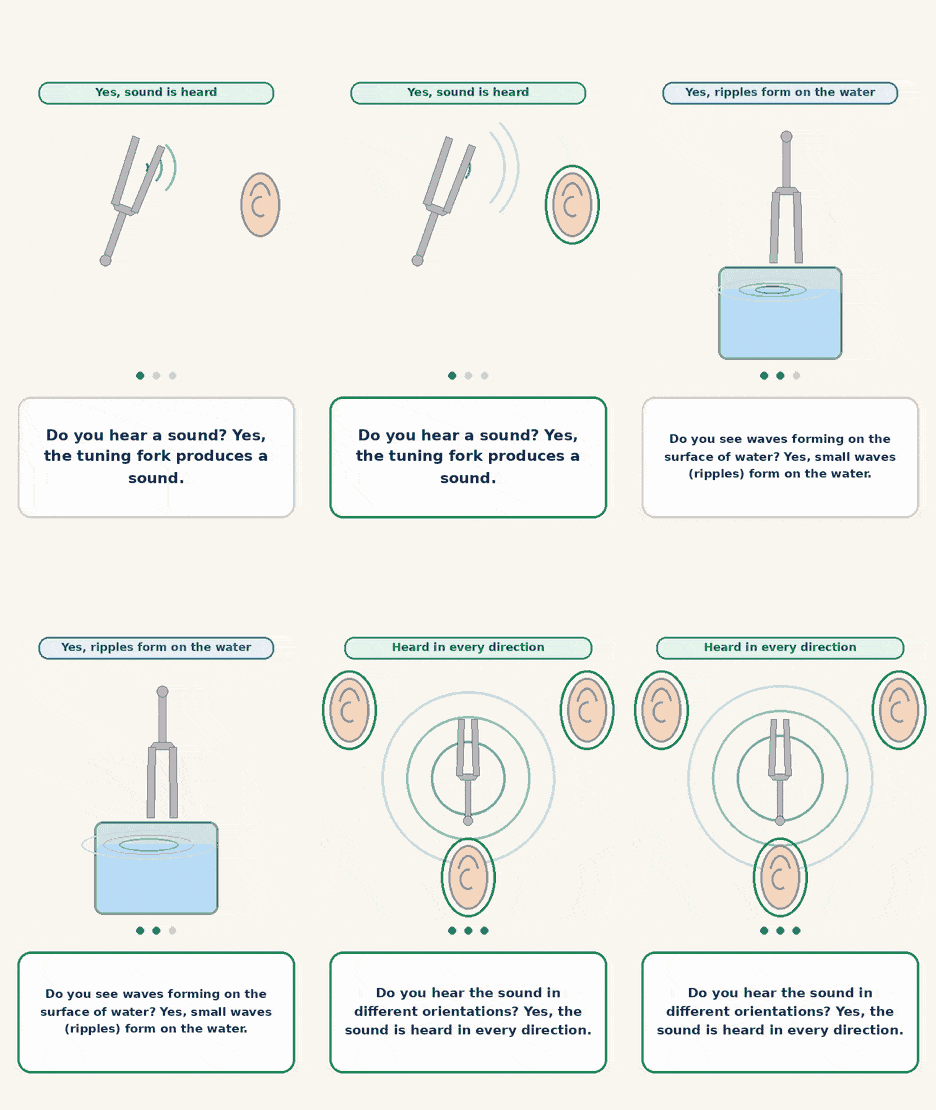
| Do you hear a sound? | Yes , the tuning fork produces a sound |
| Do you see waves forming on the surface of water? | Yes , small waves (ripples) form on the water |
| Do you hear the sound in different orientations? | Yes , the sound is heard in every direction |
What does this tell us?
- The waves on the water show that the prongs are really vibrating .
- The vibrating tuning fork produces sound .
- So, sound is produced by vibrating objects .
Summary
Sound is produced by vibrating objects.
Threads of Curiosity: What if your name were a tune?
- Kongthong is a village near Shillong in Meghalaya .
- It is also known as the Whistling Village .
- Every person there has a ‘tune name’ that can be sung or whistled .
- This tradition is called Jingrwai Iawbei .
- It begins at birth , when a mother composes a lullaby-like tune for her child.
Questions from the book for this section
-
🤔 Pause and Ponder 1
Explore various ways of producing sound.View answer
AnswerWay What vibrates Examples Plucking String Sitar , guitar, rubber band Striking Metal or membrane Bell , taal , tabla , drum Blowing Air inside a pipe Bansuri , whistle, shehnai Rubbing Strings or body parts Sarangi (bow rubbed on strings), crickets (rub wings) Shaking Small metal pieces Ghungroo , rattle Speaking or singing Vocal cords Our voice
-
🤔 Pause and Ponder 2
Make a list of different types of musical instruments and identify their vibrating parts which produce sound.View answer
AnswerType of instrument Instrument Vibrating part String instruments Sitar , veena , guitar Strings (and the hollow body ) String instruments Sarangi , violin Strings , rubbed with a bow Membrane instruments Tabla , dholak , drum Stretched membrane (skin) Wind instruments Bansuri , shehnai , trumpet Air column inside the pipe Metal instruments Taal , manjira , bell Metal body - In most musical instruments, more than one part vibrates. In a sitar , the strings vibrate and the hollow body vibrates with them, making the sound richer.
