
 You are here
Is sound an energy? Why?
- Yes. Sound is a form of energy .
- Sound can make objects move , even when the source is not touching them.
- Activity 10.6 proves this.
Activity 10.6: How do we show that sound carries energy?

What do we need?
- A wide mouthed container (like a bowl)
- A cellophane or rubber sheet (such as a piece of a balloon), larger than the mouth of the container
- Tape or a rubber band
- A loud sound source (such as a metal plate and a beater )
- Some grains or particles (such as rice , semolina , salt or chalk powder )
What do we do?
- Stretch the sheet tightly over the mouth of the container. Fix it with tape or a rubber band .
- Sprinkle the grains evenly over the sheet. Make sure they are not clumped together .
- Make a loud sound near the bowl , without touching it . Watch the grains.
- Repeat with different sources of sound .
- Try making the sound louder and softer . Try different grains .
What do we observe?
| Book question | What we observe |
|---|---|
| Does the sound have any effect on the grains? | Yes , the grains move or jump on the sheet |
| Do you observe the grains over the sheet move or jump? | Yes , the grains move or jump |
| Why does this happen, even though the source of sound is not touching the sheet or the container? | Sound travels through air , reaches the sheet and makes it vibrate . This vibration makes the grains move |
| What happens when the sound is made louder? | The grains jump more . A softer sound moves them less |
What does this tell us?
- Nothing touched the sheet, yet the grains moved.
- The sound reached the sheet through air and made it vibrate.
- To make something move, we need energy .
- So, sound is a form of energy , and sound waves carry energy .
Summary
Sound is a form of energy, and sound waves carry energy.
How does a sound wave transfer energy?
- When the source of sound vibrates , it gives energy to the medium around it.
- The particles of the medium start vibrating .
- They collide with the particles next to them and pass the energy on.
- In this way, the energy moves from particle to particle through the medium.
- The particles stay near their places . Only the energy moves forward.
📝 Note
(from the book)
In the propagation of a sound wave, it is the
energy
that is transferred,
not the particles
of the medium.
Bridging Science and Society: How do microphones and speakers work?
Energy transfer in microphone (Fig.a):
GIF
Watch: new GIF
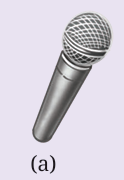
- A microphone helps us capture sound .
- When we speak or sing into it, the sound waves make a thin membrane vibrate.
- This thin membrane is called a diaphragm .
- These vibrations are changed into an electrical signal .
- So a microphone changes sound energy into electrical energy .
Energy transfer in speaker (Fig.b):
GIF
Watch: new GIF
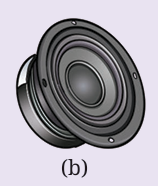
- A speaker does the opposite .
- An electrical signal makes a cone or diaphragm inside the speaker vibrate .
- This vibration produces sound .
- So a speaker changes electrical energy into sound energy .
- If all parts work properly, the sound from the speaker closely matches the sound that was first captured .
Questions from the book for this section
-
🤔 Pause and Ponder 5
When sound travels from a tuning fork to your ear, which of the following actually reaches your ear?
(i) Air particles near the tuning fork
(ii) Energy carried by sound waves
(iii) The tuning fork material
(iv) A continuous stream of compressed airView answer
AnswerAnswer: (ii) Energy carried by sound waves.- The tuning fork vibrates and gives energy to the air near it.
- The air particles pass this energy on by colliding with their neighbours.
- The particles stay near their places . Only the energy travels and reaches the ear.
Why the other options are wrong:Option Why it is wrong (i) Air particles do not travel with the wave. They only vibrate about their mean positions (iii) The tuning fork stays in our hand . Its material does not move to the ear (iv) There is no stream of air flowing. Sound is compressions and rarefactions , not air blowing towards us
Ready to Go Beyond: Are the particles of a medium ever at rest?
- No. Particles in a medium are never truly at rest .
- They are always vibrating randomly because of thermal energy (heat energy).
- When a sound wave passes , it increases the vibration of these particles for a short time .
- After the wave passes , the particles go back to their usual random motion .
