You are here
What are the problems faced by small farmers and other poor people in getting loans from formal sources of credit? Suggest some measures to improve their access to credit.
Answer:
Answer by student
Small farmers and other poor people face many problems in getting loans from formal sources of credit, such as:
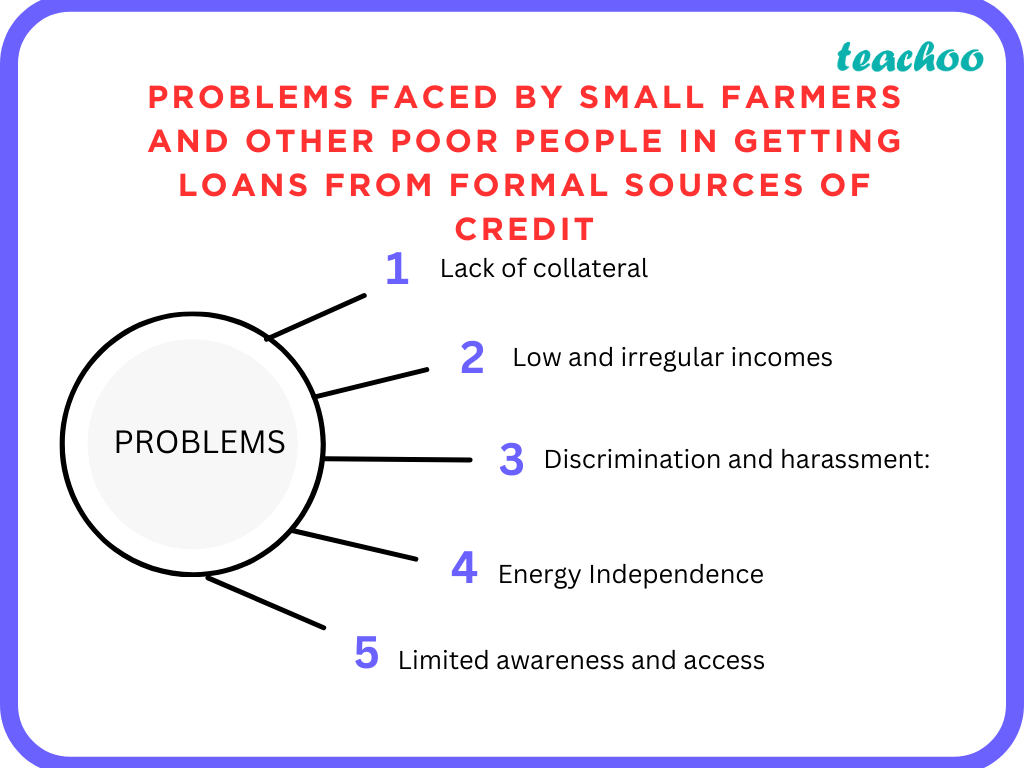
- Lack of collateral: Formal lenders usually require collateral as a condition for giving loans. However, small farmers and other poor people often lack collateral such as land titles, jewellery, vehicles etc. This makes them ineligible for formal loans.
- Low and irregular incomes: Formal lenders also assess the income and repayment capacity of the borrowers before giving loans. They prefer borrowers who have stable and regular incomes that can ensure timely repayment of loans. However, small farmers and other poor people have low and irregular incomes that depend on factors such as weather, market conditions, health etc. This makes them risky and unreliable borrowers for formal lenders.
-lock-
- Discrimination and harassment: Formal lenders may also discriminate against certain groups or communities based on their caste, religion, gender etc. They may charge higher interest rates, impose strict conditions or deny loans altogether to these groups. They may also harass or threaten the borrowers who fail to repay the loans on time. For example, they may seize their assets, file legal cases or use violence against them.
- Limited awareness and access: Formal lenders may also have limited outreach and coverage in rural areas where most of the small farmers and poor people live. They may be located far away or have complex procedures that require documents, forms
- Some measures to improve their access to credit are:
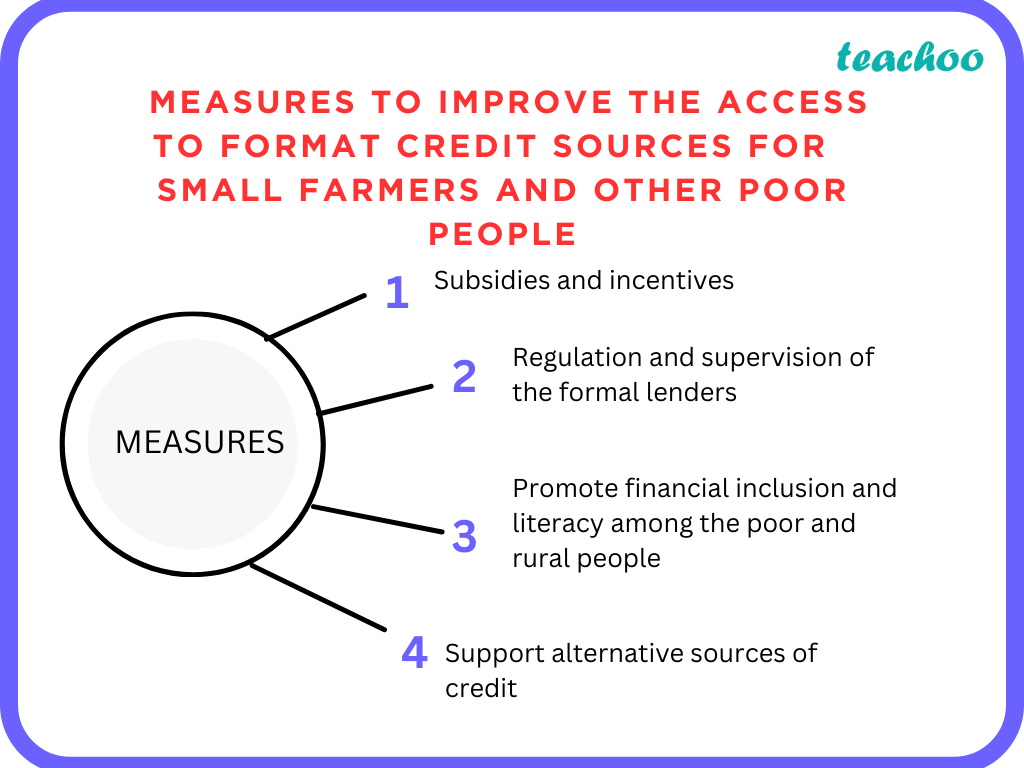
- The government should provide subsidies and incentives to the formal lenders to encourage them to lend to the poor and marginalised sections of society.
- The government should also ensure regulation and supervision of the formal lenders to prevent exploitation, corruption and malpractices.
- The government should promote financial inclusion and literacy among the poor and rural people by creating awareness, providing training and facilitating access to formal sources of credit.
- The government should support alternative sources of credit such as self-help groups, microfinance institutions and NGOs that provide loans to the poor at low interest rates and flexible terms.
Detailed Answer by Teachoo
Small farmers and other poor people face many problems in getting loans from formal sources of credit , such as banks and cooperatives. Some of these problems are:
-
Lack of collateral : Formal sources of credit usually require collateral or security as a guarantee for giving loans. Collateral can be any asset that the borrower owns, such as land, house, jewellery, vehicle etc. If the borrower fails to repay the loan, the lender can sell the collateral and recover the money. However, small farmers and other poor people often do not have any collateral to offer. This makes them ineligible for formal loans.
-
Low and irregular incomes : Formal sources of credit also assess the income and repayment capacity of the borrowers before giving loans. They prefer borrowers who have stable and regular incomes that can ensure timely repayment of loans. However, small farmers and other poor people have low and irregular incomes that depend on various factors, such as weather, market conditions, health etc. Their incomes may fluctuate due to crop failures, natural disasters, diseases etc. This makes them risky and unreliable borrowers for formal sources of credit.
-
Discrimination and harassment : Formal sources of credit may also discriminate against certain groups or communities based on their caste, religion, gender etc. They may charge higher interest rates, impose strict conditions or deny loans altogether to these groups. They may also harass or threaten the borrowers who fail to repay the loans on time. For example, they may seize their assets, file legal cases or use violence against them. This creates fear and distrust among the borrowers towards formal sources of credit.
-
Limited awareness and access : Formal sources of credit may also have limited outreach and coverage in rural areas where most of the small farmers and poor people live. They may be located far away or have complex procedures that require various documents, forms and signatures. Many small farmers and poor people may not have the required documents or may not know how to fill the forms or where to go for loans. They may also face delays or corruption in getting loans from formal sources of credit.
-
Some measures to improve their access to credit are:
-
The government should provide
subsidies and incentives
to the formal sources of credit to encourage them to lend to the
poor and marginalised sections of society
. For example, the government can provide interest rate subsidies, loan guarantees, tax benefits etc. to the formal lenders who lend to the priority sectors such as agriculture, small-scale industries, education etc.
-
The government should also
ensure regulation and supervision
of the formal sources of credit to prevent exploitation, corruption and malpractices. For example, the government can set limits on the interest rates, fees and charges that the formal lenders can charge from the borrowers. The government can also monitor the performance and accountability of the formal lenders and take action against any violations or complaints.
-
The government should
promote financial inclusion and literacy
among the poor and rural people by creating awareness, providing training and facilitating access to formal sources of credit. For example, the government can organise financial education camps, workshops and campaigns to inform the people about the benefits, procedures and rights of formal credit. The government can also provide mobile banking, online banking and other digital services to make formal credit more accessible and convenient.
- The government should support alternative sources of credit such as self-help groups (SHGs) , microfinance institutions (MFIs) and non-governmental organisations (NGOs) that provide loans to the poor at low interest rates and flexible terms. These sources of credit are based on mutual trust, cooperation and solidarity among the borrowers who form groups and pool their savings to lend to each other. They also provide other services such as savings, insurance, training etc. to the borrowers. These sources of credit can help in reducing dependence on informal sources of credit such as moneylenders who charge exorbitant interest rates and exploit the borrowers.
-
The government should provide
subsidies and incentives
to the formal sources of credit to encourage them to lend to the
poor and marginalised sections of society
. For example, the government can provide interest rate subsidies, loan guarantees, tax benefits etc. to the formal lenders who lend to the priority sectors such as agriculture, small-scale industries, education etc.
.
-endlock-