You are here
Analyze the advantages and disadvantages of a multiparty system in a democracy.
Answer:
Answer by Student
![[SQP] Analyze the advantages and disadvantages of a multiparty system - Teachoo Sample Paper - Social Science Class 10 - Paper 2](https://cdn.teachoo.com/bdcf0c69-360d-44aa-8522-91890607e45a/advantages-of-a-multiparty-system-in-a-democracy---teachoo.png)
-
The advantages of a multi-party system in a democracy are:
-
It gives more
political choices
to the voters, as they can select from a variety of parties and candidates that suit their preferences and interests. This ensures that the voters have a voice in the political process, and that their views are represented in the government.
-
It promotes
pluralism and diversity
, as different parties represent different sections of society, such as minorities, women, workers, farmers, etc. This ensures that the government reflects the diversity of the country, and that different groups have a say in the policy-making.
-
It gives more
political choices
to the voters, as they can select from a variety of parties and candidates that suit their preferences and interests. This ensures that the voters have a voice in the political process, and that their views are represented in the government.
-lock-
-
-
It enhances
accountability and transparency
, as the ruling party or coalition has to face a strong opposition that can challenge or check its policies and actions. This ensures that the government is responsive to the public opinion, and that it does not abuse its power or misuse public resources.
-
It fosters
cooperation and compromise
, as no single party can form the government on its own, and has to form alliances or coalitions with other parties based on common agendas or principles. This ensures that the government is stable and effective, and that it can deal with complex issues and challenges.
- It prevents authoritarianism and tyranny , as no single party can dominate the political system or impose its ideology on others. This ensures that the government respects the rights and freedoms of the people, and that it does not suppress dissent or opposition.
-
It enhances
accountability and transparency
, as the ruling party or coalition has to face a strong opposition that can challenge or check its policies and actions. This ensures that the government is responsive to the public opinion, and that it does not abuse its power or misuse public resources.
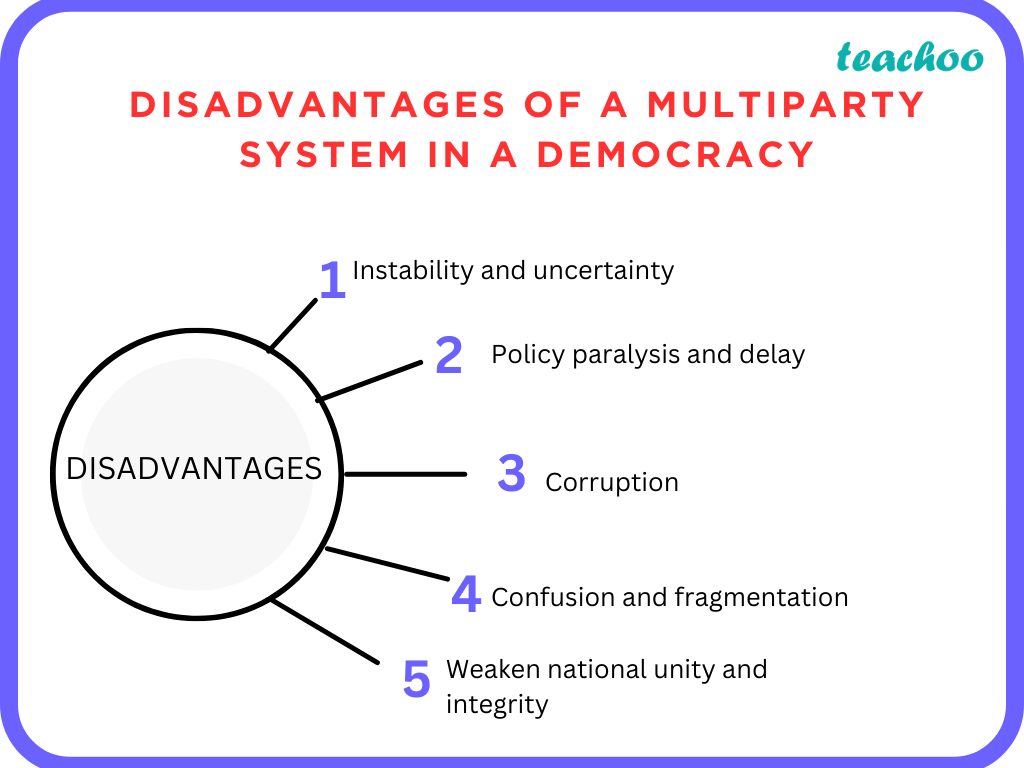
- The disadvantages of a multi-party system in a democracy are:
-
-
It may lead to
instability and uncertainty
, as the ruling party or coalition may not have a stable majority in the parliament or assembly, and may face frequent defections or splits. This may result in frequent changes of government, or even a hung parliament or assembly, where no party or coalition can form the government.
-
It may cause
policy paralysis and delay
, as the ruling party or coalition may have to deal with conflicting demands or interests of its allies or partners, and may not be able to implement its policies effectively. This may result in slow decision-making, policy inconsistency, or policy reversal.
-
It may increase
corruption
, as the ruling party or coalition may have to appease or accommodate its allies or partners by offering them ministerial posts or other benefits. This may result in patronage politics, where public offices are distributed based on loyalty or favoritism, rather than merit or performance.
-
It may create
confusion and fragmentation
, as the voters may not be able to identify clearly with any party or candidate, and may not have a clear sense of direction or vision for the country. This may result in low voter turnout, low political awareness, or low political participation.
- It may weaken national unity and integrity , as different parties may pursue their narrow or sectarian interests at the cost of national interest or common good. This may result in regionalism, communalism, separatism, or extremism, where different groups may demand more autonomy, rights, or resources from the central government, or even secede from the country.
-
It may lead to
instability and uncertainty
, as the ruling party or coalition may not have a stable majority in the parliament or assembly, and may face frequent defections or splits. This may result in frequent changes of government, or even a hung parliament or assembly, where no party or coalition can form the government.
-endlock-