
 You are here
pages 111 to 115
Think about it
The king sat at the top. But the real work happened in the province, the district and, above all, the village.
Why did large empires need several administrative levels, and how were these levels organised?
- Large kingdoms were divided into progressively smaller territorial units for administrative convenience , while supreme authority remained with the king.
How was the empire divided, largest to smallest?
KINGDOM / RAJYA
divided into
PROVINCES
subdivided into
DIVISIONS
subdivided into
DISTRICTS
below these were
GROUPS OF VILLAGES
made up of
VILLAGES
the lowest administrative units
Who administered these levels?
| Level / unit | Who the section identifies |
|---|---|
| Kingdom | King — supreme authority |
| Province | Provincial governors / officers |
| Division | No separate named officer is given in this passage. |
| District | Pradeshika / district officers — judicial and administrative functions |
| Group of villages | No separate named officer is given in this passage. |
| Village | The exact arrangement varied; in the Satavahana example, the village headman was the gramika . Later sections also describe village assemblies. |
| City (a parallel urban unit) | City governor — revenue collection and maintenance of law and order |
What were these levels called in the north and the south?
| Level | North | South |
|---|---|---|
| Province | bhukti | mandala / mandalam |
| Division | vishaya / bhoga | kottam / valanadu |
| District | adhishthana / pattana | nadu |
| Group of villages (compared in the text with a modern tahsil) | vithi | pattala / kurram |
| Lowest unit | Village | Village |
The names differed across regions and periods, but the broad idea was the same: a large territory was broken into smaller units so it could be administered.
THINK ABOUT IT
How would dividing a kingdom into provinces, districts, and villages have helped rulers manage their empires? What similarities can you identify between these administrative divisions and the system of governance in India today?
Show Answer
Suggested answer / comparison:
the historical hierarchy comes from the chapter; the modern comparison is an application.
- Smaller units made it possible for officers closer to each area to handle local administration instead of sending every matter to the king.
- A broad similarity with present-day administration is the use of multiple territorial levels , from larger regions down to local units. The names, powers and institutions, however, are different today.
How did the Satavahanas administer their empire?
How did the Satavahanas administer their empire?
SATAVAHANA KING
supreme authority
empire comprised
AHARAS
administrative divisions
each had
AMATYAS
ministers / officials associated with the ahara
below the aharas were
VILLAGES
each led by a
gramika
, the village headman
Do not mix up the terms:
ahara
is an
area
;
amatya
is an
official
;
gramika
is the
village headman
.
What does the paragraph say about administration more generally?
- General administration was carried out by officers at provincial and local levels .
- Pradeshikas , or district governors, handled judicial and administrative functions.
- District officers often consulted important residents such as bankers, caravan leaders, artisans and scribes .
- City governors were responsible for revenue collection and maintenance of law and order.
What changed in administration between about 300 CE and 800 CE?
- Between about 300 CE and 800 CE , administration became increasingly decentralised : large kingdoms were divided into provinces and progressively smaller local units for administrative convenience.
- The king remained the supreme authority, but provincial, district and village-level administration became increasingly important.
- The names of administrative units differed between northern and southern records, as shown in the previous block.
How did Gupta administration combine continuity with new offices, and what does the Damodarpur record reveal?
What did the Guptas keep, and what did they add?
Continued
Mantri; commander-in-chief; general; chief of palace guards.
New / broadened
Sāndhivigrahika (peace and war); kumārāmātyas at local or provincial level.
What they kept from before
- The Guptas retained much of the earlier form of administration .
- As before, the mantri remained the head of civil administration .
- Below him, three officers continued from the older system: the commander-in-chief , the general , and the chief of the palace guards .
What was new under the Guptas
- A new post, the sandhivigrahika , or "minister of peace and war," was created.
- The old category of amatyas also broadened, to include kumaramatyas , officers working specifically at the local or provincial level .
The district level: the Damodarpur copper plates
Damodarpur copper plate - who sat in the district office?
District office under Kumaragupta I
Head district officer
Administration
Chief banker
Banking
Chief caravan trader
Trade
Chief artisan
Craft production
Chief of revenue collection
Revenue
Inference:
district administration involved important economic interests as well as administrative officers.
- These plates, from the reign of Kumaragupta I , give a direct record of one district office.
- The listed members cover district administration, banking, caravan trade, craft production and revenue collection . This is evidence that the district office included economic interests as well as administrative and revenue functions.
- This fits the chapter's earlier observation that district-level decision-making could involve important local residents such as bankers, caravan leaders and artisans .
How did the Pallavas and Chalukyas combine monarchy with decentralised local government?
![How Were Empires Administered? - State and Society up t - [Teachoo] - Concepts](https://cdn.teachoo.com/15ab538c-dafd-4a58-b0fa-30ddfb8f7856/kingdoms-between-the-3rd-and-10th-centuries-ce.jpg)
How did Pallava and Chalukya administration compare?
Pallavas
Centralised monarchy + decentralised local governance; Brahmadeya villages; village variyams.
Chalukyas
Similar broad administrative pattern; agrahārams; Aihole and Badami became centres of learning.
- The Pallavas ruled the south from about 275 to 897 CE .
- The king was the supreme head of state , the centralised part of the system.
- The kingdom itself was divided into provinces, districts, taluks and villages , the decentralised part.
Their most striking feature: land grants
- One of the most striking features of Pallava administration was tax-free land grants to villages , called Brahmadeya villages.
How villages ran themselves
- Village assemblies functioned relatively independently of the royal administration .
- Small committees, the variyams , managed specific tasks such as irrigation, gardens and temple management .
How was Chalukya administration similar to Pallava administration?
- Like the Pallavas, the Chalukyas of Badami followed a monarchical system combined with decentralised administration .
- The king's duties, the administrative divisions, and the autonomous village assemblies all followed largely the same pattern.
- A difference highlighted in the chapter is the terminology of land grants: instead of the Pallava Brahmadeya villages, the Chalukyas gave land grants to Brahmin settlements known as agraharams .
- Some agraharams, such as those at Aihole and Badami , gradually developed into prominent centres of learning .
Kingdoms between the 3rd and 10th centuries CE
What was the Tripartite Struggle, and what was common in the administration of its three powers?
Who competed in the Tripartite Struggle for Kannauj?
KANNAUJ
Gurjara-Pratihāras
Pālas
Rāṣhṭrakūṭas
All three used a broad mix of monarchy and decentralised provincial, district and village administration.
- Kannauj , the main capital of the Gurjara-Pratiharas, became a coveted site for several kingdoms of the period.
- Three major powers fought to control it: the Gurjara-Pratiharas , the Palas and the Rashtrakutas .
What was common in how all three governed
- Despite fighting each other over Kannauj, all three kingdoms used the same administrative pattern : monarchy at the centre, decentralised provinces, districts and villages below it.
How did the imperial Cholas organise their empire and empower village assemblies?
How was the Chola Empire administered?
MAṆḌALAM
Province
subdivided into
VALANĀḌU
District
subdivided into
NĀḌU
Group of villages
contained
UR
Individual village
Why are Chola village assemblies called self-reliant?
Managed local functions
Revenue, land, irrigation, roads, records and disputes.
Not dependent on royal patronage
Local institutions handled much of their own administration.
Together → independent and self-reliant village institutions
- The imperial Cholas discussed here belong to the 9th–11th centuries CE and were noted for their efficient administrative and revenue systems . They should not be confused with the much earlier Cholas described in Sangam-period material.
How the Chola Empire was divided
- As usual, the village ( ur ) remained the smallest unit within a district.
What functions did Chola village assemblies perform, and why are they called independent?
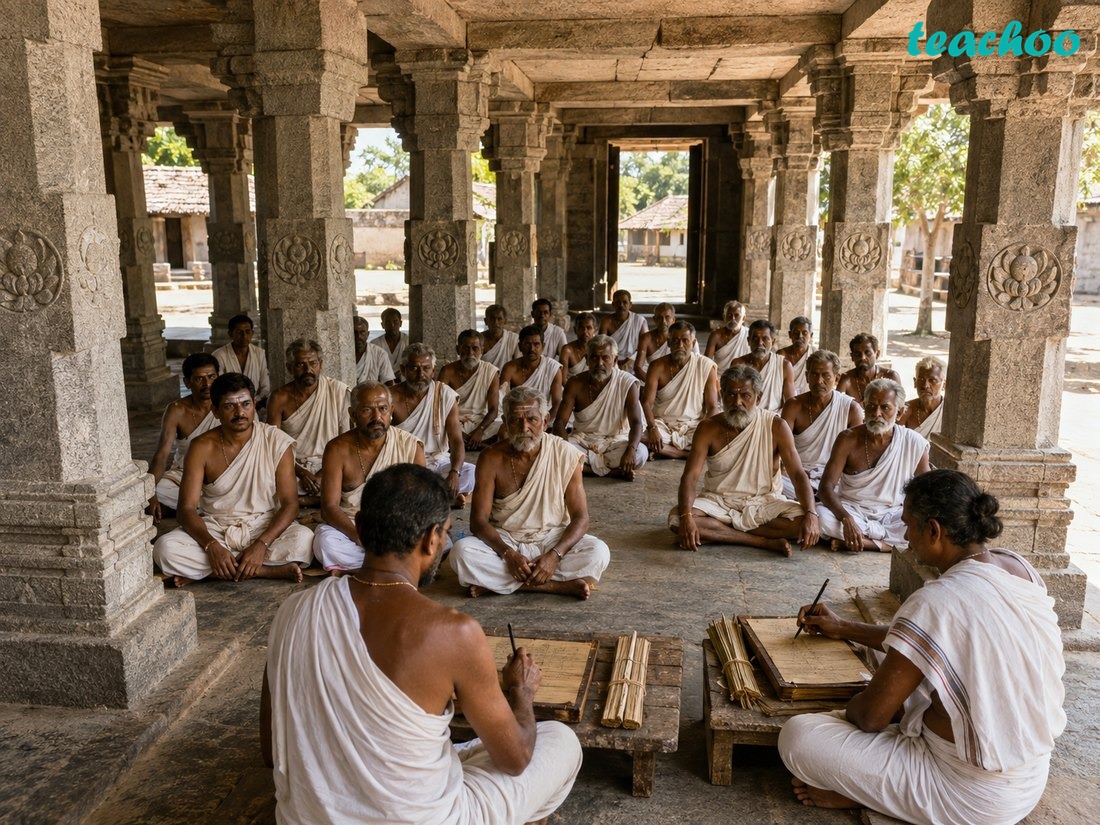
A Chola village assembly
- Chola village assemblies handled revenue collection, land management, irrigation, road construction, record maintenance, and settling disputes and general local affairs.
- They handled this entire range of functions themselves, and were not dependent on the government for patronage , that is, for money or support from above. That is what makes them "independent and self-reliant."
What does the Uttaramerur inscription reveal about village elections and committees?
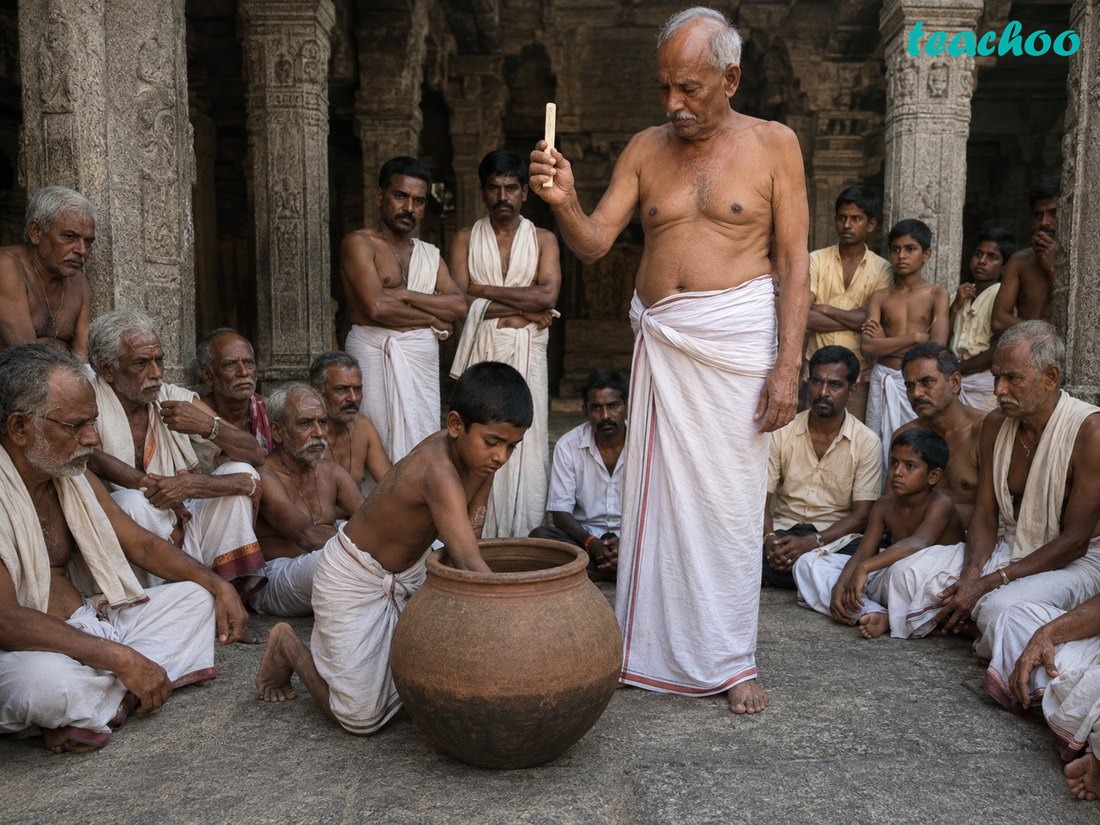
The Kudavolai ballot pot
How did the Kudavolai selection process work?
Eligible candidates
names written on palm leaves
↓
Palm leaves placed in a large pot
↓
Public gathering
the draw took place in full view of the community, often at a temple
↓
A young child drew the leaves
↓
Representatives were selected
↓
Selected members were assigned to specialised committees (variyams)
Don't Miss Out — Uttaramerur inscription
- It belongs to the reign of Parantaka I in the 10th century CE .
- It is located in the Vaikuntha Perumal Temple in Kanchipuram district, Tamil Nadu.
- The Tamil inscriptions provide details about the functioning of village assemblies and the Kudavolai (“ballot pot”) system used in village elections.
- To ensure fairness, the draw took place in full view of the community , often at a temple.
What happened after representatives were selected?
- Elected members were divided into specialised committees called variyams .
- The chapter gives examples connected with irrigation (the tank committee) , justice , and tax collection .
- This inscription is direct evidence of the organised functioning of village assemblies under the Cholas.
What Have We Learned
- Large kingdoms were administered through progressively smaller territorial units, with the king remaining the supreme authority.
- Satavahana records name āhāras , amātyas and village headmen called grāmikas .
- From about 300 CE to 800 CE , decentralised provincial, district and village-level administration became increasingly important.
- The Damodarpur plates show a Gupta district office including administrative, banking, trade, craft and revenue interests.
- Pallava, Chalukya and Chola examples show the importance of village assemblies; the Uttaramerur inscription records the Kudavolai method and specialised variyams .
Section Summary - How Were Empires Administered?
Top
Kingdom under the king's supreme authority
Middle
Provinces, divisions and districts under officers
Base
Groups of villages, and the village itself
↓
Authority ran from the king down to the village, the smallest administrative unit
