
 You are here
pages 108 to 111
Think about it
"One wheel does not move the carriage." The king was one wheel. He needed the others.
Did the king rule alone, and who generally formed the mantri-parishad?
No, he had a council of ministers called the mantri-parishad.
What was the council of ministers?
- The mantri-parishad was a small body of elder statesmen whose primary role was to advise and support the king .
Who generally sat in the council of ministers?
Mantri-parishad - advised and supported the king
Treasurer
Treasury / money
Chief tax collector
Revenue
Chief legal advisor
Law
Commander-in-chief
Defence
- Its primary role was to advise and support the king .
- The king governed through a multi-layered administrative system , and this council was central to it.
Who was generally in it
Money, revenue, law, defence.
What is Kautilya’s Saptanga theory of the state?
![Council of Ministers - State and Society up to 1000 CE - [Teachoo] - Concepts](https://cdn.teachoo.com/dd5bba30-06b8-42a8-ae43-e50cd3f97aaa/a-fortified-town.jpg)
A fortified town
- Saptanga means the state was understood as an organic whole made up of seven constituents . The chapter says the state functions effectively when these remain properly integrated.
| Constituent | Meaning given in the chapter |
|---|---|
| Swami | The king |
| Amatya | Councillors, ministers and other high officials |
| Janapada | The territory of the state together with its population |
| Durga | Fortified towns and cities |
| Kosha | The treasury or wealth of the kingdom |
| Danda | The forces of defence and law and order |
| Mitra | The allies |
Why does the Arthashastra stress both training and cooperation in governance?
- The Arthashastra is described in the chapter as one of the earliest and most systematic treatises on statecraft .
- It emphasises training the king in the art of governance and public administration .
- Its statement, “one wheel does not move the carriage” , expresses the idea that effective governance requires cooperation and a well-organised administrative machinery .
Why couldn't the king govern alone?
Cooperation among king, ministers and officers
A multi-layered administrative machinery
↓
Effective governance
Could the council take decisions when the emperor was absent, and what evidence do inscriptions provide?
- An Ashokan inscription refers to decisions taken by the council of ministers during the emperor’s absence.
- The chapter uses this to show that, in exceptional circumstances , the council could take decisions independently in the public interest .
Why is the Junagadh Rock Inscription such valuable evidence for administration across different periods?
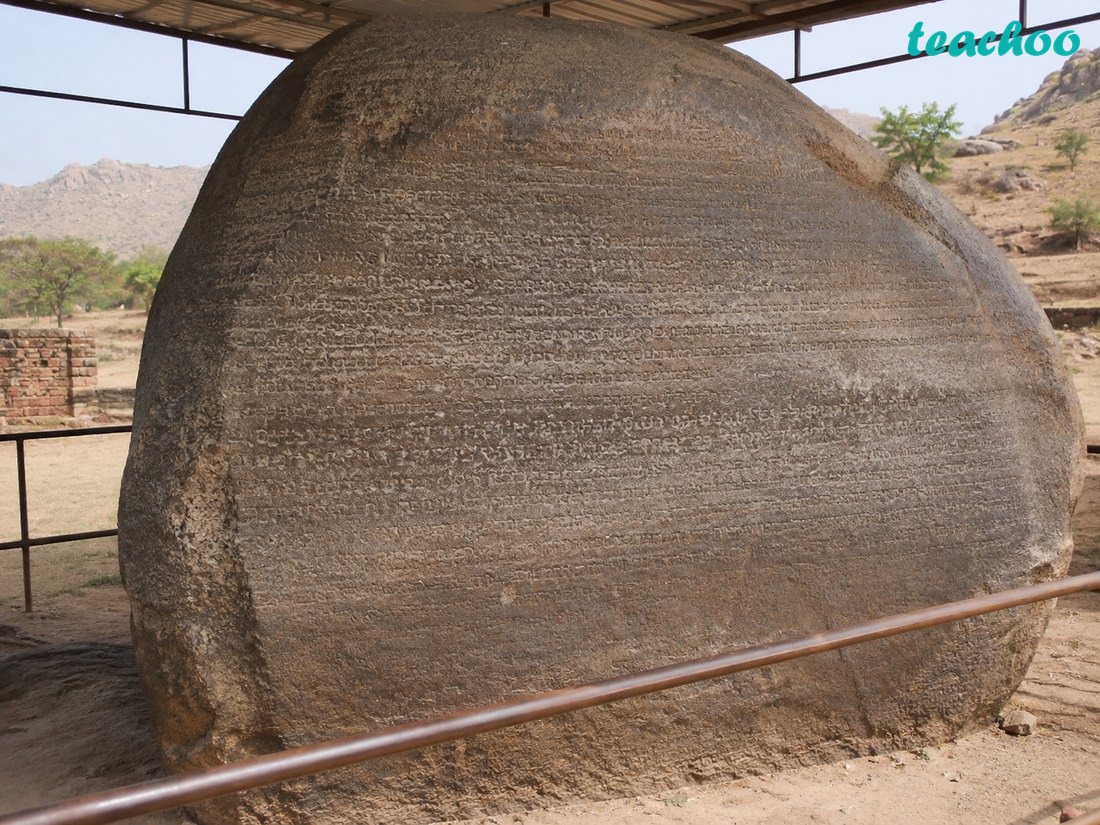
Don't Miss Out — The Junagadh Rock Inscription
- It is near Girnar in Gujarat .
- It preserves inscriptions of three rulers from different periods on the same rock.
| Ruler | Period | What the inscription records |
|---|---|---|
| Ashoka | 3rd century BCE | Major Rock Edicts in Prakrit spreading the message of Dhamma and moral governance. |
| Rudradaman I | c. 150 CE | A long Sanskrit inscription describing military achievements and repair of the Sudarshana Lake. |
| Skandagupta | 5th century CE | Records restoration of the lake after severe damage. |
This one site therefore preserves evidence spanning roughly 700 years and gives information about administration, public works and political history.
The Junagadh Rock Inscription
THINK ABOUT IT — page 111
Why do you think different rulers chose to record their inscriptions on the same stone instead of a new one? Discuss your answers with your classmates.
Show Answer
Suggested answer / inference:
the textbook does not state the reason.
- The rock was already an established inscription site, so later rulers may have deliberately added their records to a place already associated with public authority.
- Because the records also concern the Sudarshana Lake and its repairs, using the same site may have connected later public works with earlier ones.
Section Summary - Council of Ministers
Who
Mantri-parishad, a small body of elder statesmen
Members
Treasurer, chief tax collector, legal advisor, commander
Role
Advise and support the king
↓
One wheel does not move the carriage - the king governed through a council
