Plane

 You are here
Last updated at August 14, 2026 by Teachoo
Transcript
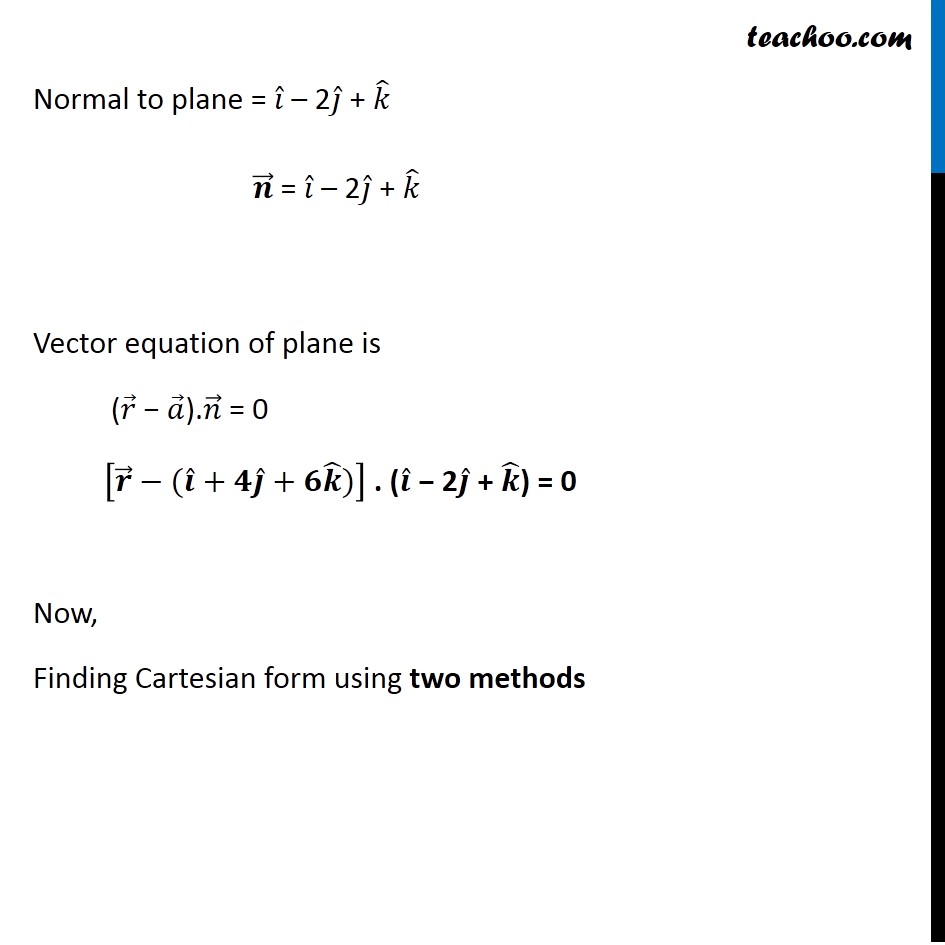
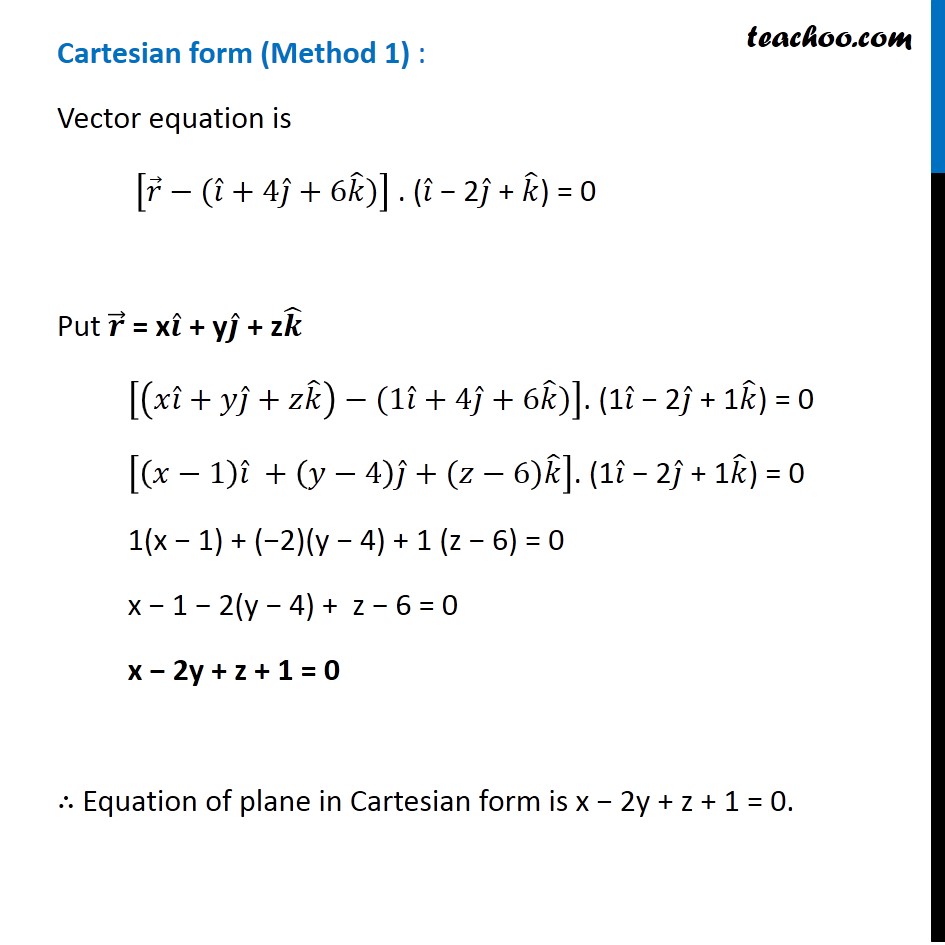
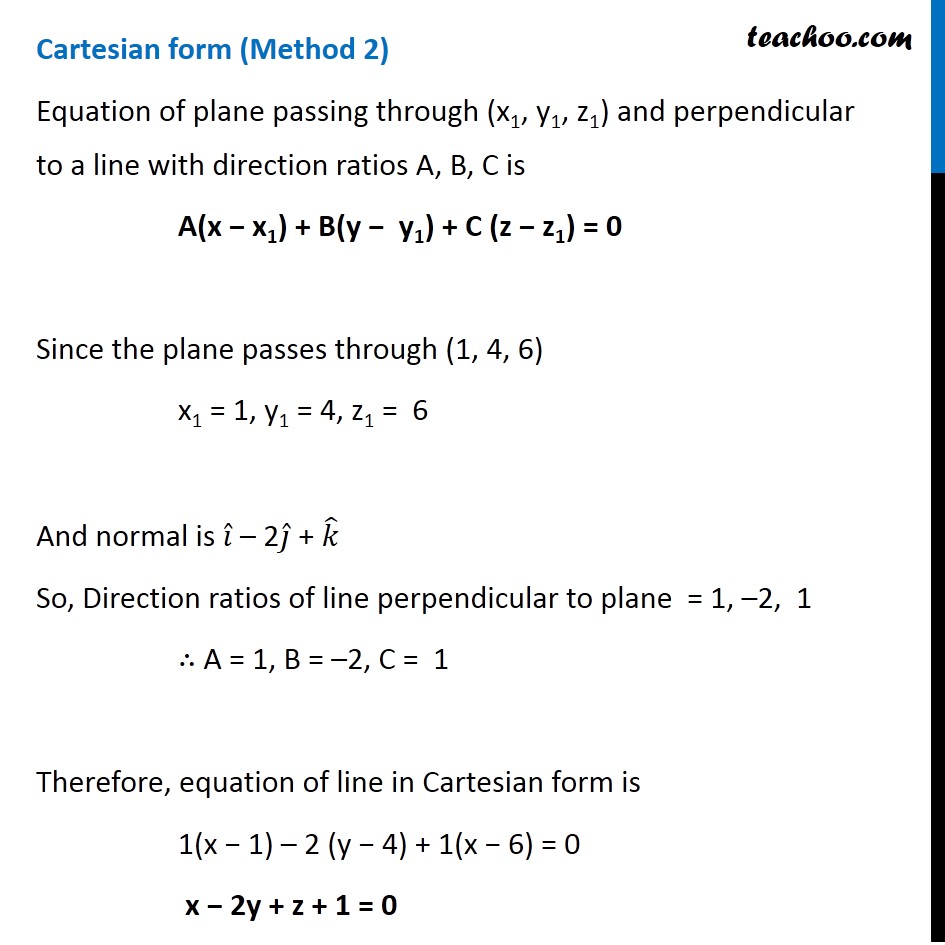
Question 5 Find the vector and cartesian equations of the planes (b) That passes through the point (1, 4, 6) and the normal vector to the plane is 𝑖 ̂ – 2𝑗 ̂ + 𝑘 ̂ Vector equation Equation of plane passing through point A whose position vector is 𝒂 ⃗ & perpendicular to 𝒏 ⃗ is (𝒓 ⃗ − 𝒂 ⃗) . 𝒏 ⃗ = 0 Given, Plane passes through (1, 4, 6) So, 𝒂 ⃗ = 1𝑖 ̂ + 4𝑗 ̂ + 6𝑘 ̂ Normal to plane = 𝑖 ̂ – 2𝑗 ̂ + 𝑘 ̂ 𝒏 ⃗ = 𝑖 ̂ – 2𝑗 ̂ + 𝑘 ̂ Vector equation of plane is (𝑟 ⃗ − 𝑎 ⃗).𝑛 ⃗ = 0 [𝒓 ⃗−(𝒊 ̂+𝟒𝒋 ̂+𝟔𝒌 ̂)] . (𝒊 ̂ − 2𝒋 ̂ + 𝒌 ̂) = 0 Now, Finding Cartesian form using two methods Cartesian form (Method 1) : Vector equation is [𝑟 ⃗−(𝑖 ̂+4𝑗 ̂+6𝑘 ̂)] . (𝑖 ̂ − 2𝑗 ̂ + 𝑘 ̂) = 0 Put 𝒓 ⃗ = x𝒊 ̂ + y𝒋 ̂ + z𝒌 ̂ [(𝑥𝑖 ̂+𝑦𝑗 ̂+𝑧𝑘 ̂ )−(1𝑖 ̂+4𝑗 ̂+6𝑘 ̂)]. (1𝑖 ̂ − 2𝑗 ̂ + 1𝑘 ̂) = 0 [(𝑥−1) 𝑖 ̂ +(𝑦−4) 𝑗 ̂+(𝑧−6)𝑘 ̂ ]. (1𝑖 ̂ − 2𝑗 ̂ + 1𝑘 ̂) = 0 1(x − 1) + (−2)(y − 4) + 1 (z − 6) = 0 x − 1 − 2(y − 4) + z − 6 = 0 x − 2y + z + 1 = 0 ∴ Equation of plane in Cartesian form is x − 2y + z + 1 = 0. Cartesian form (Method 2) Equation of plane passing through (x1, y1, z1) and perpendicular to a line with direction ratios A, B, C is A(x − x1) + B(y − y1) + C (z − z1) = 0 Since the plane passes through (1, 4, 6) x1 = 1, y1 = 4, z1 = 6 And normal is 𝑖 ̂ – 2𝑗 ̂ + 𝑘 ̂ So, Direction ratios of line perpendicular to plane = 1, –2, 1 ∴ A = 1, B = –2, C = 1 Therefore, equation of line in Cartesian form is 1(x − 1) – 2 (y − 4) + 1(x − 6) = 0 x − 2y + z + 1 = 0