
 You are here
- We have studied menstruation in Class 7 . Now we will connect it to ovulation and fertilisation .
Sperm
(testes)
Egg
(ovary)
Ovulation
Release of a mature egg from the ovary
Fertilisation
Cell division
Implantation
Pregnancy
No fertilisation
No sperm fuses with the egg
Egg degenerates
The egg breaks down in about a day
Thick lining not needed
The thick lining of the uterus is not needed as there is no zygote
Lining sheds
The lining breaks off and leaves the body with some blood through the vagina
Menstruation (period)
Usually lasts 3 to 7 days
Let's study the "No fertilisation" side in detail.
What happens to the egg if it is not fertilised?
- After ovulation, the egg stays viable (alive and able to be fertilised) for about a day .
- If no sperm fuses with it in this time, the egg degenerates (breaks down).
What happens to the thick lining of the uterus?
- The inner lining of the uterus became thick and rich in blood vessels to receive and nourish the zygote.
- When there is no zygote , this lining is no longer needed .
- So, the lining sheds (breaks off). It leaves the body through the vagina , along with some blood .
What is menstruation?
The shedding of the inner lining of the uterus, along with some blood, through the vagina is called menstruation or a period.
Example:
If Rina's egg is not fertilised in a month, her uterus lining sheds and she gets her
period
.
- Menstruation usually lasts 3 to 7 days .
What is the menstrual cycle?
The cycle of ovulation, preparation of the uterus and menstruation, which repeats regularly, is called the menstrual cycle.
Example:
In a
28 day
cycle, a girl gets her period, the lining rebuilds, ovulation happens and the lining thickens again. Then the cycle
starts over
.
- The cycle repeats every 21 to 35 days . It is often around 28 days .
- It usually begins at puberty , between the ages of 10 to 14 in girls.
- It continues till menopause (the time when the menstrual cycle stops for good), at around age 50 .
What happens on each day of a 28 day menstrual cycle?
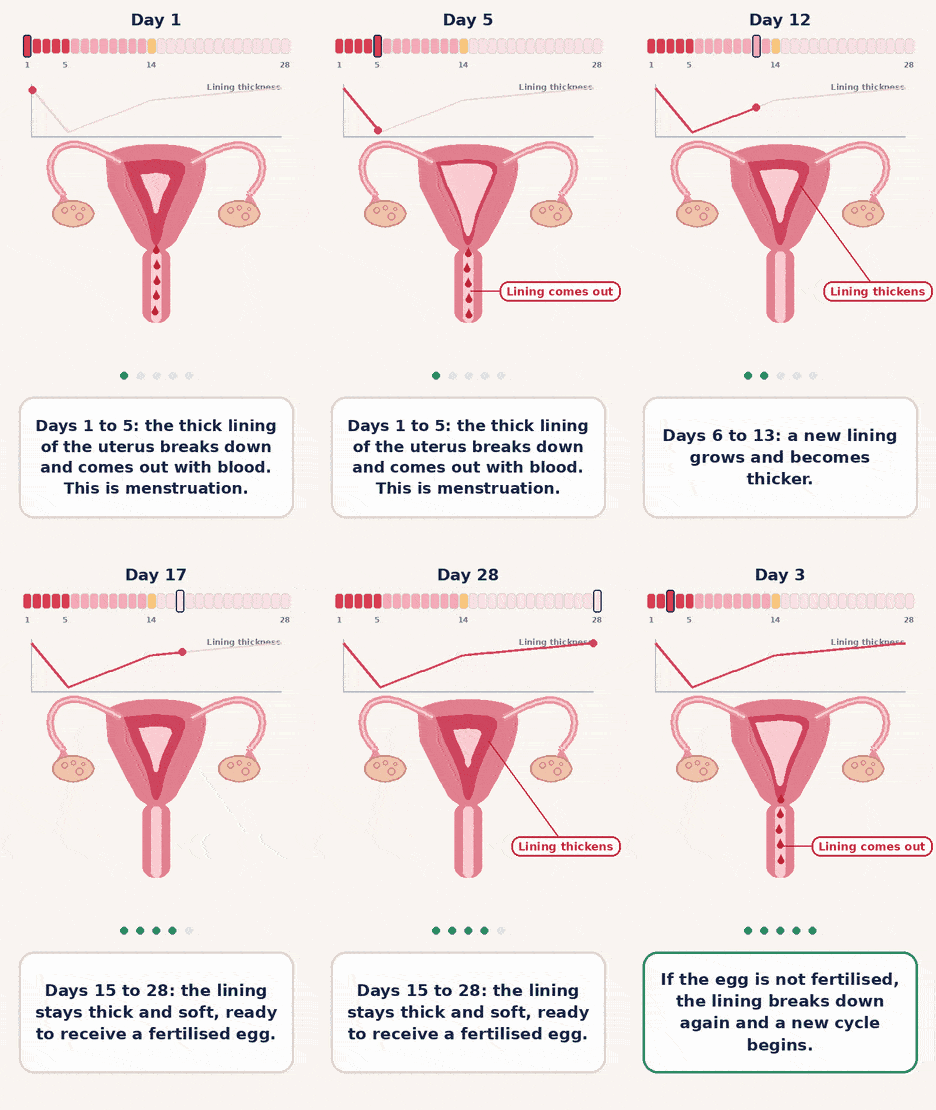
| Days | Stage | What happens |
|---|---|---|
| Day 1 to 5 | Menstruation | The uterine lining sheds |
| Day 6 to 14 | Lining rebuilds | The lining slowly rebuilds . An egg starts maturing in the ovary |
| Around Day 14 | Ovulation | The ovary releases a mature egg |
| Day 15 to 28 | Lining thickens | The lining becomes thick and rich in blood vessels . If no fertilisation happens, it starts breaking down around Day 28 and the cycle repeats |
- These days are for a typical 28 day cycle . The cycle can be shorter or longer in different girls, so these days can change .
Questions from the book for this section
-
🤔 Pause and Ponder 7
Rina's period occurs every 28 days. Her last period was on the 5th of March. On which day is she most likely to get her next period?View answer
Answer- Her next period comes 28 days after 5th March .
- March has 31 days . So, 5th March + 28 days = 33rd March = 2nd April .
5 March + 28 days = 2 April- So, she is most likely to get her next period on 2nd April .
-
📝 Revise, Reflect, Refine Q5
Explain why the menstrual cycle stops during pregnancy.View answer
Answer- Menstruation happens when the egg is not fertilised and the thick lining of the uterus is not needed .
- During pregnancy, the zygote has implanted in this thick lining .
- The lining now protects and nourishes the growing baby. So, it must not shed .
- Since the lining does not shed , there is no menstruation . So, the menstrual cycle stops during pregnancy.
-
📝 Revise, Reflect, Refine Q13
A student claims, "In humans, ovulation always happens on day 14 of the menstrual cycle". Critically examine this claim and state whether the claim is correct or not. Give at least two reasons for your answer.View answer
AnswerAnswer: The claim is not correct.- Reason 1: The menstrual cycle is not the same length for everyone. It can be anywhere from 21 to 35 days . Day 14 fits only a typical 28 day cycle.
- Reason 2: In a shorter cycle, ovulation happens earlier than Day 14. In a longer cycle, it happens later .
- So, ovulation happens around Day 14 in a 28 day cycle, but not always on Day 14.
Threads of Curiosity: What determines a baby's biological sex?
- Every person has two sex chromosomes .
- Females have XX and males have XY .
- The mother always gives an X chromosome.
- The father gives either an X or a Y chromosome.
Mother (XX)
Egg:
X
Father (XY)
Sperm:
X
or Sperm:
Y
Egg X + Sperm X
XX (Girl)
Egg X + Sperm Y
XY (Boy)
Can you predict who determines the sex of a baby?
- The father does, because only the father's sperm can carry a Y chromosome.
- If the sperm carries X , the baby is a girl (XX) . If it carries Y , the baby is a boy (XY) .
Bridging Science and Society
Which hygiene practices should we follow during menstruation (period)?
| Practice | What to do |
|---|---|
| Use menstrual products | Use sanitary pads (preferably biodegradable ones, which break down naturally), tampons or menstrual cups |
| Wash regularly | Clean the genital area with water . Avoid soap , because it can disturb the natural bacterial balance |
| Wash hands | Wash hands with soap and water before and after changing a sanitary pad |
| Dispose of used products properly | Wrap used pads in newspaper or their wrapper before putting them in a bin . Do not flush them down the toilet |
| Care for reusable products | Clean reusable pads as the maker's instructions say. Make sure they are completely dry before the next use |
| Change products regularly | Change pads every 4 to 6 hours , or more often if the flow is heavy |
Period is your pride
- Menstruation is a sign of a healthy reproductive system . It is not something to be ashamed of .
- Using clean products , changing them as often as needed and disposing of them responsibly keeps us healthy and our surroundings clean .
