
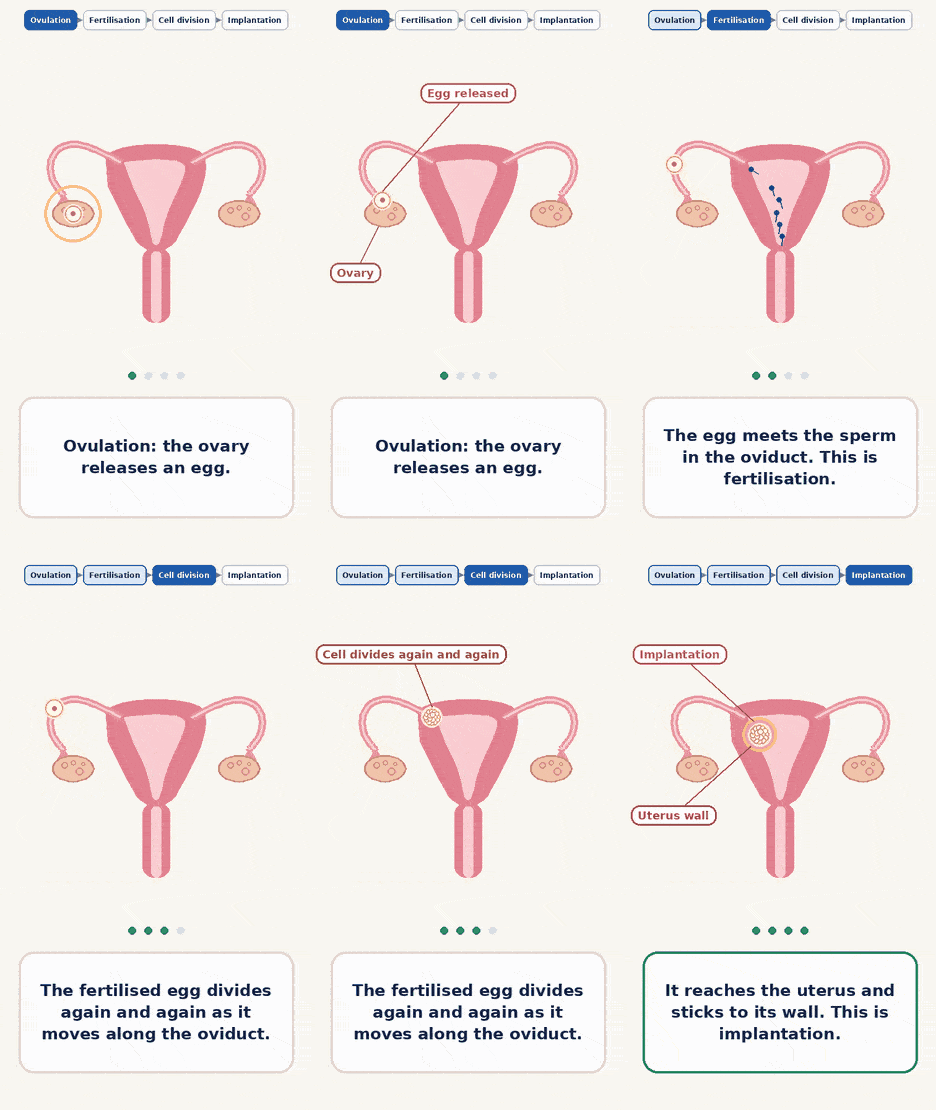
 You are here
- When a sperm meets the egg and fuses (joins) with it, a zygote is formed.
Sperm
(testes)
Egg
(ovary)
Ovulation
Release of a mature egg from the ovary
Happens in: Ovary
Fertilisation
Fusion of the sperm and the egg to form a zygote
Happens in: Oviduct
Cell division
The zygote divides again and again by mitosis while moving to the uterus
Happens in: Oviduct (on the way to the uterus)
Implantation
The zygote fixes itself into the inner lining of the uterus
Happens in: Uterus
Pregnancy
The baby grows and develops inside the uterus
Happens in: Uterus
Let's study this in detail.
How many eggs does a girl have?
- At birth , a girl's ovaries already have millions of immature eggs (eggs that are not yet ready).
- From puberty onwards, usually one mature egg (an egg that is ready) is released every month from one of the ovaries .
What is ovulation?
The release of a mature egg from the ovary every month is called ovulation.
Example:
Every month,
one ovary
releases
one mature egg
.
- Before ovulation , the uterus starts to prepare itself . Its inner lining becomes thick .
- After ovulation, the egg travels from the ovary to the oviduct .
Ovary releases one mature egg (ovulation)
→
Egg travels into the oviduct
How does a sperm reach the egg?
- During sexual intercourse , millions of sperm enter the female body through the vagina .
- They swim through the reproductive tract (the passage through the cervix and uterus).
- Some of them may reach the egg in the oviduct .
Vagina
→
Cervix
→
Uterus
→
Oviduct (sperm may meet the egg here)
What happens when a sperm fuses with the egg?
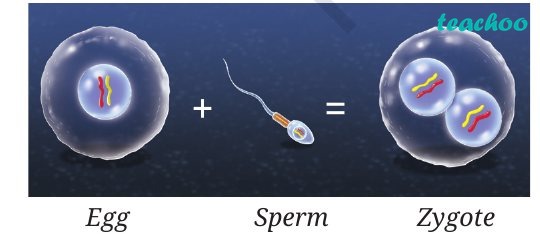
- If a sperm meets the egg and fuses (joins) with it, a zygote is formed. This is fertilisation .
- Fertilisation takes place in the oviduct .
Egg
+
Sperm
=
Zygote
What happens after the zygote is formed?
- The inner lining of the uterus becomes thicker and richer in blood vessels .
- The zygote undergoes a series of mitotic divisions (it divides again and again by mitosis ) while travelling to the uterus .
- It then implants (fixes itself) into the inner lining of the uterus.
- There, it receives nourishment (food) for development .
What is implantation?
The fixing of the zygote into the inner lining of the uterus is called implantation. Implantation marks the beginning of pregnancy.
Example:
After travelling down the oviduct, the dividing zygote
attaches to the thick lining
of the uterus, and
pregnancy begins
.
Summary
| Step | What happens | Happens in |
|---|---|---|
| 1. Ovulation | One mature egg is released | Ovary |
| 2. Fertilisation | A sperm fuses with the egg to form a zygote | Oviduct |
| 3. Cell division | The zygote divides by mitosis | Oviduct (on the way to the uterus ) |
| 4. Implantation | The zygote fixes itself in the thick lining | Uterus |
| 5. Pregnancy | The zygote receives nourishment and develops | Uterus |
Questions from the book for this section
-
📝 Revise, Reflect, Refine Q3
Assertion (A): The zygote formed after fertilisation immediately attaches to the uterus wall.Reason (R): The uterus wall is always prepared to receive the zygote.(i) Both A and R are true, and R is the correct explanation of A.(ii) Both A and R are true, but R is not the correct explanation of A.(iii) A is true, but R is false.(iv) A is false, but R is true.View answer
AnswerAnswer: Both A and R are false.- A is false: The zygote is formed in the oviduct , not in the uterus. It first divides by mitosis while travelling to the uterus. Only then does it implant in the uterus wall. So, it does not attach immediately .
- R is false: The uterus wall is not always prepared. Its inner lining becomes thick only before ovulation each month. If no fertilisation happens, the lining breaks down and is shed in menstruation .
Why none of the options fit:- (i), (ii) and (iii) are wrong because they say A is true .
- (iv) is wrong because it says R is true .
- The correct answer, "Both A and R are false", is not one of the options given in the book.
