
 You are here
- We have already studied pollination .
- Pollination is done with the help of pollinators .
What are pollinators?
A pollinator is an external agent that moves pollen from the male part of a flower (the anther) to the female part of a flower (the stigma).
- Plants cannot move , so they need pollinators to carry their pollen.
Example:
Bees
and
butterflies
carry pollen from one
sunflower
to another.
What are the different types of pollinators?
| Pollinator | Examples of plants |
|---|---|
| Wind | Wheat , maize , rice |
| Water | Vallisneria , Hydrilla |
| Insects | Sunflower , hibiscus , marigold |
| Birds | Coral tree , hibiscus |
Let's study each one by one.
How does wind help in pollination?
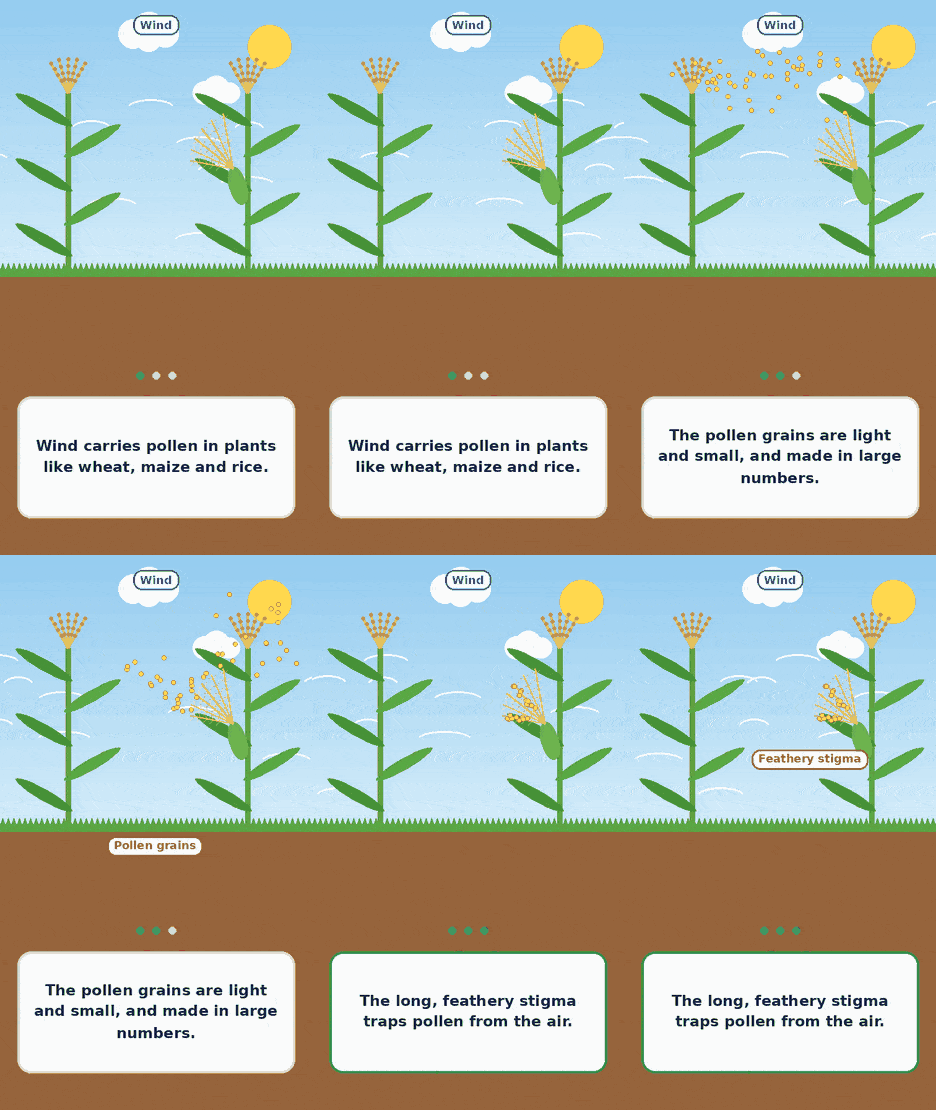
- Pollination by wind is seen in plants like wheat , maize and rice .
- The pollen grains are light and small , so the wind can carry them easily.
- They are produced in large numbers .
- The stigma is long and feathery (with fine branches, like a feather), so it can trap pollen from the air.
-
How does water help in pollination?
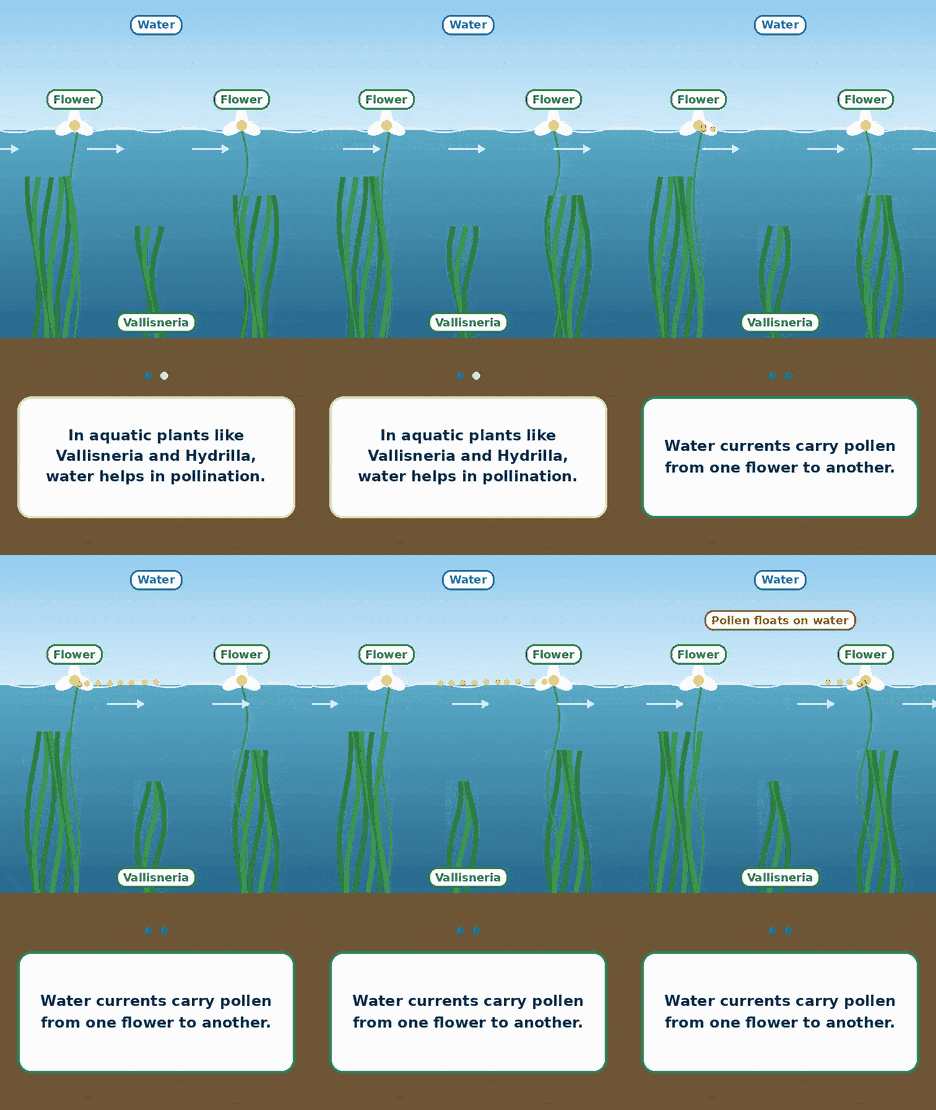
- Pollination by water happens in aquatic plants (plants that live in water) like Vallisneria and Hydrilla .
- The pollen grains are carried by water currents (moving water) from one flower to another.
-
How do insects help in pollination?
- Pollination by insects happens in sunflower , hibiscus and marigold .
- The pollen grains are carried by insects like bees and butterflies from one flower to another.
- The flowers are brightly coloured , which attracts insects.
- They produce nectar (a sweet liquid), which insects come to drink .
- They give off fragrance (sweet smell), which attracts insects from far .
- The pollen grains are large , sticky or spiny (with tiny spikes), so they stick to the insect's body.
- The stigma is sticky , so it can hold the pollen brought by the insect.
-
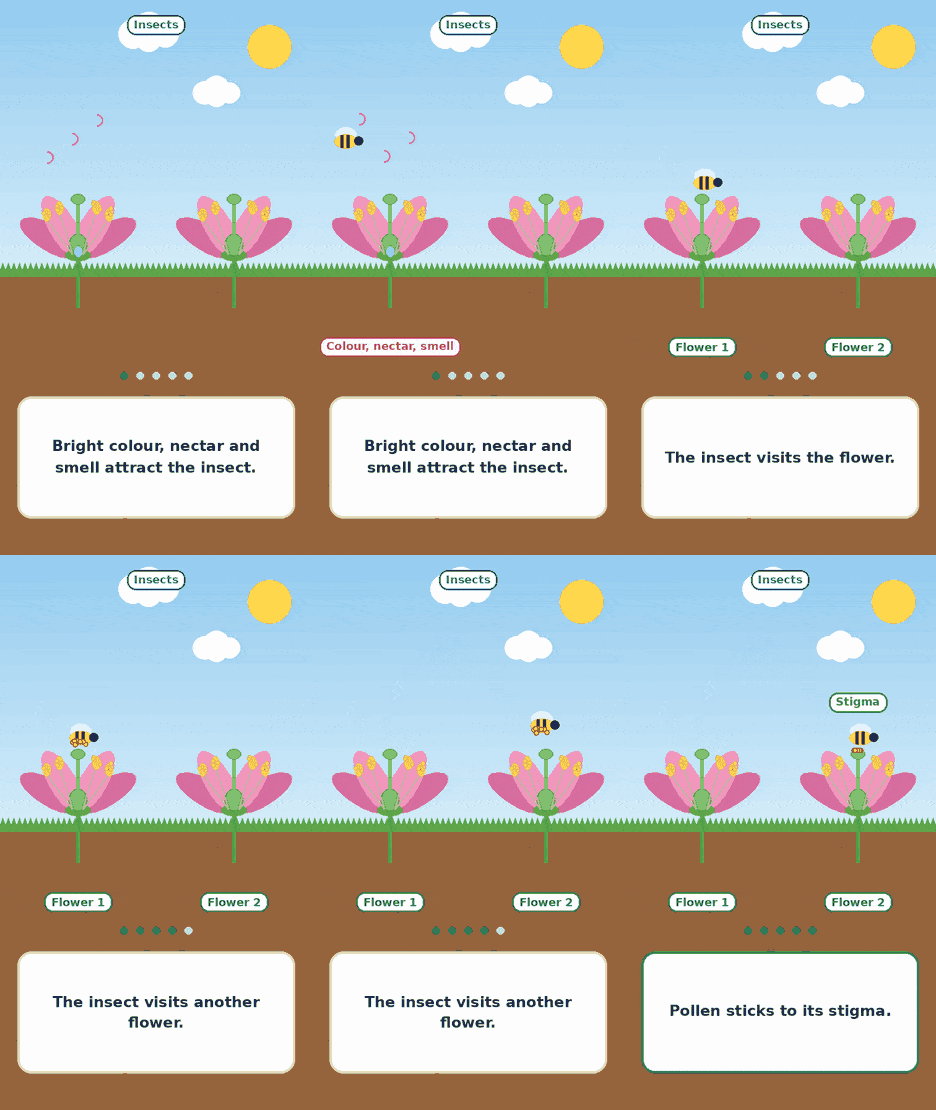
Bright colour, nectar, smell
→
Insect visits flower
→
Pollen sticks to insect
→
Insect visits another flower
→
Pollen sticks to its stigma
How do birds help in pollination?
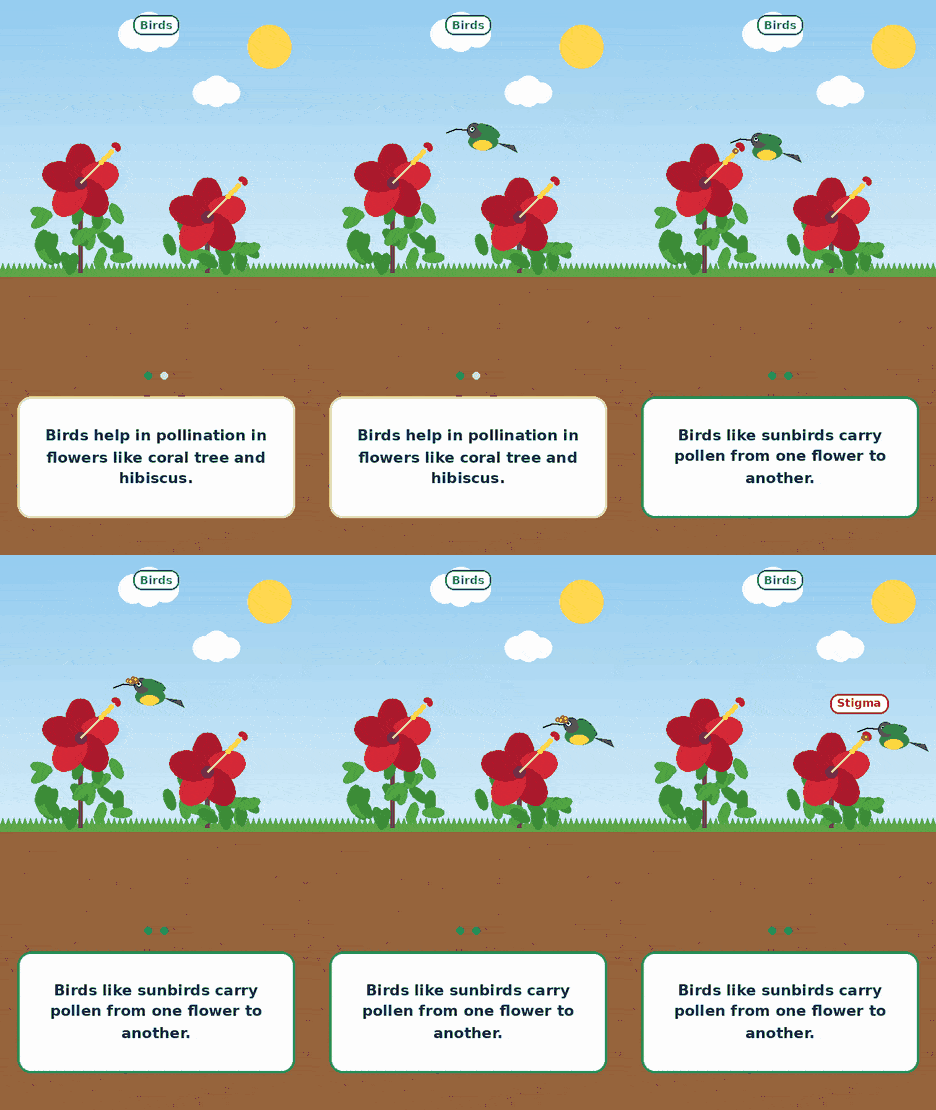
- Pollination by birds happens in the flowers of the coral tree and the hibiscus plant.
- The pollen grains are carried by birds like the Indian white-eye and sunbirds from one flower to another.
-
Summary
| Pollinator | Examples of plants | Main features |
|---|---|---|
| Wind | Wheat , maize , rice | Pollen light , small , made in large numbers . Stigma long and feathery . |
| Water | Vallisneria , Hydrilla | Water currents carry the pollen in aquatic plants |
| Insects | Sunflower , hibiscus , marigold | Flowers bright , with nectar and fragrance . Pollen large , sticky or spiny . Stigma sticky . |
| Birds | Coral tree , hibiscus | Birds like the Indian white-eye and sunbirds carry the pollen |
Questions from the book for this section
-
📝 Revise, Reflect, Refine Q6
Why are flowers that bloom at night white or light in colour as compared to flowers that bloom during the day?View answer
Answer- At night, there is very little light .
- White or light colours are easier to see in the dark than bright colours.
- So, night-blooming flowers can be seen by pollinators that are active at night, like moths and bats .
- Many night flowers also have a strong fragrance , which helps pollinators find them in the dark.
-
📝 Revise, Reflect, Refine Q12
In the lower Himalayan region of northern India, apples are an important cash crop that contribute significantly to farmer’s livelihoods. The fruit yield in apple cultivation is declining continuously, associated with climate change and a significant decline in the population of natural pollinators. A researcher-farmer group set up two experimental apple orchards at two distinct locations: Places A and B. In apple orchards at Place A, they allowed natural pollinators to pollinate the flowers of the apple. In apple orchards at Place B, they applied mixed farming techniques of beekeeping. Along with honey, the farmer yielded apples. The yield of apples is depicted in Figure below, in terms of fruit setting (number of fruits/the total number of corresponding fruit-bearing branches) and fruit drop (premature falling of developing fruits) in the two types of experimental places of apple orchards.
(i) What are the hypotheses the researcher-farmer group has thought of for this investigation?(ii) What are the different parameters in the experiment?(iii) Compare and analyse the data of the two orchards in terms of high yields of apple fruits.(iv) Based on your analysis, what do you infer from the data?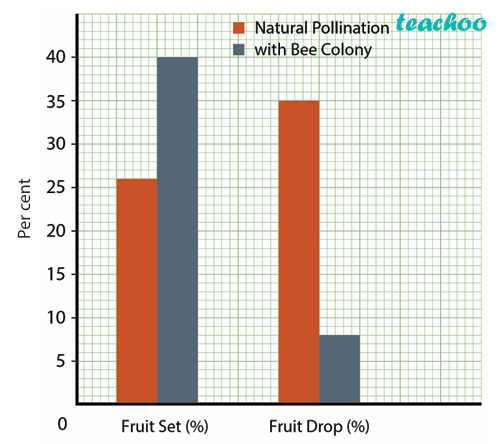
View answer
Answer(i) What are the hypotheses the researcher-farmer group has thought of for this investigation?- Adding bee colonies (more pollinators) will increase fruit set in apple trees.
- More pollination will reduce fruit drop .
- So, beekeeping can increase apple yield where natural pollinators have declined .
(ii) What are the different parameters in the experiment?- What is changed: the type of pollination (natural pollinators only, or with bee colonies).
- What is measured: fruit set and fruit drop .
- What should be kept the same: the apple variety , age of the trees , soil , water , fertiliser and weather in both places.
(iii) Compare and analyse the data of the two orchards in terms of high yields of apple fruits.Place A: Natural pollination Place B: With bee colony Fruit set (fruits formed per fruit-bearing branch) About 26% About 40% Fruit drop (young fruits falling early) About 35% About 8% - Fruit set is higher at Place B ( about 40% ) than at Place A ( about 26% ).
- Fruit drop is much lower at Place B ( about 8% ) than at Place A ( about 35% ).
- So, more fruits form and fewer fall at Place B. Place B gives a much higher yield of apples.
(iv) Based on your analysis, what do you infer from the data?- Bees improve pollination of apple flowers.
- Better pollination gives more fruits and less fruit drop .
- So, beekeeping is a good way to increase apple yield when natural pollinators are declining . The farmer also gets honey .
