
 You are here
How do animals reproduce?
Reproduction in animals
Sexual reproduction
Offspring (young ones)
inherit a mix of characteristics
from the
two individuals
Examples:
fish, frogs, lizards, birds, humans
Fertilisation happens
Asexual reproduction
A
single parent
produces offspring that are
almost exact copies
of the parent
Examples:
hydra
(budding),
sponge
No fertilisation
happens
What are the types of fertilisation in animals?
Fertilisation
Fusion of the male gamete and the female gamete
External fertilisation
Outside
the female's body
Examples:
frogs
, most
fish
Internal fertilisation
Inside
the female's body
Examples:
reptiles, birds, mammals
What is external fertilisation?
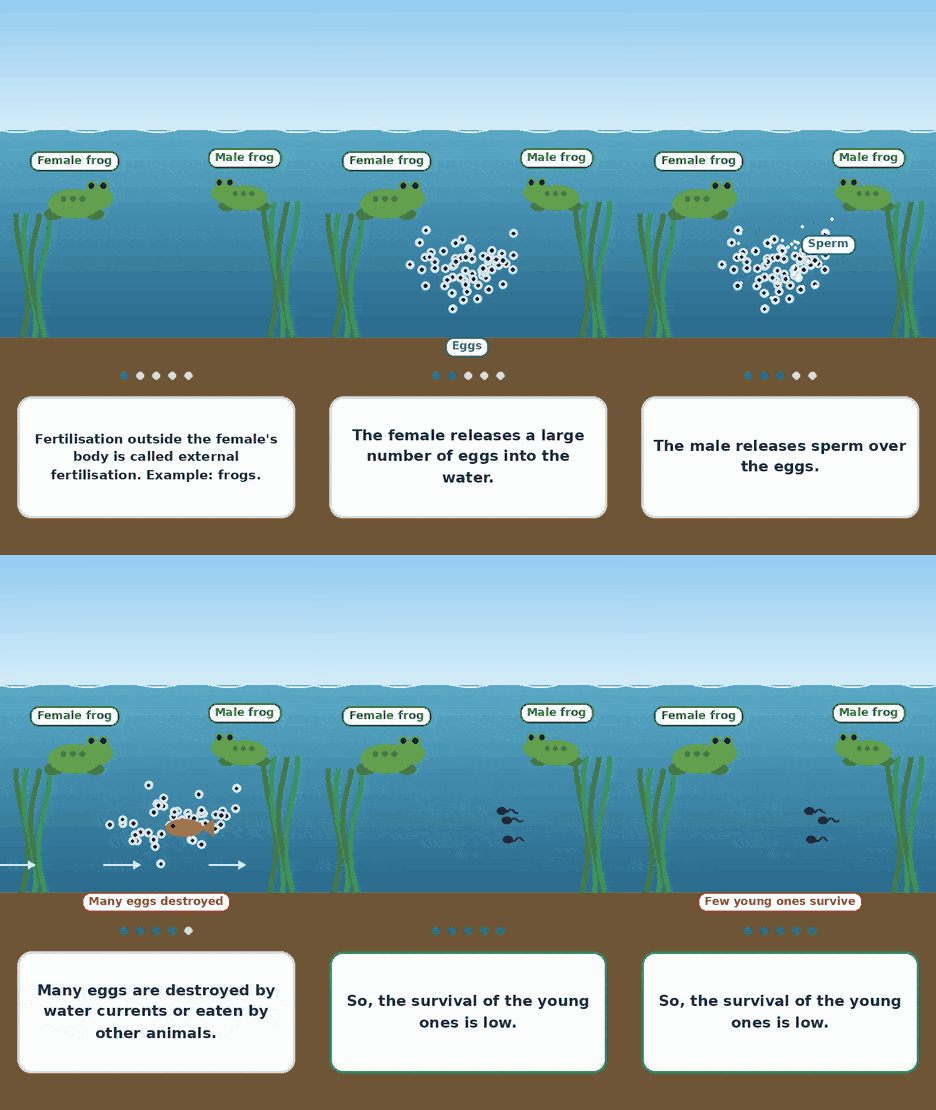
- Fertilisation that takes place outside the body of the female is called external fertilisation .
- The female releases eggs into the water , and the male releases sperm over the eggs.
- These animals lay a large number of eggs.
- Many of these eggs are destroyed by water currents or eaten by other animals.
- So, the survival of the young ones is low .
Example:
Frogs
and most
fish
(many
aquatic
animals) show external fertilisation.
What is internal fertilisation?
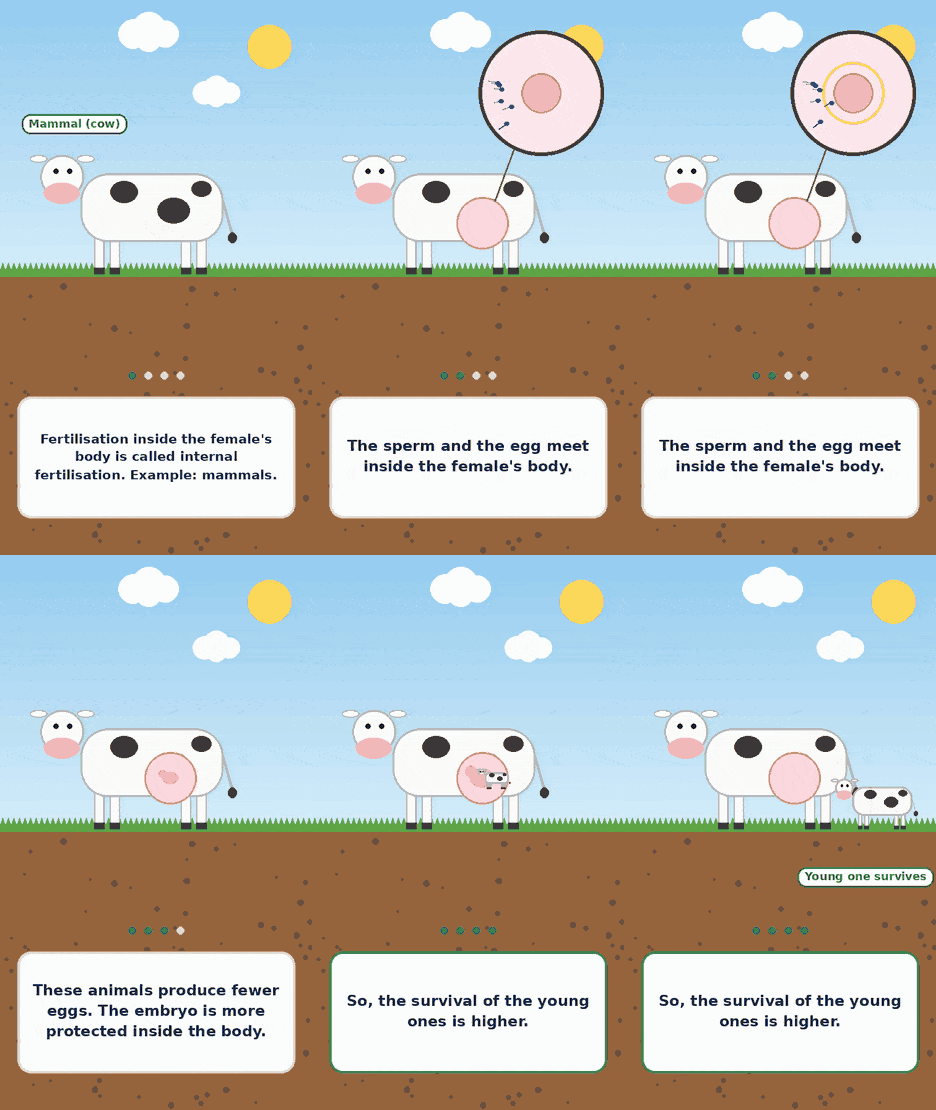
- Fertilisation that takes place inside the body of the female is called internal fertilisation .
- The sperm and the egg meet inside the female's body .
- These animals produce fewer eggs.
- The fertilised egg or embryo is more protected inside the body.
- So, the survival of the young ones is higher .
Example:
Reptiles
,
birds
and
mammals
show internal fertilisation.
How are external and internal fertilisation different?
| External fertilisation | Internal fertilisation | |
|---|---|---|
| Where it happens | Outside the female's body, in water | Inside the female's body |
| Number of eggs | Large number | Fewer eggs |
| Safety of eggs | Many eggs are destroyed or eaten | The egg or embryo is more protected |
| Survival of young ones | Low | Higher |
| Examples | Frogs , most fish | Reptiles , birds , mammals |
Questions from the book for this section
-
🤔 Pause and Ponder 4
Why do animals with external fertilisation generally produce more eggs than animals with internal fertilisation?View answer
Answer- In external fertilisation, eggs are laid in water , without any protection.
- Many eggs are destroyed by water currents or eaten by other animals.
- Some eggs may also not meet the sperm at all.
- So, these animals lay a large number of eggs . This makes sure that at least some survive and grow into young ones.
-
🤔 Pause and Ponder 5
In animals, which fertilisation method are the gametes more protected in?View answer
Answer- The gametes are more protected in internal fertilisation .
- The sperm and the egg meet inside the female's body , so they are safe from water currents and from other animals.
