
 You are here
How is reproduction in a frog or fish different from reproduction in a bird or lizard?
| Frog or fish | Bird or lizard |
|---|---|
| External fertilisation (fertilisation takes place outside the female's body). | Internal fertilisation (fertilisation takes place inside the female's body). |
| They lay a very large number of eggs at a time (fish: hundreds to thousands , frog: 5,000 to 50,000 ). | They lay only a few eggs at a time (lizard: 2 to 20 , bird: 1 to 15 ). |
| Each egg has only a little yolk (food), enough to make a larva . | Each egg has enough yolk to feed the embryo until it hatches into a young one. |
| The larva finds its own food and later changes into an adult. | The young one hatches from the egg and looks like a small adult . |
| Many eggs are destroyed by water currents or eaten by other animals. So, the survival of the young ones is low . | The fertilised egg is more protected . So, the survival of the young ones is moderate to high . |
Why is it said that there is variation in reproduction in animals? Give examples.
- All animals reproduce sexually, but they do it in very different ways . This is called variation in reproduction .
-
Animals are different in:
- where fertilisation happens (outside or inside the female's body)
- how many eggs they produce
- how the embryo gets food (yolk in the egg, or from the mother's body)
- how much care the young ones need after birth
| Animal | Habitat (where it lives) | Mode of fertilisation | Number of eggs produced | Survival of young ones |
|---|---|---|---|---|
| Fish | Water | External | 100s to 1000s at a time | Low |
| Frog | Water/land | External | 5,000 to 50,000 at a time | Low |
| Butterfly | Land | Internal | Hundreds at a time | Low |
| Lizard | Land | Internal | 2 to 20 at a time | Moderate |
| Bird | Water/land | Internal | 1 to 15 at a time | Moderate to high |
- Fish and frogs have external fertilisation . They lay many eggs , but fewer young ones survive .
- Lizards and birds have internal fertilisation . They lay fewer eggs , but more young ones survive .
- The butterfly has internal fertilisation , but it still lays hundreds of eggs . Its eggs have only a little yolk and grow into a larva , like those of fish and frogs. So, its young ones also have low survival .
Explain the life cycle of a butterfly.
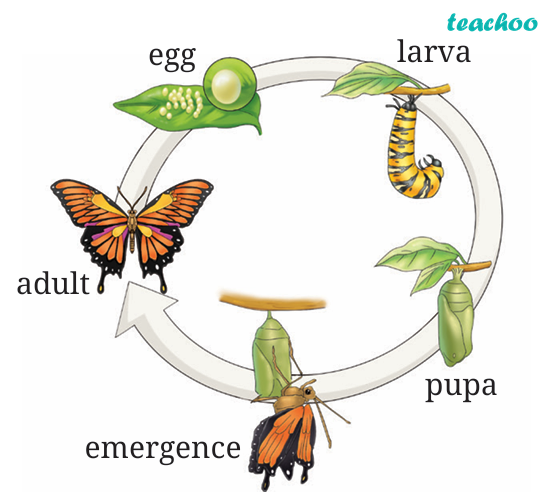
Egg
→
Larva
→
Pupa
→
Adult butterfly
→
Egg (cycle repeats)
- Egg: The butterfly lays many eggs . Each egg has only a little yolk (food), just enough to make a larva .
- Larva: The larva hatches (comes out) from the egg. It looks very different from the adult butterfly. It eats and grows . This is the feeding stage .
- Pupa: When the larva has collected enough food , it becomes a pupa . Inside the pupa, a transformation (big change) takes place, and the adult body is formed.
- Adult: The adult butterfly lays eggs , and the cycle repeats .
What are the two types of internal fertilisation?
Internal fertilisation
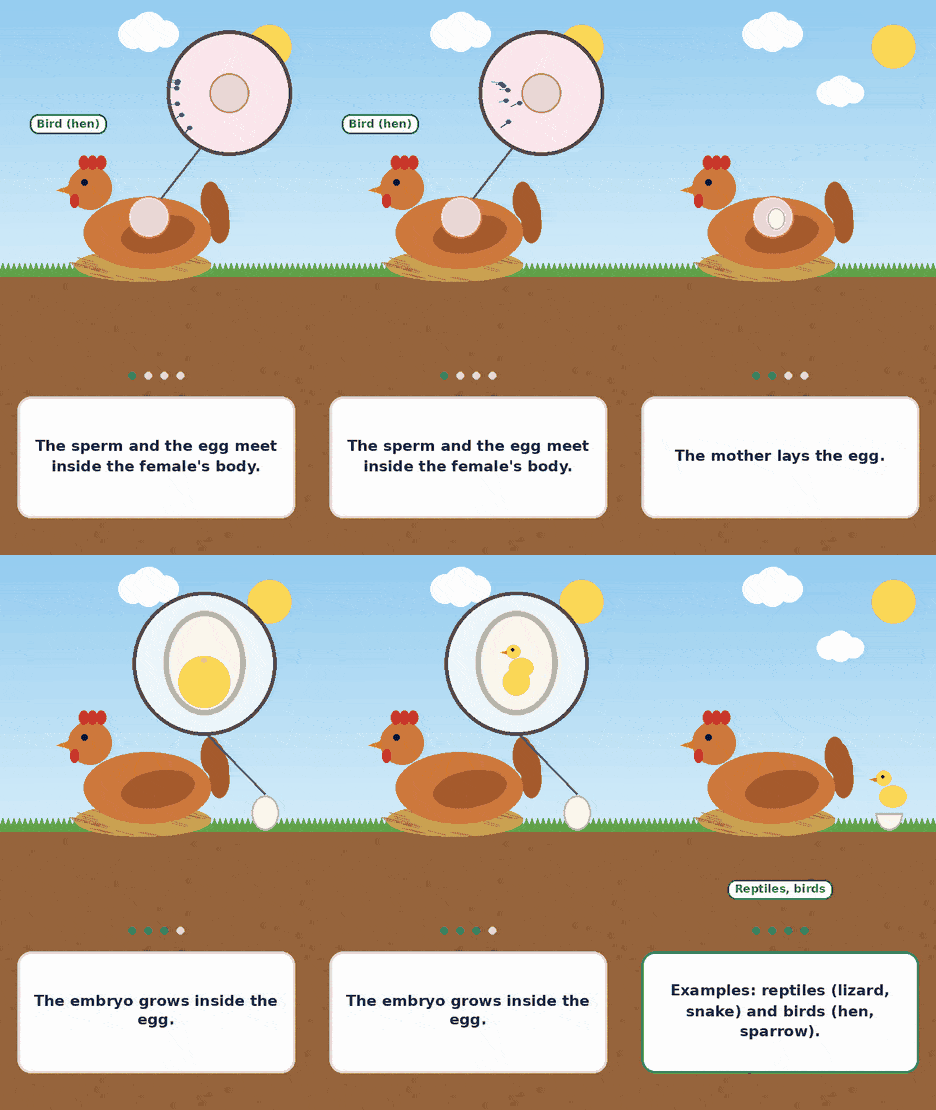
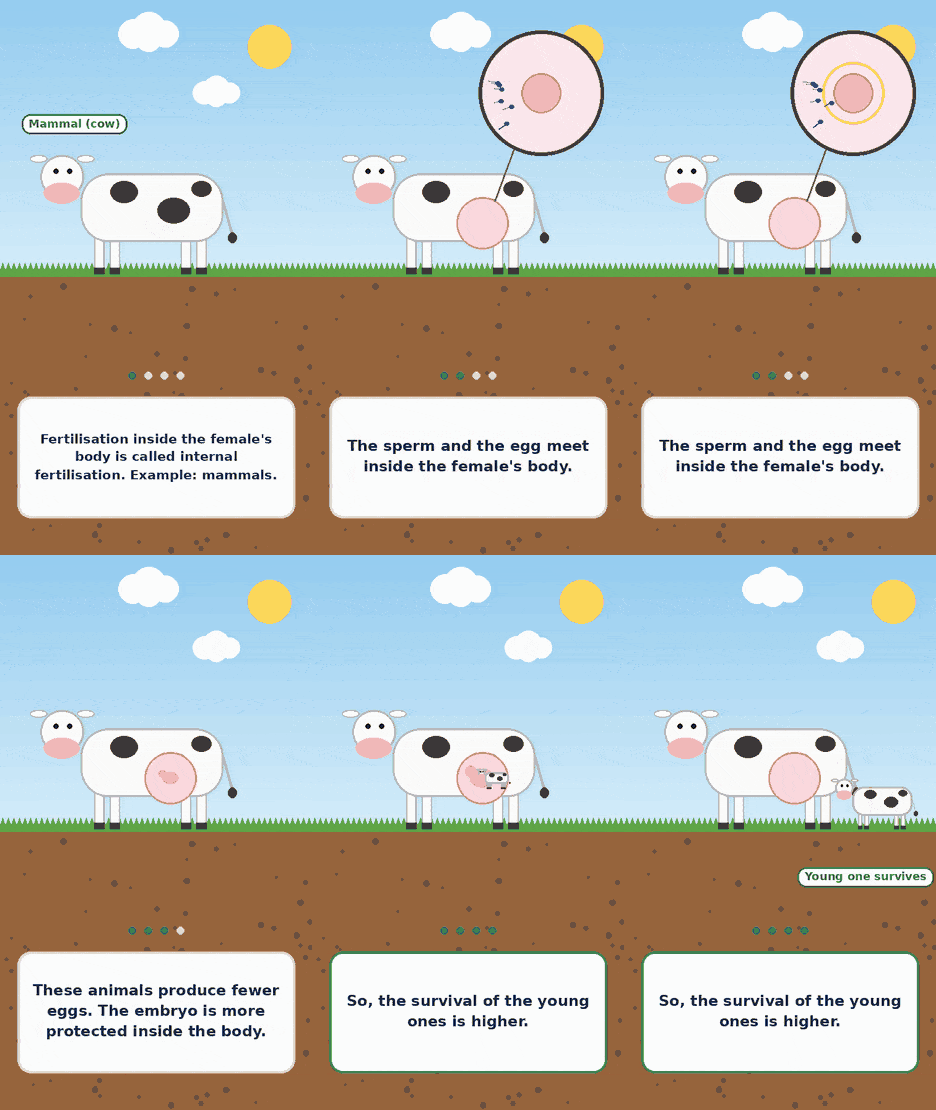
Sperm and egg meet inside the female's body
Embryo grows inside an egg
The mother
lays the egg
Examples:
reptiles
(lizard, snake),
birds
(hen, sparrow)
Embryo grows inside the mother's body
The mother
gives birth
Examples:
mammals
(humans, cows, dogs)
- In internal fertilisation , the sperm and the egg meet inside the female's body .
-
After fertilisation, the embryo can grow in
two ways
:
- inside an egg , which the mother lays outside her body
- inside the mother's body itself
| Embryo grows inside an egg | Embryo grows inside the mother's body |
|---|---|
| The mother lays eggs after fertilisation. | The zygote (fertilised egg) grows and develops inside the mother's body. |
| Each egg has enough yolk to feed the embryo until it hatches . | The embryo gets its food from the mother's body . |
| The young one hatches out of the egg. | The mother gives birth to the young one. |
| Reptiles and birds reproduce this way. | Mammals reproduce this way. |
Do all young ones need care after birth?
-
No.
In some species, the young ones can
find their own food
as soon as they are born.
- Examples: Fish , lizards and snakes . Their young ones start looking for food on their own soon after hatching. Chicks of hens and ducks can also walk and peck for food soon after hatching.
-
In others, the young ones need a
long period
of
feeding and care
after
hatching
or
birth
.
- Examples: Humans , cows , dogs and cats . Their young ones need their mother's milk and care for a long time. Chicks of sparrows and pigeons are fed by their parents in the nest.
- This mostly depends on how long the embryo develops inside the egg or inside the mother's body .
- Mammals feed their young ones with breast milk for some time after birth.
