
 You are here
What is sexual reproduction?
It is a type of reproduction where offspring (young ones) inherit a mix of characteristics from the two individuals.
Breaking it down:
| Part of the definition | Meaning |
|---|---|
| Offspring | The young ones |
| Inherit | Get something from the parents |
| Mix of characteristics | Some features from one parent and some from the other |
| Two individuals | Two parents are needed |
Example:
Humans
,
cows
,
dogs
,
cats
and
flowering plants
like the
mango tree
.
How do offspring inherit a mix of characteristics?
- Sexual reproduction involves two parents in the formation of a new individual.
- Both parents contribute (give) their genetic material (the information that decides characteristics, like colour, height or shape) to the offspring.
- Chromosomes carry this genetic material.
Parent 1 (genetic material)
+
Parent 2 (genetic material)
→
Offspring (a mix of both)
What are chromosomes?
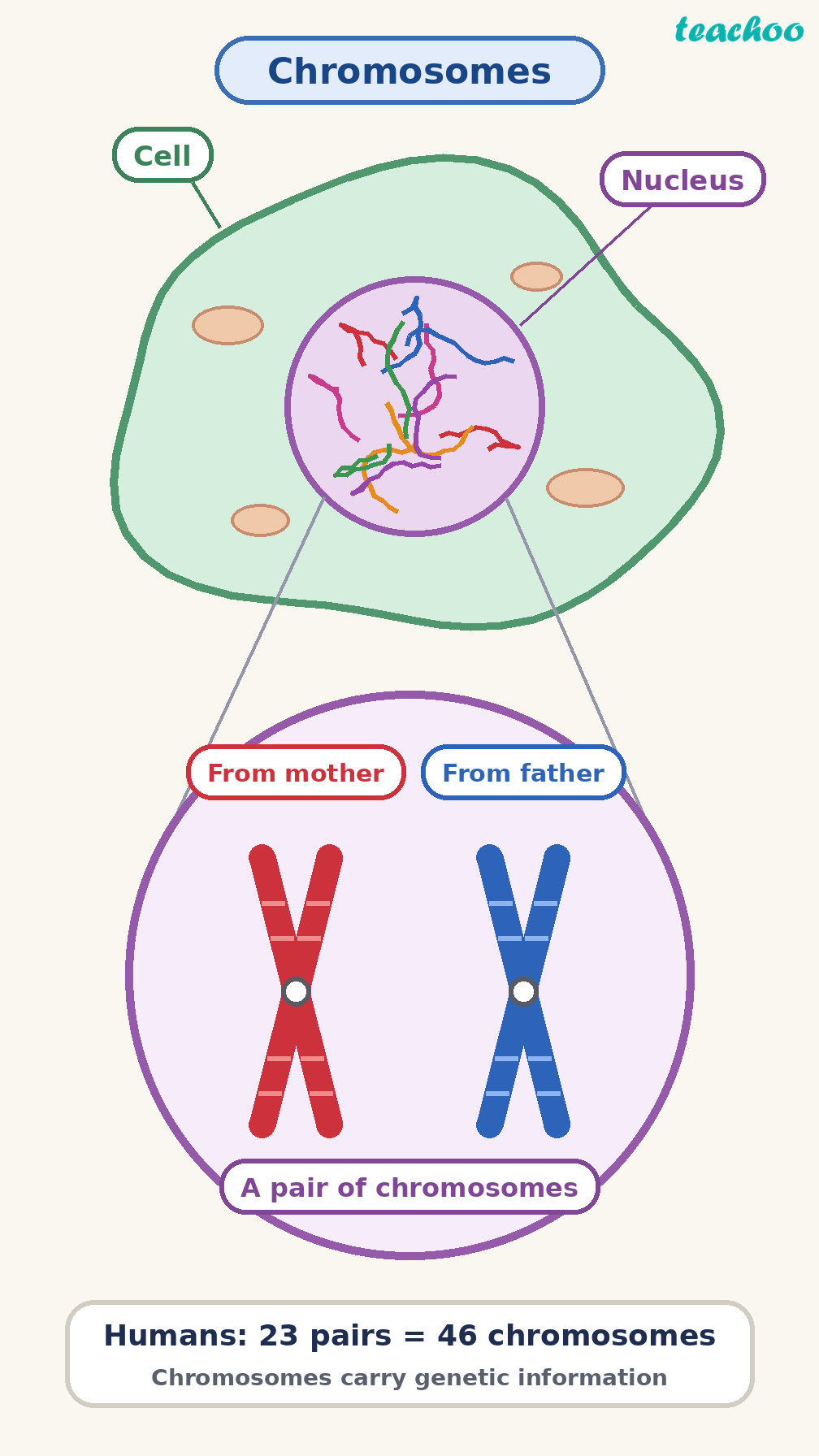
- Chromosomes are thread-like structures in the nucleus of a cell. They carry genetic information .
- Each species (each kind of living being) has a fixed number of chromosomes in its cells.
Example: Humans
- Humans have 23 pairs of chromosomes, which is 46 chromosomes in total.
- In each pair, one chromosome comes from the mother and one from the father .
23 chromosomes from father
+
23 chromosomes from mother
=
46 chromosomes
What would happen if each parent gave all its chromosomes?
- Suppose each parent gave its full set of chromosomes to the offspring.
- Then the offspring would have double the number of chromosomes of its parents.
- This would happen again in every generation .
Example: Humans
- Each parent has 46 chromosomes .
- If each parent gave all 46, the child would get:
46 chromosomes from father
+
46 chromosomes from mother
=
92 chromosomes
- So, the chromosome number would double in every generation.
- This is a biological problem , because each kind of living being must keep the same number of chromosomes.
How is this problem solved?
- This problem is solved by a special type of cell division called meiosis .
Problem
Full chromosomes from both parents
→
Number doubles every generation
Solution
Meiosis (a special type of cell division)
- Let's see how meiosis works.
