
 You are here
What is vegetative propagation?
- The word vegetative means related to the growing parts of a plant, like the stem , root and leaf .
- The word propagation means producing more plants .
- So, vegetative propagation means producing new plants from the growing parts of a plant.
New plants arise from the vegetative parts, i.e., from growing parts of a plant.
What are the different types of vegetative propagation?
| Method | Examples |
|---|---|
| Cutting | Money plant , sugarcane |
| Grafting | Rose |
| Layering | Lemon |
| Tissue culture | Banana |
Let's study each one by one.
Activity 11.1: Let us explore
- Talk to gardeners in your school garden or farmers working in a field.
- Watch how they do cutting , grafting and layering .
- Discuss these methods with them and record what you see in your notebook.
What we record from the gardeners:
| Point to note | Cutting | Grafting | Layering |
|---|---|---|---|
| Example plant | Money plant , sugarcane | Rose | Lemon |
| Part used | A piece of stem | A stem piece of Plant B fixed on a rooted Plant A | A flexible twig still on the parent |
| Is it cut from the parent first? | Yes | Yes (the stem piece of Plant B) | No , it is cut only after roots grow |
| Where the roots come from | Grows its own roots from the nodes | Uses the roots of Plant A | Grows its own roots from the buried part |
| Time taken | Roots in about 2 to 3 weeks | Joint heals in about 3 to 4 weeks | Roots in 10 to 15 days |
| Result | A new plant , same as the parent | Plant B grows on the roots of Plant A | A new plant , same as the parent |
What is cutting?
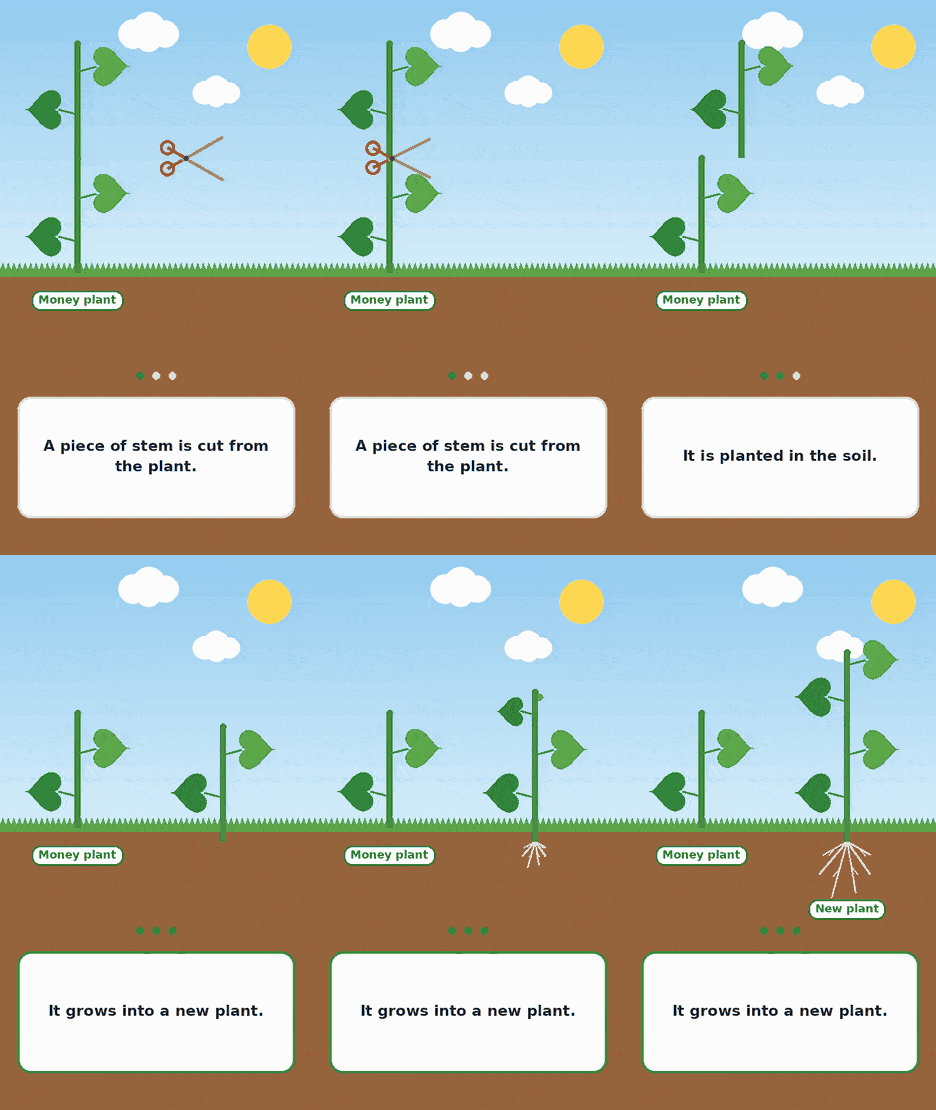
- In cutting, a piece of stem is cut from a plant and planted in the soil.
- This piece grows into a new plant.
Example:
Money plant
and
sugarcane
. A stem cutting of these plants grows into a new plant.
What do we need?
- A plant with overgrown branches
- Soil mixed with compost
- Water
What do we do?
-
Note the following points while observing the technique of cutting in the field.
- (i) Does the gardener, scientist or horticulturist cut the overgrown branches of a plant at the end of its growing season? (Different plants have different growing seasons.)
- (ii) Observe them prepare the cuttings from a plant for the purpose of growing new plants. Note the average length of the cuttings.
- (iii) Count the number of nodes (points on a stem where a leaf grows) and internodes (parts of the stem between two nodes) on the cuttings.
- Collect the cuttings of the shoots in the morning for planting.
- Remove leaves from the lower half of each cutting.
- Insert the cuttings up to approximately half of their length in the soil mixed with compost at an angle of about 45° to 60° from the soil surface.
- Water them regularly and observe the change, if any.
What do we observe?
| Point | Answer |
|---|---|
| (i) Are overgrown branches cut at the end of the growing season? | Yes. Gardeners cut (prune) the overgrown branches at the end of the growing season. These branches are used to make cuttings. |
| (ii) Average length of the cuttings | About 15 to 20 cm |
| (iii) Number of nodes and internodes | Usually 3 to 4 nodes , with 2 to 3 internodes between them |
After planting:
- After about 2 to 3 weeks , new roots grow from the nodes buried in the soil .
- New leaves and buds grow from the nodes above the soil .
- The cutting slowly grows into a new plant .
What does this tell us?
- A piece of stem can grow into a complete new plant .
- New roots and shoots grow from the nodes . So, every cutting must have nodes .
- The new plant is the same as the parent plant.
What is grafting?
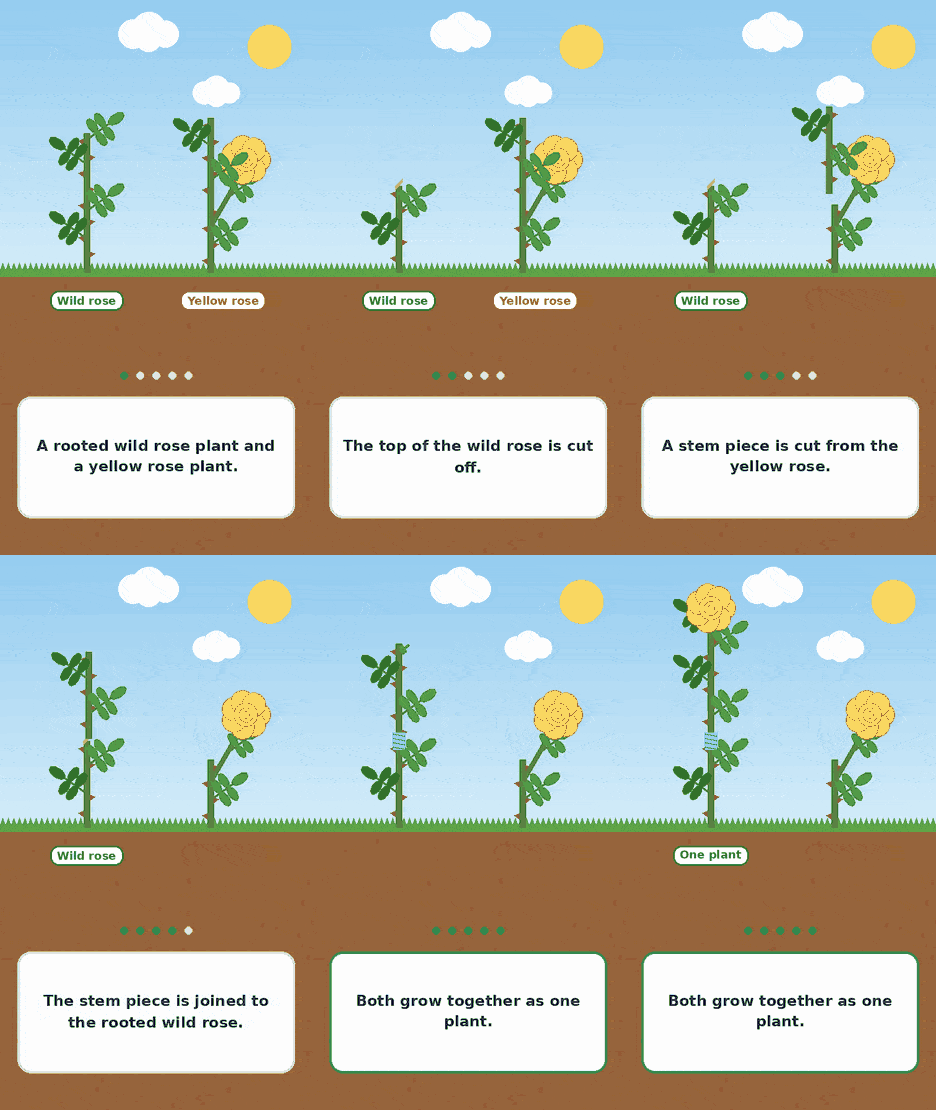
- In grafting, a stem piece of one plant is joined to a rooted plant of another variety.
- Both grow together as one plant.
Example:
Rose
. A stem piece of a
yellow rose
or
pink rose
is joined to a rooted
wild rose
plant.
What do we need?
- Plant A: a healthy rooted plant, for example a wild rose
- Plant B: a healthy stem piece from another variety, for example a yellow rose or pink rose
- Cotton cloth or wrapping film
- Water
What do we do?
- Take a healthy rooted plant ( Plant A) , for example a wild rose variety, and a healthy stem piece from another plant ( Plant B ) of other varieties, for example a yellow rose plant and/or a pink rose plant.
- Create a wound or a slit on a twig of Plant A.
- Insert and fit the cutting of stem of Plant B into the slit of stem of Plant A.
- Protect the wound or slit by using a cotton cloth or by wrapping film , to avoid pests entering the graft until it heals. Cut the other branches of Plant A.
- Water the plant regularly and observe the growth of Plant B along with Plant A.
What do we observe?
- In about 3 to 4 weeks , the joint heals . The stems of Plant A and Plant B join together .
- Plant B grows new leaves and shoots on Plant A.
- Later, Plant B gives flowers of its own variety (yellow or pink roses), while the roots belong to Plant A (wild rose).
Why are the other branches of Plant A cut?
- So that the water and food from the roots of Plant A go only to Plant B .
What does this tell us?
- The stem of one plant can grow on the roots of another plant .
- We can grow a desired variety (Plant B) on an already rooted plant (Plant A).
| Plant | What it gives | Example |
|---|---|---|
| Plant A | Roots (the rooted plant) | Wild rose |
| Plant B | Stem piece that is joined | Yellow rose or pink rose |
What is layering?
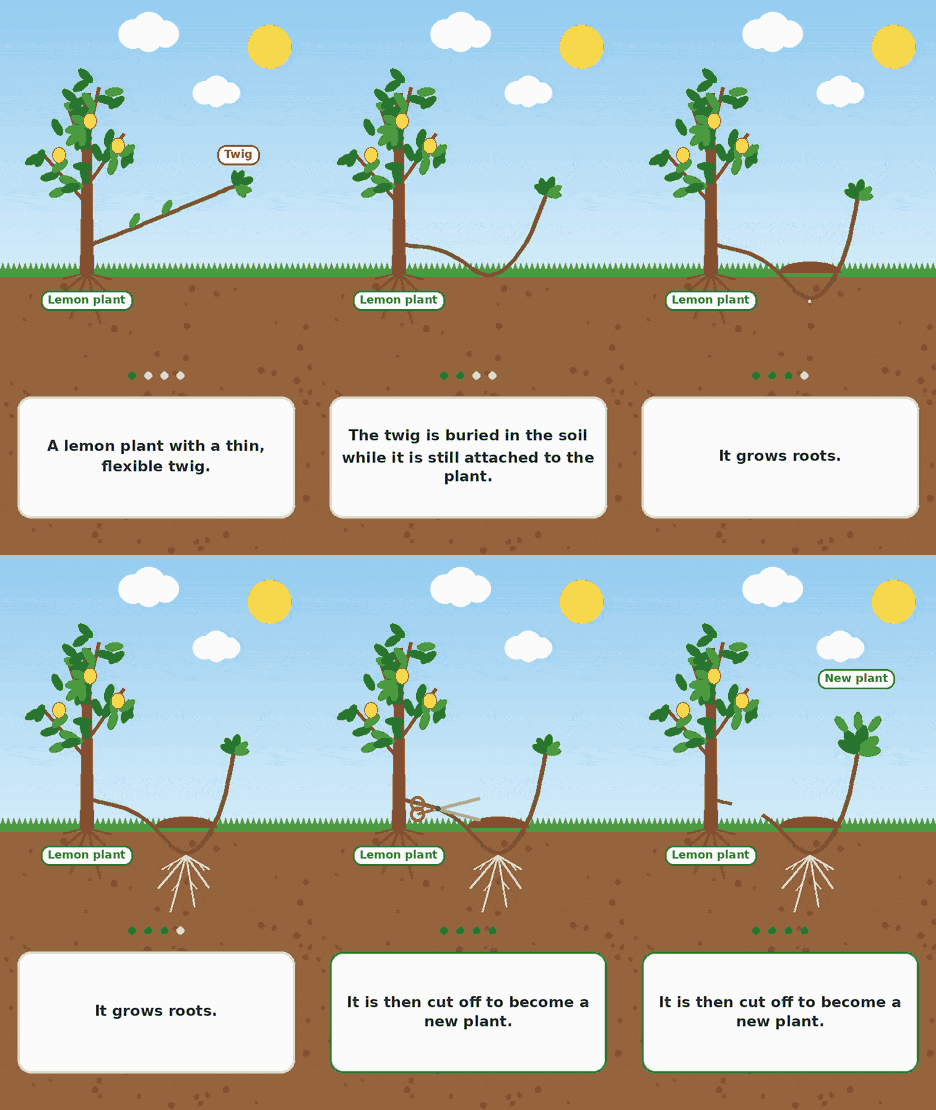
- In layering, a twig (a small thin branch on a tree or bush) is buried in the soil while it is still attached to the parent plant.
- It grows roots, and is then cut off to become a new plant.
Example:
Lemon
. A flexible, thin twig of a lemon plant is buried in the soil to grow a new plant.
What do we need?
- A plant with a flexible, thin twig , like a lemon tree or shrub
- Soil
- Water
What do we do?
- Select a flexible, thin twig of a tree or a shrub, such as a lemon, and bury the middle part of the twig under the soil surface.
- Water it regularly and observe the growth of new leaves on the twig buried in the soil.
- After 10 to 15 days , the roots will develop from the area of the twig buried in the soil.
- Once roots have developed, cut the twig from the parent plant, so that it can grow as a new plant.
What do we observe?
- New leaves grow on the twig.
- After 10 to 15 days , roots grow from the part of the twig buried in the soil .
- After it is cut from the parent, the twig grows as a separate new plant .
What does this tell us?
- A twig can grow its own roots while it is still attached to the parent plant.
- Until its own roots grow, the twig gets water and food from the parent plant .
- Once cut off, it grows as a new plant , same as the parent.
- These are some methods of asexual reproduction through which different varieties of plants can be grown.
What is tissue culture?
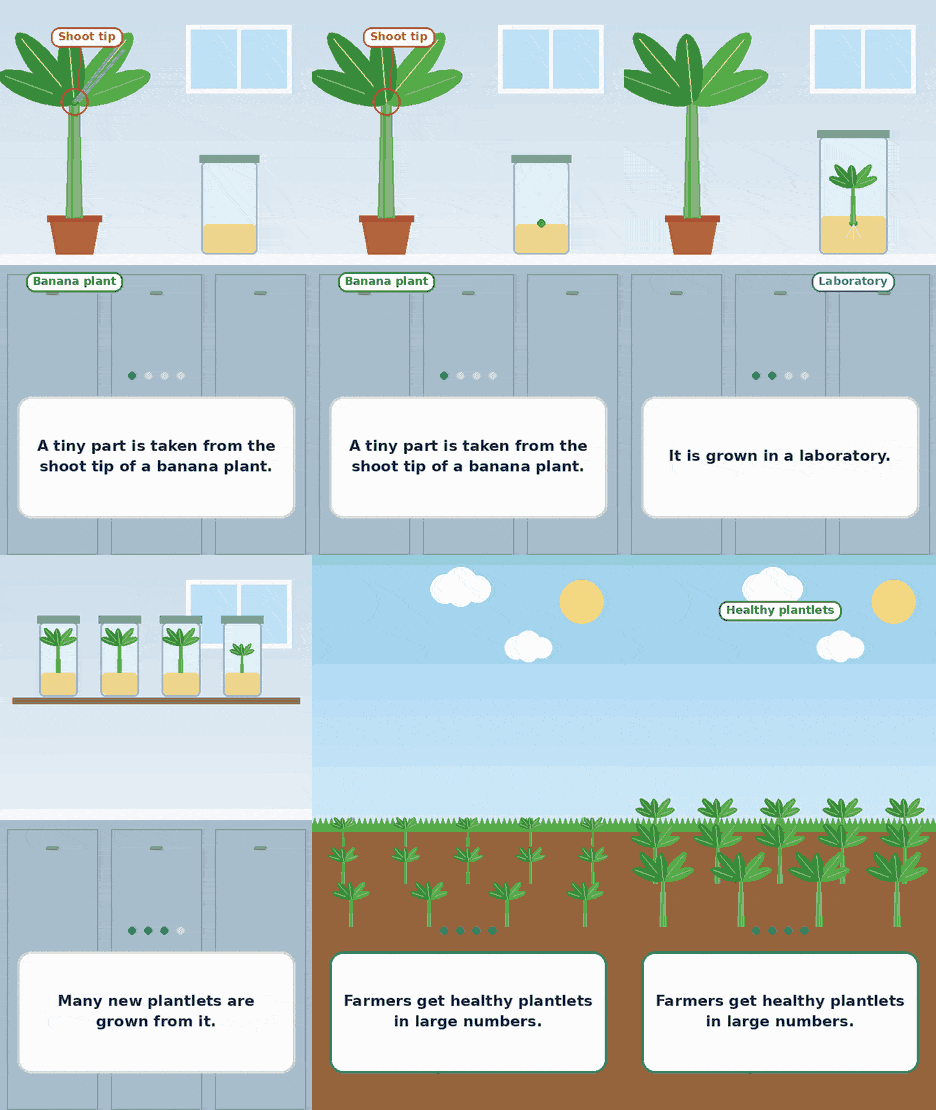
- In tissue culture, many new plants are grown from a tiny part of a plant in a laboratory.
- In farming, healthy plantlets are mass-produced from the shoot tip (apical meristem) of plants.
- Mass-produced means made in very large numbers.
- The apical meristem is the tissue at the tip of a shoot that keeps dividing and growing.
Example:
Banana
. Tissue culture has
completely changed
banana farming. Farmers now get
healthy plantlets
in large numbers.
Why is tissue culture useful?
- It helps remove virus-infected plants.
- It gives high yields . Yield means the amount of crop produced.
- It is also an example of asexual reproduction in plants.
How is vegetative propagation helpful in agriculture?
- Vegetative propagation involves only one parent .
- So, it produces genetically identical plants (new plants carry exactly the same genetic information as the parent).
One parent
→
No mixing
→
Genetically identical new plants
- Scientists and horticulturists (people who grow fruits, vegetables and flowers) have used this natural process to develop methods like cutting, grafting, layering and tissue culture.
-
These methods:
- propagate plants efficiently , which means they produce many plants quickly and easily
- have greatly improved farming and gardening
- let farmers grow desirable crops (with the good qualities we want, like sweet fruit or high yield) on a large scale
We have learnt about methods of vegetative propagation in plants.
Now let us look at asexual reproduction in other organisms.
What are the different types of asexual reproduction in other organisms?
| Method | Examples |
|---|---|
| Budding | Yeast , hydra |
| Spore formation | Bread mould (Rhizopus), Aspergillus |
Let's study each of them one by one.
What is budding?
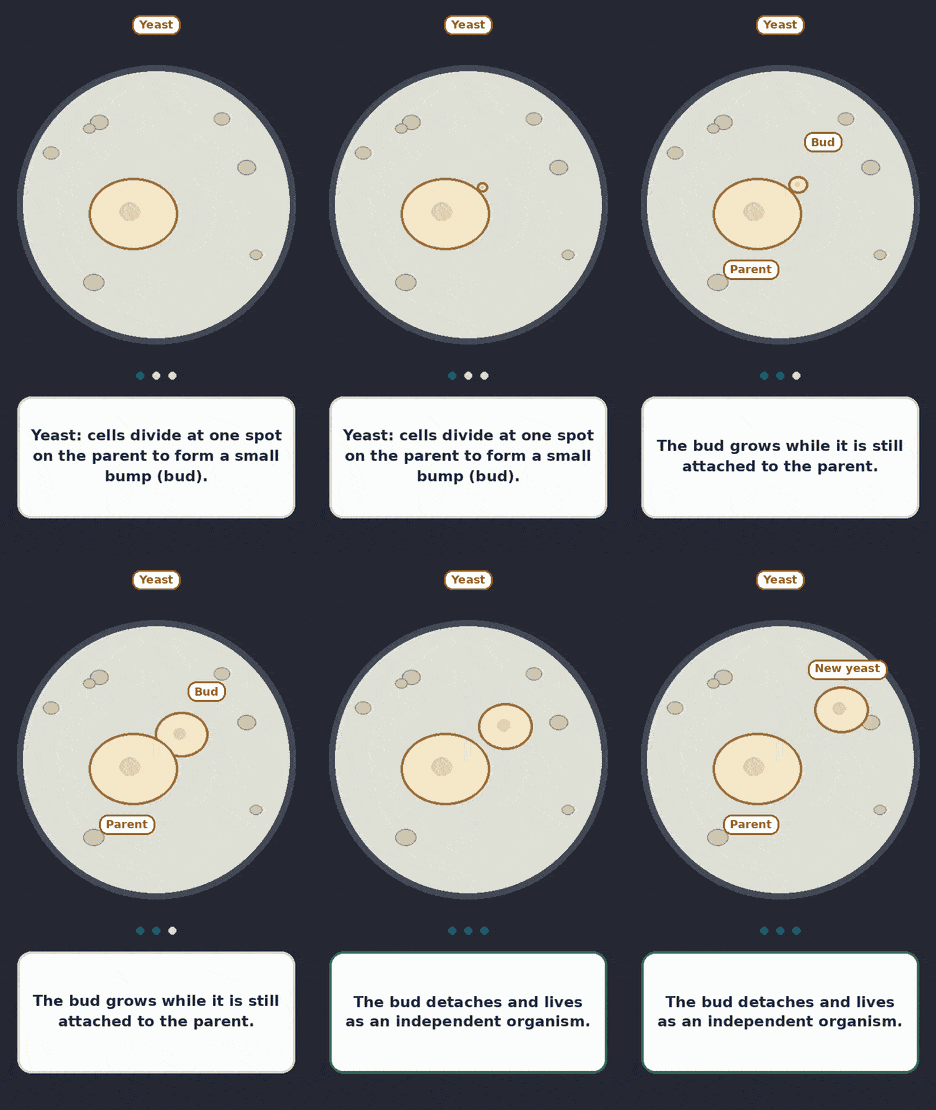
- Budding is a type of asexual reproduction where a new organism grows directly from a single parent .
- Cells divide rapidly at one specific spot on the parent to form a small bump (called a bud ).
- The bud grows, matures , and receives nutrients while it is still attached to the parent .
- Once fully developed, the bud detaches (breaks away) and lives as an independent organism .
Example:
Yeast
and
hydra
reproduce by budding.
Cells divide at one spot
→
Bud forms
→
Bud grows bigger
→
Bud separates
→
Lives as a new organism
Activity 11.2: Let us explore (Budding in yeast)
What do we need?
- A test tube
- 20 mL of sugar solution (1 g sugar in 10 mL water)
- A pinch of yeast granules
- Cotton plug
- Glass slide and coverslip (a thin glass piece placed over the sample)
- Compound microscope (a microscope with more than one lens, used to see very small things)
What do we do?
- Take 20 mL of sugar solution in a test tube.
- Add a pinch of yeast granules.
- Close the mouth of the test tube with a cotton plug.
- Keep it undisturbed in a warm place , so the yeast becomes active .
- After 1 to 2 hours , put a small drop of the yeast mixture on a glass slide.
- Cover it with a coverslip.
- Observe the slide under the microscope at different magnifications (how many times bigger the object looks).
- Draw what you see.
What do we observe?
- Small, round outgrowths (buds) come out of the parent yeast cells.
What does this tell us?
- The yeast is duplicating (making copies of itself).
- Yeast reproduces by budding .
How does hydra reproduce by budding?
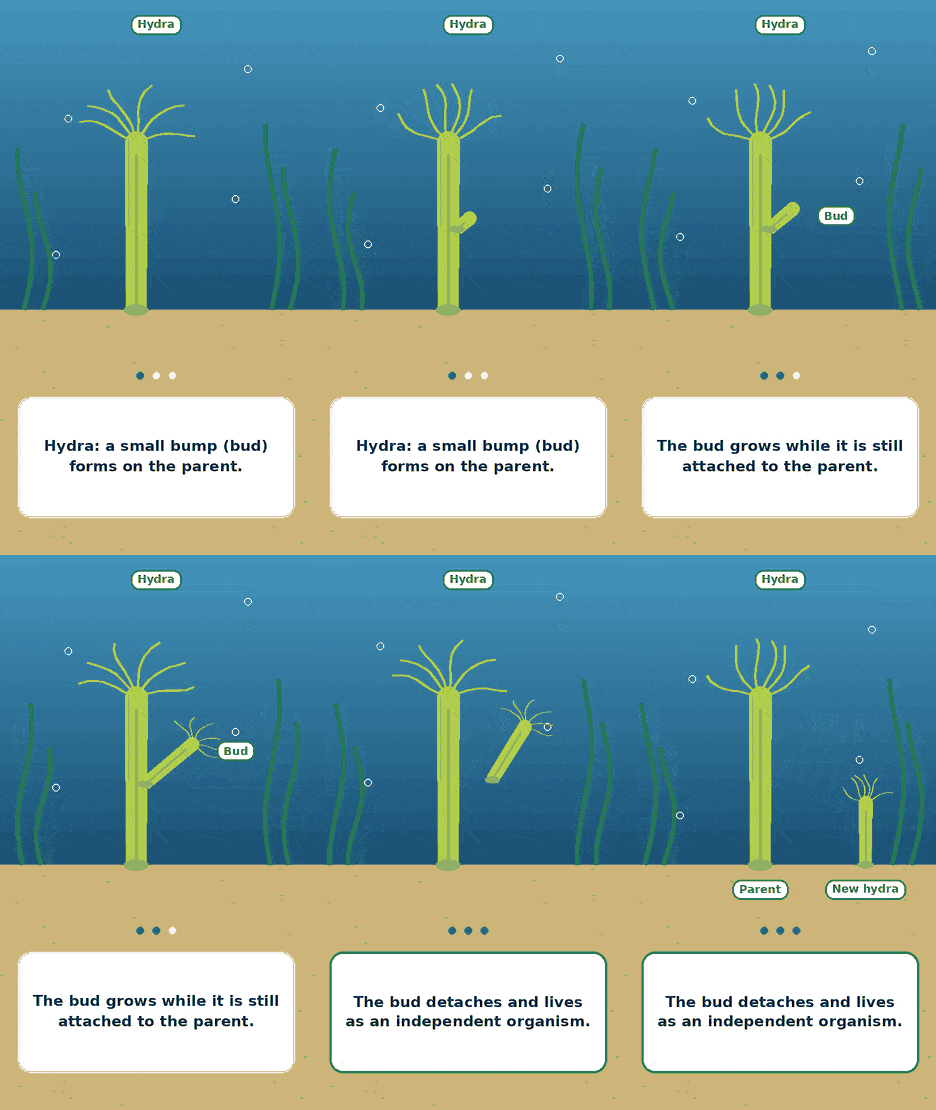
- Hydra is a multicellular animal (made of many cells).
- Cells divide again and again at one spot on its body.
- This makes a small outgrowth called a bud .
- The bud grows bigger .
- Then it separates from the parent and lives on its own.
- In hydra, we can often see many buds growing on the parent's body at the same time .
How is budding in yeast and hydra different?
| Yeast | Hydra |
|---|---|
| Yeast is a unicellular organism, which means it is made of only one cell . | Hydra is a multicellular animal, which means it is made of many cells . |
| The bud grows out of the parent cell itself. | The bud grows from one spot on the parent's body . |
| Small buds come out of the parent yeast cells. | Many buds often grow on the parent's body at the same time . |
| A new yeast cell comes from only one parent . | A new hydra comes from only one parent . |
What is spore formation?
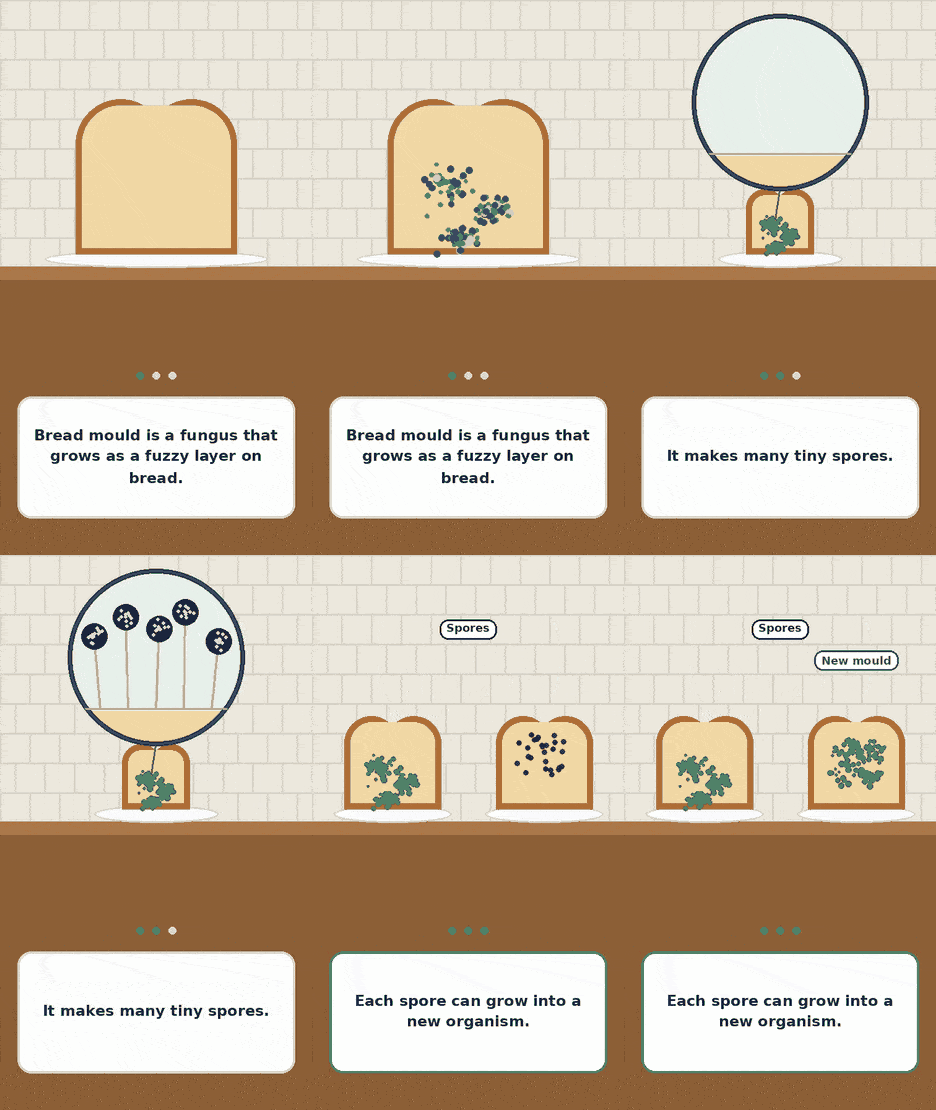
- In spore formation, an organism makes many tiny spores .
- Each spore can grow into a new organism .
Example:
Bread mould
(Rhizopus) and
Aspergillus
. These are
fungi
that grow by forming spores.
- A mould is a fungus that grows as a fuzzy layer on food.
-
Activity 11.3: Let us experiment (Mould on bread)
What do we need?
- A small slice of bread or a roti
- A plastic box or steel dabba (to make a moist chamber , a closed box that stays wet inside)
- Cotton, tissue paper and pre-boiled water
- Magnifying glass
- Needle, microscope slide, cotton blue stain (a coloured dye that helps us see the mould better) and microscope
What do we do?
- Lightly wet the bread or roti with a few drops of water.
-
Make a moist chamber:
- Put a thin layer of cotton in the box.
- Cover it with tissue paper.
- Wet it with pre-boiled water.
- Place the bread or roti on this wet bed.
-
Keep the box in a
warm and dark place
, away from direct sunlight.
- If the bread starts drying, add a few drops of water.
- Observe it every day . Record what you see without touching it .
- After three days , look at the surface carefully with a magnifying glass .
- When enough mould has grown, take the box to the school laboratory.
- With a needle, carefully put a little mould on a microscope slide.
- With your teacher's help, add cotton blue stain .
- Observe under the microscope and draw what you see.
What do we observe?
- Mould grows on the bread or roti.
-
Under the microscope, we see:
- thread-like structures with a round sac at the tip
- tiny round structures inside the sac. These are spores .
What does this tell us?
- The mould grows and reproduces by forming spores .
| Part seen | What it is |
|---|---|
| Hyphae | The thread-like structures of the fungus |
| Sac | The round structure at the tip of a thread |
| Spores | The tiny round structures inside the sac |
Where did the mould on the bread come from?
- The mould was not there when the bread was fresh.
- Spores of mould are already present in the air .
- They settled on the moist bread and began reproducing rapidly .
- In the same way, fungi grow on rotten fruits and in manure from spores in the air.
Spores in the air
→
Settle on moist bread
→
Grow and reproduce rapidly
→
Mould
What are spores?
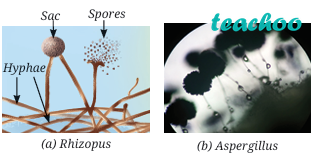
- Spores are the tiny structures that grow into a new fungus .
Where are spores formed?
| Fungus | Where spores are formed |
|---|---|
| Rhizopus | Inside a sac-like structure |
| Aspergillus | On a swollen vesicle (a small round bulge) at the end of a long thread of fungal hyphae |
What are the features of spores?
- Spores are produced in huge numbers ( millions from one mould colony).
- Spores are lightweight, usually single-celled and float easily through air currents, waiting for moisture and nutrients to germinate quickly into a new individual.
| Feature | Meaning |
|---|---|
| Lightweight | Very light , so they can float |
| Single-celled | Made of only one cell |
| Float through air currents | Carried by moving air to new places |
| Moisture and nutrients | Wetness and food |
| Germinate | Start growing into a new organism |
Which cell division is behind asexual reproduction?

- In all the organisms we studied in this section, the main process behind asexual reproduction is mitosis .
Mitosis is a type of cell division that produces two daughter cells, each having the same number of chromosomes identical to the parent cell.
Breaking it down:
| Part of the definition | Meaning |
|---|---|
| Cell division | One cell splits to make new cells |
| Daughter cells | The new cells formed |
| Chromosomes | Thread-like structures in the nucleus that carry genetic information |
| Same number, identical | Each new cell gets the same chromosomes as the parent cell |
One parent cell
→
Mitosis
→
Two daughter cells (same chromosomes as parent)
What are clones?
- Because of mitosis, the young ones are genetically identical to the parent.
- Such genetically identical young ones are called clones .
- Clones are the result of asexual reproduction, not a method of it.
Asexual reproduction
→
happens by Mitosis (process)
→
gives Clones (result)
| What it is | |
|---|---|
| Cutting, grafting, layering, tissue culture, budding, spore formation | Methods (ways of reproducing) |
| Mitosis | Process (the cell division behind all of them) |
| Clones | Result (genetically identical young ones) |
Why is asexual reproduction useful for organisms?
- It is fast .
- It helps organisms increase their population quickly .
- This happens especially when conditions are favourable (good for growth).
Bridging Science and Society: Krishi Vigyan Kendras
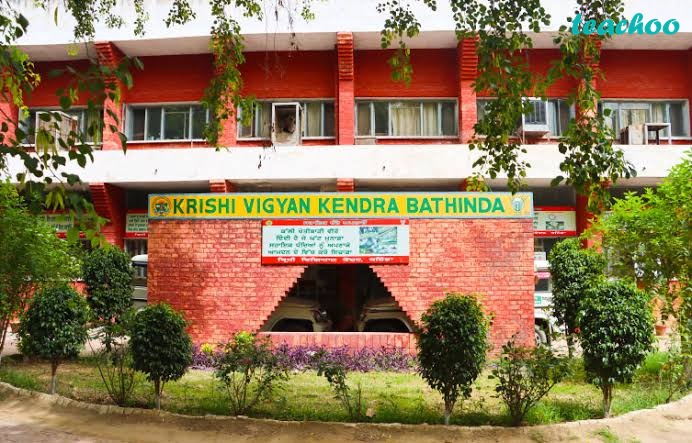
- Krishi Vigyan Kendras (KVKs) work under the Indian Council of Agricultural Research (ICAR) .
- They help farmers learn job skills in modern grafting.
-
This helps farmers:
- grow high-yield fruits
- increase their income , by learning marketing methods and about government programmes
Threads of Curiosity: Why do we keep food in the fridge?
- In Activity 11.3, the moist chamber was kept warm (25 °C to 35 °C) .
- This is because mould spores need warmth and moisture to grow on bread or roti.
- Lower temperatures slow down or stop their reproduction.
- This is why we keep food that spoils easily in the refrigerator .
- About 100 years ago , before refrigerators were common, fresh food lasted only 1 to 2 days .
-
Refrigeration
(including
deep freezing
) completely changed our food habits:
- Fruits, vegetables and dairy products are available all year round .
- Food is protected from spoiling by moulds and bacteria.
Bridging Science and Society: Fungi are useful
- Mould on bread looks unpleasant, but fungi are very useful to society.
- Fungi grow very fast by spore formation.
-
They:
- break down organic wastes and pollutants
- help remove heavy metals from industrial wastes
- give us many antibiotics (medicines that kill bacteria), like penicillin and amoxicillin , which have saved countless lives
-
Do you know any fungus that can break down plastic?
- Yes. Some fungi, like Aspergillus tubingensis and Pestalotiopsis microspora , can break down some types of plastic.
Meet a Scientist: Louis Pasteur

Where do we see microorganisms?
- Fruits get rotten because of microbes like fungi .
- Cooked food left on the kitchen counter for a day in warm weather starts to smell and may grow fuzzy patches .
- Black patches are often seen on a damp wall (a slightly wet wall).
- All of these are microorganisms .
Where do microorganisms come from?
- For a long time, people thought living things came spontaneously (by themselves) from non-living matter .
- Louis Pasteur did experiments and proved that new life always comes from pre-existing life .
- Pre-existing means already present before.
- So, microorganisms do not come from nowhere. They come from other living microorganisms.
What else did Pasteur do?
- He gave the germ theory of disease (the idea that many diseases are caused by germs).
- He strengthened the cell theory : all cells arise from pre-existing cells .
- His work led to sterilisation (killing all germs) of food and instruments .
Questions from the book for this section
-
📝 Revise, Reflect, Refine Q4
Why does asexual reproduction produce offsprings that are genetically identical to the parent?View answer
Answer- Asexual reproduction involves only one parent .
- It happens by mitosis , which makes daughter cells with the same chromosomes as the parent cell.
- There is no mixing of genetic material from two parents.
- So, the offspring are genetically identical to the parent. They are called clones .
-
📝 Revise, Reflect, Refine Q7
Why do vegetatively propagated plants tend to be more vulnerable to diseases than sexually reproduced plants?View answer
Answer- Vegetatively propagated plants come from one parent , so they are all genetically identical (clones).
- There is no variation among them.
- If a disease can harm one plant, it can harm all of them in the same way.
- So, a whole crop can be destroyed by one disease.
- Sexually reproduced plants have variation , so some of them may be able to resist the disease and survive.
-
📝 Revise, Reflect, Refine Q9
A farmer wants to produce a large number of genetically identical plants quickly. Suggest suitable reproduction methods and explain why they are effective.View answer
Answer- The farmer should use vegetative propagation methods, like cutting , grafting , layering and tissue culture .
- Tissue culture is the best for very large numbers . For example, many healthy banana plantlets are made from a small shoot tip.
Why these methods are effective:- They need only one parent , so there is no mixing .
- New plants are made by mitosis , so they are genetically identical to the parent.
- The good qualities of the parent plant (like sweet fruit or high yield) are kept in every new plant.
- They are fast and can be done on a large scale .
