
 You are here
What is meiosis?
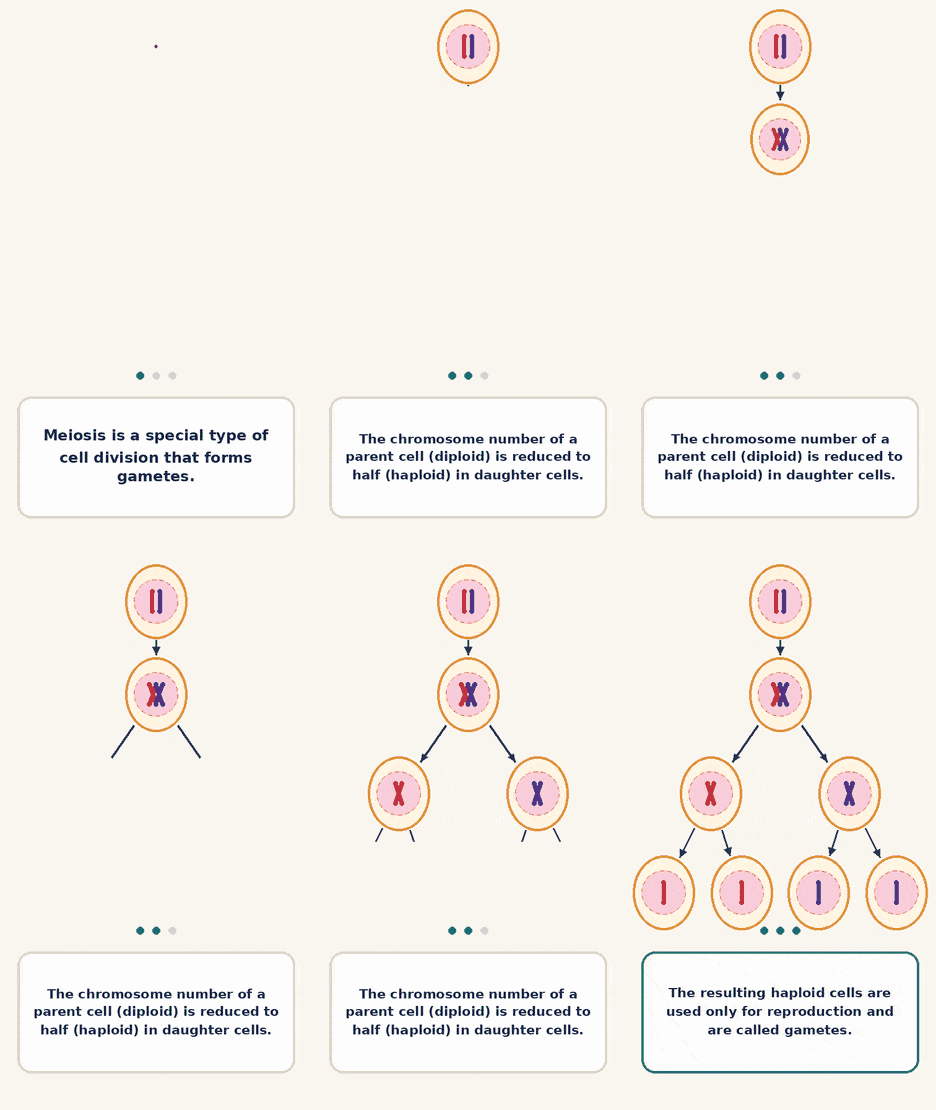
Meiosis is a special type of cell division that forms gametes. In meiosis, the chromosome number of a parent cell (diploid) is reduced to half (haploid) in daughter cells. The resulting haploid cells are used only for reproduction and are called gametes.
Important points (step by step):
- Meiosis is a special type of cell division. One cell splits to make new cells. It is different from mitosis .
- It starts with a parent cell. The parent cell is diploid , which means it has the full number of chromosomes, in pairs . In humans, it has 46 chromosomes (23 pairs).
- The parent cell divides. The new cells formed are called daughter cells .
- The chromosome number becomes half. Each daughter cell gets only one chromosome from each pair . Such a cell is called haploid . In humans, it has 23 chromosomes .
- These haploid cells are gametes. Gametes are sex cells . They are used only for reproduction .
Example:
In humans, a cell with
46 chromosomes
forms gametes with
23 chromosomes
.
Diploid parent cell (46)
→
Meiosis
→
Haploid gametes (23 each)
What are the gametes in animals and plants?
| Male gamete | Female gamete | |
|---|---|---|
| In animals | Sperm | Egg |
| In plants | Found inside the pollen grain | Egg , found inside the ovule |
What happens to the chromosomes during meiosis?
- During meiosis, the two chromosomes of each pair separate .
- So, each gamete gets only one chromosome from each pair .
- This means every human gamete has 23 chromosomes .
- Each parent gives a gamete with only half the chromosomes.
- When the two gametes join, the full number comes back .
Meiosis
Male gamete
Sperm
(23 chromosomes)
Female gamete
Egg
(23 chromosomes)
Offspring (23 pairs = 46 chromosomes)
- So, the chromosome number stays the same in every generation .
- This is how meiosis solves the doubling problem .
How many combinations of characters can gametes carry?
What do we need?
- Three pairs of beads of different colours -
| Pair | Light bead | Dark bead | Chromosome |
|---|---|---|---|
| Pair 1 (green) | Blonde hair colour | Black hair colour | Chromosome 1 |
| Pair 2 (blue) | Straight hair | Curly hair | Chromosome 2 |
| Pair 3 (red) | Brown eye colour | Black eye colour | Chromosome 3 |
- Each pair of beads stands for one pair of chromosomes . The two beads carry contrasting (opposite) characters .
What do we do?
- Randomly pick one bead from each pair.
- Write your combination, for example, "light green, light blue, light red" .
- Repeat and see how many different combinations you can make.
- Imagine how many combinations are possible with 23 pairs of chromosomes.
What do we observe?
- Each time, we get either the same combination or a different one.
- With just three pairs , eight combinations are possible.
| # | Pair 1 | Pair 2 | Pair 3 | Characters |
|---|---|---|---|---|
| 1 | Light green | Light blue | Light red | Blonde , straight hair, brown eyes |
| 2 | Light green | Light blue | Dark red | Blonde , straight hair, black eyes |
| 3 | Light green | Dark blue | Light red | Blonde , curly hair, brown eyes |
| 4 | Light green | Dark blue | Dark red | Blonde , curly hair, black eyes |
| 5 | Dark green | Light blue | Light red | Black , straight hair, brown eyes |
| 6 | Dark green | Light blue | Dark red | Black , straight hair, black eyes |
| 7 | Dark green | Dark blue | Light red | Black , curly hair, brown eyes |
| 8 | Dark green | Dark blue | Dark red | Black , curly hair, black eyes |
2 choices
×
2 choices
×
2 choices
=
2³
=
8 combinations
What does this tell us?
- Each gamete gets a random mix of chromosomes.
- With 23 pairs , the number of combinations is huge :
2²³ = 8,388,608 (about 84 lakh)
Why are children different from their parents and siblings?
- This random mixing gives many combinations .
- So, children are genetically different from their parents and also from their siblings (brothers and sisters).
- Each of us gets a unique combination of chromosomes.
- This creates variation (differences) among individuals.
Meiosis
→
Random mixing of chromosomes
→
Many combinations
→
Variation
What is variation and why is it important?
Differences among organisms, caused either by genetics or by other reasons, are called variation.
- Variation is important for the survival of a species.
- It helps some individuals adapt better to changing environments .
- Over time, this process contributes to evolution (slow change in living beings over many generations).
Examples:
- Some people can tolerate low oxygen levels at high altitudes (high places like mountains).
- Some people can digest milk in their adulthood .
