
 You are here
What are the types of pollination?
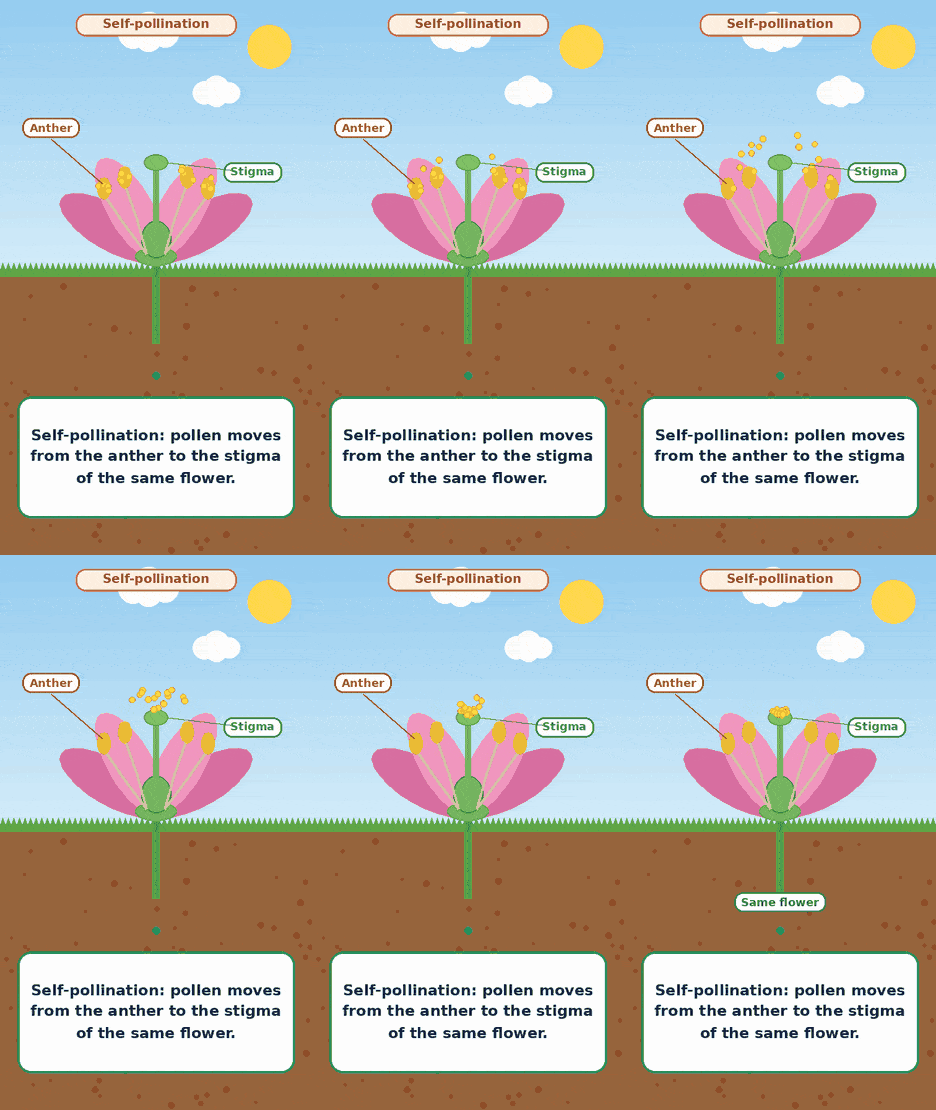
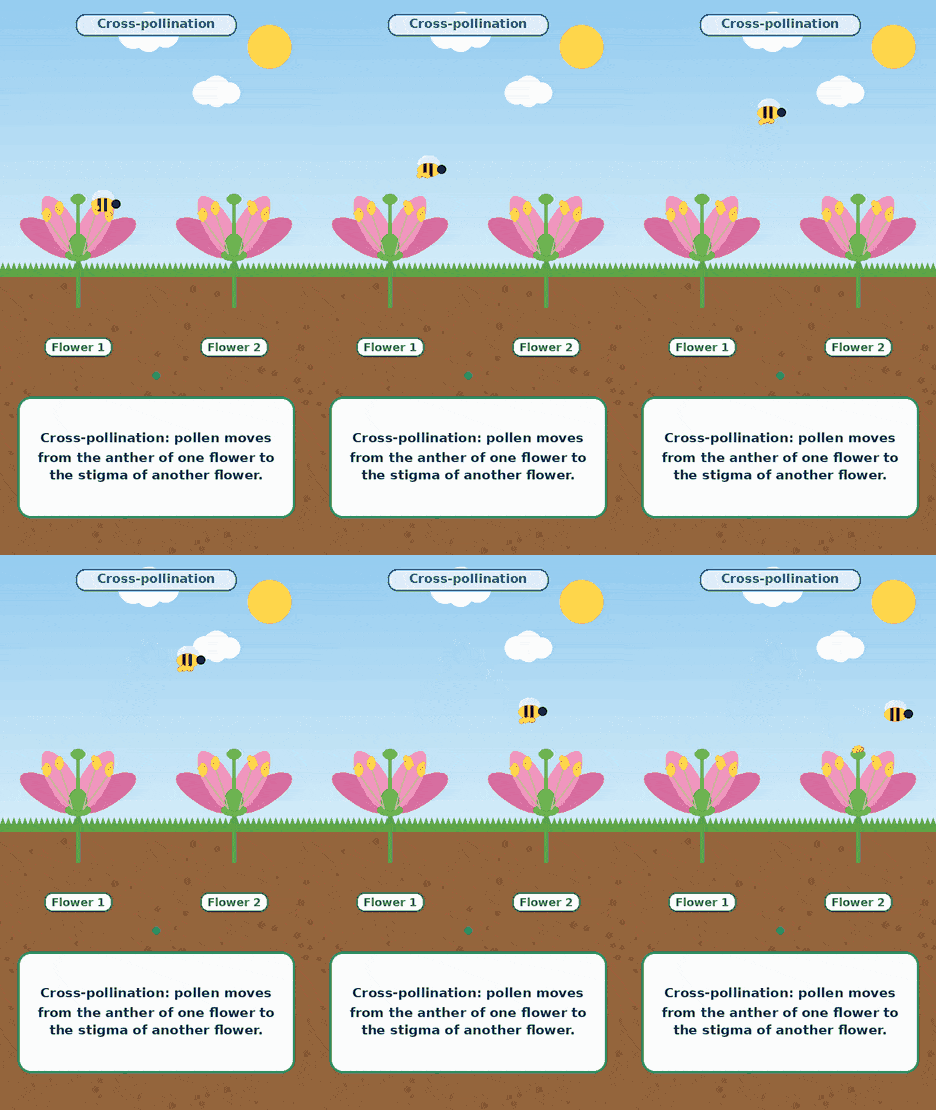
Pollination
Transfer of pollen from anther to stigma
Self-pollination
Pollen goes to the
same flower
or to
another flower of the same plant
Cross-pollination
Pollen goes to a flower of
another plant
of the same type
How are self-pollination and cross-pollination different?
| Self-pollination | Cross-pollination | |
|---|---|---|
| Definition | The transfer of pollen to the stigma of the same flower or another flower of the same plant is called self-pollination. | The transfer of pollen from the anther of a flower of one plant to the stigma of a flower of another plant of the same type is called cross-pollination. |
| Pollen goes to | The same flower , or another flower of the same plant | A flower of another plant of the same type |
| Number of plants | One | Two |
| Example | Pea | Papaya (male and female flowers on different trees ) |
Self-pollination
Flower (anther)
→
Same flower / same plant (stigma)
Cross-pollination
Plant 1 (anther)
→
Plant 2 (stigma)
Is self-pollination still sexual reproduction?
- Yes. In self-pollination, only one plant is involved.
- But that plant still makes both a male gamete (in the pollen) and a female gamete (the egg).
- Both gametes are made by meiosis , and they join .
- So, it is still sexual reproduction , even with one plant.
- There is less mixing of characteristics than in cross-pollination, because both gametes come from the same plant .
Why is pollination important?
- The transfer of pollen grains to the stigma is important for the formation of fruits and seeds .
- Nature has given plants many ways (strategies) for pollination to happen.
What do you think will happen if pollination does not occur?
- No fruits and seeds will form.
- So, the plant cannot reproduce sexually , and new plants will not grow from seeds.
Pollination
→
Fruits and seeds form
No pollination
→
No fruits and seeds
Questions from the book for this section
-
🤔 Pause and Ponder 3
A farmer plants two varieties of maize side by side, but notices that seeds form only when pollen from one variety reaches the stigma of the other. What type of pollination is this?View answer
Answer- This is cross-pollination .
- The pollen goes from a flower of one plant to the stigma of a flower of another plant of the same type (maize).
-
📝 Revise, Reflect, Refine Q1
A flower's anthers are removed before it matures. Later, pollen from another plant of the same species is dusted onto its stigma and seeds are produced. Which process has been ensured here?(i) Self-pollination
(ii) Cross-pollination
(iii) Fertilisation
(iv) Tissue cultureView answer
AnswerAnswer: (ii) Cross-pollination- The anthers were removed , so the flower cannot get its own pollen .
- Pollen from another plant of the same species was put on its stigma. This is cross-pollination .
Why the other options are wrong:- (i) Self-pollination: It needs pollen from the same flower or the same plant . But the anthers were removed, so this is not possible .
- (iii) Fertilisation: Fertilisation does happen later, after the pollen reaches the stigma. But the step that was controlled here is which pollen reached the stigma. That is cross-pollination.
- (iv) Tissue culture: It is a method of asexual reproduction in a laboratory. It does not use pollen at all.
-
📝 Revise, Reflect, Refine Q8
If all flowers in a type of plant were only capable of self-pollination, how would it affect the genetic diversity over several generations? Explain.View answer
Answer- Genetic diversity means the differences in genetic material among plants of the same type.
- In self-pollination, both gametes come from the same plant , so there is less mixing of characteristics.
- Over many generations , the plants would become more and more alike .
- So, the genetic diversity would decrease .
- With less variation, the plants would find it harder to adapt to changes in the environment, and a disease could harm many plants at once.
-
📝 Revise, Reflect, Refine Q11
Look at the picture and find out which type(s) of pollination might have been followed in these flowers.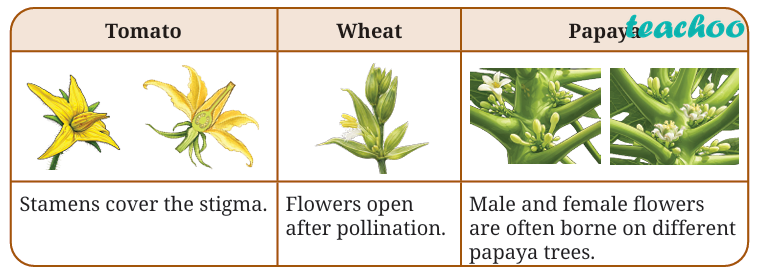
View answer
AnswerFlower Prompt in the book Type of pollination Reason Tomato Stamens cover the stigma. Self-pollination The anthers are right around the stigma, so pollen falls on the stigma of the same flower . Wheat Flowers open after pollination. Self-pollination Pollination happens while the flower is still closed , so only its own pollen can reach the stigma. Papaya Male and female flowers are often borne on different papaya trees. Cross-pollination Pollen must travel from a flower on one tree to a flower on another tree .
