
 You are here
What are the types of plants?
Plants
Flowering plants
They
have flowers
Called
angiosperms
Example: rose, hibiscus, mango, pea, sunflower
Non-flowering plants
They
do not have flowers
Called
gymnosperms
Example: pine, deodar, cycas
Let's study flowering plants in detail.
What are the different parts of a flower and what do they do?
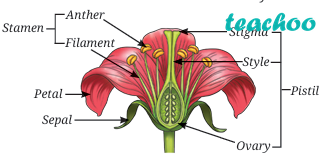
Flower
- Sepals (outermost, green)
- Petals (coloured)
- Stamens (male part)
- Pistil (female part, in the centre)
Let's study them one by one.
What is a sepal?
- The sepal is the thin, flat, green covering around all the parts of a flower.
- It is the outermost whorl (ring) of the flower.
- In a bud , the sepals cover the coloured parts.
- Function: Sepals protect the flower in the bud stage , and the other parts when it blooms.
What is a petal?
- Petals are the coloured projections (parts that stick out) of a flower.
- They are the most attractive part of a flower.
- Function: Their bright colours and fragrance (sweet smell) attract insects and birds , which help in reproduction.
- In some flowers, the sepals and petals are fused (joined together).
How are the colour and fragrance of flowers useful for reproduction?
- Bright colours and fragrance attract insects and birds .
- These animals carry pollen from one flower to another, which helps the flower reproduce .
What is a stamen?
- The stamen is the male part of a flower.
| Part of stamen | What it does |
|---|---|
| Filament | A thin stalk that holds the anther |
| Anther | Produces pollen grains , which contain the male gametes |
What is a pistil?
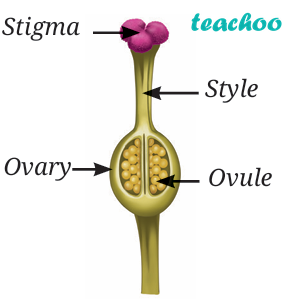
- The pistil is the female part of a flower. It is in the centre .
| Part of pistil | What it is |
|---|---|
| Stigma | The tip of the pistil. It may be flat and/or sticky . |
| Style | A thin, long tube that connects the stigma to the ovary |
| Ovary | The swollen base . It contains ovules . Each ovule has an egg cell (female gamete). |
| Stamen | Pistil | |
|---|---|---|
| Type | Male part | Female part |
| Parts | Filament , anther | Stigma , style , ovary |
| Gamete | Male gametes inside pollen grains | Egg cell inside the ovule |
Activity 11.5: Let us explore (Parts of a flower)
What do we need?
- Different types of flowers from our surroundings
- A blade
- A dissecting microscope (a microscope used to see the inside of a cut object)
What do we do?
- Collect different types of flowers from your surroundings.
- Carefully observe each part of the flowers, starting from the outer whorl to the inner one.
- Record the presence of each floral part in Table 11.1.
- Guess the function of each part of the flower from what you see.
- Cut a transverse section (a cut across) and a longitudinal section (a cut along the length) of the ovary (the swollen base of the pistil). Observe it under a dissecting microscope.
- Record any other feature(s) in Table 11.1.
- Draw a diagram of the structure you observed under the microscope.
What do we observe?
Table 11.1: Observation table to study the parts of a flower
| Flower part | A: Pumpkin (female flower) | B: Pumpkin (male flower) | C: Hibiscus | D: Mustard | Function |
|---|---|---|---|---|---|
| Sepal | Yes | Yes | Yes | Yes | Protects the bud |
| Petal | Yes | Yes | Yes | Yes | Attracts insects |
| Stamen | No | Yes | Yes | Yes | Male part , makes pollen |
| Pistil | Yes | No | Yes | Yes | Female part , has egg cells |
| Other features | Swollen ovary below the petals | Many stamens in the centre | Large red petals | Small yellow flowers with 4 petals |
- Inside the cut ovary, we see small round ovules .
What does this tell us?
- Most flowers have all four parts .
- Some flowers do not have a stamen or a pistil.
How does the stamen work with the pistil?
- The stamen makes pollen , which carries the male gametes .
- The pistil has the egg cells , and a stigma to receive pollen .
- So, for the two to work together, pollen from a stamen must reach the stigma of a pistil for a fruit to form.
- But is this really needed? What if the pollen never reaches the stigma? Will the flower still form a fruit ?
Stamen (makes pollen)
→
pollen must reach
→
Stigma of pistil
→
Fruit can form
- Let's find out with an activity.
Activity 11.6: Let us investigate
What do we need?
- A pea (matar) plant in a garden or field
- Muslin cloth bags (bags made of thin, soft cotton cloth)
What do we do?
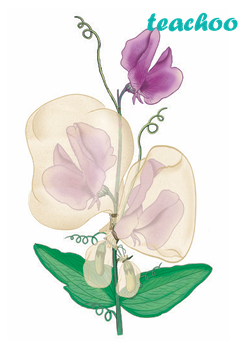
- On the same pea plant , select two young flower buds and three freshly blossomed (just opened) flowers .
- Carefully remove the stamens from one bud and one flower .
-
Loosely
wrap muslin cloth bags
around:
- the bud,
- the bud with stamens removed,
- the flower with stamens removed,
- one freshly blossomed flower.
- Leave one freshly blossomed flower uncovered .
- Observe them regularly. Fruits start forming in place of the uncovered flower. Let them grow for a few more days.
- When the pods on the uncovered flower are fully developed, remove the bags from all the wrapped flowers and observe.
- Note your observations in Table 11.2.
-
What do we observe?
Table 11.2: Observation table to study pollination in a pea plant
| Treatment | Fruit formation |
|---|---|
| Flower bud (wrapped) | Yes |
| Flower bud with stamens removed (wrapped) | No |
| Flower with stamens removed (wrapped) | Yes |
| Flower (wrapped) | Yes |
| Flower (not wrapped) | Yes |
- Fruits form in all the treatments except one : the bud with stamens removed .
Why does each flower behave this way?
- A pea flower pollinates itself (gets its own pollen), often even before it opens .
- Wrapped bud: its own stamens give pollen inside the bag, so fruit forms.
- Bud with stamens removed: it has no pollen of its own , and the bag stops pollen from outside . So, no fruit forms.
- Flower with stamens removed: it had already got pollen before it opened , so fruit still forms.
- Wrapped flower and uncovered flower: both get pollen, so fruit forms.
What does this tell us?
- If pollen does not reach the stigma, no fruit forms.
- So, the transfer of pollen grains from the anther to the stigma is necessary for fruit formation .
What is pollination?
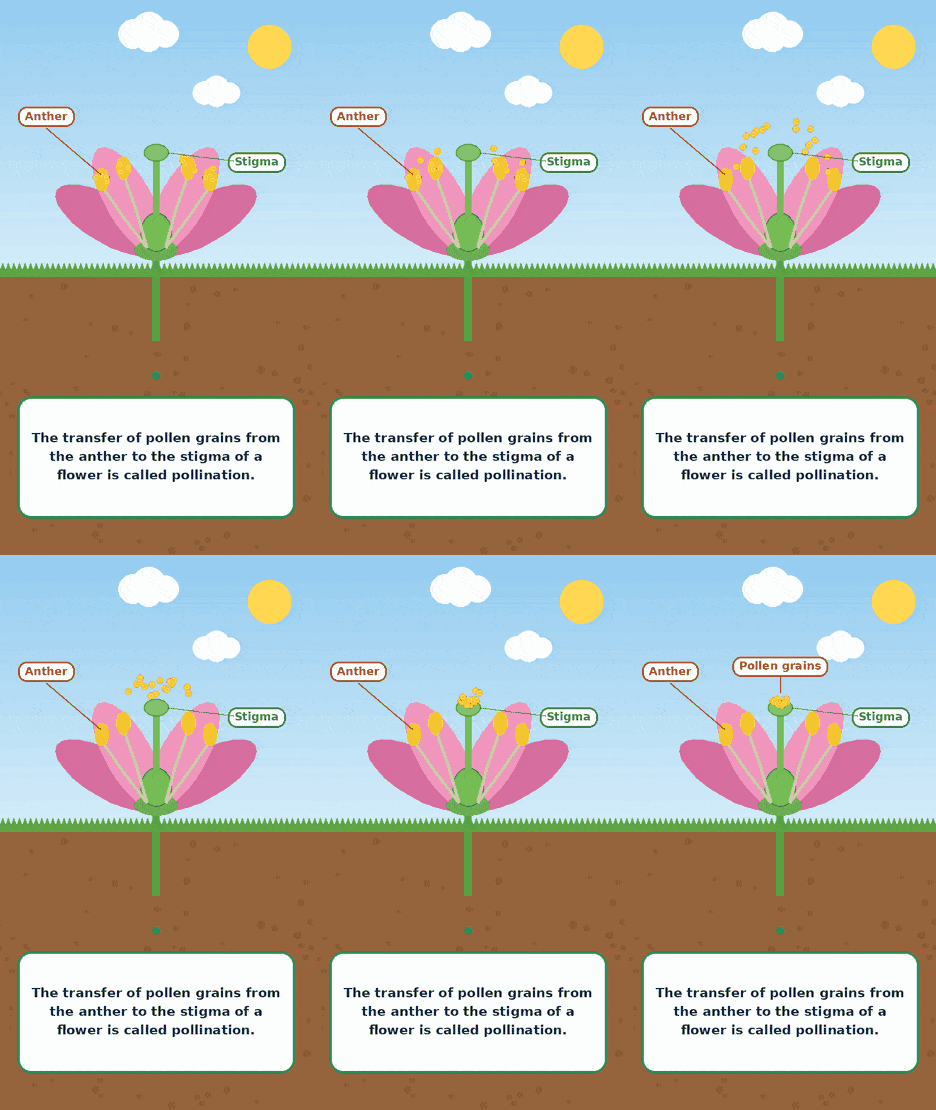
The transfer of pollen grains from the anther to the stigma of a flower is called pollination.
Example:
In a
pea
flower, pollen moves from its
anther
to its
stigma
, and then a
pod
(fruit) forms.
Breaking it down:
| Part of the definition | Meaning |
|---|---|
| Transfer | Moving from one place to another |
| Pollen grains | Tiny grains made by the anther . They carry the male gametes . |
| Anther | The part of the stamen that makes pollen |
| Stigma | The tip of the pistil that receives pollen |
Pollen in anther
→
Transferred
→
Lands on stigma
→
Fruit can form
