
 You are here
What happens after pollen reaches the stigma?
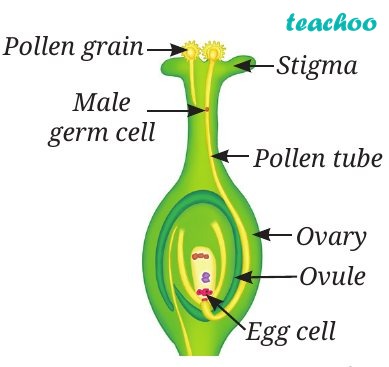
- The pollen must land on a compatible stigma (the stigma of a flower of the same type of plant).
- Then, the pollen grain produces a pollen tube .
- The pollen tube grows down through the style into the ovary .
- The male gamete moves through this tube and reaches the ovule .
- There, it fuses (joins) with the egg cell .
Pollen lands on stigma
→
Pollen tube grows down the style
→
Reaches the ovule
→
Male gamete fuses with the egg cell
What is fertilisation?
Fertilisation is the biological process where a male and a female gamete (reproductive cell) fuse to form a single new cell called a zygote.
Example:
In a
pea
flower, the male gamete from the pollen fuses with the egg cell in the ovule.
Male gamete
+
Female gamete
→
Fertilisation
→
Zygote (fertilised egg)
→
Embryo (young plant inside a seed)
What is a zygote?
- The fertilised egg (the egg after fertilisation) is called a zygote .
- The zygote later develops into an embryo (a young developing plant inside a seed).
Where does fertilisation take place?
-
Fertilisation takes place
inside the ovule
, which is located
within the ovary
of the flower.
- Ovary: the swollen base of the pistil. It contains ovules .
- Ovule: it contains the female gamete (egg cell).
- When a pollen grain lands on the stigma , it grows a long pollen tube down into the ovary and enters the ovule .
- This is the exact spot where the male gamete meets the egg cell .
-
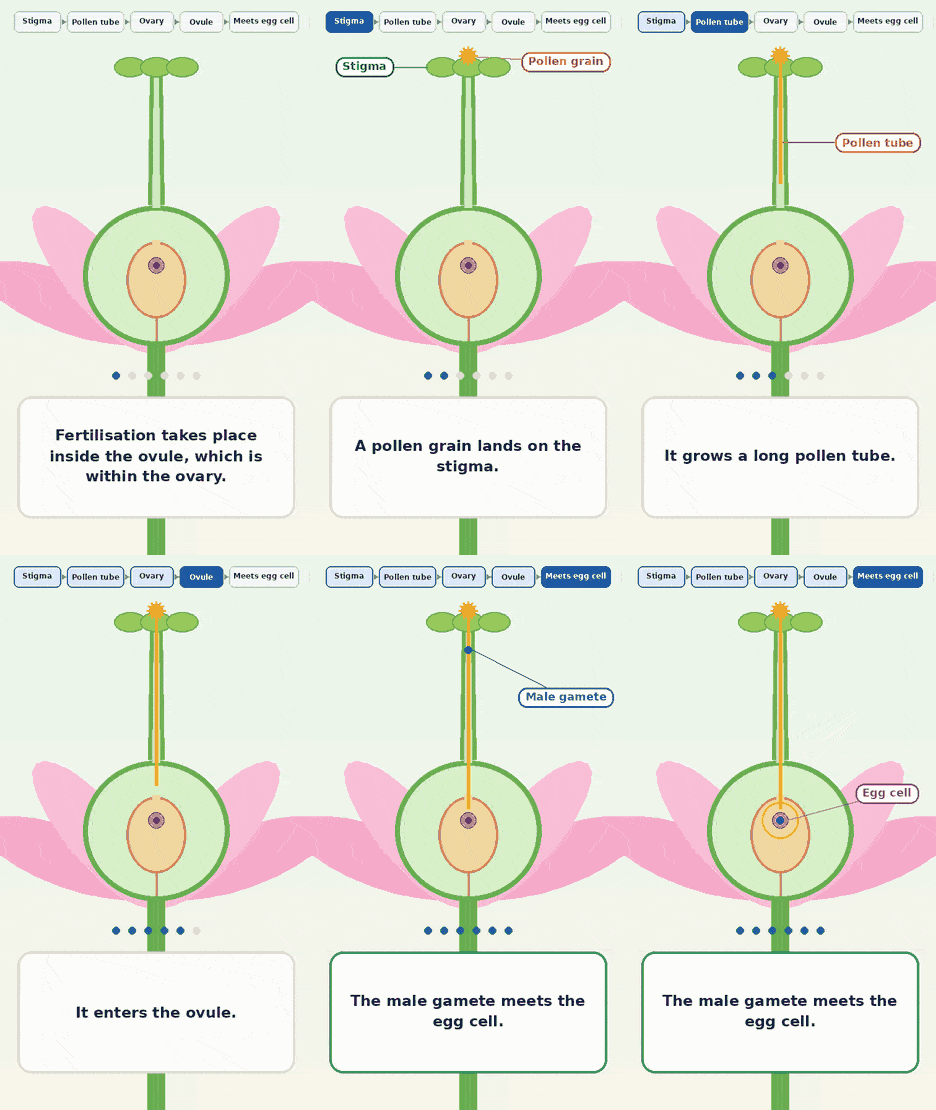
Stigma
→
Pollen tube
→
Ovary
→
Ovule
→
Male gamete meets the egg cell
How are fruits and seeds formed?
- After fertilisation, the ovary around the ovules grows bigger and becomes the fruit .
- The ovules inside it become the seeds .
-
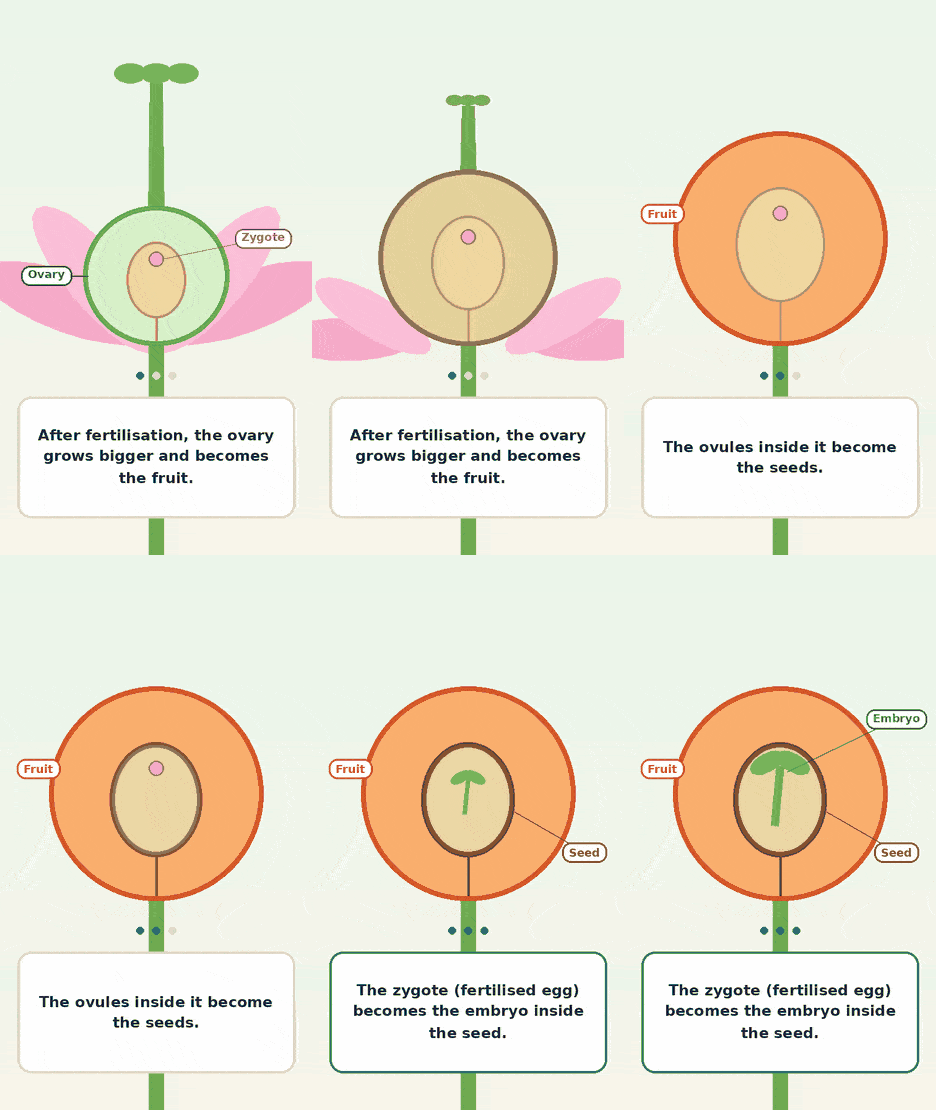
| Part of the flower | Becomes |
|---|---|
| Ovary | Fruit |
| Ovule | Seed |
| Zygote (fertilised egg) | Embryo (inside the seed) |
How does a seed grow into a new plant?
- Seeds are spread to new places by wind , water and animals . This is called seed dispersal .
- When the conditions are favourable (right water , air and temperature ), the seed germinates (starts to grow).
- It grows into a new plant .
-
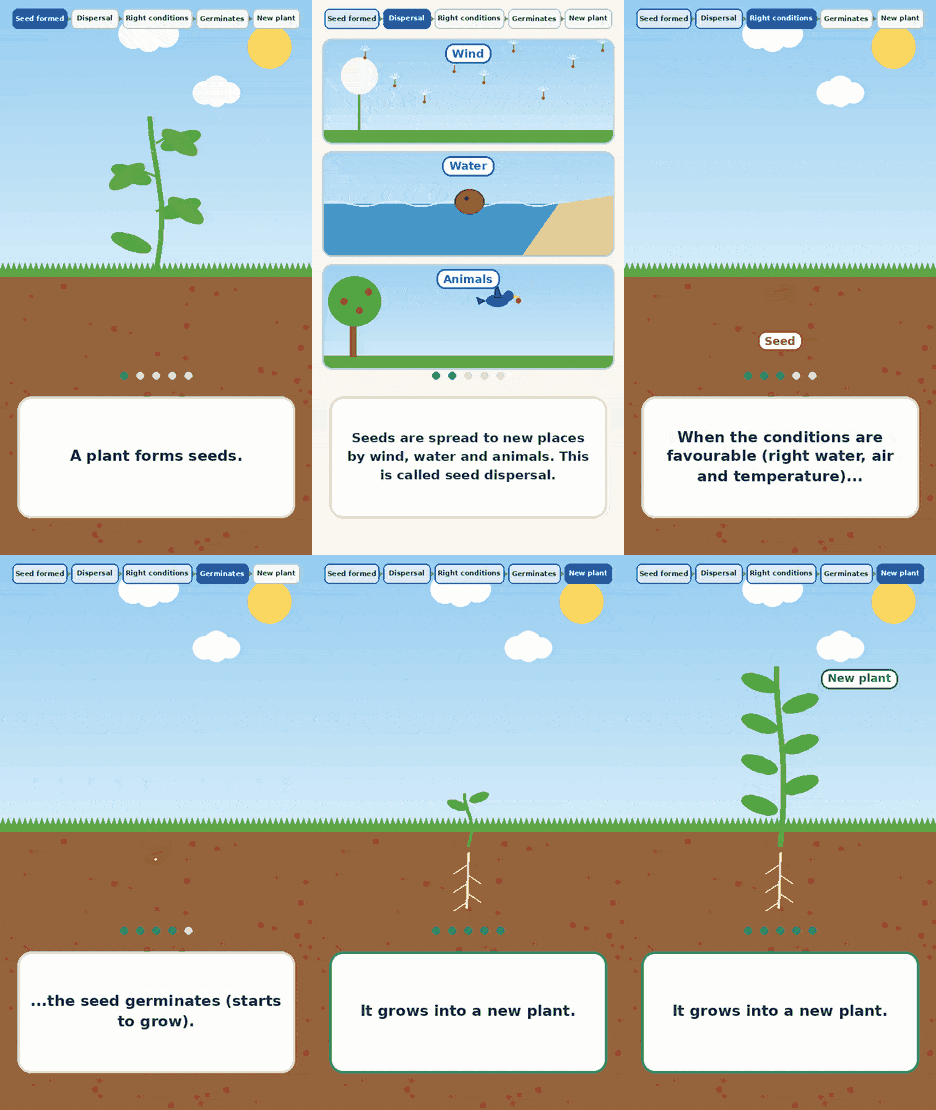
Seed formed
→
Seed dispersal (wind, water, animals)
→
Right conditions
→
Seed germinates
→
New plant
Which type of reproduction is this and why is it important?
- This is sexual reproduction , because a male gamete and a female gamete fuse to form the new plant.
- It produces new plants .
- It also creates variation (differences), which helps plant species survive and adapt to their environment.
Activity 11.7: Let us find out
- Studies of pollen production and seed formation in different flowers show these approximate results.
Table 11.3: Pollen production and seed formation data
| Pollination strategy | Pollen grains released per flower | Average number of seeds formed |
|---|---|---|
| Wind-pollinated grasses (maize, wheat) | 5,00,000 to 10,00,000 | 50 to 200 |
| Insect-pollinated plants (sunflower) | 20,000 to 40,000 | 800 to 1,000 |
1. Compare the two strategies
(a) Pollen to seed ratio
(how many pollen grains are needed for one seed)
| Strategy | Working | Pollen grains for one seed |
|---|---|---|
| Wind | 5,00,000 ÷ 200 = 2,500 and 10,00,000 ÷ 50 = 20,000 | 2,500 to 20,000 |
| Insect | 20,000 ÷ 1,000 = 20 and 40,000 ÷ 800 = 50 | 20 to 50 |
(b) Efficiency of pollination and seed formation
- Pollination by insects is much more efficient .
- It makes more seeds with far fewer pollen grains.
- With wind , most pollen grains are wasted . They never reach a stigma.
2. Why can making a very large number of pollen grains still be a good strategy?
- The wind carries pollen randomly (in any direction), so most pollen is lost.
- By making lakhs of pollen grains , the plant makes sure that at least some reach a stigma.
- The wind is always available and free . The plant does not need to make bright petals , nectar or fragrance to attract insects.
- So, even with a lot of waste, the plant still forms enough seeds .
Questions from the book for this section
-
🤔 Pause and Ponder 1
In a china-rose (hibiscus or gudhal) plant, a pollen tube grows and continues through the style after pollen lands on the stigma. Which process is about to happen next?View answer
Answer- Fertilisation is about to happen.
- The pollen tube will reach the ovule , and the male gamete will fuse with the egg cell .
-
🤔 Pause and Ponder 2
Look at the pictures of calotropis (madar) seeds and dandelion seeds. Can you guess what kind of seed dispersal these seeds are adapted for?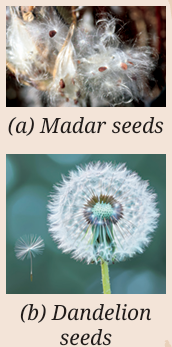
View answer
Answer- These seeds are adapted for dispersal by wind .
- They are very light and have fine, soft hairs that help them float in the air and travel far.
-
📝 Revise, Reflect, Refine Q2
Arrange the following stages of sexual reproduction in plants in the correct order:(i) Pollen germination on stigma (ii) Fertilisation (iii) Pollination (iv) Formation of zygoteView answer
AnswerAnswer: (iii) → (i) → (ii) → (iv)Pollination → Pollen germination on stigma → Fertilisation → Formation of zygote- Pollination: pollen reaches the stigma .
- Pollen germination: the pollen grain grows a pollen tube on the stigma.
- Fertilisation: the male gamete fuses with the egg cell in the ovule.
- Formation of zygote: the fertilised egg is the zygote.
-
📝 Revise, Reflect, Refine Q10
Suresh prepares slides with pollen grains in different sugar concentrations (0%, 2.5%, 5%, 7.5%, 10%) to study the germination of pollen.(i) What are the different hypotheses which can be tested using this set-up?(ii) What parameters should be kept the same in this set-up?View answer
Answer(i) What are the different hypotheses which can be tested using this set-up?- The amount of sugar affects pollen germination .
- Pollen germinates best at one particular sugar concentration.
- Pollen does not germinate (or germinates very little) without sugar (0%).
- Too much sugar may slow down or stop pollen germination.
(ii) What parameters should be kept the same in this set-up?- The type of pollen (from the same kind of plant)
- The amount of pollen on each slide
- The amount of sugar solution on each slide
- The temperature and light
- The time after which the slides are observed
- The 0% slide is the control . It shows what happens without sugar .
Meet a Scientist: P. Maheshwari
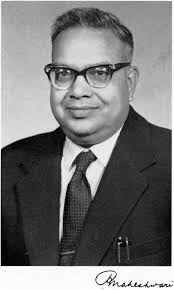
- P. Maheshwari is known as the "Father of Indian Embryology" .
- Embryology is the study of the reproductive organs of plants.
-
He developed
in-vitro fertilisation
(fertilisation
outside
the plant) in flowering plants.
- He fused an egg and a male gamete in a test tube to create new hybrid plants .
- He was one of the first scientists to grow plant embryos on artificial nutrient media (man-made food in the lab).
- His book, An Introduction to the Embryology of Angiosperms (1950) , is a classic and is still used by scientists around the world.
Bridging Science and Society: Plant breeding
- Sexual reproduction in plants is used in plant breeding (making new and better varieties of crops).
| Method | How it is done |
|---|---|
| Selective breeding | Farmers select plants with desirable characters (good features) for reproduction |
| Artificial hybridisation | Remove the stamens , cover the flower with a bag to stop self-pollination, and transfer pollen with desired characters by hand |
| Genetic engineering | Insert genetic material with desired characters into the DNA of selected varieties |
- These methods give new varieties , like high-yielding and disease-resistant varieties.
- This has completely changed crop production in agriculture.
