
 You are here
End-of-Chapter Exercises
Last updated at October 23, 2026 by Teachoo
Transcript
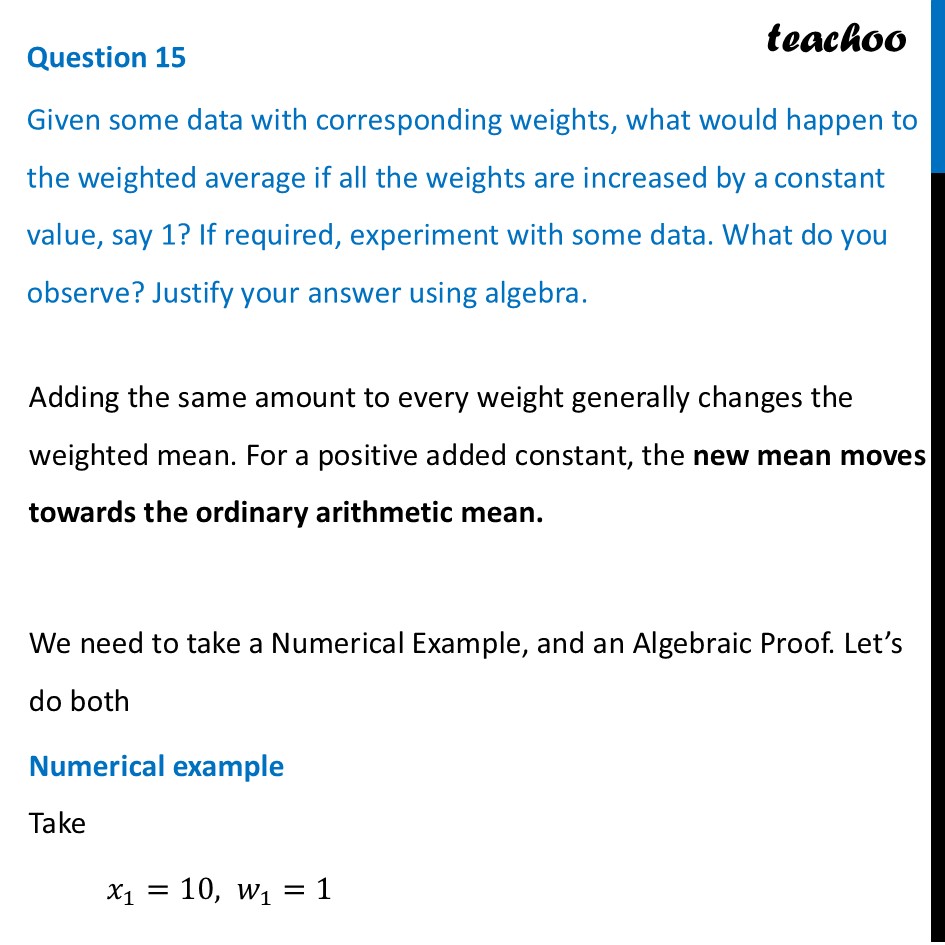
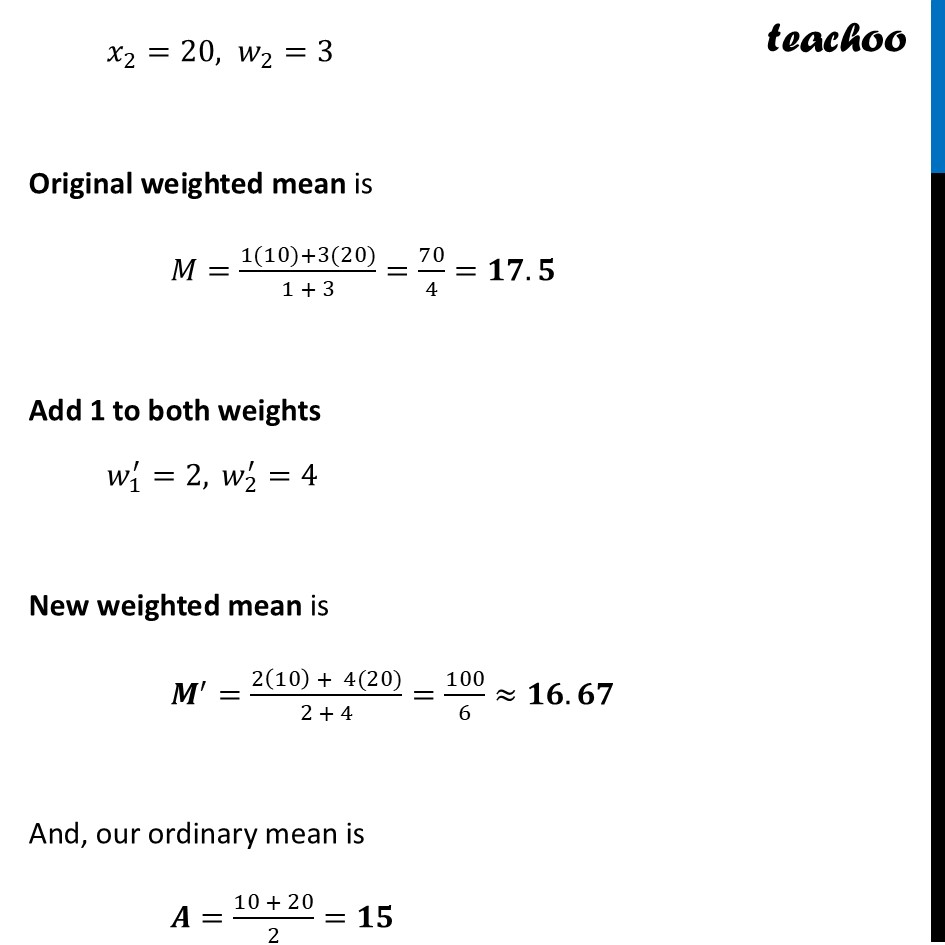
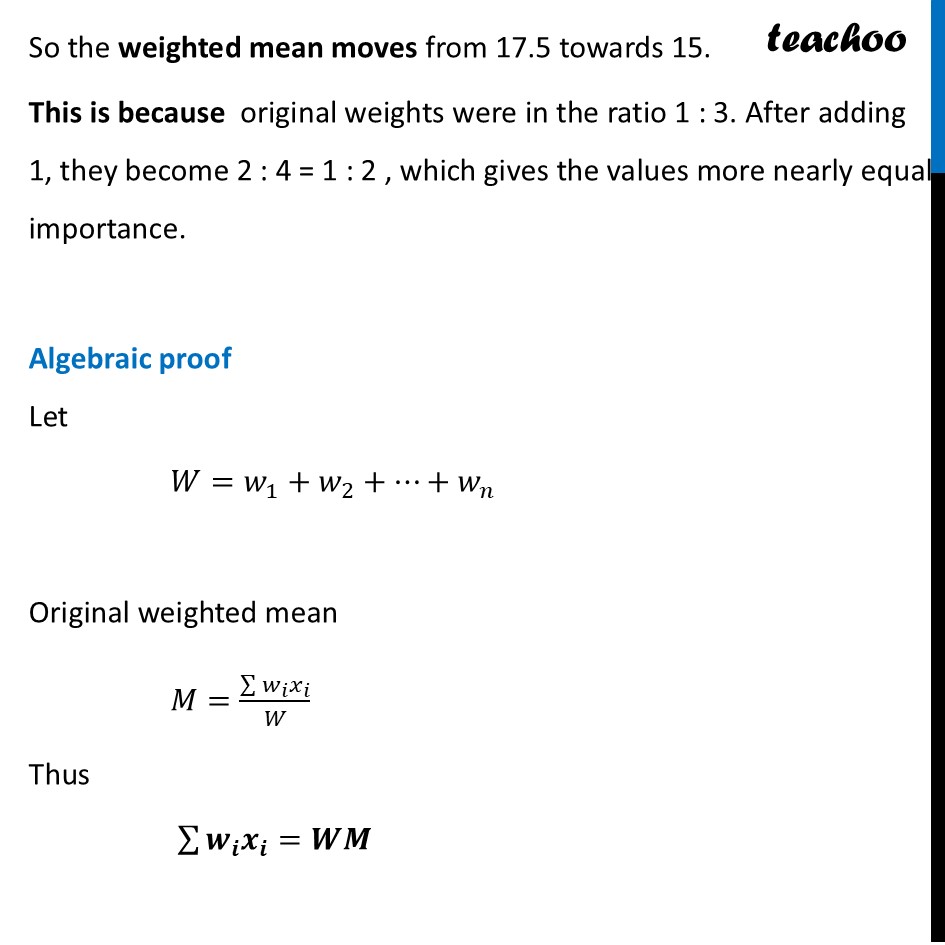
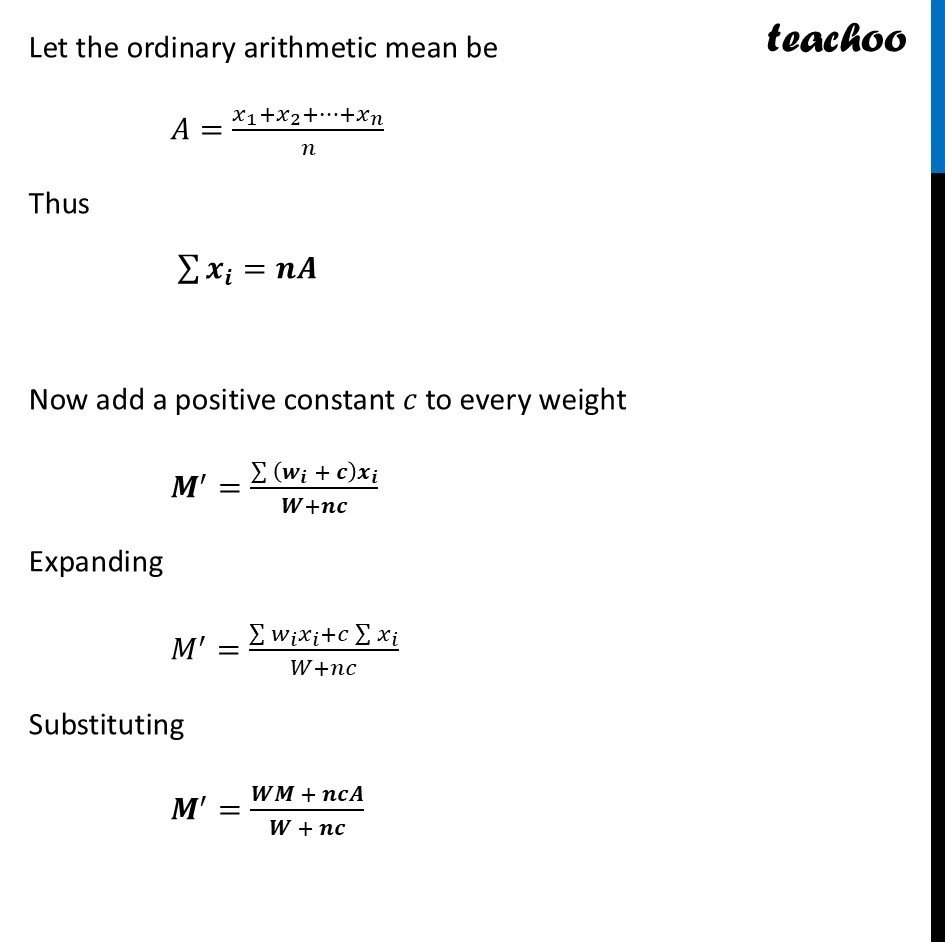
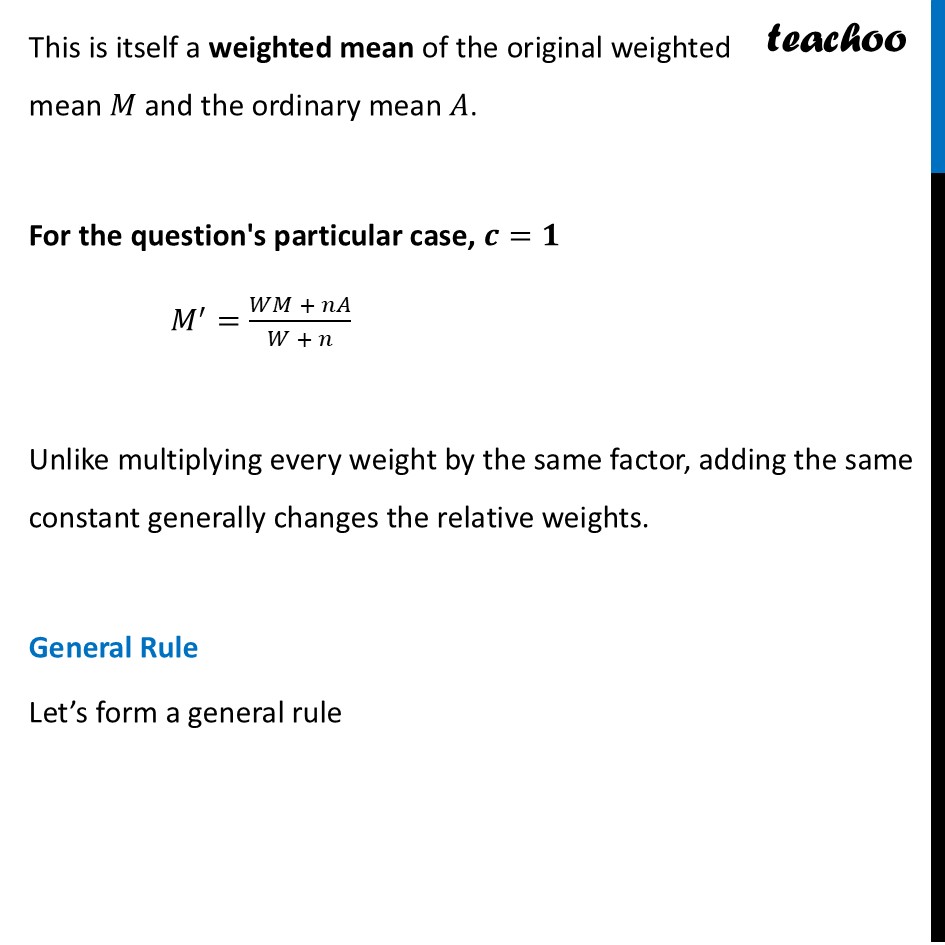
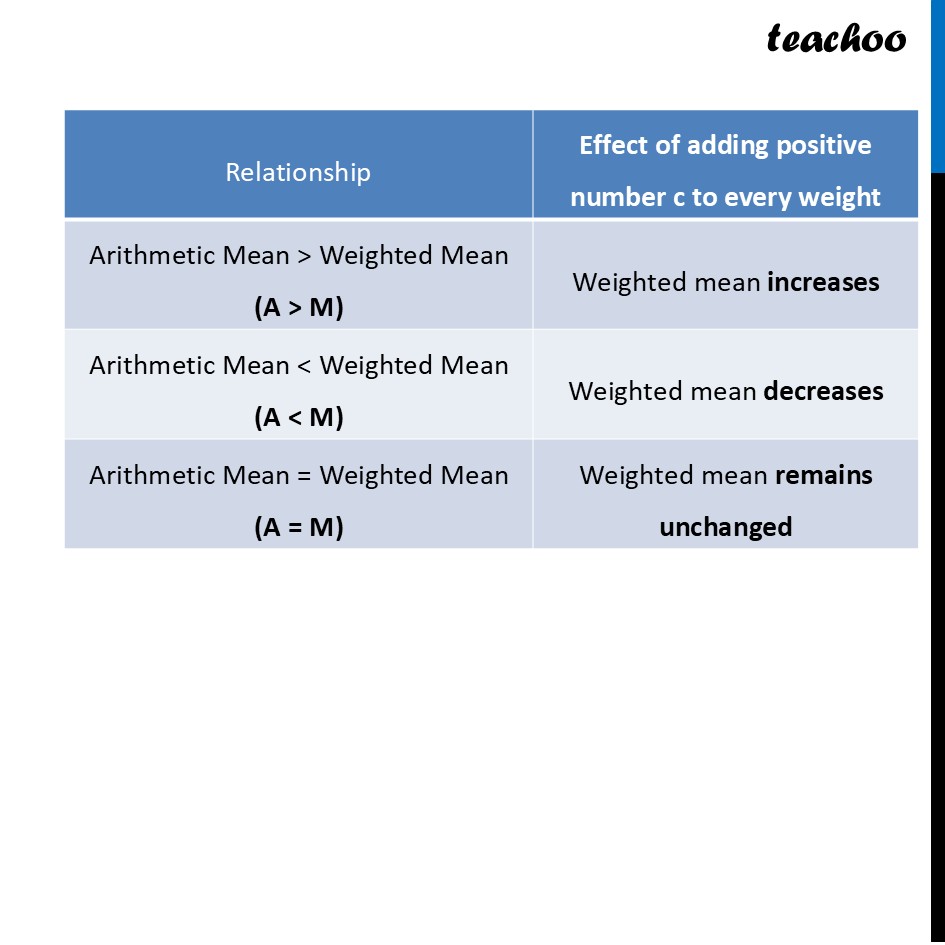
Question 15 Given some data with corresponding weights, what would happen to the weighted average if all the weights are increased by a_( )constant value, say 1? If required, experiment with some data. What do you observe? Justify your answer using algebra. Adding the same amount to every weight generally changes the weighted mean. For a positive added constant, the new mean moves towards the ordinary arithmetic mean. We need to take a Numerical Example, and an Algebraic Proof. Let’s do both Numerical example Take 𝑥_(1)=10, 𝑤_(1)=1 𝑥_(2)=20, 𝑤_(2)=3[, ; , ] Original weighted mean 𝑀=(1(10)+3(20))/(1 + 3)=(70)/(4)=𝟏𝟕.𝟓 Add 1 to both weights 𝑤_(1)^(′)=2, 𝑤_(2)^(′)=4 New weighted mean 𝑀^(′)=(2(10)+4(20))/(2+4)=(100)/(6)≈16.67 The ordinary mean is 𝐴=(10+20)/(2)=15 So the weighted mean moves from 17.5 towards 15. 𝑥_(2)=20, 𝑤_(2)=3[, ; , ] Original weighted mean is 𝑀=(1(10)+3(20))/(1 + 3)=(70)/(4)=𝟏𝟕.𝟓 Add 1 to both weights 𝑤_(1)^(′)=2, 𝑤_(2)^(′)=4 New weighted mean is 𝑴^(′)=(2(10) + 4(20))/(2 + 4)=(100)/(6)≈𝟏𝟔.𝟔𝟕 And, our ordinary mean is 𝑨=(10 + 20)/(2)=𝟏𝟓 So the weighted mean moves from 17.5 towards 15. This is because original weights were in the ratio 1 : 3. After adding 1, they become 2 : 4 = 1 : 2 , which gives the values more nearly equal importance. Algebraic proof Let 𝑊=𝑤_(1)+𝑤_(2)+⋯+𝑤_(𝑛) Original weighted mean 𝑀=(∑_()^() 𝑤_(𝑖)𝑥_(𝑖))/(𝑊) Thus ∑_()^() 𝒘_(𝒊)𝒙_(𝒊)=𝑾𝑴 Let the ordinary arithmetic mean be 𝐴=(𝑥_(1)+𝑥_(2)+⋯+𝑥_(𝑛))/(𝑛) Thus ∑_()^() 𝒙_(𝒊)=𝒏𝑨 Now add a positive constant 𝑐 to every weight 𝑴^(′)=(∑_()^() (𝒘_(𝒊) + 𝒄)𝒙_(𝒊))/(𝑾+𝒏𝒄) Expanding 𝑀^(′)=(∑_()^() 𝑤_(𝑖)𝑥_(𝑖)+𝑐∑_()^() 𝑥_(𝑖))/(𝑊+𝑛𝑐) Substituting 𝑴^(′)=(𝑾𝑴 + 𝒏𝒄𝑨)/(𝑾 + 𝒏𝒄) This is itself a weighted mean of the original weighted mean 𝑀 and the ordinary mean 𝐴. For the question's particular case, 𝒄=𝟏 𝑀^(′)=(𝑊𝑀 + 𝑛𝐴)/(𝑊 + 𝑛) Unlike multiplying every weight by the same factor, adding the same constant generally changes the relative weights. General Rule Let’s form a general rule Relationship | Effect of adding positive number c to every weight Arithmetic Mean > Weighted Mean (A > M) | Weighted mean increases Arithmetic Mean < Weighted Mean (A < M) | Weighted mean decreases Arithmetic Mean = Weighted Mean (A = M) | Weighted mean remains unchanged
