You are here
End-of-Chapter Exercises
Last updated at October 23, 2026 by Teachoo
Transcript
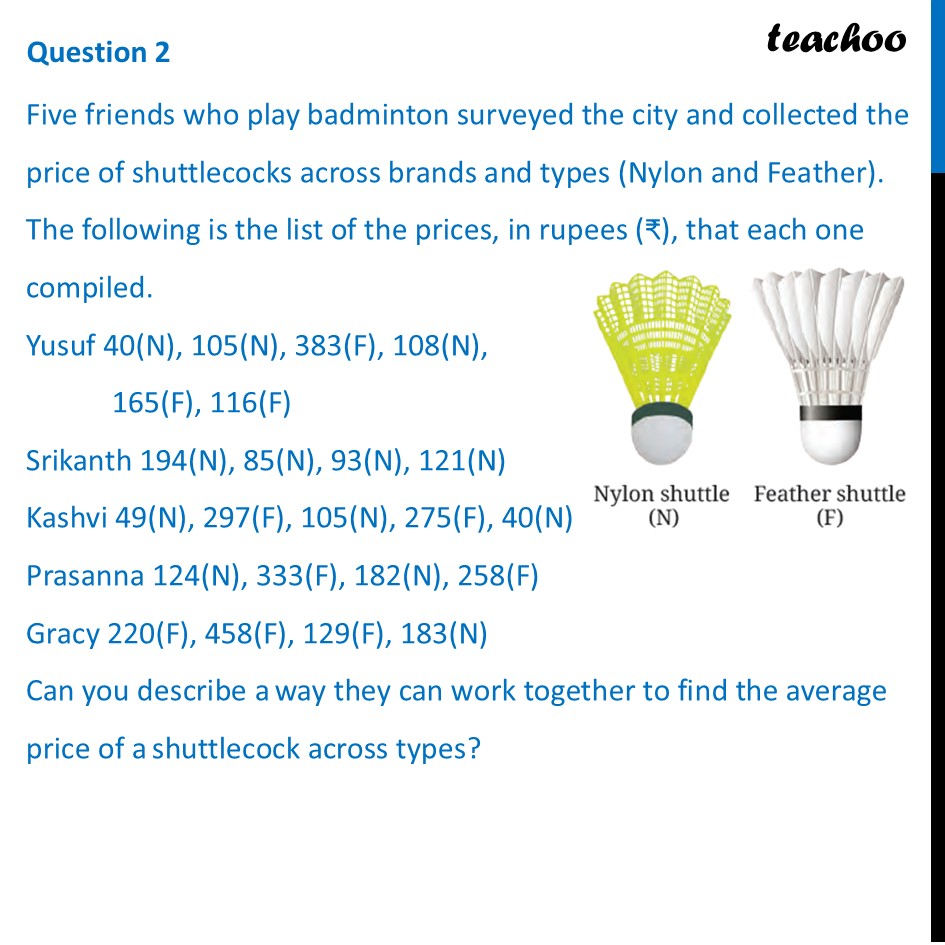
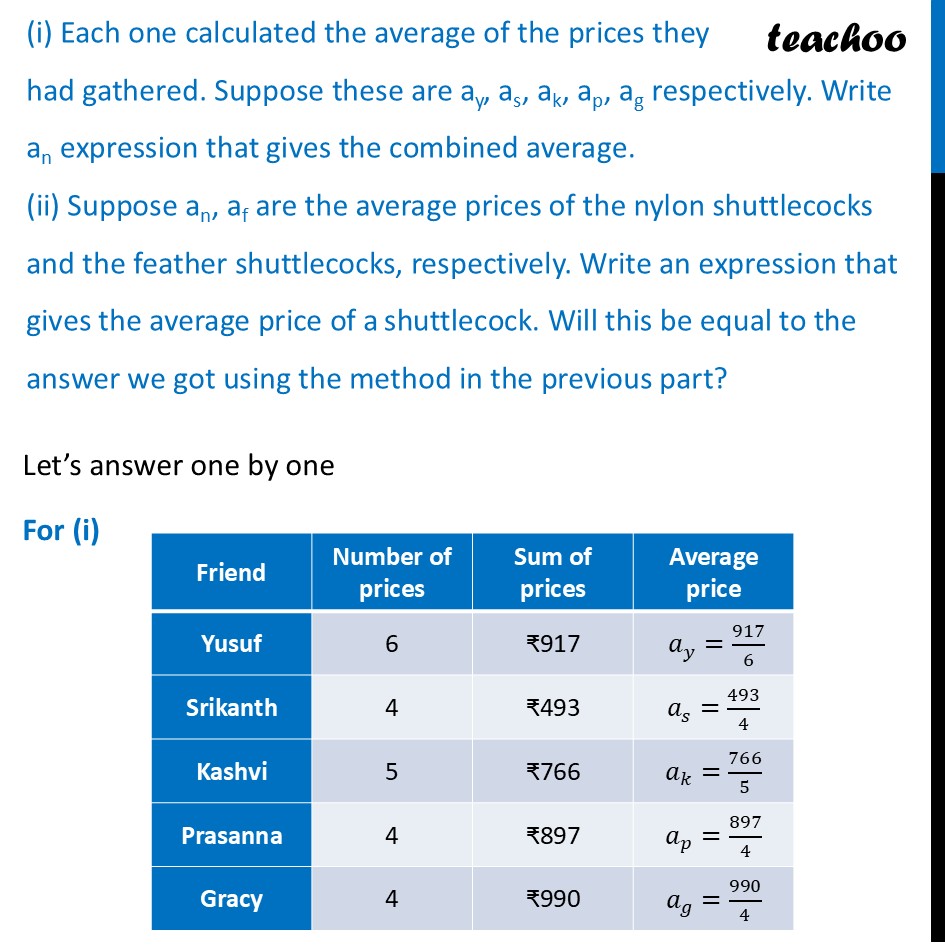
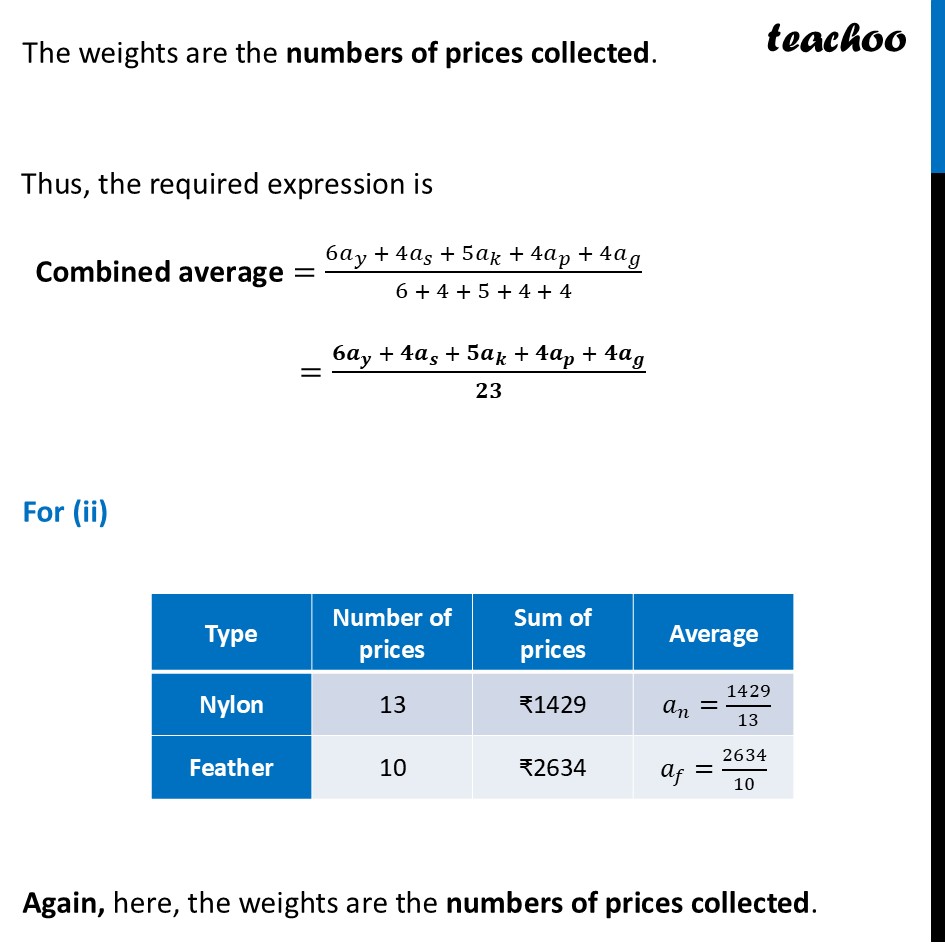
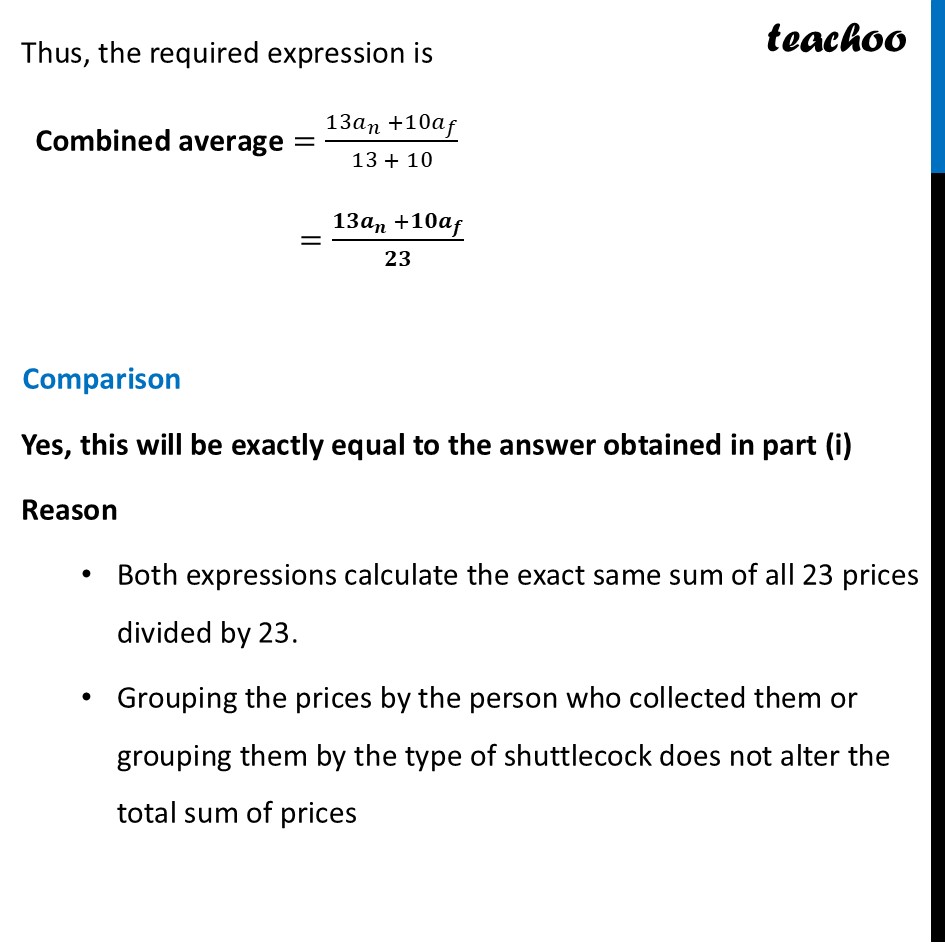
Question 2 Five friends who play badminton surveyed the city and collected the price of shuttlecocks across brands and types (Nylon and Feather). The following is the list of the prices, in rupees (₹), that each one compiled. Yusuf 40(N), 105(N), 383(F), 108(N), 165(F), 116(F) Srikanth 194(N), 85(N), 93(N), 121(N) Kashvi 49(N), 297(F), 105(N), 275(F), 40(N) Prasanna 124(N), 333(F), 182(N), 258(F) Gracy 220(F), 458(F), 129(F), 183(N) Can you describe a_( )way they can work together to find the average price of a_( )shuttlecock across types? Nylon shuttle Feather shuttle Ww) (F) (i) Each one calculated the average of the prices they had gathered. Suppose these are a_(y), a_(s), a_(k), a_(p), a_(g) respectively. Write a_(n) expression that gives the combined average. (ii) Suppose a_(n), a_(f) are the average prices of the nylon shuttlecocks and the feather shuttlecocks, respectively. Write an expression that gives the average price of a_( )shuttlecock. Will this be equal to the answer we got using the method in the previous part? Let’s answer one by one For (i) Friend | Number of prices | Sum of prices | Average price Yusuf | 6 | ₹917 | 𝑎_(𝑦)=(917)/(6) Srikanth | 4 | ₹493 | 𝑎_(𝑠)=(493)/(4) Kashvi | 5 | ₹766 | 𝑎_(𝑘)=(766)/(5) Prasanna | 4 | ₹897 | 𝑎_(𝑝)=(897)/(4) Gracy | 4 | ₹990 | 𝑎_(𝑔)=(990)/(4) Friend | Number of prices | Sum of prices | Average price Yusuf | 6 | ₹917 | Srikanth | 4 | ₹493 | Kashvi | 5 | ₹766 | Prasanna | 4 | ₹897 | Gracy | 4 | ₹990 | The weights are the numbers of prices collected. Thus, the required expression is Combined average=(6𝑎_(𝑦) + 4𝑎_(𝑠) + 5𝑎_(𝑘) + 4𝑎_(𝑝) + 4𝑎_(𝑔))/(6 + 4 + 5 + 4 + 4) =(𝟔𝒂_(𝒚) + 𝟒𝒂_(𝒔) + 𝟓𝒂_(𝒌) + 𝟒𝒂_(𝒑) + 𝟒𝒂_(𝒈))/(𝟐𝟑) For (ii) Again, here, the weights are the numbers of prices collected. Type | Number of prices | Sum of prices | Average Nylon | 13 | ₹1429 | 𝑎_(𝑛)=(1429)/(13) Feather | 10 | ₹2634 | 𝑎_(𝑓)=(2634)/(10) Type | Number of prices | Sum of prices | Average Nylon | 13 | ₹1429 | Feather | 10 | ₹2634 | Thus, the required expression is Combined average=(13𝑎_(𝑛) +10𝑎_(𝑓))/(13 + 10) =(𝟏𝟑𝒂_(𝒏) +𝟏𝟎𝒂_(𝒇))/(𝟐𝟑) Comparison Yes, this will be exactly equal to the answer obtained in part (i) Reason Both expressions calculate the exact same sum of all 23 prices divided by 23. Grouping the prices by the person who collected them or grouping them by the type of shuttlecock does not alter the total sum of prices