
 You are here

End-of-Chapter Exercises
Last updated at October 23, 2026 by Teachoo
Transcript
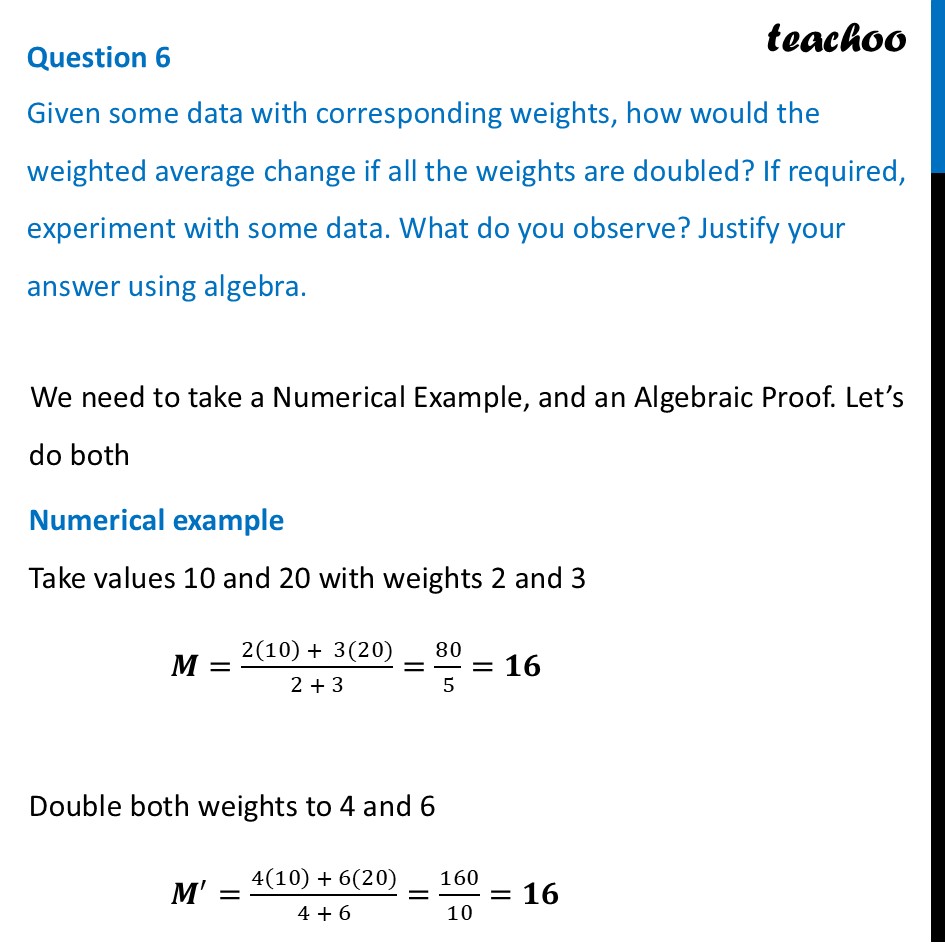
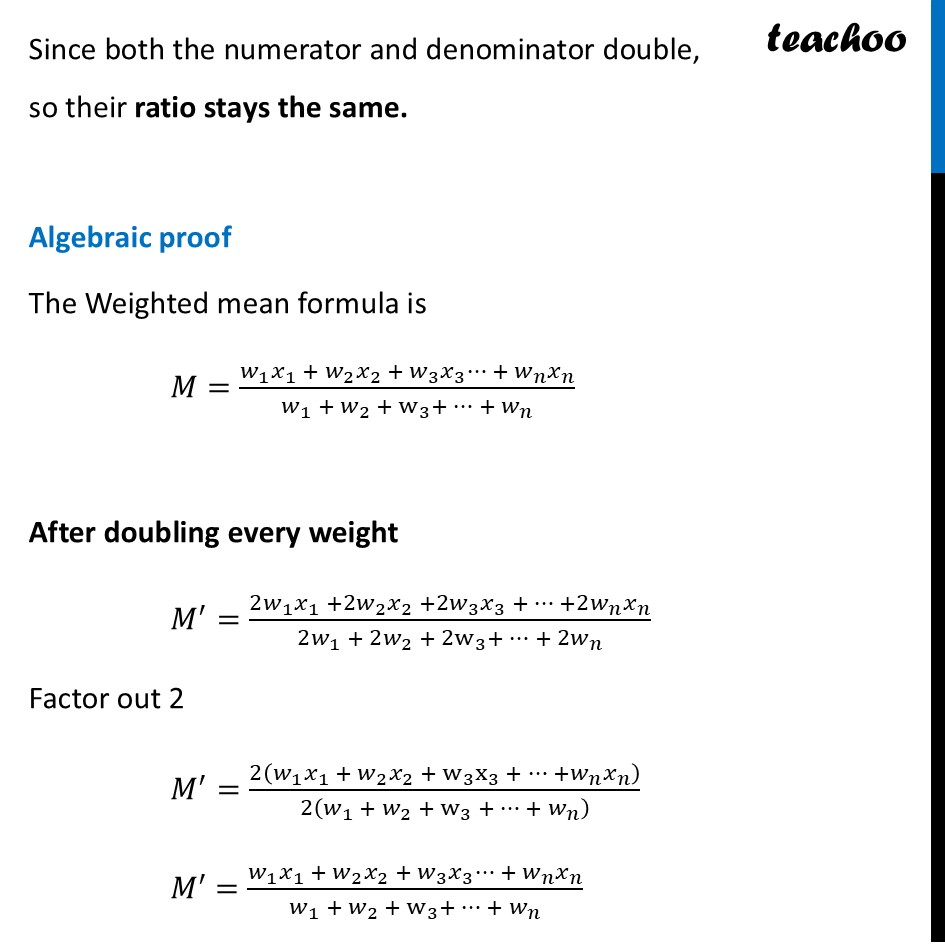
Question 6 Given some data with corresponding weights, how would the weighted average change if all the weights are doubled? If required, experiment with some data. What do you observe? Justify your answer using algebra. We need to take a Numerical Example, and an Algebraic Proof. Let’s do both Numerical example Take values 10 and 20 with weights 2 and 3 𝑴=(2(10) + 3(20))/(2 + 3)=(80)/(5)=𝟏𝟔 Double both weights to 4 and 6 𝑴^(′)=(4(10) + 6(20))/(4 + 6)=(160)/(10)=𝟏𝟔 Since both the numerator and denominator double, so their ratio stays the same. Algebraic proof Originally 𝑀=(𝑤_(1)𝑥_(1)+𝑤_(2)𝑥_(2)+⋯+𝑤_(𝑛)𝑥_(𝑛))/(𝑤_(1)+𝑤_(2)+⋯+𝑤_(𝑛)) After doubling every weight 𝑀^(′)=(2𝑤_(1)𝑥_(1)+2𝑤_(2)𝑥_(2)+⋯+2𝑤_(𝑛)𝑥_(𝑛))/(2𝑤_(1)+2𝑤_(2)+⋯+2𝑤_(𝑛)) Factor out 2 𝑀^(′)=(2(𝑤_(1)𝑥_(1)+𝑤_(2)𝑥_(2)+⋯+𝑤_(𝑛)𝑥_(𝑛)))/(2(𝑤_(1)+𝑤_(2)+⋯+𝑤_(𝑛)))=𝑀 Doubling all weights does not change the weighted mean. The same holds when all weights are multiplied by any common positive number. Since both the numerator and denominator double, so their ratio stays the same. Algebraic proof The Weighted mean formula is 𝑀=(𝑤_(1)𝑥_(1) + 𝑤_(2)𝑥_(2) + 𝑤_(3)𝑥_(3)⋯ + 𝑤_(𝑛)𝑥_(𝑛))/(𝑤_(1) + 𝑤_(2) + w_(3)+ ⋯ + 𝑤_(𝑛)) After doubling every weight 𝑀^(′)=(2𝑤_(1)𝑥_(1) +2𝑤_(2)𝑥_(2) +2𝑤_(3)𝑥_(3) + ⋯ +2𝑤_(𝑛)𝑥_(𝑛))/(2𝑤_(1) + 2𝑤_(2) + 2w_(3)+ ⋯ + 2𝑤_(𝑛)) Factor out 2 𝑀^(′)=(2(𝑤_(1)𝑥_(1) + 𝑤_(2)𝑥_(2) + w_(3)x_(3) + ⋯ +𝑤_(𝑛)𝑥_(𝑛)))/(2(𝑤_(1) + 𝑤_(2) + w_(3) + ⋯ + 𝑤_(𝑛))) 𝑀^(′) =(𝑤_(1)𝑥_(1) + 𝑤_(2)𝑥_(2) + 𝑤_(3)𝑥_(3)⋯ + 𝑤_(𝑛)𝑥_(𝑛))/(𝑤_(1) + 𝑤_(2) + w_(3)+ ⋯ + 𝑤_(𝑛)) 𝑴^(′) =𝑴 Thus, Doubling all weights does not change the weighted mean. So, the weighted mean remains the same
