You are here
End-of-Chapter Exercises
Last updated at October 23, 2026 by Teachoo
Transcript
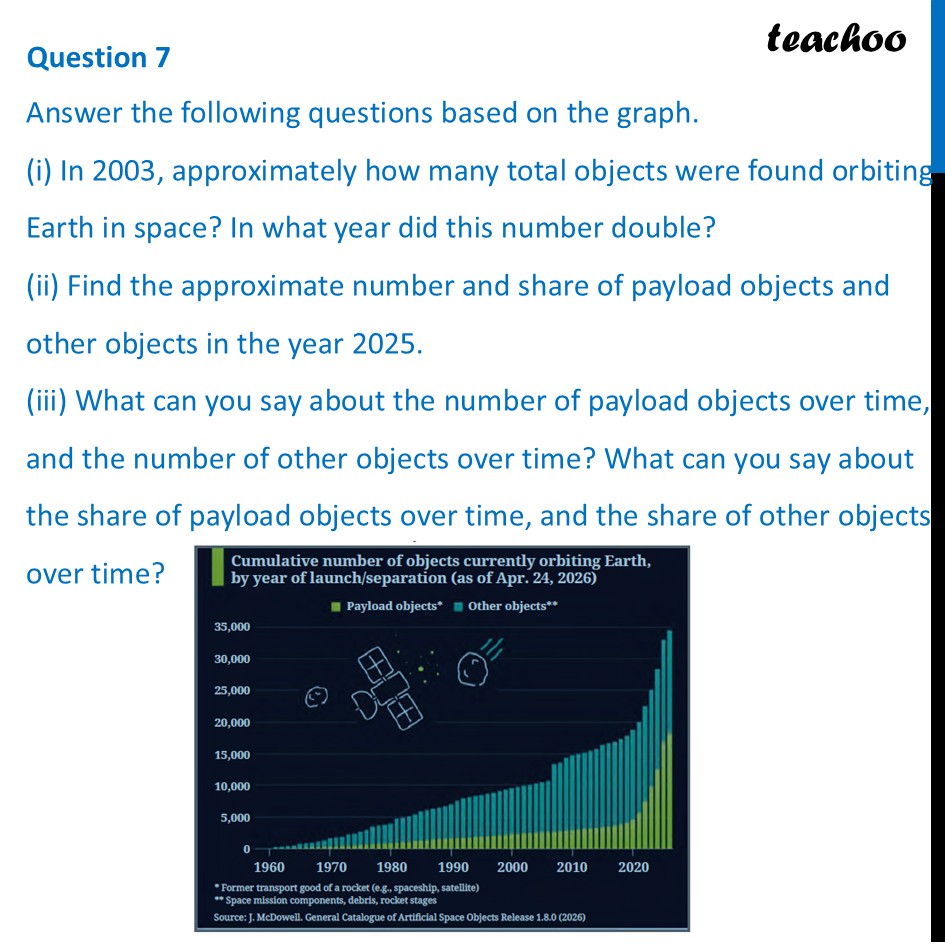
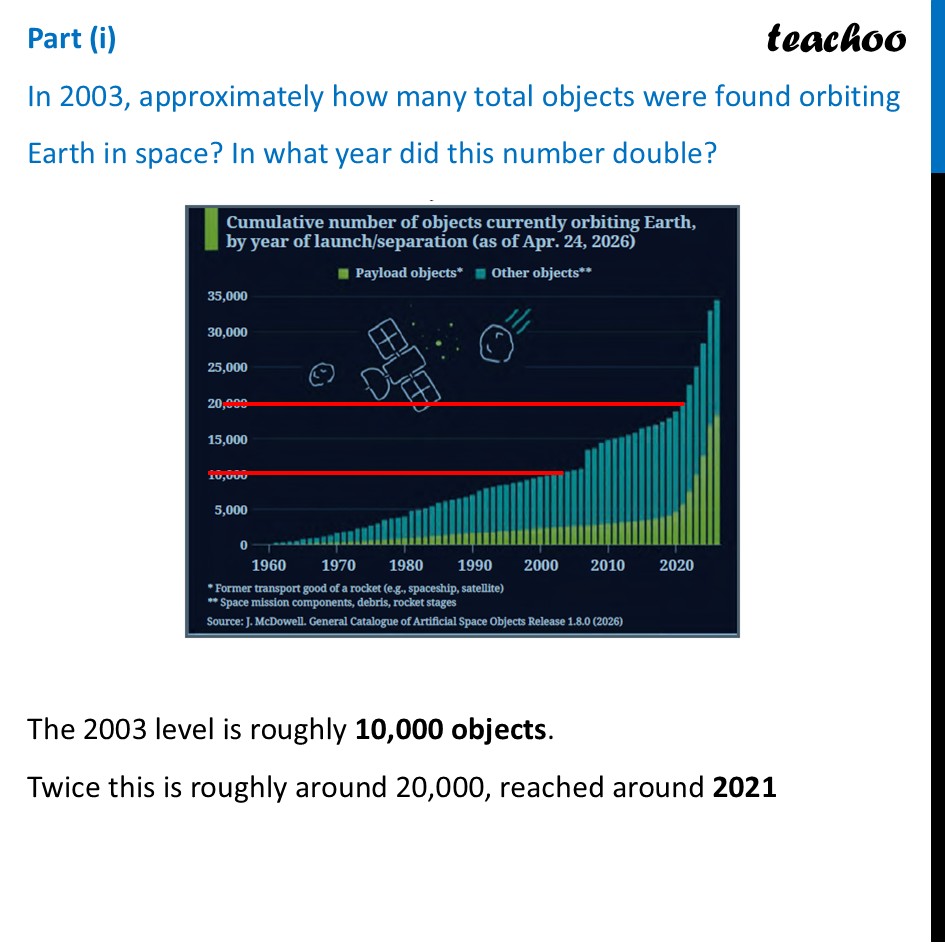
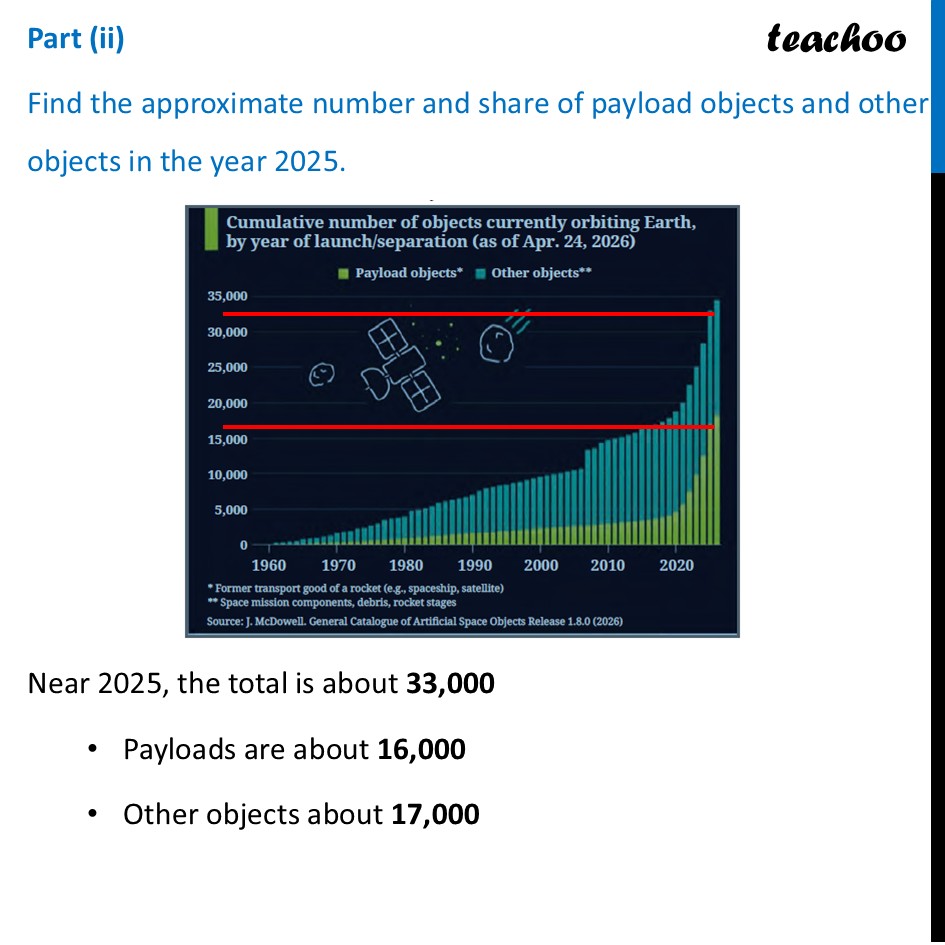
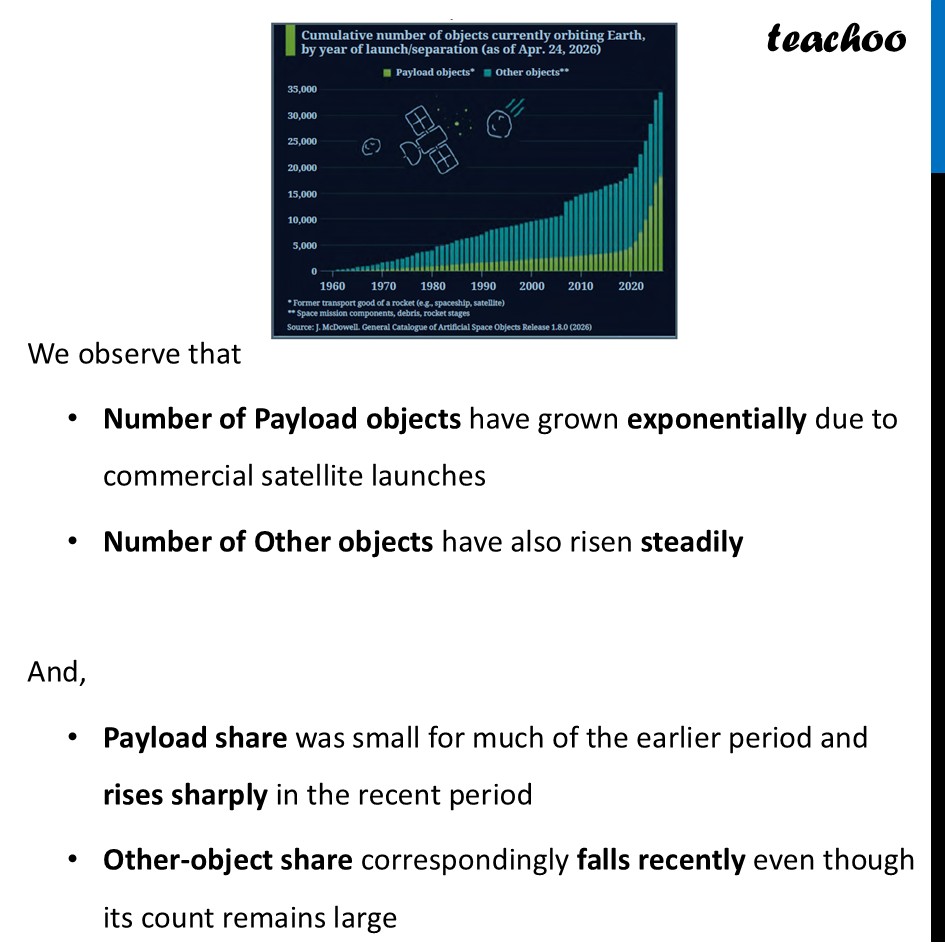
Question 7 Answer the following questions based on the graph. (i) In 2003, approximately how many total objects were found orbiting Earth in space? In what year did this number double? (ii) Find the approximate number and share of payload objects and other objects in the year 2025. (iii) What can you say about the number of payload objects over time, and the number of other objects over time? What can you say about the share of payload objects over time, and the share of other objects over time? Cumulative number of objects currently orbiting Earth, by year of launch/separation (as of Apr. 24, 2026) lm Payload objects ™ Other objects** x © ual il ul 1970 1980 1990 2000 2010 2020 ‘Former transport good of a rocket (eg. spaceship, satellite) ** Space mission components, debris, rocket stages ‘Source: J. McDowell. General Catalogue of Artificial Space Objects Release 1.8.0 (2026) Part (i) In 2003, approximately how many total objects were found orbiting Earth in space? In what year did this number double? The 2003 level is roughly 10,000 objects. Twice this is roughly around 20,000, reached around 2021 Cumulative number of objects currently orbiting Earth, by year of launch/separation (as of Apr. 24, 2026) lm Payload objects ™ Other objects** x © ual il ul 1970 1980 1990 2000 2010 2020 ‘Former transport good of a rocket (eg. spaceship, satellite) ** Space mission components, debris, rocket stages ‘Source: J. McDowell. General Catalogue of Artificial Space Objects Release 1.8.0 (2026) Part (ii) Find the approximate number and share of payload objects and other objects in the year 2025. Near 2025, the total is about 33,000 Payloads are about 16,000 Other objects about 17,000 Cumulative number of objects currently orbiting Earth, by year of launch/separation (as of Apr. 24, 2026) lm Payload objects ™ Other objects** x © ual il ul 1970 1980 1990 2000 2010 2020 ‘Former transport good of a rocket (eg. spaceship, satellite) ** Space mission components, debris, rocket stages ‘Source: J. McDowell. General Catalogue of Artificial Space Objects Release 1.8.0 (2026) Finding Share percentage Payload percentage = (16,000)/(33,000) × 100 = 48.5% (approx.) Other objects percentage = (17,000)/(33,000) × 100 = 51.5% (approx.) So each group contributes roughly half Part (iii) What can you say about the number of payload objects over time, and the number of other objects over time? What can you say about the share of payload objects over time, and the share of other objects over time? We observe that Number of Payload objects have grown exponentially due to commercial satellite launches Number of Other objects have also risen steadily And, Payload share was small for much of the earlier period and rises sharply in the recent period Other-object share correspondingly falls recently even though its count remains large Cumulative number of objects currently orbiting Earth, by year of launch/separation (as of Apr. 24, 2026) lm Payload objects ™ Other objects** x © ual il ul 1970 1980 1990 2000 2010 2020 ‘Former transport good of a rocket (eg. spaceship, satellite) ** Space mission components, debris, rocket stages ‘Source: J. McDowell. General Catalogue of Artificial Space Objects Release 1.8.0 (2026)