Exercise Questions

 You are here
Last updated at October 12, 2026 by Teachoo
Transcript
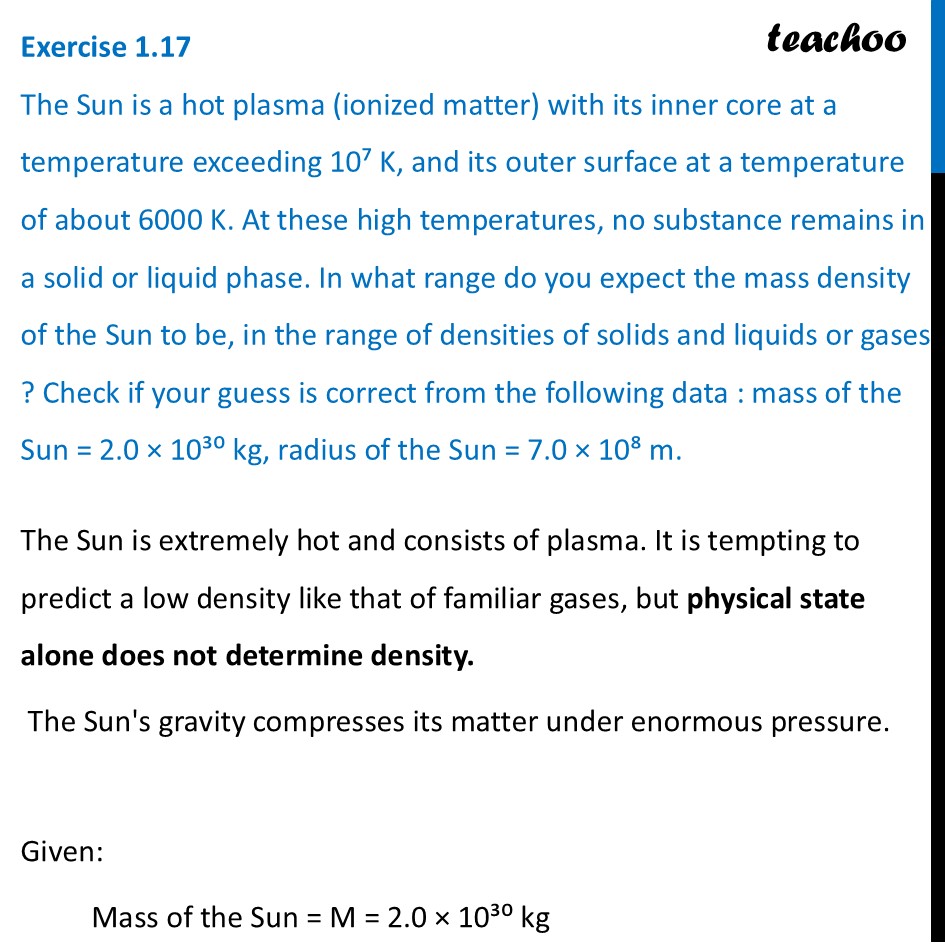
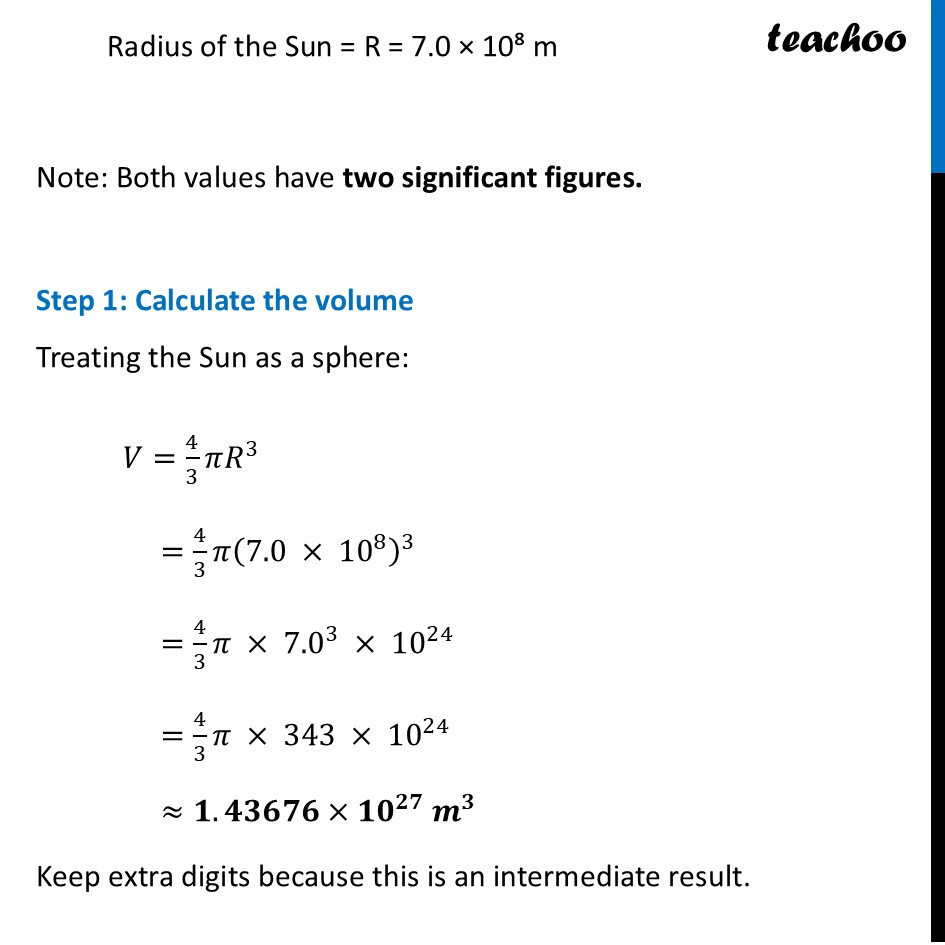
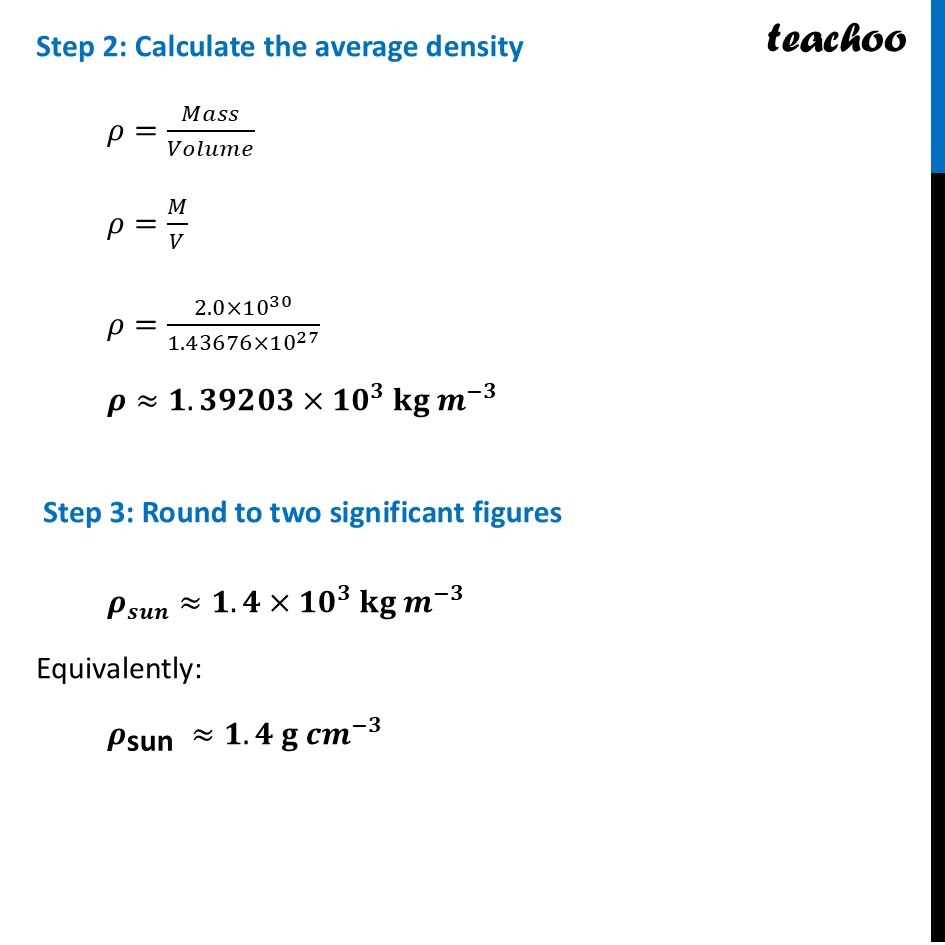
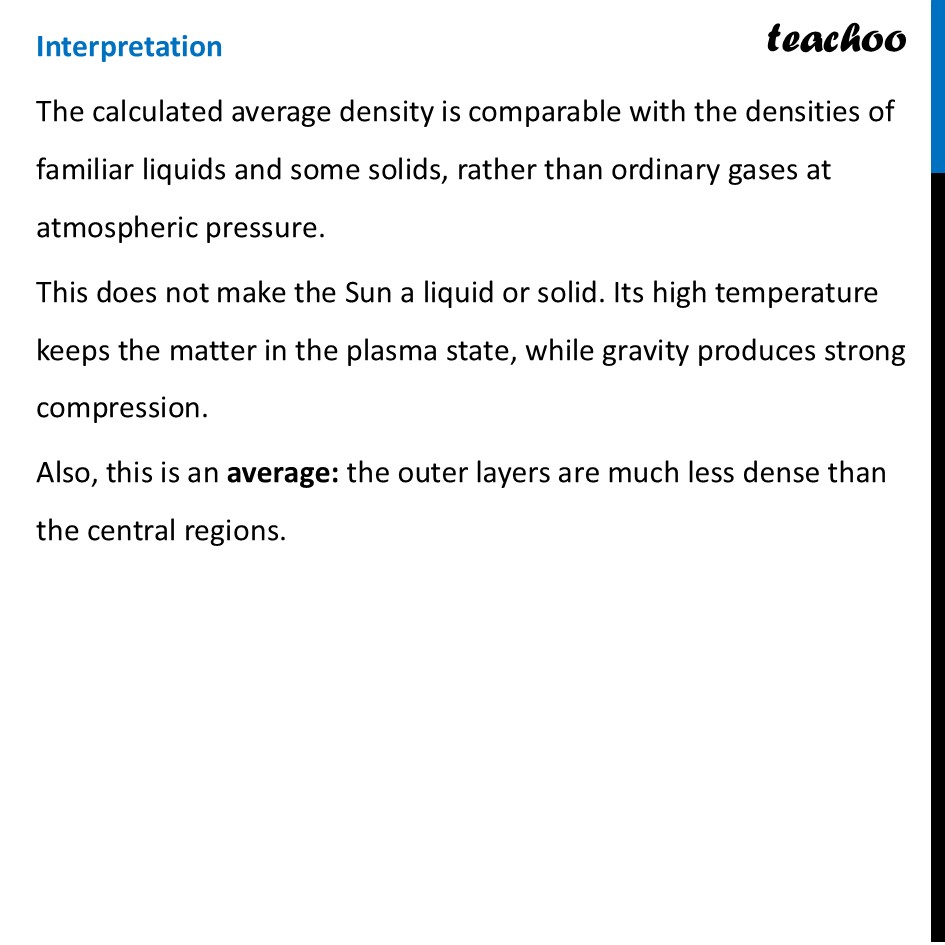
Exercise 1.17 The Sun is a hot plasma (ionized matter) with its inner core at a temperature exceeding 10⁷ K, and its outer surface at a temperature of about 6000 K. At these high temperatures, no substance remains in a solid or liquid phase. In what range do you expect the mass density of the Sun to be, in the range of densities of solids and liquids or gases ? Check if your guess is correct from the following data : mass of the Sun = 2.0 × 10³⁰ kg, radius of the Sun = 7.0 × 10⁸ m. The Sun is extremely hot and consists of plasma. It is tempting to predict a low density like that of familiar gases, but physical state alone does not determine density. The Sun's gravity compresses its matter under enormous pressure. Given: Mass of the Sun = M = 2.0 × 10³⁰ kg Radius of the Sun = R = 7.0 × 10⁸ m Note: Both values have two significant figures. Step 1: Calculate the volume Treating the Sun as a sphere: [; 𝑉=(4)/(3)𝜋𝑅^(3)] =(4)/(3)𝜋(7.0 × 10^(8))^(3) =(4)/(3)𝜋 × 7.0^(3) × 10^(24) =(4)/(3)𝜋 × 343 × 10^(24) ≈𝟏.𝟒𝟑𝟔𝟕𝟔×𝟏𝟎^(𝟐𝟕) 𝒎^(𝟑) Keep extra digits because this is an intermediate result. Step 2: Calculate the average density 𝜌=(𝑀𝑎𝑠𝑠)/(𝑉𝑜𝑙𝑢𝑚𝑒) 𝜌=(𝑀)/(𝑉) 𝜌=(2.0×10^(30))/(1.43676×10^(27)) 𝝆≈𝟏.𝟑𝟗𝟐𝟎𝟑×𝟏𝟎^(𝟑) 𝐤𝐠 𝒎^(−𝟑) [; ; ]Step 3: Round to two significant figures 𝝆_(𝒔𝒖𝒏)≈𝟏.𝟒×𝟏𝟎^(𝟑) 𝐤𝐠 𝒎^(−𝟑) Equivalently: 𝝆_(sun )≈𝟏.𝟒 𝐠 𝒄𝒎^(−𝟑) Interpretation The calculated average density is comparable with the densities of familiar liquids and some solids, rather than ordinary gases at atmospheric pressure. This does not make the Sun a liquid or solid. Its high temperature keeps the matter in the plasma state, while gravity produces strong compression. Also, this is an average: the outer layers are much less dense than the central regions.