Exercise Questions

 You are here
Last updated at October 12, 2026 by Teachoo
Transcript
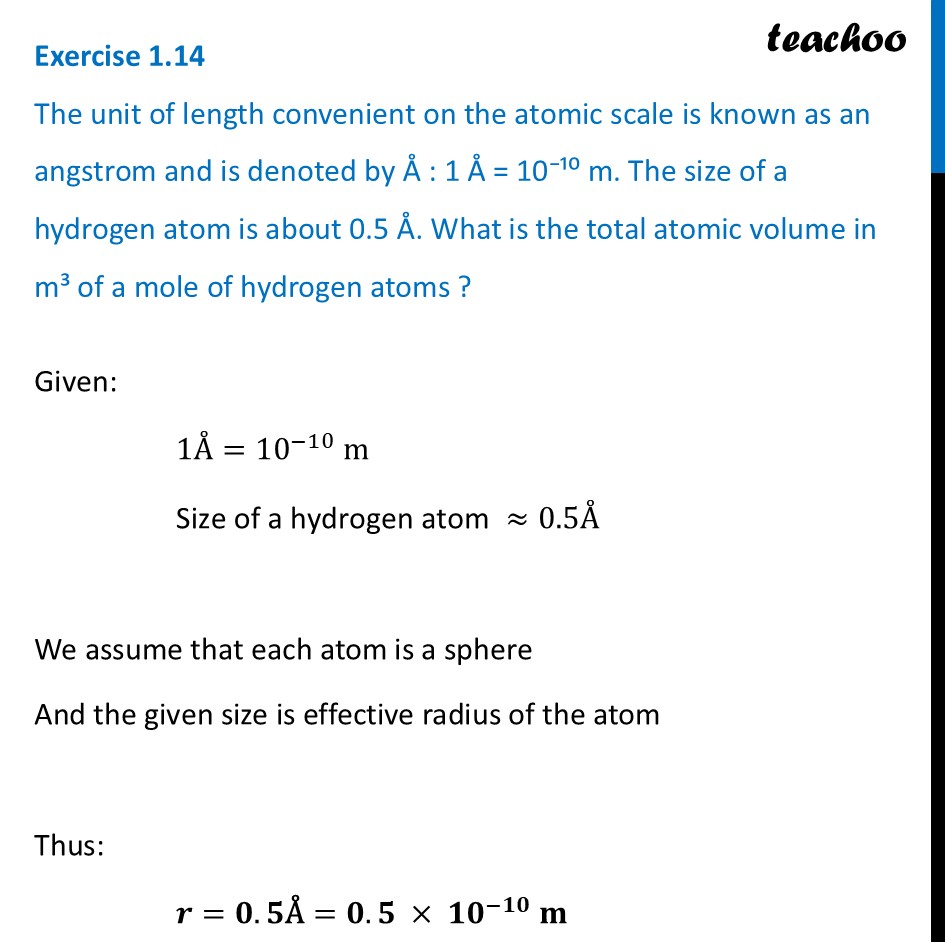
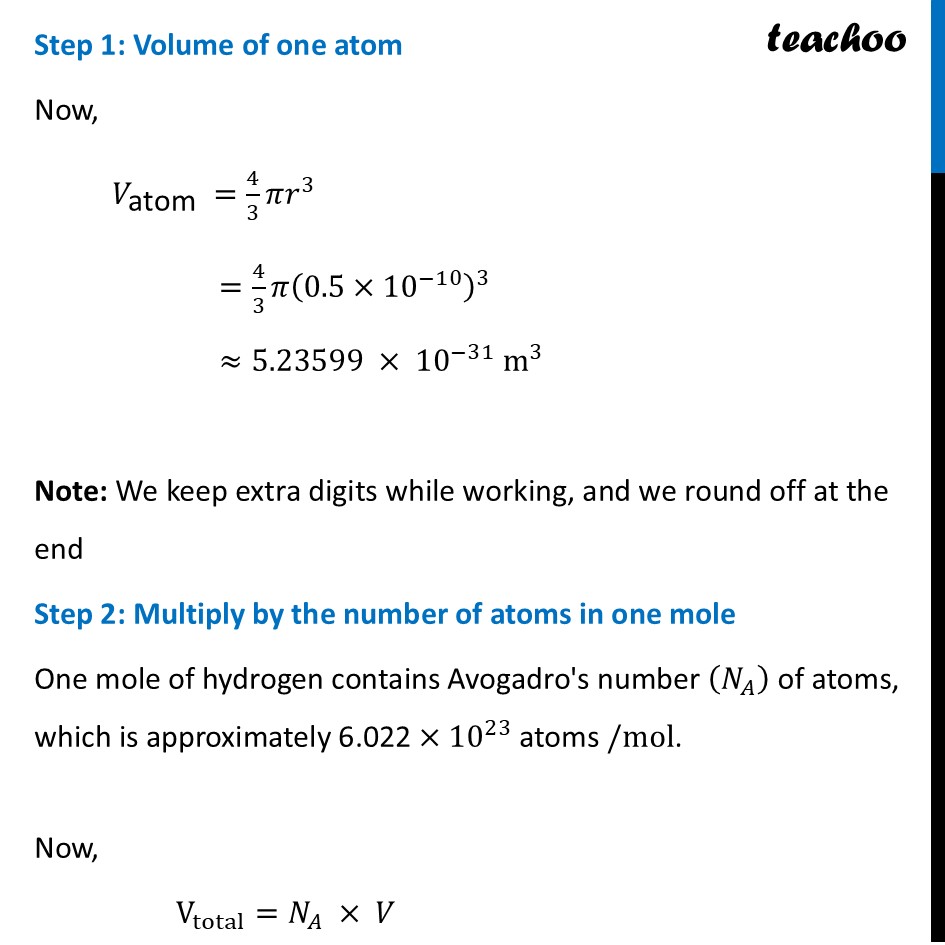
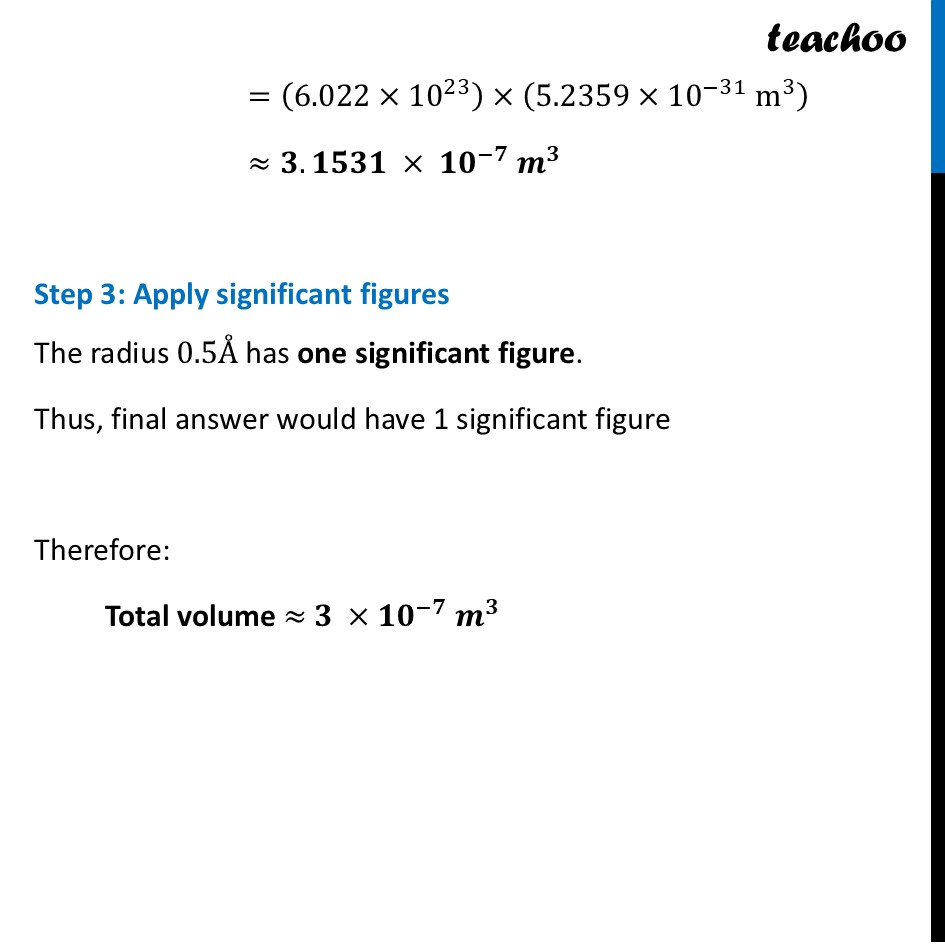
Exercise 1.14 The unit of length convenient on the atomic scale is known as an angstrom and is denoted by Å : 1 Å = 10⁻¹⁰ m. The size of a hydrogen atom is about 0.5 Å. What is the total atomic volume in m³ of a mole of hydrogen atoms ? Given: 1Å=10^(−10) m Size of a hydrogen atom ≈0.5Å We assume that each atom is a sphere And the given size is effective radius of the atom Thus: 𝒓=𝟎.𝟓Å=𝟎.𝟓 × 𝟏𝟎^(−𝟏𝟎) 𝐦 Step 1: Volume of one atom [𝑉_(atom )=(4)/(3)𝜋𝑟^(3); 𝑉_(atom )=(4)/(3)𝜋(0.5×10^(−10))^(3); 𝑉_(atom )≈5.23599×10^(−31) m^(3)] Keep these extra digits during working. Step 2: Multiply by the number of atoms in one mole Using: [𝑁_(𝐴)≈6.022×10^(23) mol^(−1); 𝑉_(total )=𝑁_(𝐴)𝑉_(atom ); 𝑉_(total )≈(6.022×10^(23))(5.23599×10^(−31)); 𝑉_(total )≈3.1531×10^(−7) m^(3)] Step 3: Apply significant figures The radius 0.5Å has one significant figure. Therefore: 𝑉_(total )≈3×10^(−7) m^(3) (1 significant figure ) Step 1: Volume of one atom Now, 𝑉_(atom )=(4)/(3)𝜋𝑟^(3) =(4)/(3)𝜋(0.5×10^(−10))^(3) ≈5.23599 × 10^(−31) m^(3) Note: We keep extra digits while working, and we round off at the end Step 2: Multiply by the number of atoms in one mole One mole of hydrogen contains Avogadro's number (𝑁_(𝐴)) of atoms, which is approximately 6.022 ×10^(23) atoms /mol. Now, V_(total)=𝑁_(𝐴) × 𝑉 𝑉_(total )=(6.022×10^(23))×(5.236×10^(−31) m^(3)) 𝑉_(total )≈3.154×10^(−7) m^(3)[1.1.3] (A) Allen +1 Using: [𝑁_(𝐴)≈6.022×10^(23) mol^(−1); 𝑉_(total )=𝑁_(𝐴)𝑉_(atom ); 𝑉_(total )≈(6.022×10^(23))(5.23599×10^(−31)); 𝑉_(total )≈3.1531×10^(−7) m^(3)] Step 3: Apply significant figures The radius 0.5Å has one significant figure. Therefore: 𝑉_(total )≈3×10^(−7) m^(3) (1 significant figure ) =(6.022×10^(23))×(5.2359×10^(−31) m^(3)) ≈𝟑.𝟏𝟓𝟑𝟏 × 𝟏𝟎^(−𝟕) 𝒎^(𝟑) Step 3: Apply significant figures The radius 0.5Å has one significant figure. Thus, final answer would have 1 significant figure Therefore: Total volume ≈ 𝟑 ×𝟏𝟎^(−𝟕) 𝒎^(𝟑)