Exercise Questions

 You are here
Last updated at October 12, 2026 by Teachoo
Transcript
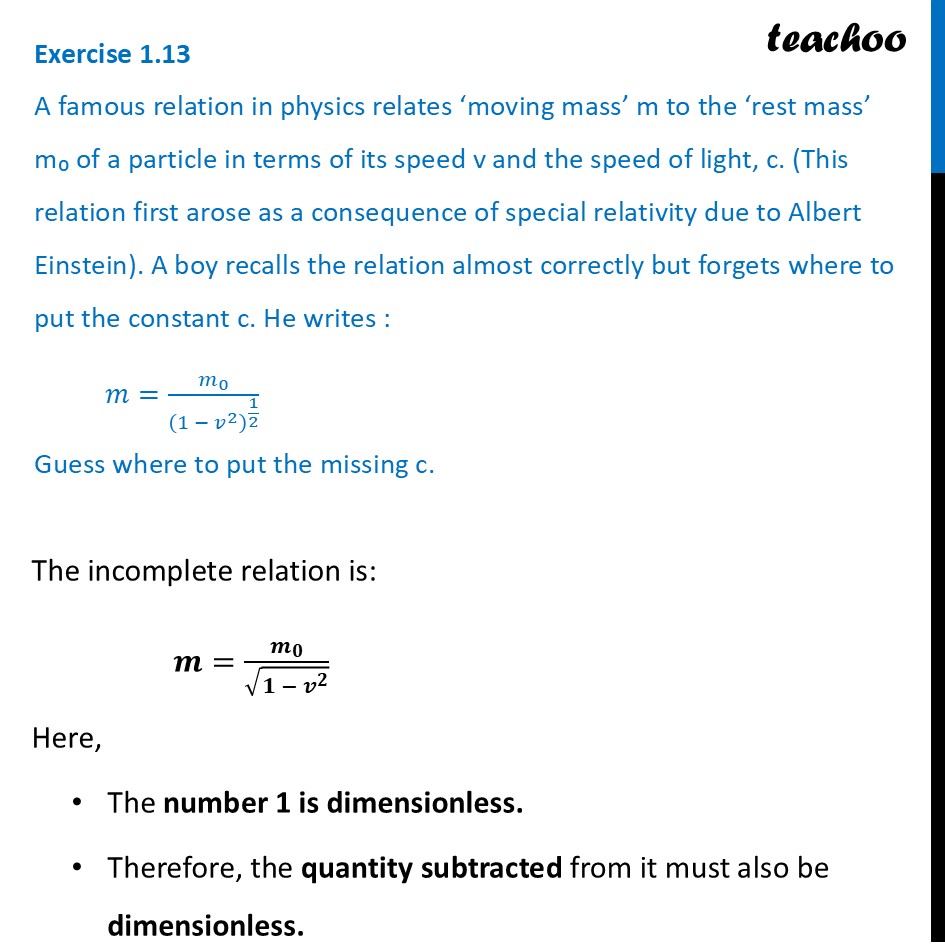
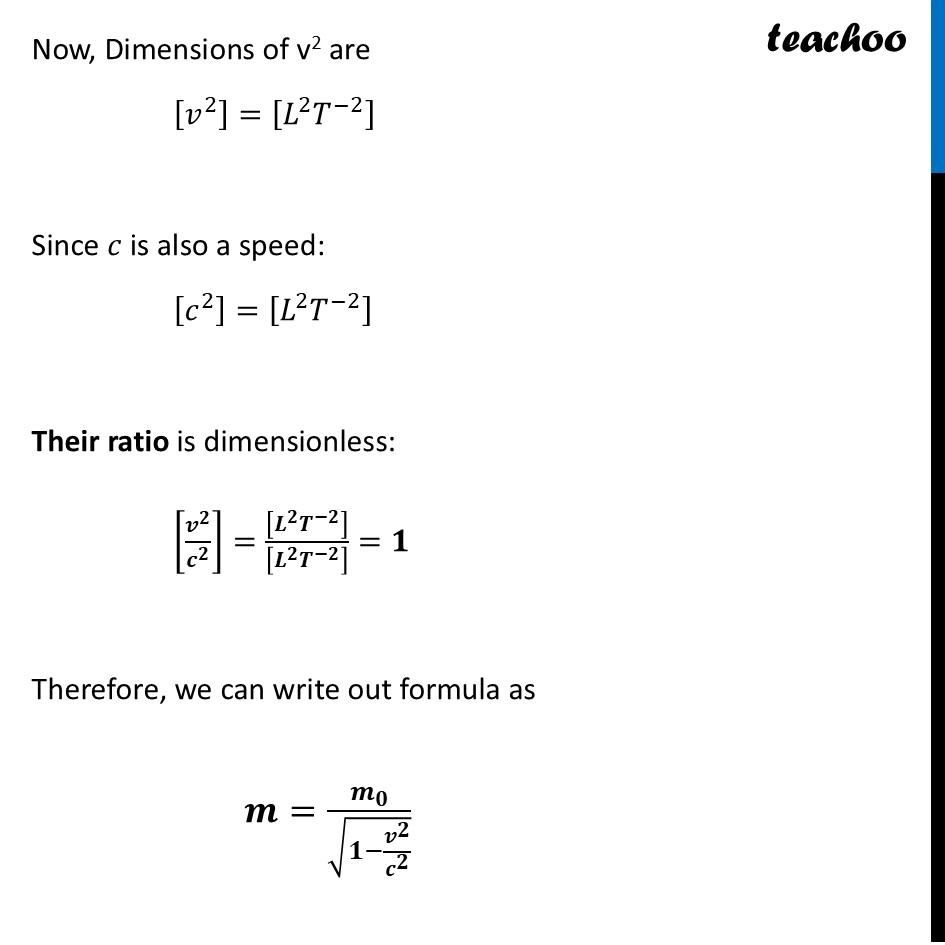
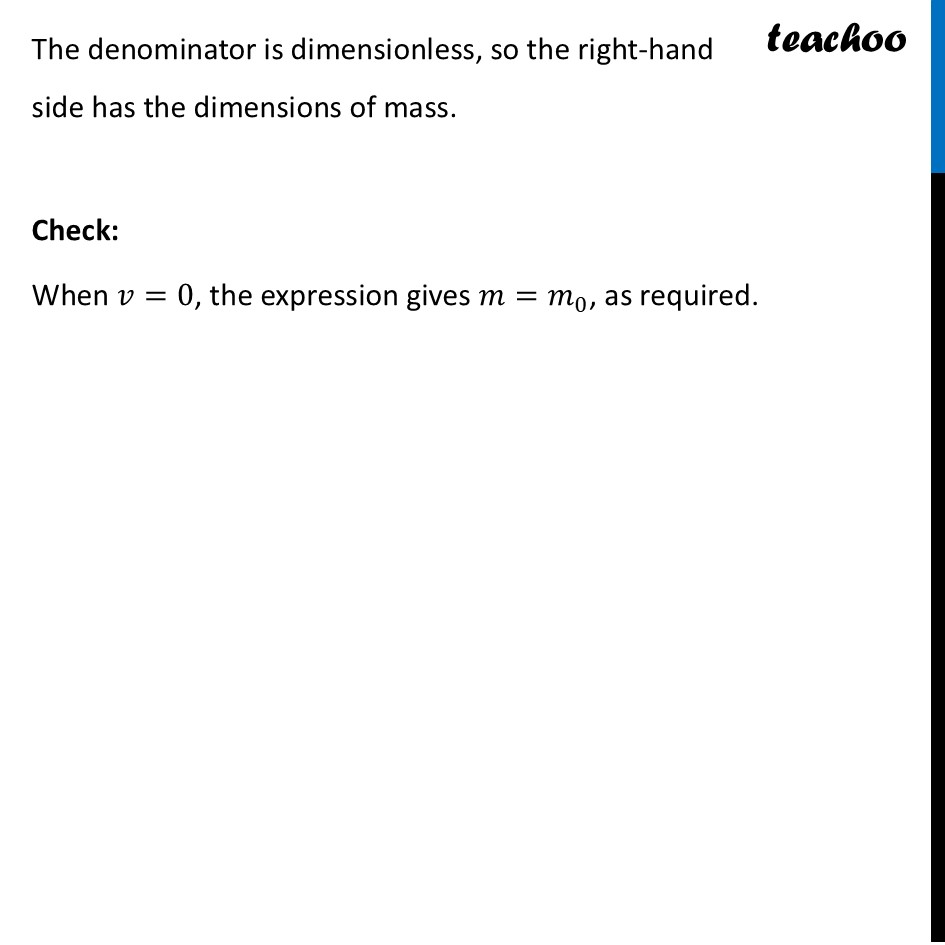
Exercise 1.13 A famous relation in physics relates ‘moving mass’ m to the ‘rest mass’ m₀ of a particle in terms of its speed v and the speed of light, c. (This relation first arose as a consequence of special relativity due to Albert Einstein). A boy recalls the relation almost correctly but forgets where to put the constant c. He writes : 𝑚=(𝑚_(0))/((1 − 𝑣^(2))^((1)/(2))) Guess where to put the missing c. The incomplete relation is: 𝒎=(𝒎_(𝟎))/(sqrt(𝟏 − 𝒗^(𝟐))) Here, The number 1 is dimensionless. Therefore, the quantity subtracted from it must also be dimensionless. However: [𝑣^(2)]=[𝐿^(2)𝑇^(−2)] Since 𝑐 is also a speed: [𝑐^(2)]=[𝐿^(2)𝑇^(−2)] Their ratio is dimensionless: [(𝑣^(2))/(𝑐^(2))]=([𝐿^(2)𝑇^(−2)])/([𝐿^(2)𝑇^(−2)])=1 Therefore: 𝑚=(𝑚_(0))/(sqrt(1−(𝑣^(2))/(𝑐^(2)))) The denominator is dimensionless, so the right-hand side has the dimensions of mass. Check: when 𝑣=0, the expression gives 𝑚=𝑚_(0), as required. Now, Dimensions of v^(2) are [𝑣^(2)]=[𝐿^(2)𝑇^(−2)] Since 𝑐 is also a speed: [𝑐^(2)]=[𝐿^(2)𝑇^(−2)] Their ratio is dimensionless: [(𝒗^(𝟐))/(𝒄^(𝟐))]=([𝑳^(𝟐)𝑻^(−𝟐)])/([𝑳^(𝟐)𝑻^(−𝟐)])=𝟏 Therefore, we can write out formula as 𝒎=(𝒎_(𝟎))/(sqrt(𝟏−(𝒗^(𝟐))/(𝒄^(𝟐)))) The denominator is dimensionless, so the right-hand side has the dimensions of mass. Check: When 𝑣=0, the expression gives 𝑚=𝑚_(0), as required. The denominator is dimensionless, so the right-hand side has the dimensions of mass. Check: When 𝑣=0, the expression gives 𝑚=𝑚_(0), as required.