Exercise Questions

 You are here
Last updated at October 12, 2026 by Teachoo
Transcript
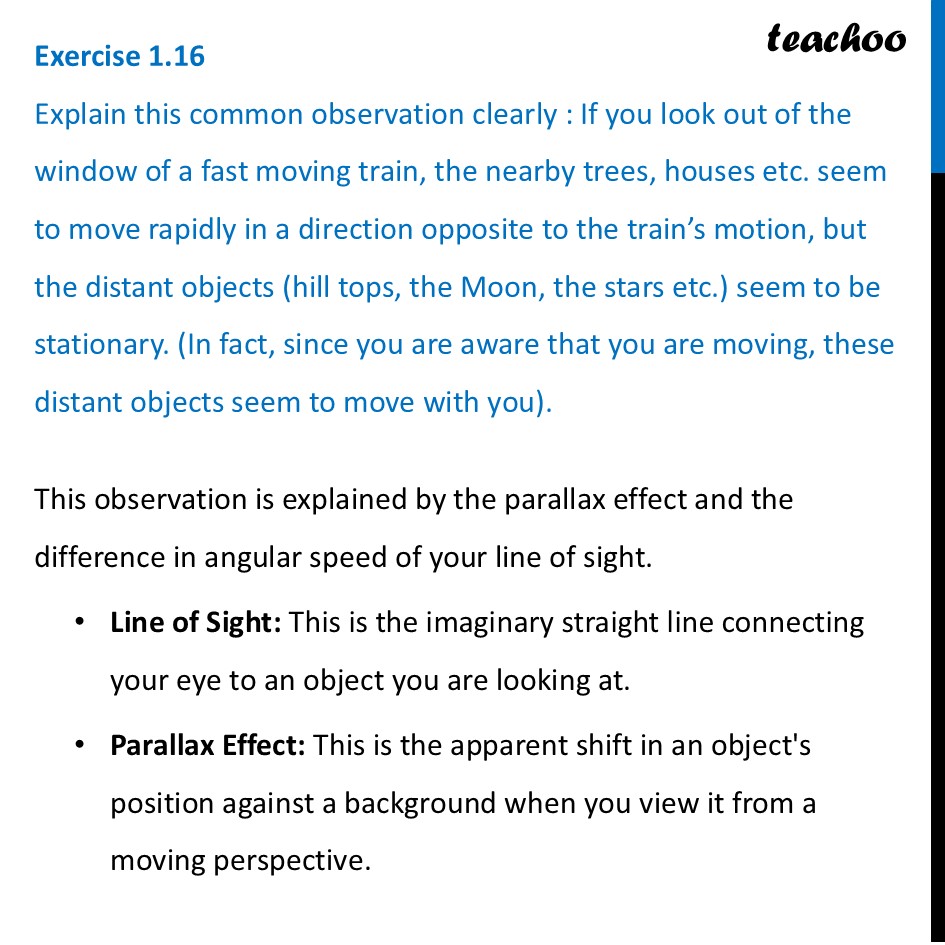
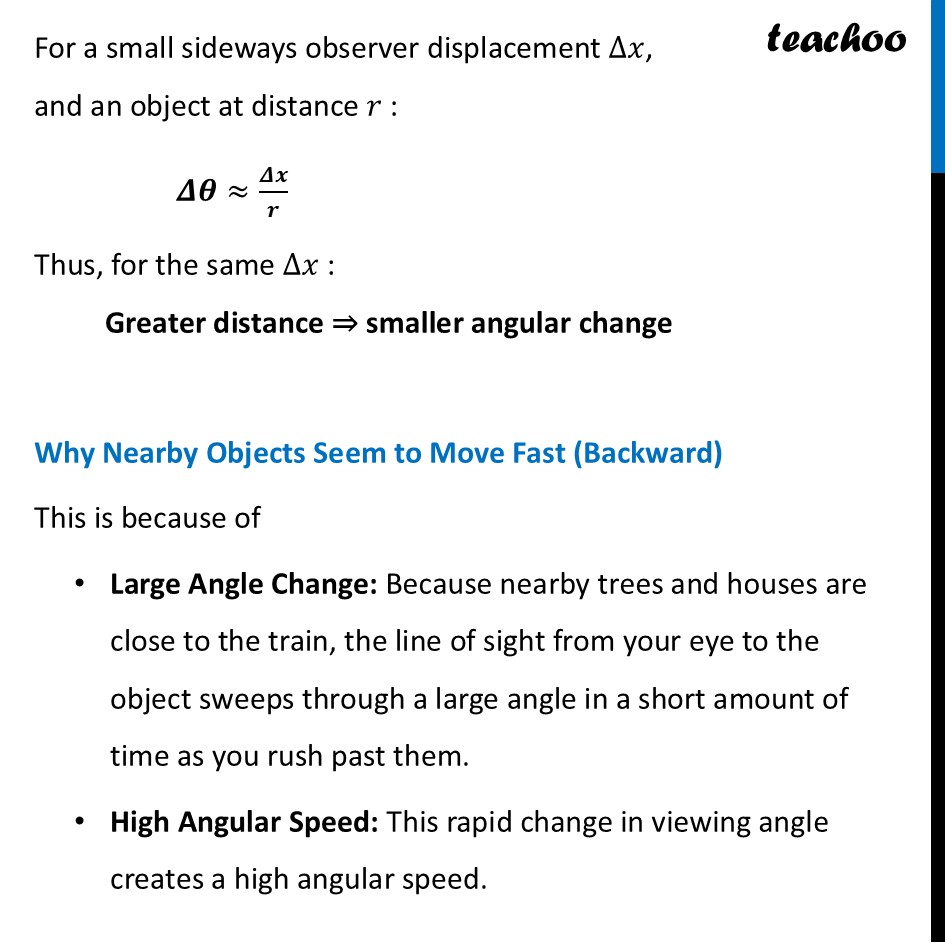
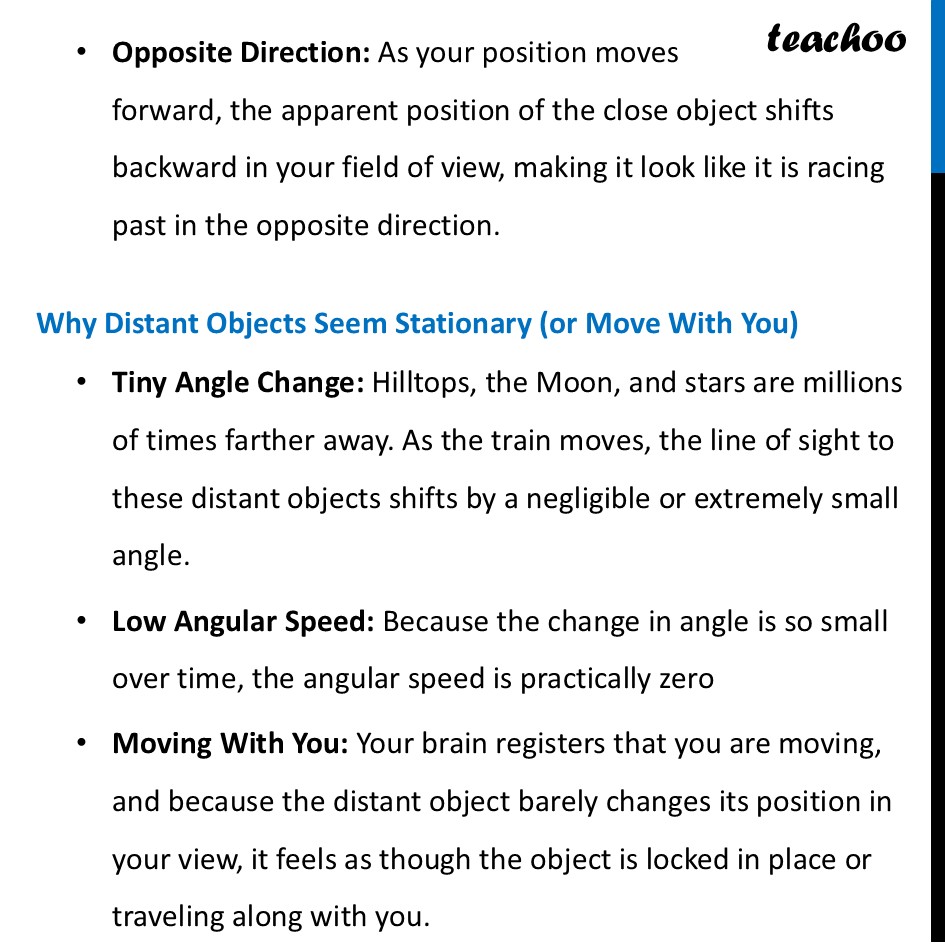
Exercise 1.16 Explain this common observation clearly : If you look out of the window of a fast moving train, the nearby trees, houses etc. seem to move rapidly in a direction opposite to the train’s motion, but the distant objects (hill tops, the Moon, the stars etc.) seem to be stationary. (In fact, since you are aware that you are moving, these distant objects seem to move with you). This observation is explained by the parallax effect and the difference in angular speed of your line of sight. Line of Sight: This is the imaginary straight line connecting your eye to an object you are looking at. Parallax Effect: This is the apparent shift in an object's position against a background when you view it from a moving perspective. For a small sideways observer displacement Δ𝑥, and an object at distance 𝑟 : 𝜟𝜽≈(𝜟𝒙)/(𝒓) Thus, for the same Δ𝑥 : Greater distance ⇒ smaller angular change Why Nearby Objects Seem to Move Fast (Backward) This is because of Large Angle Change: Because nearby trees and houses are close to the train, the line of sight from your eye to the object sweeps through a large angle in a short amount of time as you rush past them. High Angular Speed: This rapid change in viewing angle creates a high angular speed. Opposite Direction: As your position moves forward, the apparent position of the close object shifts backward in your field of view, making it look like it is racing past in the opposite direction. Why Distant Objects Seem Stationary (or Move With You) Tiny Angle Change: Hilltops, the Moon, and stars are millions of times farther away. As the train moves, the line of sight to these distant objects shifts by a negligible or extremely small angle. Low Angular Speed: Because the change in angle is so small over time, the angular speed is practically zero Moving With You: Your brain registers that you are moving, and because the distant object barely changes its position in your view, it feels as though the object is locked in place or traveling along with you.