Exercise Questions

 You are here
Last updated at October 12, 2026 by Teachoo
Transcript
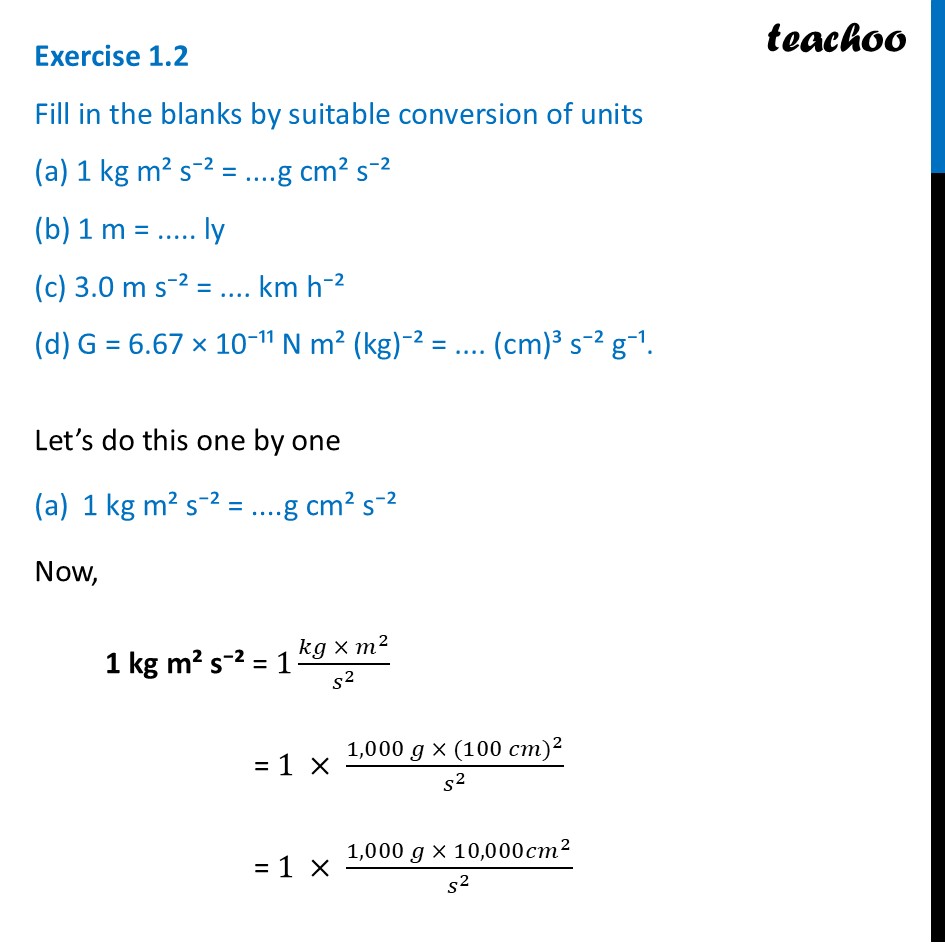
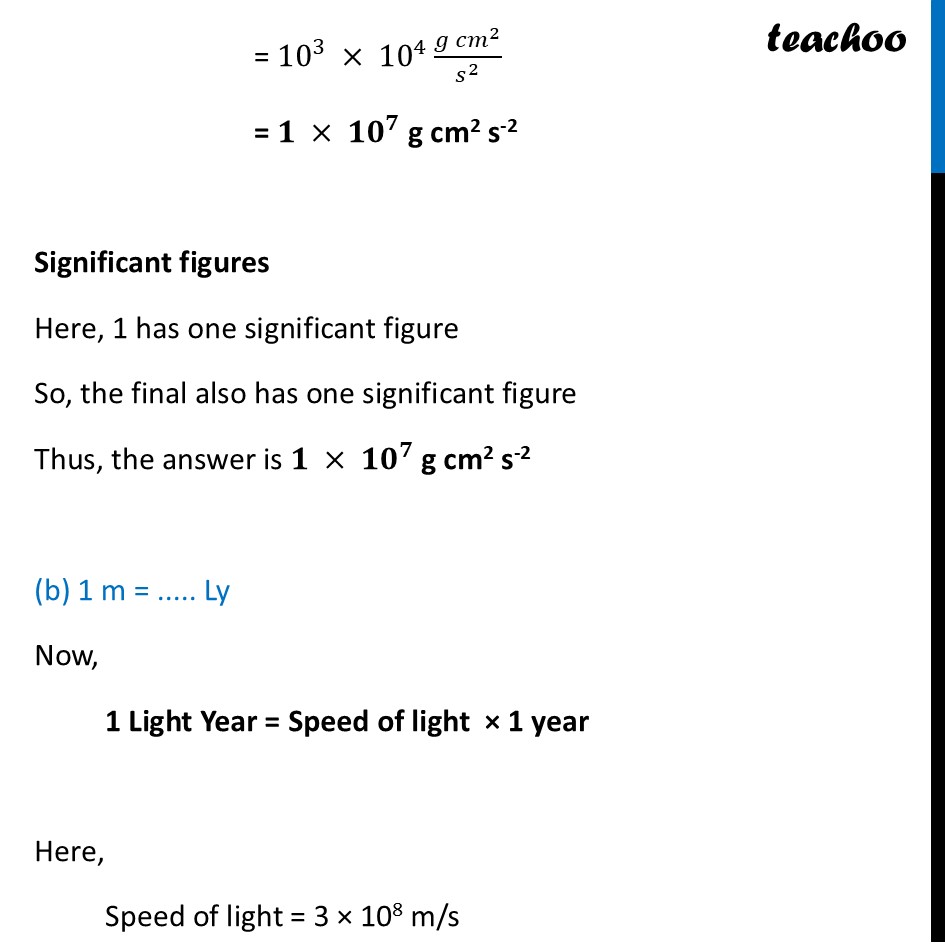
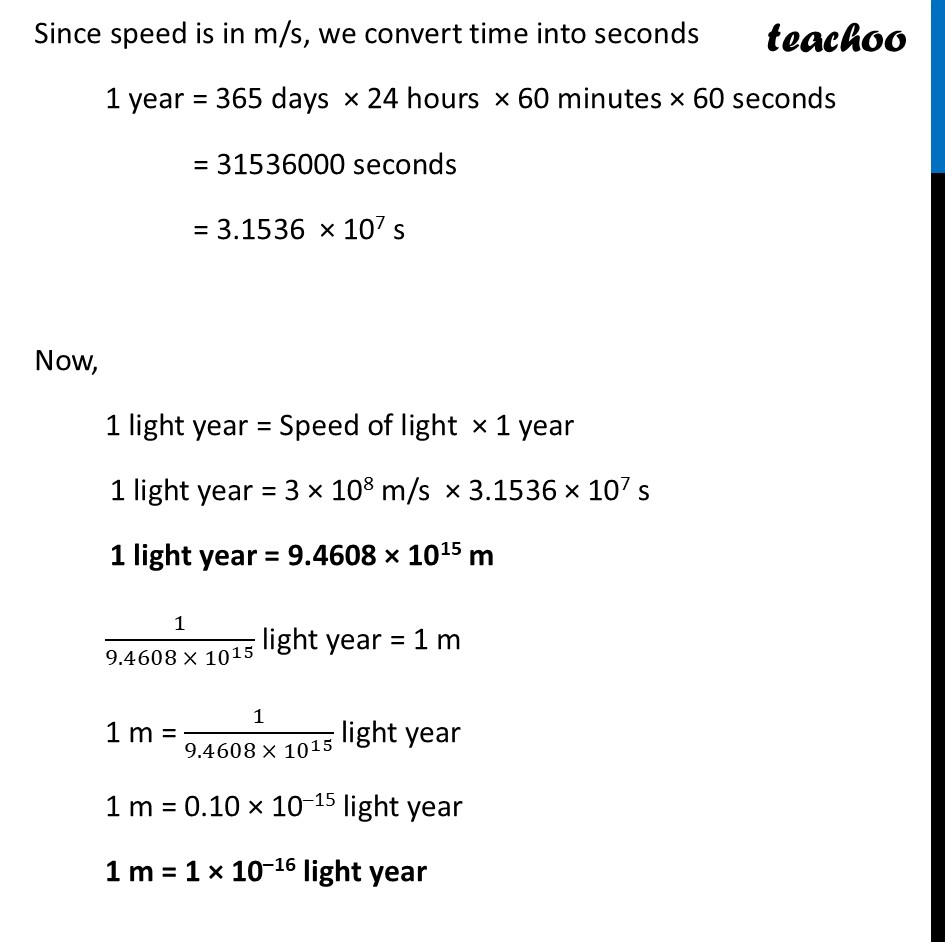
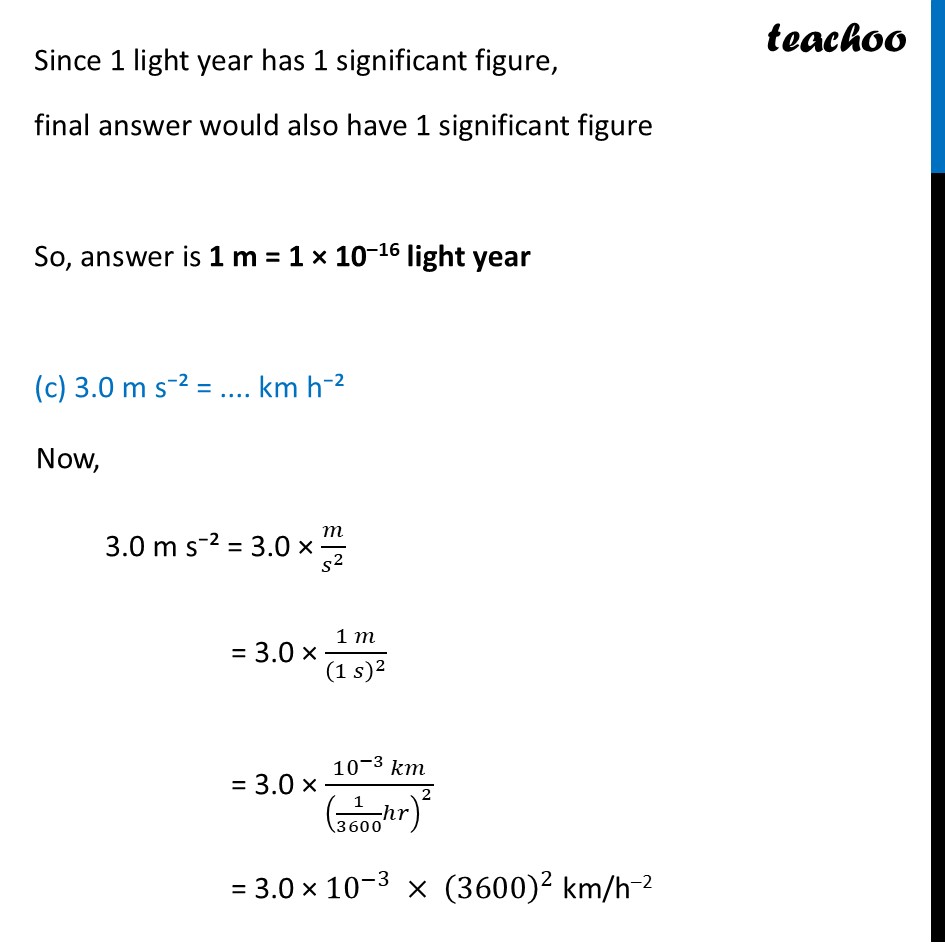
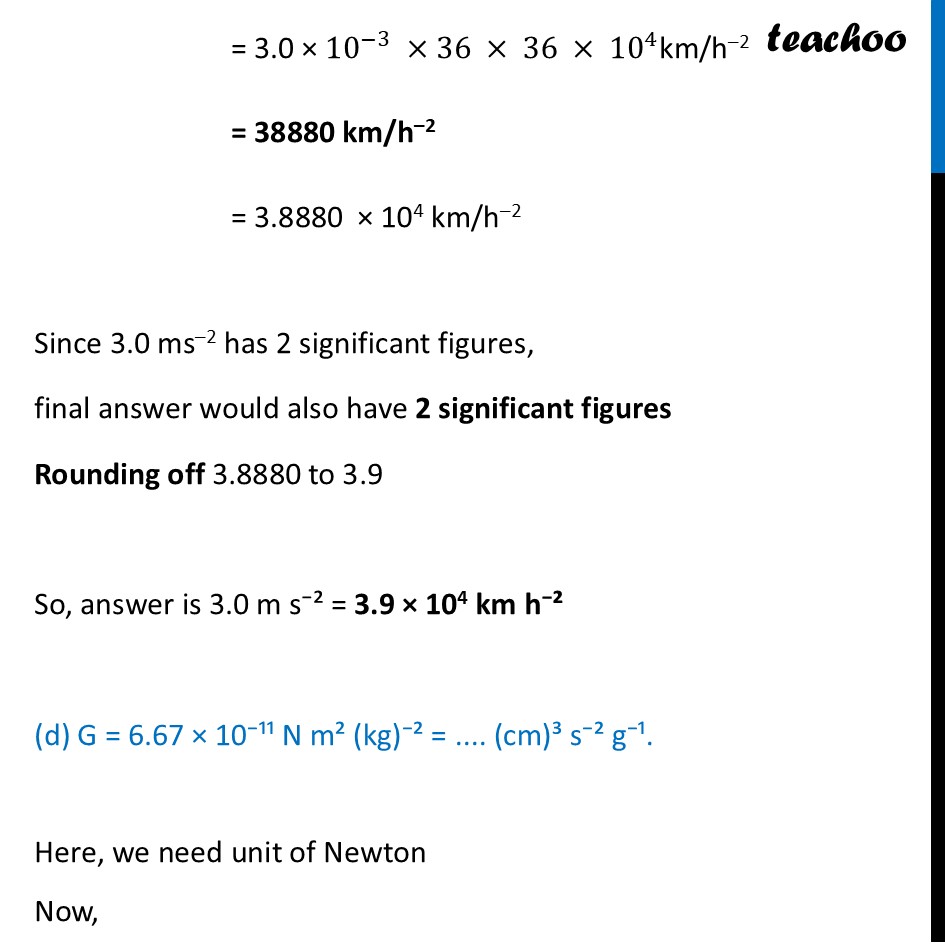
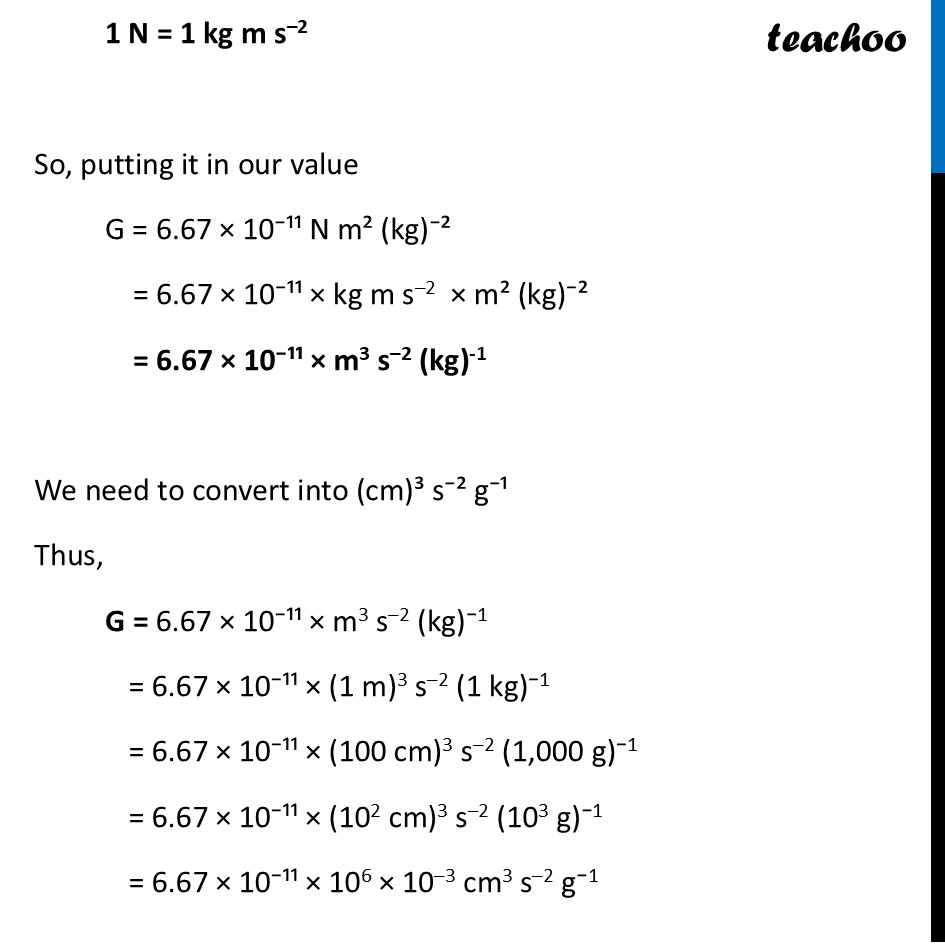
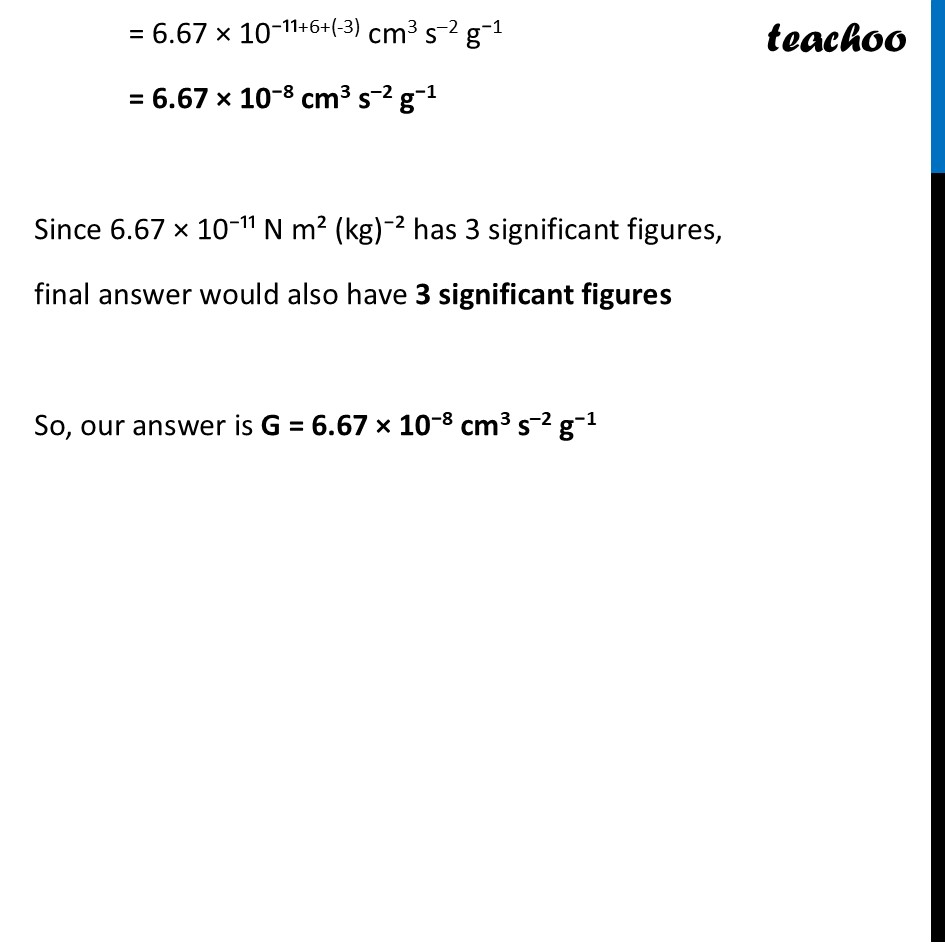
Exercise 1.2 Fill in the blanks by suitable conversion of units (a) 1 kg m² s⁻² = ....g cm² s⁻² (b) 1 m = ..... ly (c) 3.0 m s⁻² = .... km h⁻² (d) G = 6.67 × 10⁻¹¹ N m² (kg)⁻² = .... (cm)³ s⁻² g⁻¹. Let’s do this one by one 1 kg m² s⁻² = ....g cm² s⁻² Now, 1 kg m² s⁻² = 1(𝑘𝑔 × 𝑚^(2))/(𝑠^(2)) = 1 × (1,000 𝑔 × (100 𝑐𝑚)^(2))/(𝑠^(2)) = 1 × (1,000 𝑔 × 10,000𝑐𝑚^(2))/(𝑠^(2)) = 10^(3) × 10^(4)(𝑔 𝑐𝑚^(2))/(𝑠^(2)) = 𝟏 × 𝟏𝟎^(𝟕) g cm^(2) s^(-2) Significant figures Here, 1 has one significant figure So, the final also has one significant figure Thus, the answer is 𝟏 × 𝟏𝟎^(𝟕) g cm^(2) s^(-2) (b) 1 m = ..... Ly Now, 1 Light Year = Speed of light × 1 year Here, Speed of light = 3 × 10^(8) m/s Since speed is in m/s, we convert time into seconds 1 year = 365 days × 24 hours × 60 minutes × 60 seconds = 31536000 seconds = 3.1536 × 10^(7) s Now, 1 light year = Speed of light × 1 year 1 light year = 3 × 10^(8) m/s × 3.1536 × 10^(7) s 1 light year = 9.4608 × 10^(15) m (1)/(9.4608 × 10^(15)) light year = 1 m 1 m = 1 light year = 9.4608 × 10^(15) m Since 1 light year has 1 significant figure, final answer would also have 1 signicant figure = 10^(3) × 10^(4)(𝑔 𝑐𝑚^(2))/(𝑠^(2)) = 𝟏 × 𝟏𝟎^(𝟕) g cm^(2) s^(-2) Significant figures Here, 1 has one significant figure So, the final also has one significant figure Thus, the answer is 𝟏 × 𝟏𝟎^(𝟕) g cm^(2) s^(-2) (b) 1 m = ..... Ly Now, 1 Light Year = Speed of light × 1 year Here, Speed of light = 3 × 10^(8) m/s Since speed is in m/s, we convert time into seconds 1 year = 365 days × 24 hours × 60 minutes × 60 seconds = 31536000 seconds = 3.1536 × 10^(7) s Now, 1 light year = Speed of light × 1 year 1 light year = 3 × 10^(8) m/s × 3.1536 × 10^(7) s 1 light year = 9.4608 × 10^(15) m (1)/(9.4608 × 10^(15)) light year = 1 m 1 m = 1 light year = 9.4608 × 10^(15) m Since 1 light year has 1 significant figure, final answer would also have 1 signicant figure Since speed is in m/s, we convert time into seconds 1 year = 365 days × 24 hours × 60 minutes × 60 seconds = 31536000 seconds = 3.1536 × 10^(7) s Now, 1 light year = Speed of light × 1 year 1 light year = 3 × 10^(8) m/s × 3.1536 × 10^(7) s 1 light year = 9.4608 × 10^(15) m (1)/(9.4608 × 10^(15)) light year = 1 m 1 m = (1)/(9.4608 × 10^(15)) light year 1 m = 0.10 × 10^(–15) light year 1 m = 1 × 10^(–16) light year Since 1 light year has 1 significant figure, final answer would also have 1 signicant figure Since 1 light year has 1 significant figure, final answer would also have 1 significant figure So, answer is 1 m = 1 × 10^(–16) light year (c) 3.0 m s⁻² = .... km h⁻² Now, 3.0 m s⁻² = 3.0 × (𝑚)/(𝑠^(2)) = 3.0 × (1 𝑚)/((1 𝑠)^(2)) = 3.0 × (10^(−3) 𝑘𝑚)/(((1)/(3600)ℎ𝑟)^(2)) = 3.0 × 10^(−3) × (3600)^(2) km/h^(–2) = 3.0 × 10^(−3) ×36 × 36 × 10^(4)km/h^(–2) = 38880 km/h^(–2) = 3.8880 × 10^(4) km/h^(–2) Since 3.0 ms^(–2) has 2 significant figures, final answer would also have 2 significant figures Rounding off 3.8880 to 3.9 So, answer is 3.0 m s⁻² = 3.9 × 10^(4) km h⁻² = 3.0 × 10^(−3) ×36 × 36 × 10^(4)km/h^(–2) = 38880 km/h^(–2) = 3.8880 × 10^(4) km/h^(–2) Since 3.0 ms^(–2) has 2 significant figures, final answer would also have 2 significant figures Rounding off 3.8880 to 3.9 So, answer is 3.0 m s⁻² = 3.9 × 10^(4) km h⁻² (d) G = 6.67 × 10⁻¹¹ N m² (kg)⁻² = .... (cm)³ s⁻² g⁻¹. Here, we need unit of Newton Now, 1 N = 1 kg m s^(–2) So, putting it in our value G = 6.67 × 10⁻¹¹ N m² (kg)⁻² = 6.67 × 10⁻¹¹ × kg m s^(–2) × m² (kg)⁻² = 6.67 × 10⁻¹¹ × m^(3) s^(–2) (kg)^(-1) We need to convert into (cm)³ s⁻² g⁻¹ Thus, G = 6.67 × 10⁻¹¹ × m^(3) s^(–2) (kg)⁻^(1) = 6.67 × 10⁻¹¹ × (1 m)^(3) s^(–2) (1 kg)⁻^(1) = 6.67 × 10⁻¹¹ × (100 cm)^(3) s^(–2) (1,000 g)⁻^(1) = 6.67 × 10⁻¹¹ × (10^(2) cm)^(3) s^(–2) (10^(3) g)⁻^(1) = 6.67 × 10⁻¹¹ × 10^(6) × 10^(–3) cm^(3) s^(–2) g⁻^(1) = 6.67 × 10⁻¹¹^(+6+(-3)) cm^(3) s^(–2) g⁻^(1) = 6.67 × 10⁻^(8) cm^(3) s^(–2) g⁻^(1) Since 6.67 × 10⁻¹¹ N m² (kg)⁻² has 3 significant figures, final answer would also have 3 significant figures So, our answer is G = 6.67 × 10⁻^(8) cm^(3) s^(–2) g⁻^(1) 1 N = 1 kg m s^(–2) So, putting it in our value G = 6.67 × 10⁻¹¹ N m² (kg)⁻² = 6.67 × 10⁻¹¹ × kg m s^(–2) × m² (kg)⁻² = 6.67 × 10⁻¹¹ × m^(3) s^(–2) (kg)^(-1) We need to convert into (cm)³ s⁻² g⁻¹ Thus, G = 6.67 × 10⁻¹¹ × m^(3) s^(–2) (kg)⁻^(1) = 6.67 × 10⁻¹¹ × (1 m)^(3) s^(–2) (1 kg)⁻^(1) = 6.67 × 10⁻¹¹ × (100 cm)^(3) s^(–2) (1,000 g)⁻^(1) = 6.67 × 10⁻¹¹ × (10^(2) cm)^(3) s^(–2) (10^(3) g)⁻^(1) = 6.67 × 10⁻¹¹ × 10^(6) × 10^(–3) cm^(3) s^(–2) g⁻^(1) = 6.67 × 10⁻¹¹^(+6+(-3)) cm^(3) s^(–2) g⁻^(1) = 6.67 × 10⁻^(8) cm^(3) s^(–2) g⁻^(1) Since 6.67 × 10⁻¹¹ N m² (kg)⁻² has 3 significant figures, final answer would also have 3 significant figures So, our answer is G = 6.67 × 10⁻^(8) cm^(3) s^(–2) g⁻^(1)