Concepts
 You are here

Last updated at October 7, 2026 by Teachoo
Transcript
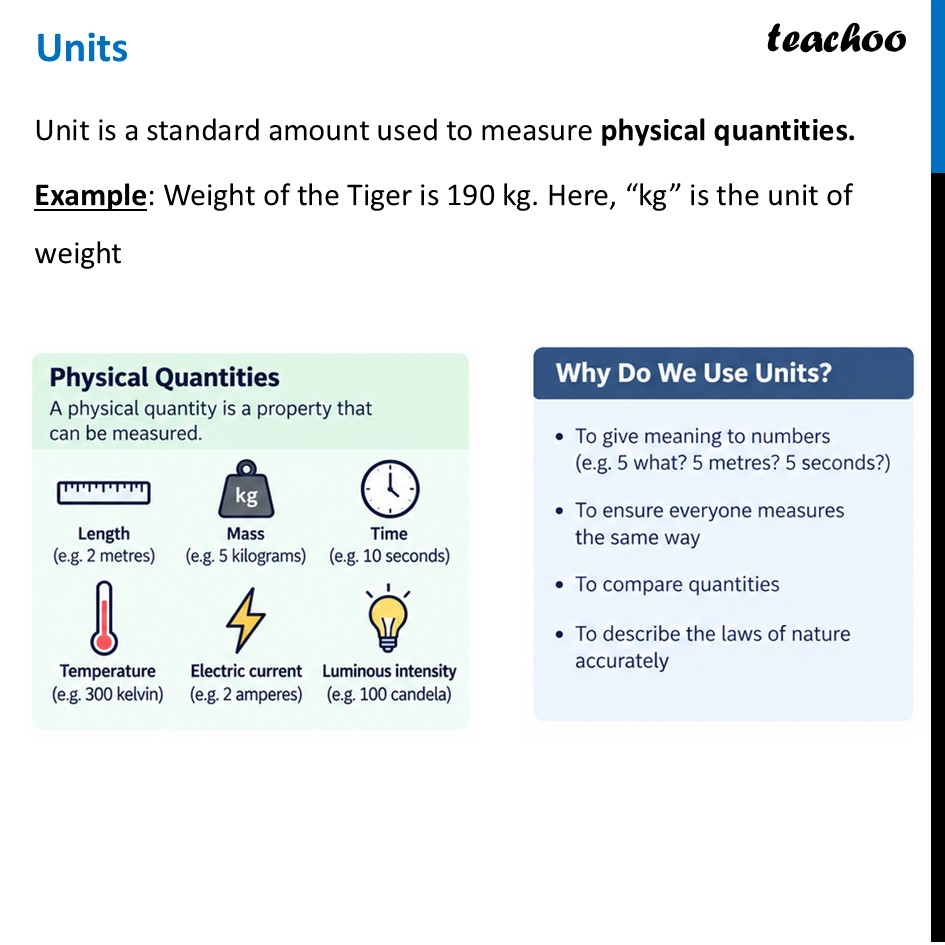
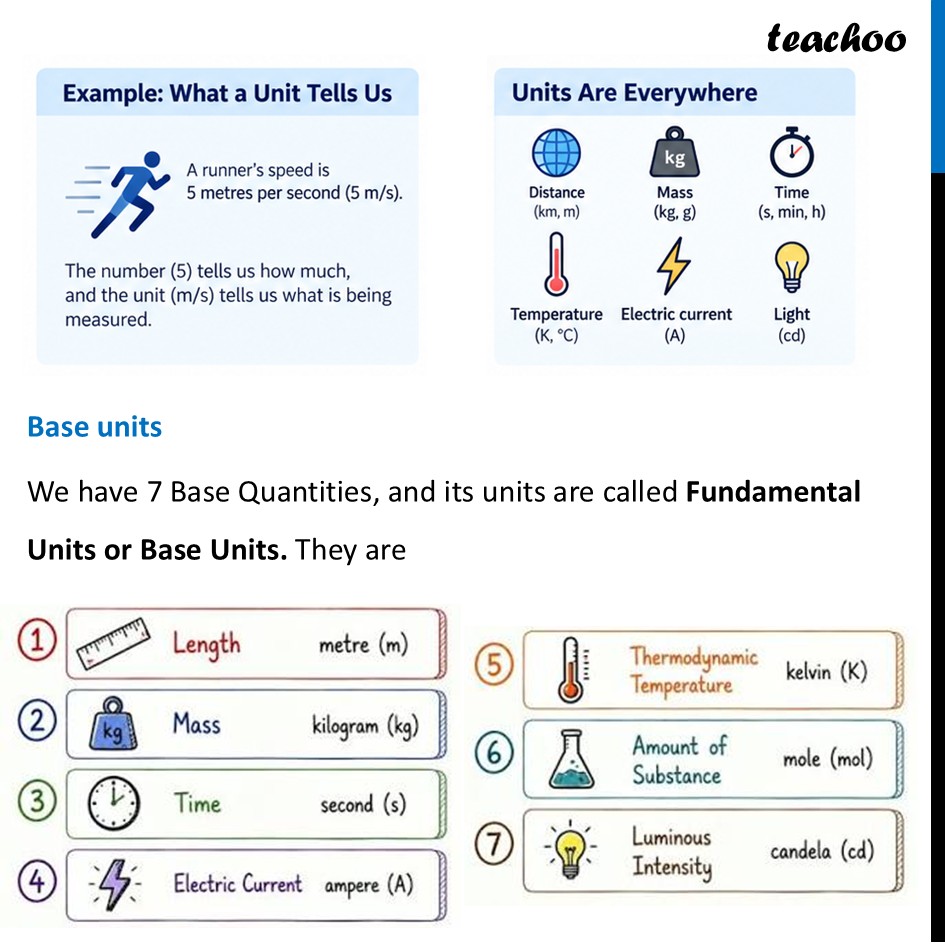
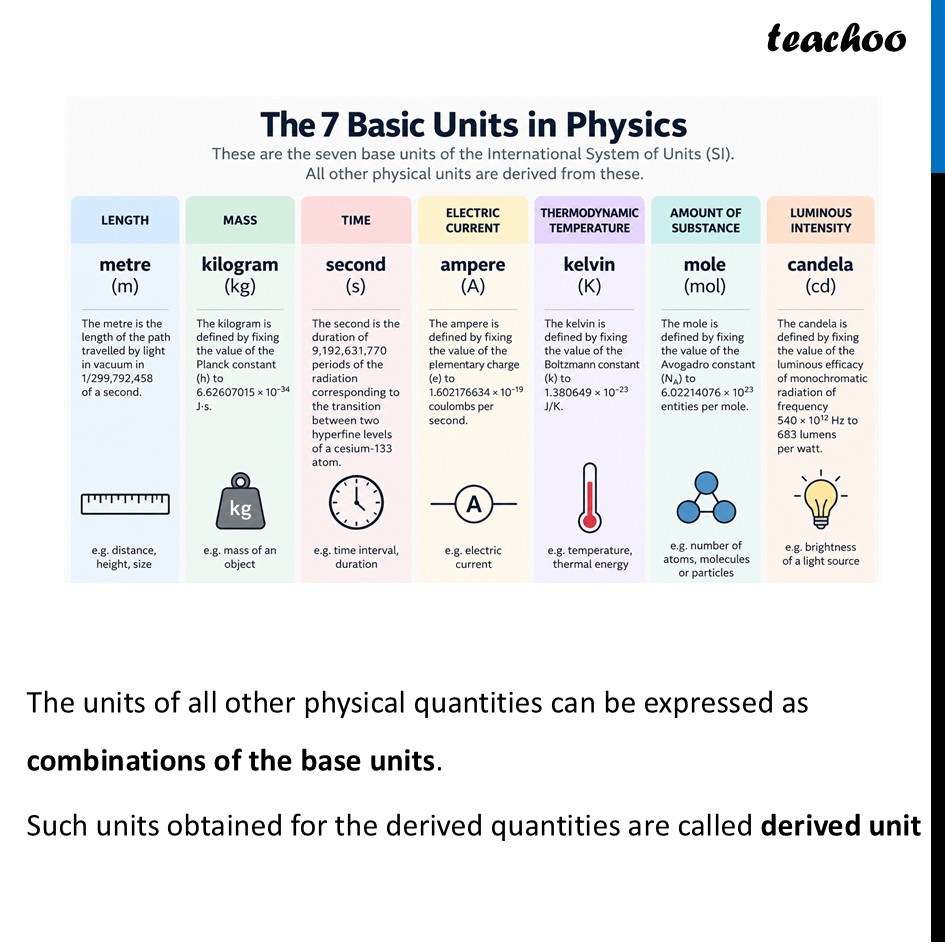
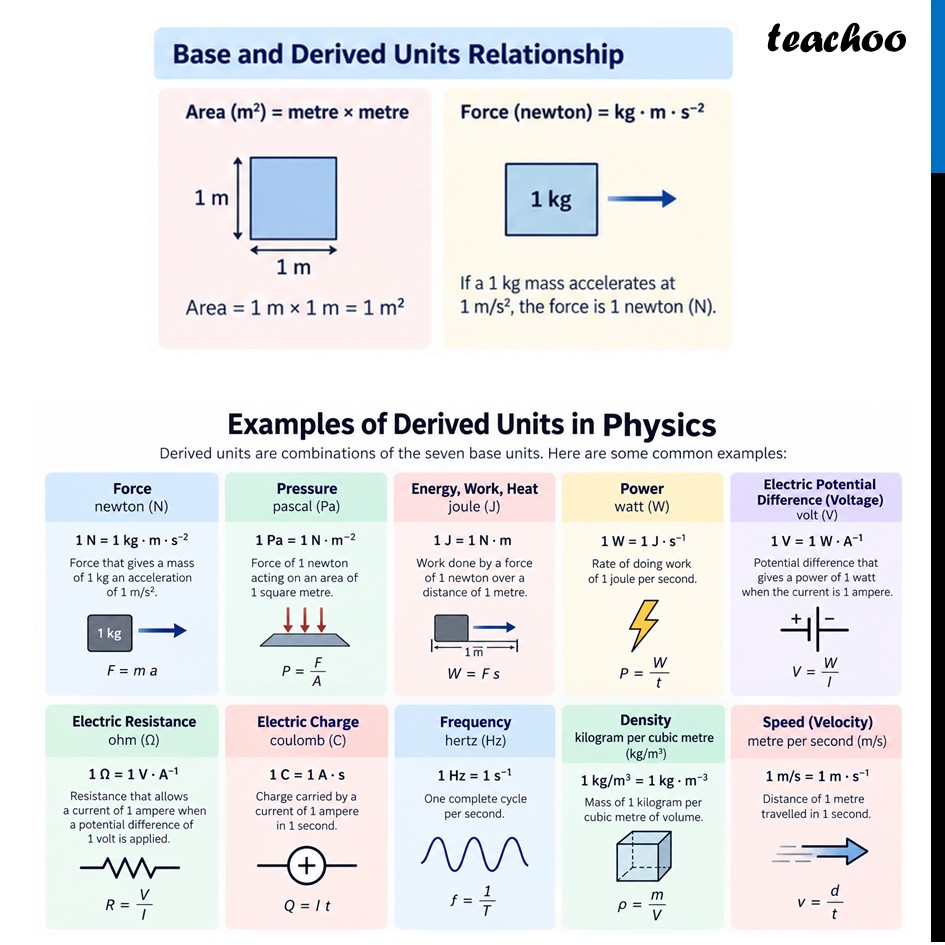
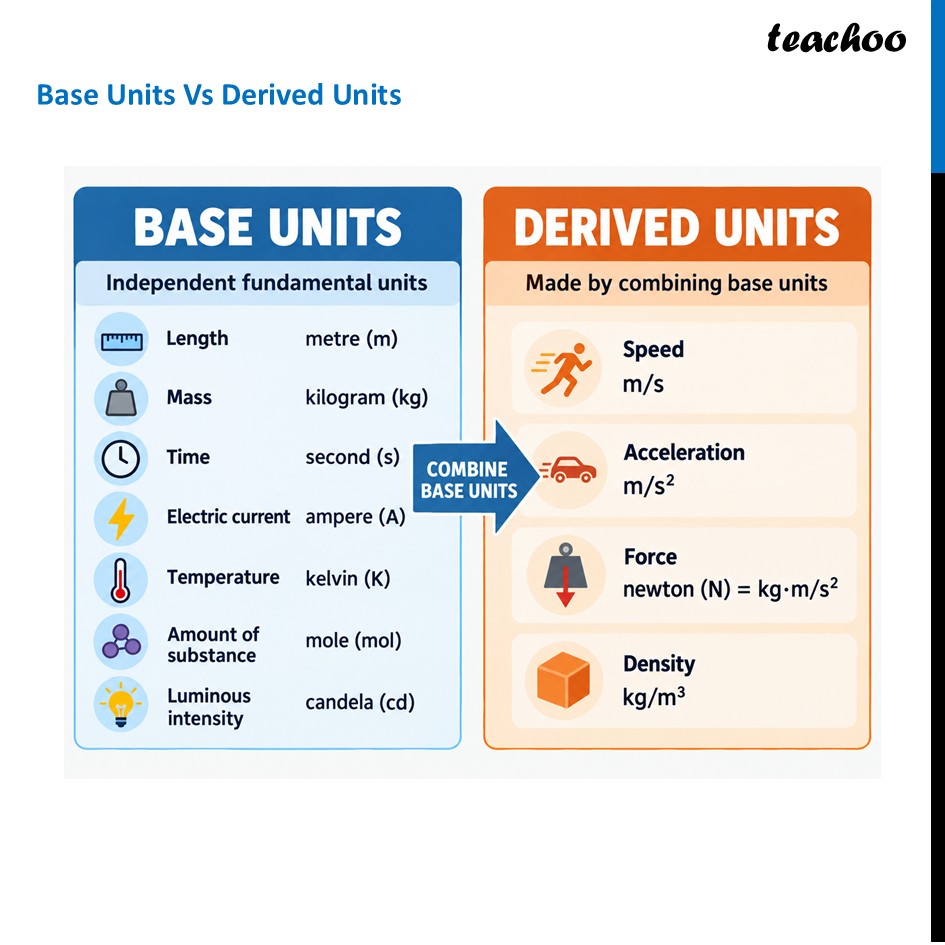
Units A unit is a standard amount used to measure a physical quantity. For example, if the mass of a tiger is 190 kg, then 190 is the numerical value and kilogram (kg) is the unit. Physical quantity = Numerical value × Unit Units help us communicate measurements clearly, compare quantities and describe physical laws. BASE UNITS There are seven base physical quantities. Their units are called fundamental units or base units. Length — metre (m) Mass — kilogram (kg) Time — second (s) Electric current — ampere (A) Thermodynamic temperature — kelvin (K) Amount of substance — mole (mol) Luminous intensity — candela (cd) DERIVED UNITS The units of other physical quantities can be expressed as combinations of base units. These are called derived units. Area = Length × Breadth Unit of area = m × m = m² Volume = Length × Breadth × Height Unit of volume = m³ Speed = Distance / Time Unit of speed = m s⁻¹ Acceleration = Change in velocity / Time Unit of acceleration = m s⁻² Force = Mass × Acceleration Unit of force = kg m s⁻² = newton (N) EXAMPLES OF DERIVED UNITS Force: 1 N = 1 kg m s⁻² Pressure: 1 Pa = 1 N m⁻² Energy and work: 1 J = 1 N m Power: 1 W = 1 J s⁻¹ Electric charge: 1 C = 1 A s Potential difference: 1 V = 1 W A⁻¹ Electrical resistance: 1 Ω = 1 V A⁻¹ Frequency: 1 Hz = 1 s⁻¹ Density: kg m⁻³ Speed: m s⁻¹ Base units are fundamental units. Derived units are formed by combining base units through multiplication, division or powers.