Concepts

 You are here
Last updated at October 7, 2026 by Teachoo
Transcript
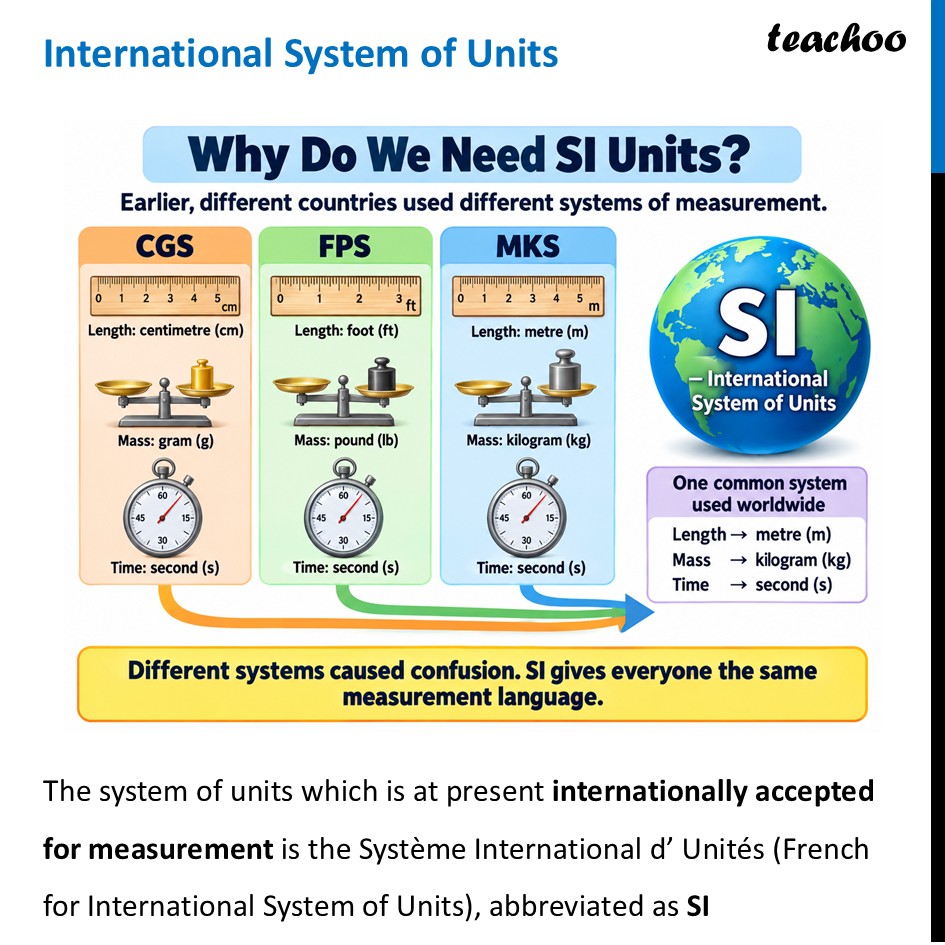
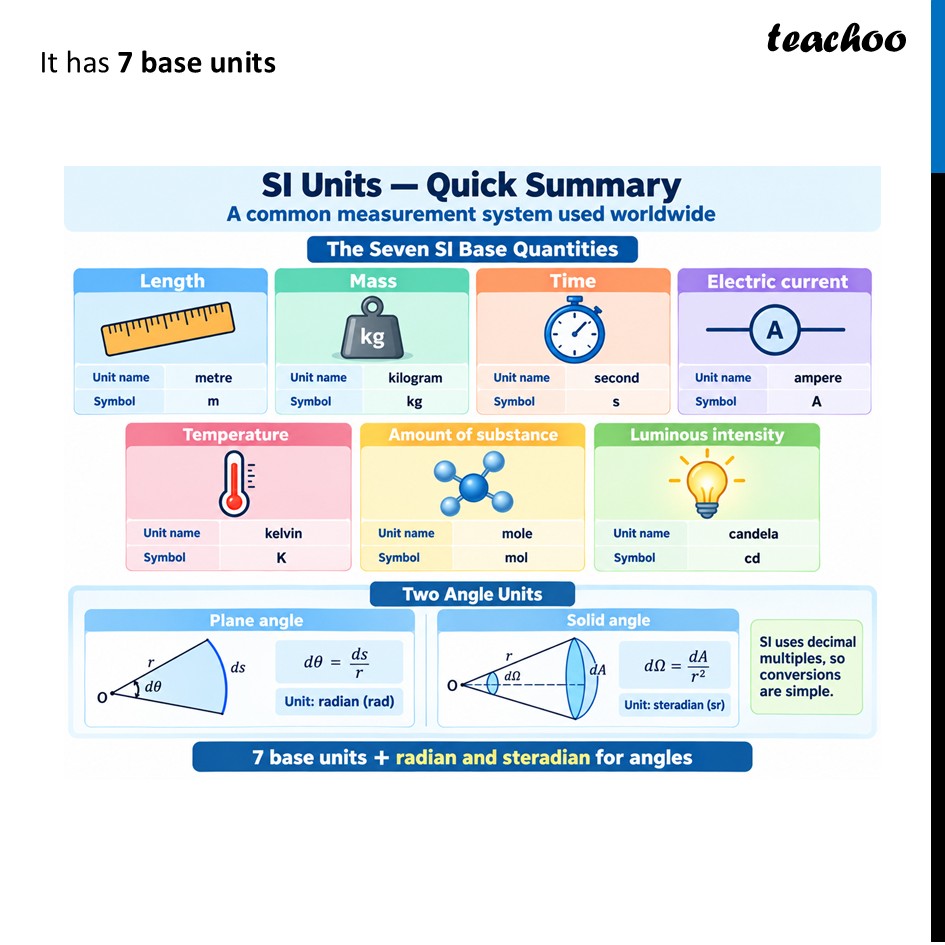
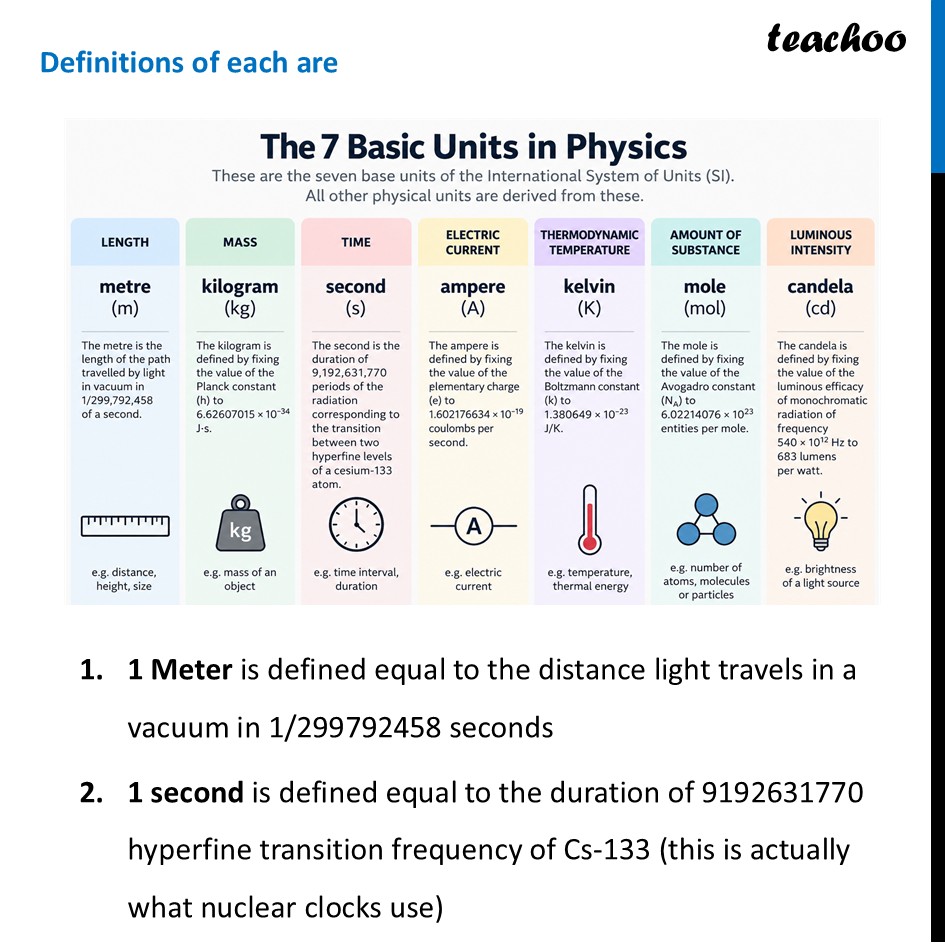
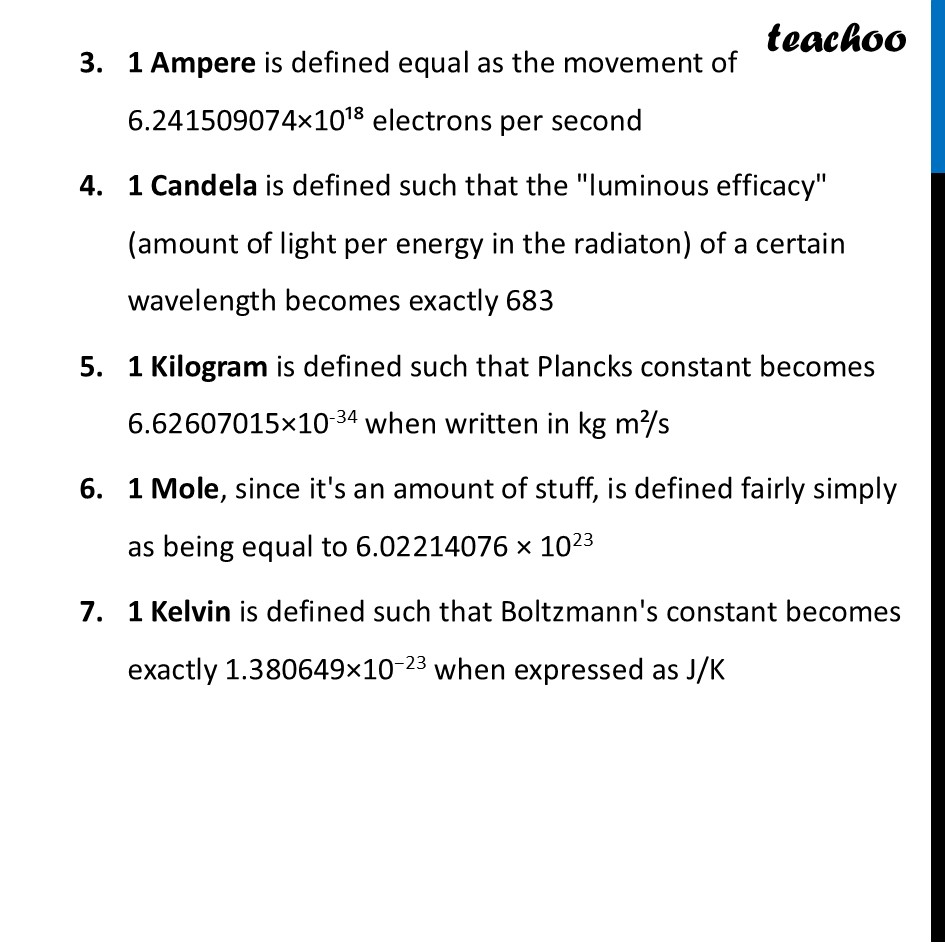
International System of Units The internationally accepted system of measurement is the Système International d’Unités, abbreviated as SI. Earlier, different systems of units were used: CGS system: Length — centimetre Mass — gram Time — second FPS system: Length — foot Mass — pound Time — second MKS system: Length — metre Mass — kilogram Time — second Using different systems could create confusion. SI provides a common measurement system. THE SEVEN SI BASE UNITS Length — metre (m) Mass — kilogram (kg) Time — second (s) Electric current — ampere (A) Thermodynamic temperature — kelvin (K) Amount of substance — mole (mol) Luminous intensity — candela (cd) DEFINITIONS Metre: One metre is the distance travelled by light in vacuum in 1/299,792,458 of a second. Second: One second corresponds to 9,192,631,770 periods of the radiation associated with the specified transition between two hyperfine levels of the ground state of a caesium-133 atom. Kilogram: The kilogram is defined by fixing Planck’s constant at 6.62607015 × 10⁻³⁴ J s, equivalent to kg m² s⁻¹. Ampere: The ampere is defined by fixing the elementary charge at 1.602176634 × 10⁻¹⁹ C, where C = A s. Kelvin: The kelvin is defined by fixing Boltzmann’s constant at 1.380649 × 10⁻²³ J K⁻¹. Mole: One mole contains exactly 6.02214076 × 10²³ specified elementary entities. Candela: The candela is defined using monochromatic radiation of frequency 540 × 10¹² Hz, with its luminous efficacy fixed at 683 lm W⁻¹. ANGLE UNITS Plane angle is measured in radians (rad). Solid angle is measured in steradians (sr). Both are dimensionless derived quantities.