Concepts

 You are here
Last updated at October 7, 2026 by Teachoo
Transcript
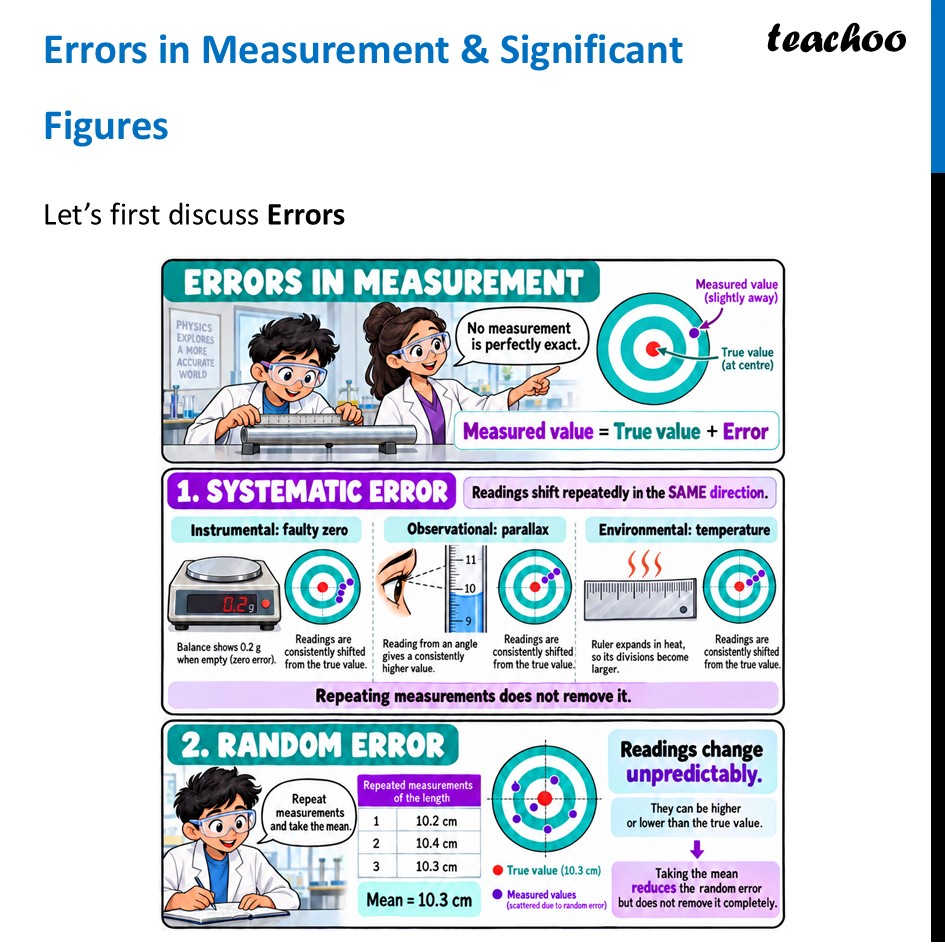
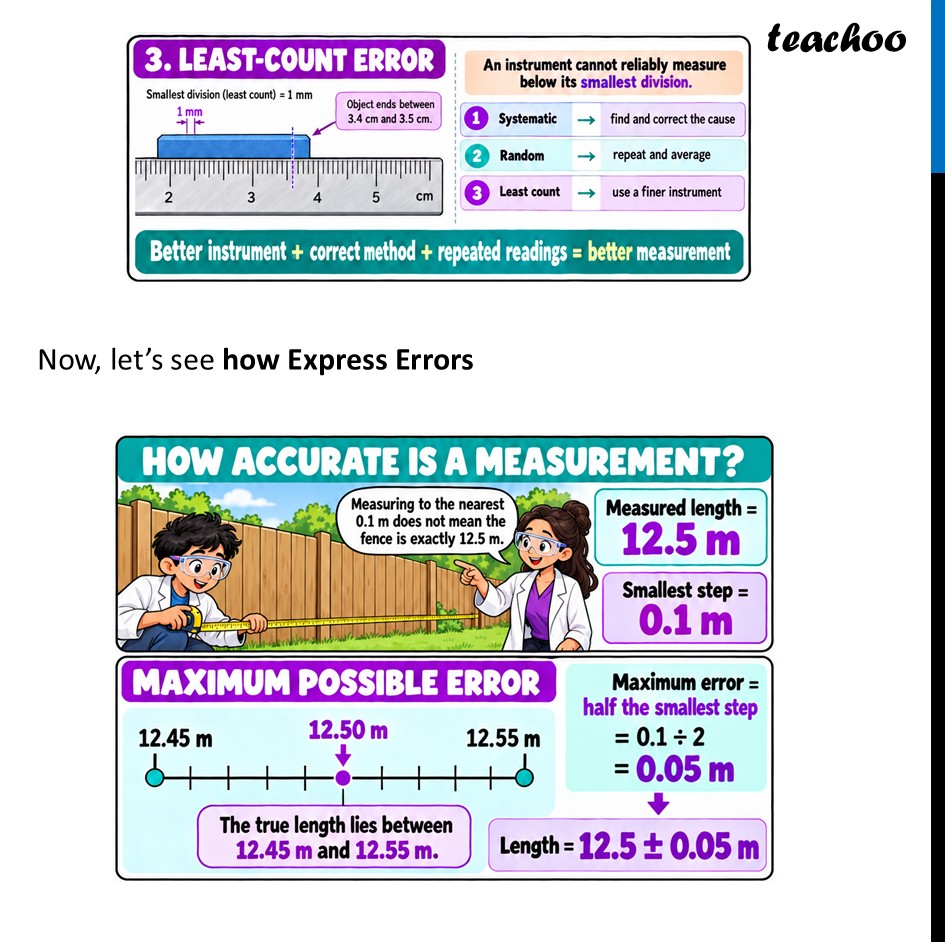
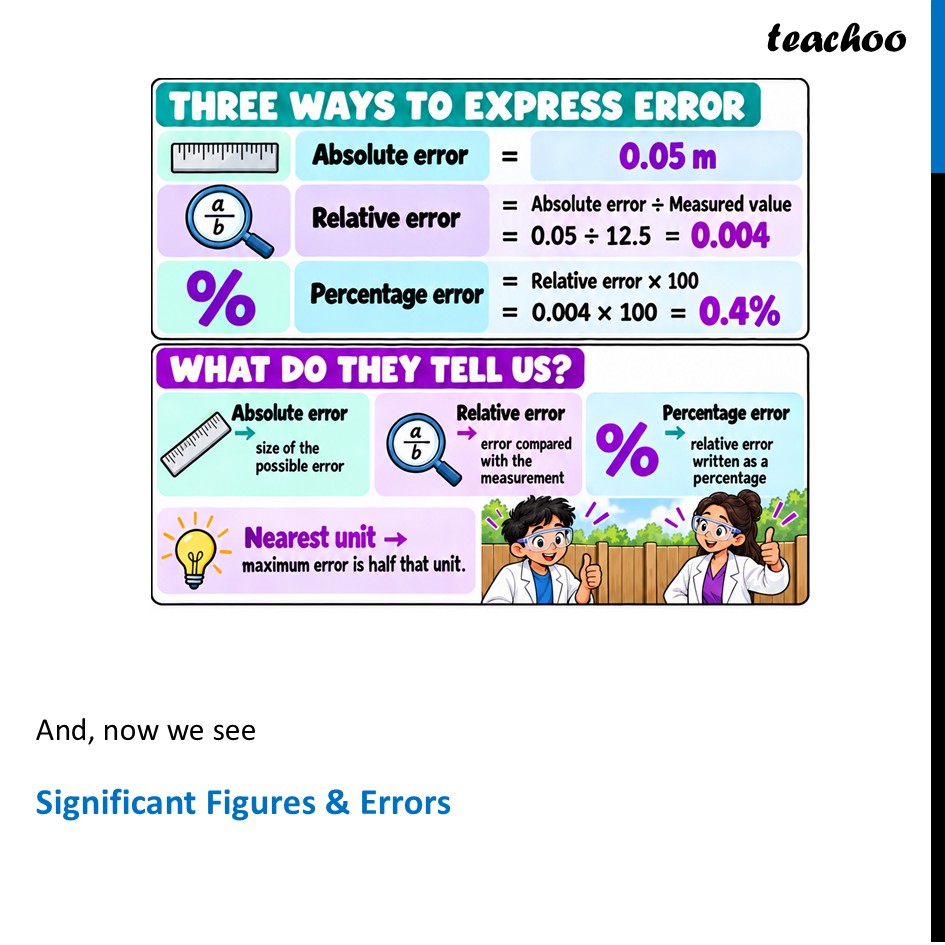
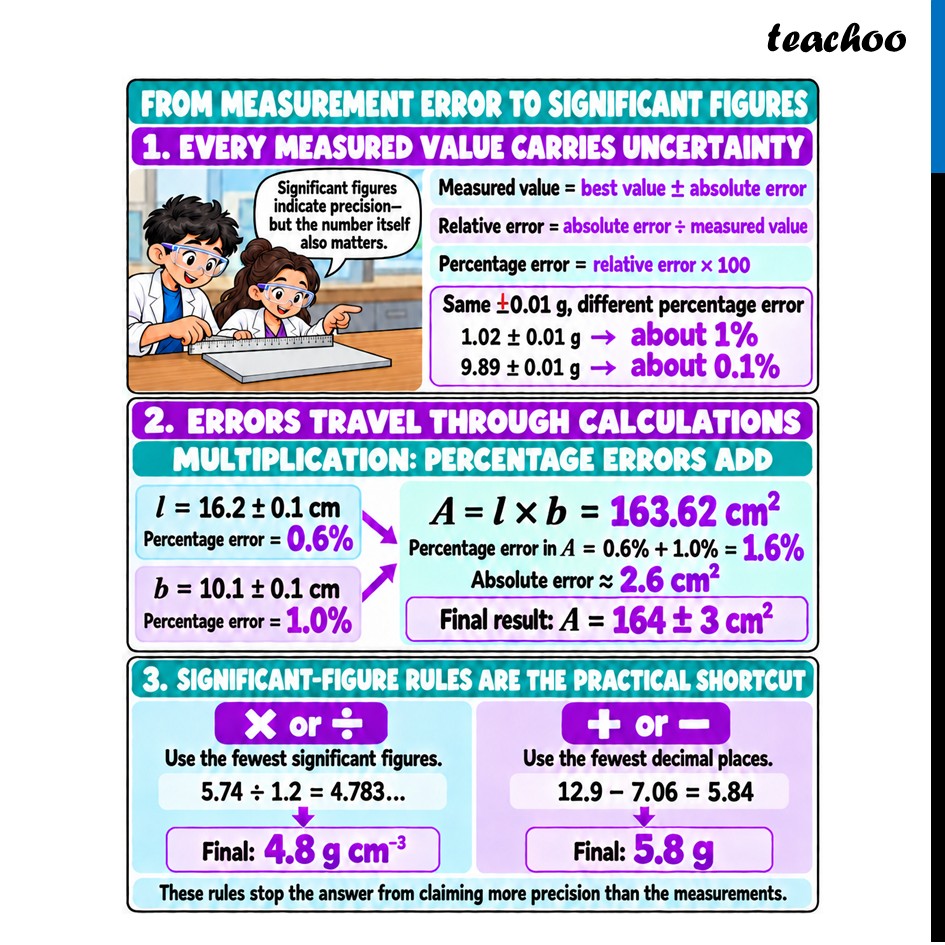
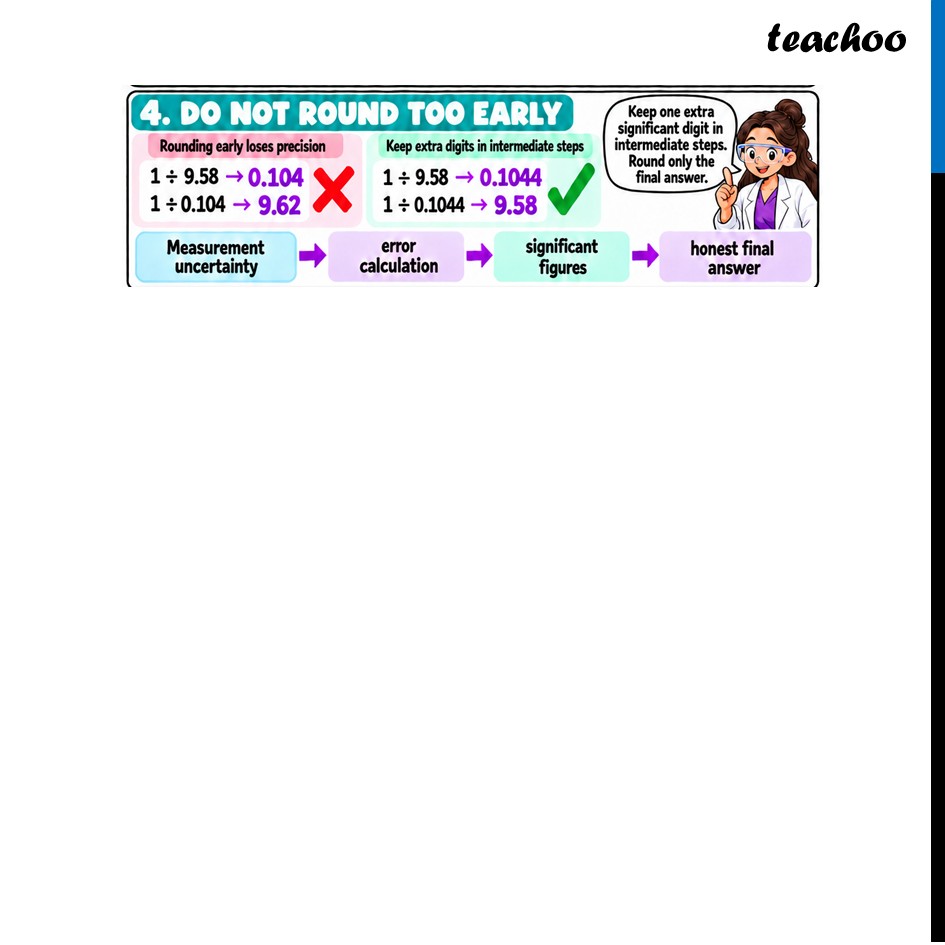
Errors in Measurement & Significant Figures No measurement is perfectly exact. Every measured value carries some uncertainty. SYSTEMATIC ERRORS Systematic errors repeatedly shift measurements in the same direction. Examples: Instrumental error: A balance reads 0.2 g when empty. Observational error: Viewing a scale from an incorrect angle causes parallax. Environmental error: Temperature changes cause a measuring tape to expand. Repeating measurements does not remove a systematic error. Its cause must be identified and corrected. RANDOM ERRORS Random errors cause readings to vary unpredictably. Some readings may be higher and others lower than the best estimate. For example: 10.2 cm, 10.4 cm and 10.3 cm Mean = (10.2 + 10.4 + 10.3) / 3 Mean = 10.3 cm Taking repeated readings and calculating the mean reduces random uncertainty. LEAST-COUNT LIMITATION An instrument’s smallest scale division limits the detail that can be resolved. If a scale is marked every 1 mm, it cannot directly resolve arbitrarily small changes in length. EXPRESSING UNCERTAINTY Measured value = Best estimate ± Absolute uncertainty Suppose a length is recorded as 12.5 m to the nearest 0.1 m. Maximum rounding uncertainty = 0.1 / 2 = 0.05 m Therefore: Length = (12.5 ± 0.05) m Considering rounding alone, the value lies between 12.45 m and 12.55 m. THREE WAYS TO EXPRESS UNCERTAINTY Absolute uncertainty = 0.05 m Relative uncertainty = Absolute uncertainty / Measured value = 0.05 / 12.5 = 0.004 Percentage uncertainty = Relative uncertainty × 100 = 0.004 × 100 = 0.4% SIGNIFICANT FIGURES AND UNCERTAINTY Significant figures indicate the precision of a reported measurement. The same absolute uncertainty can represent different relative uncertainties. (1.02 ± 0.01) g has approximately 1% uncertainty. (9.89 ± 0.01) g has approximately 0.1% uncertainty. UNCERTAINTY IN CALCULATIONS For a product, maximum fractional uncertainties approximately add. Length = (16.2 ± 0.1) cm Breadth = (10.1 ± 0.1) cm Area = 16.2 × 10.1 = 163.62 cm² Percentage uncertainty in length: (0.1 / 16.2) × 100 ≈ 0.6% Percentage uncertainty in breadth: (0.1 / 10.1) × 100 ≈ 1.0% Maximum percentage uncertainty in area: 0.6% + 1.0% ≈ 1.6% Absolute uncertainty in area: (1.6 / 100) × 163.62 ≈ 2.6 cm² PRACTICAL RULES For multiplication and division, use the fewest significant figures. For addition and subtraction, use the least precise decimal place. Keep extra digits in intermediate calculations. Round the final result.