Concepts

 You are here
Last updated at October 7, 2026 by Teachoo
Transcript
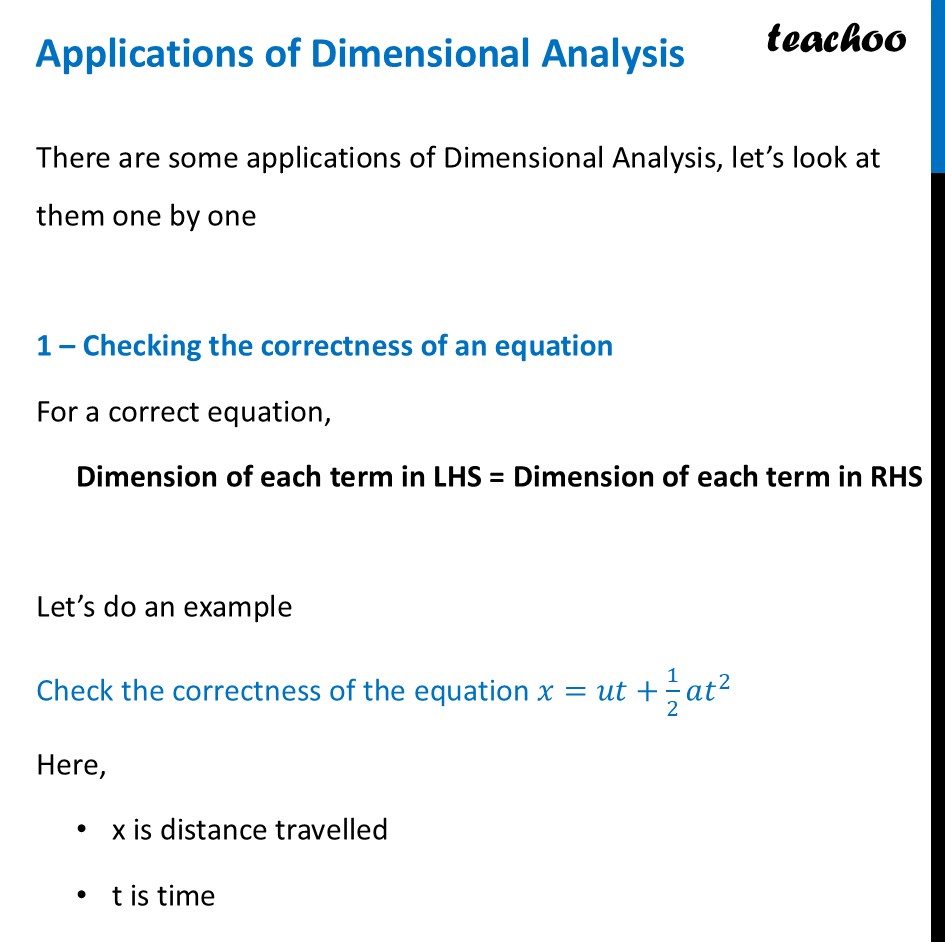
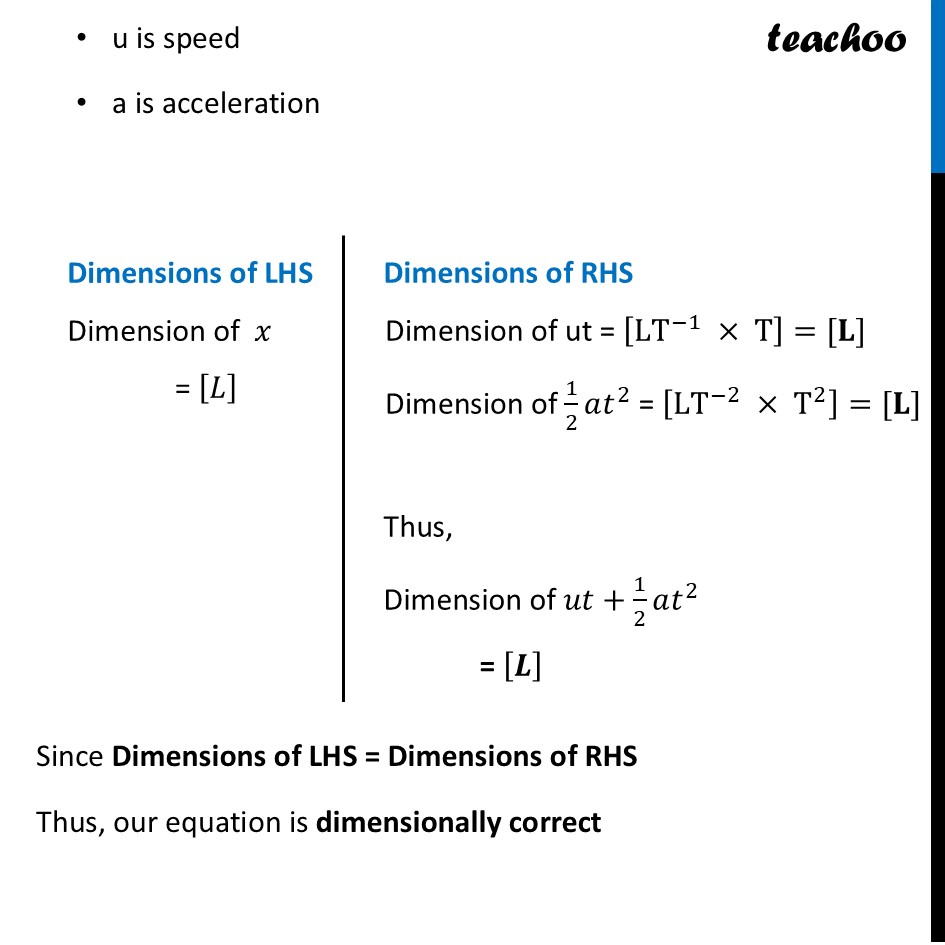
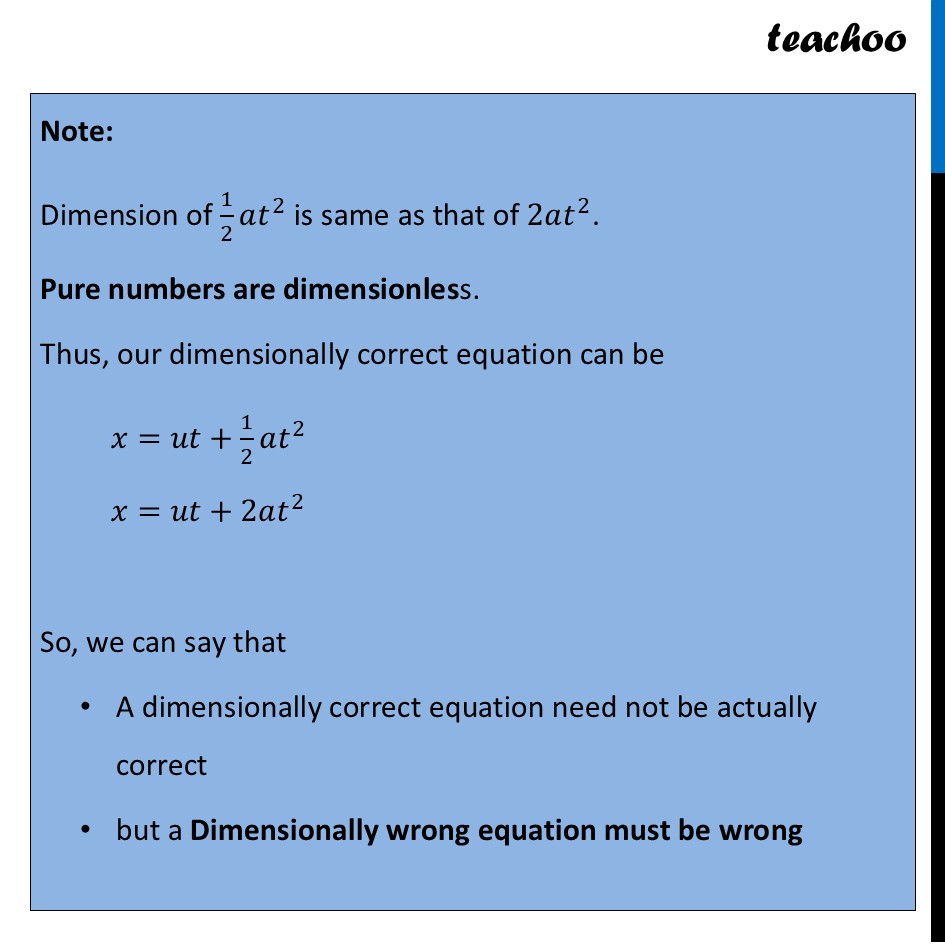
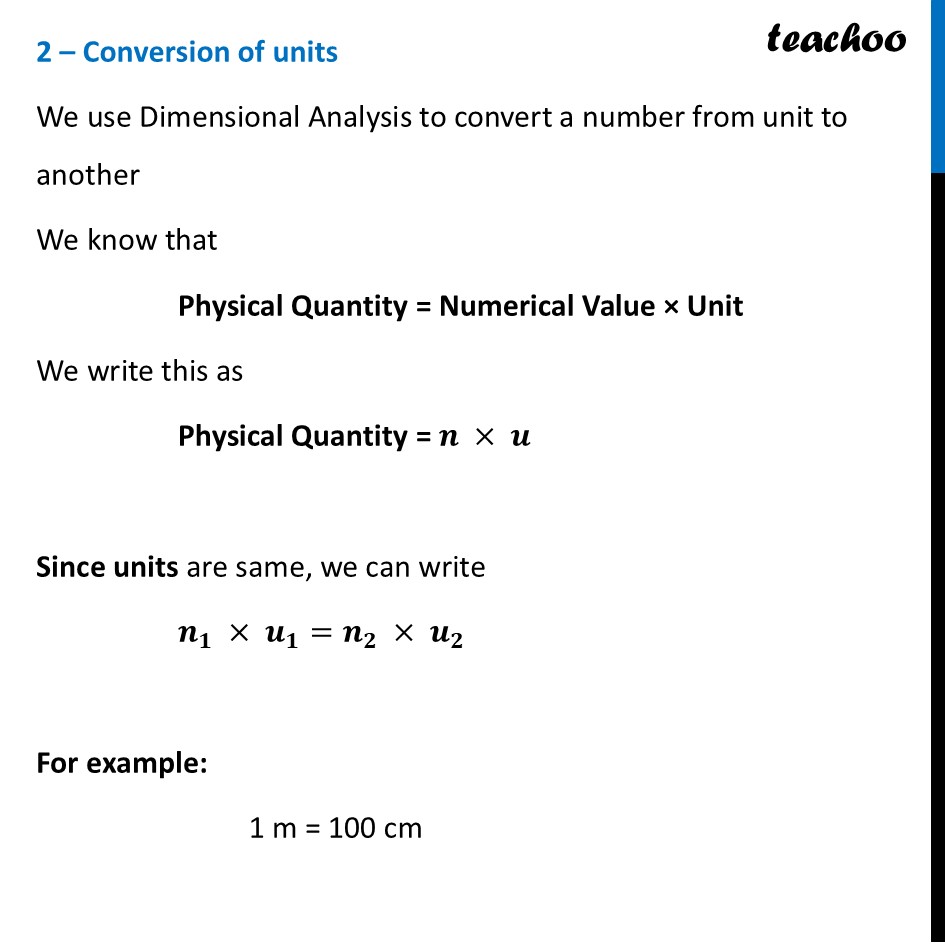
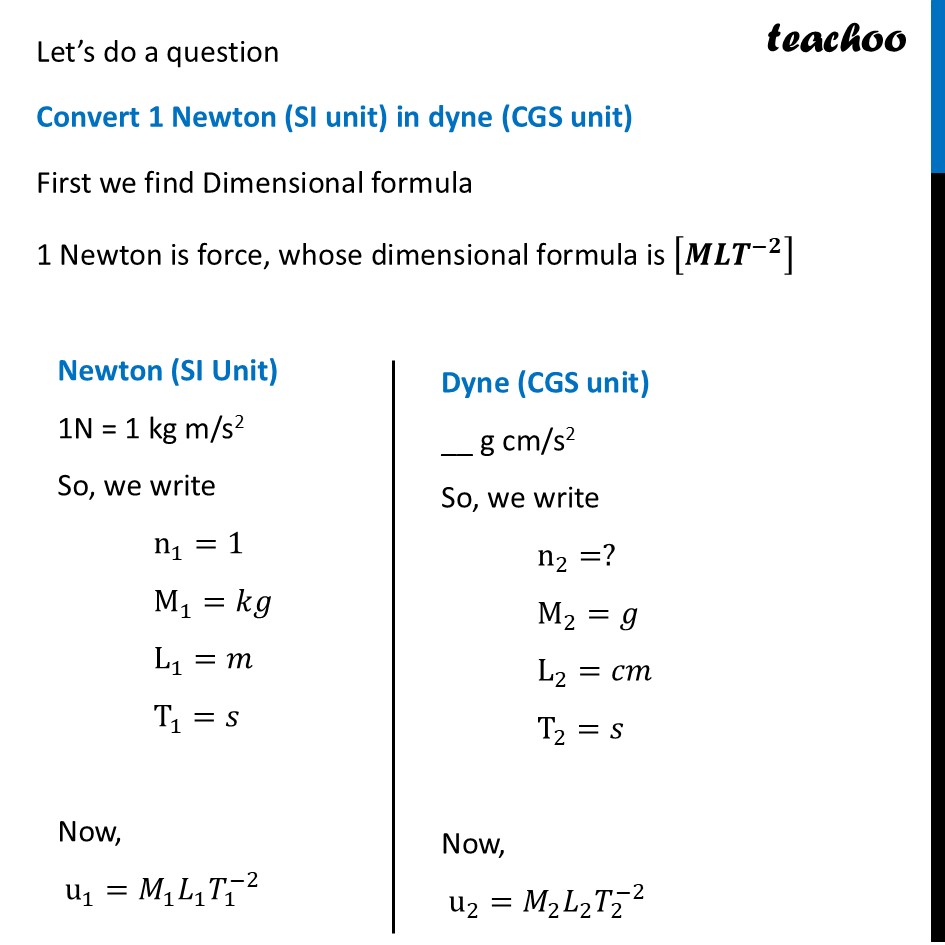
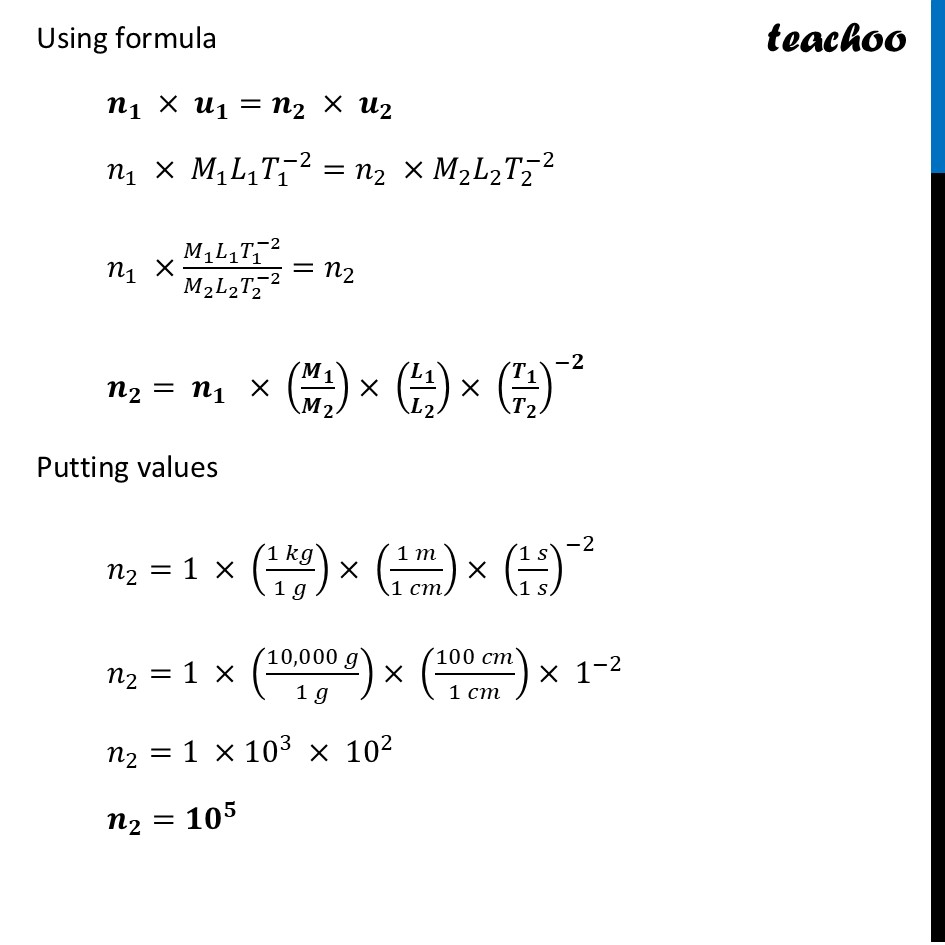
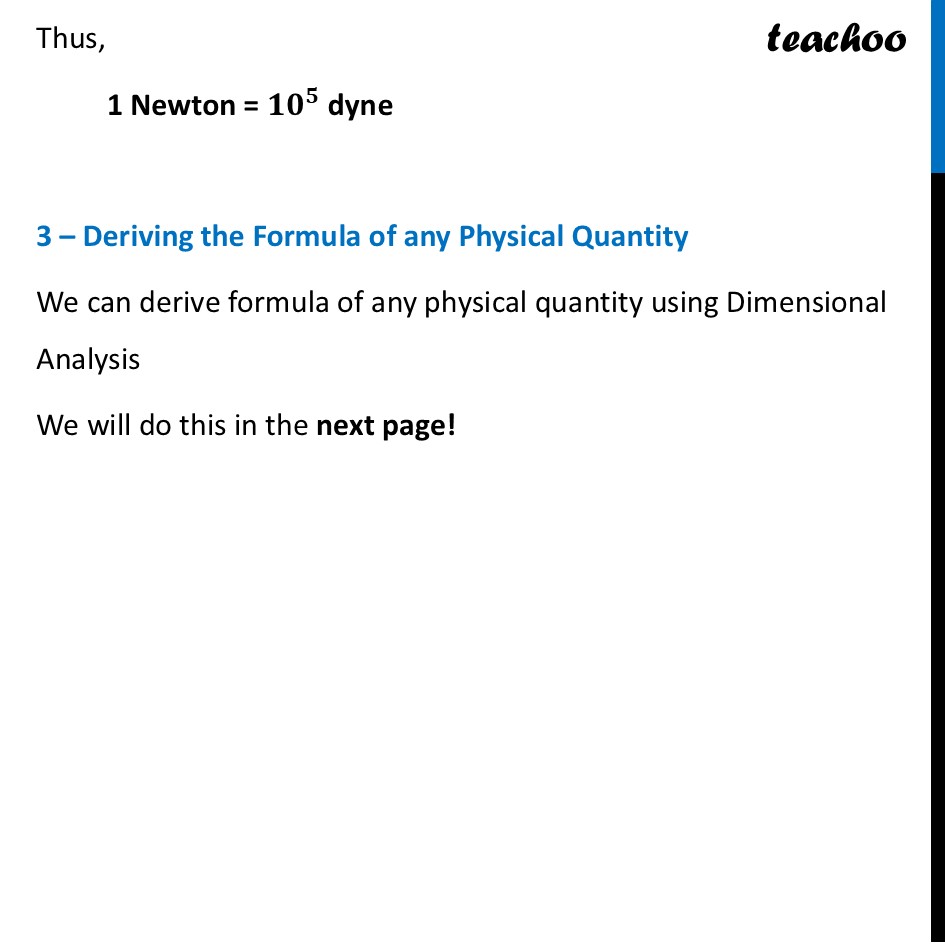
Applications of Dimensional Analysis Dimensional analysis has three main applications: 1. Checking dimensional consistency of equations. 2. Converting units. 3. Deriving possible relationships between physical quantities. 1. CHECKING AN EQUATION Consider: x = ut + (1/2)at² [x] = [L] [ut] = [LT⁻¹ × T] = [L] [(1/2)at²] = [LT⁻² × T²] = [L] The equation is dimensionally consistent. Numerical constants are dimensionless. Dimensional analysis cannot distinguish between: x = ut + (1/2)at² and x = ut + 2at² Both are dimensionally consistent, but they cannot both describe the same motion correctly. A dimensionally consistent equation need not be physically correct. An equation with inconsistent dimensions cannot be a valid physical equation as written. 2. CONVERSION OF UNITS Physical quantity = Numerical value × Unit The physical quantity remains unchanged when its unit changes. n₁u₁ = n₂u₂ For a quantity with dimensions [MᵃLᵇTᶜ]: n₂ = n₁(M₁/M₂)ᵃ(L₁/L₂)ᵇ(T₁/T₂)ᶜ EXAMPLE: Convert 1 newton into dyne 1 N = 1 kg m s⁻² 1 kg = 10³ g 1 m = 10² cm Therefore: 1 N = 10³ × 10² g cm s⁻² 1 N = 10⁵ g cm s⁻² Since 1 dyne = 1 g cm s⁻²: 1 N = 10⁵ dyne 3. DERIVING RELATIONSHIPS Dimensional analysis can determine the powers of relevant quantities in a proposed relationship. It cannot determine a dimensionless numerical constant.