Concepts

 You are here
Last updated at October 7, 2026 by Teachoo
Transcript
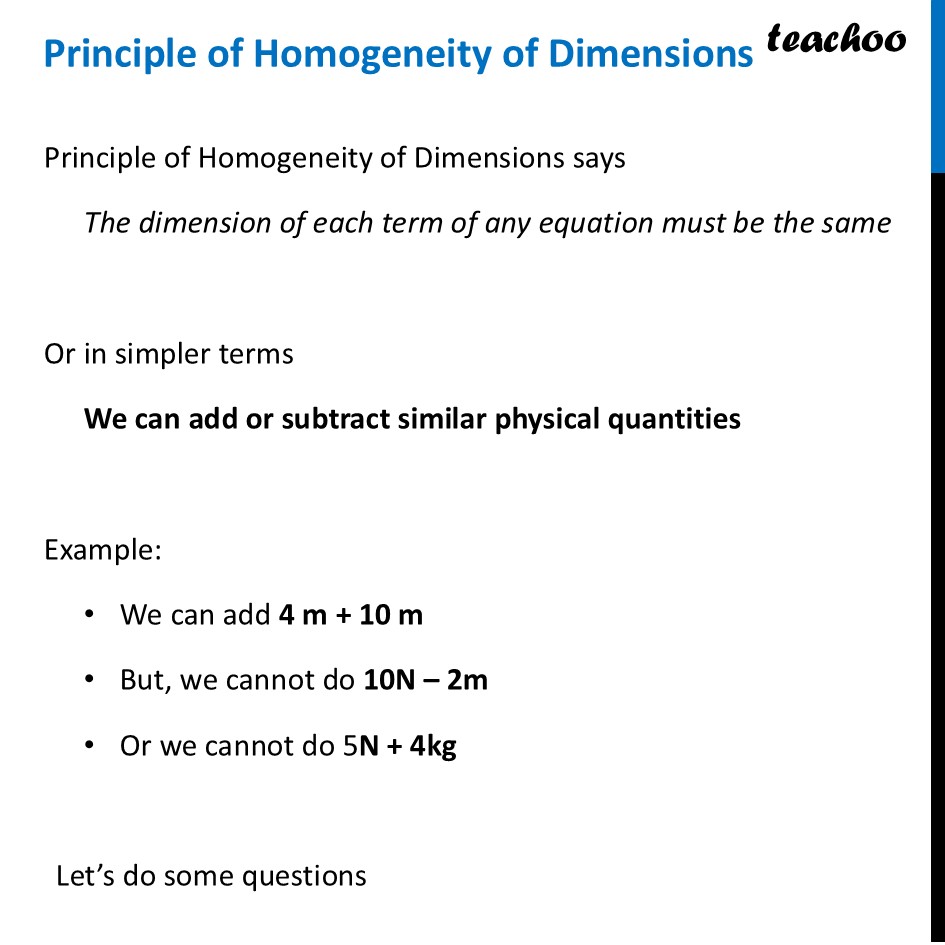
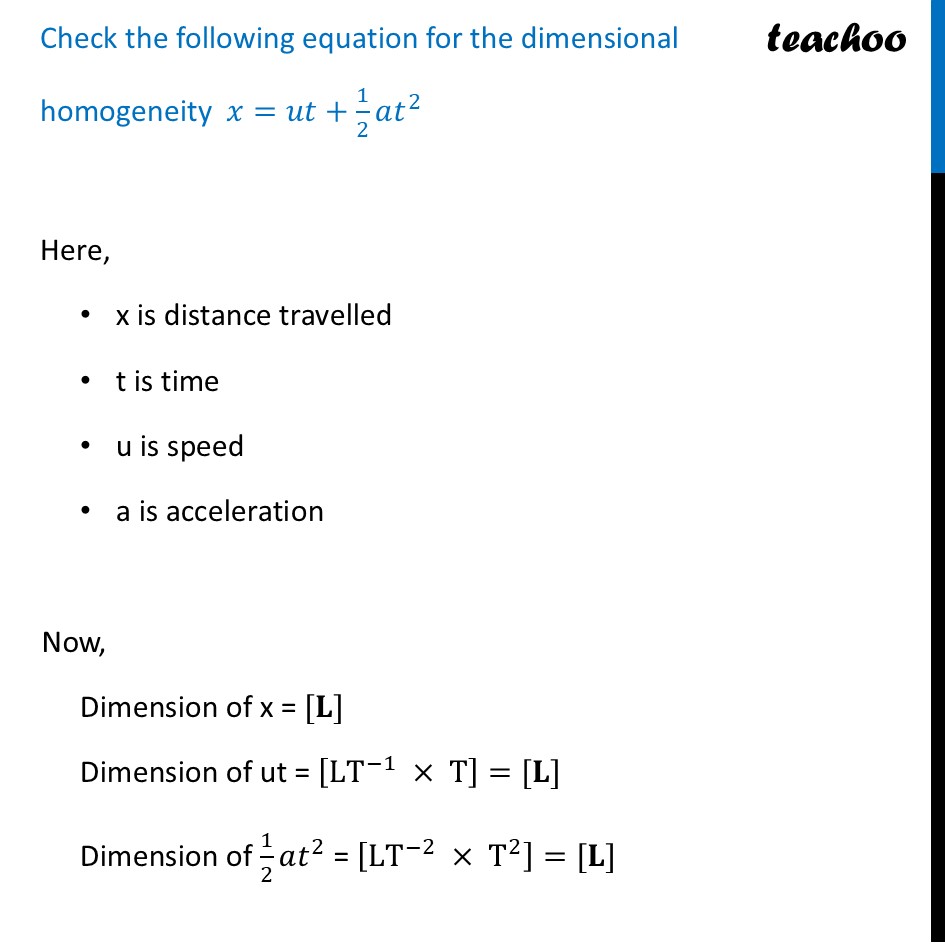
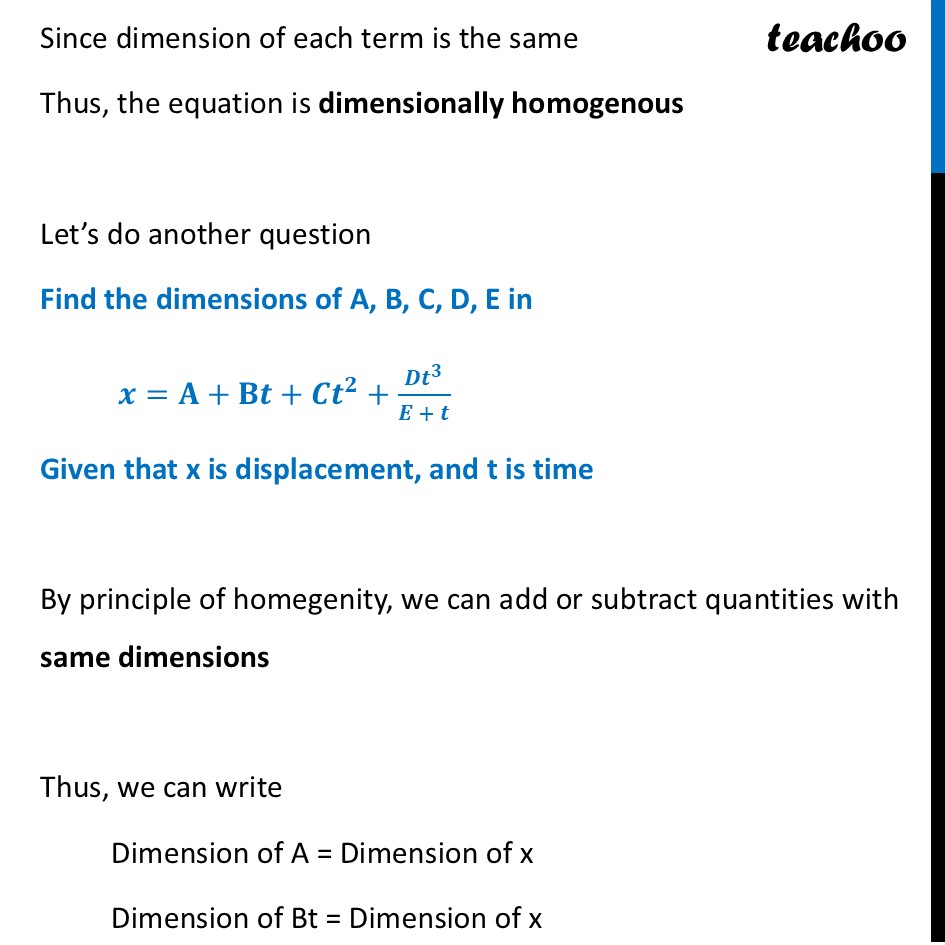
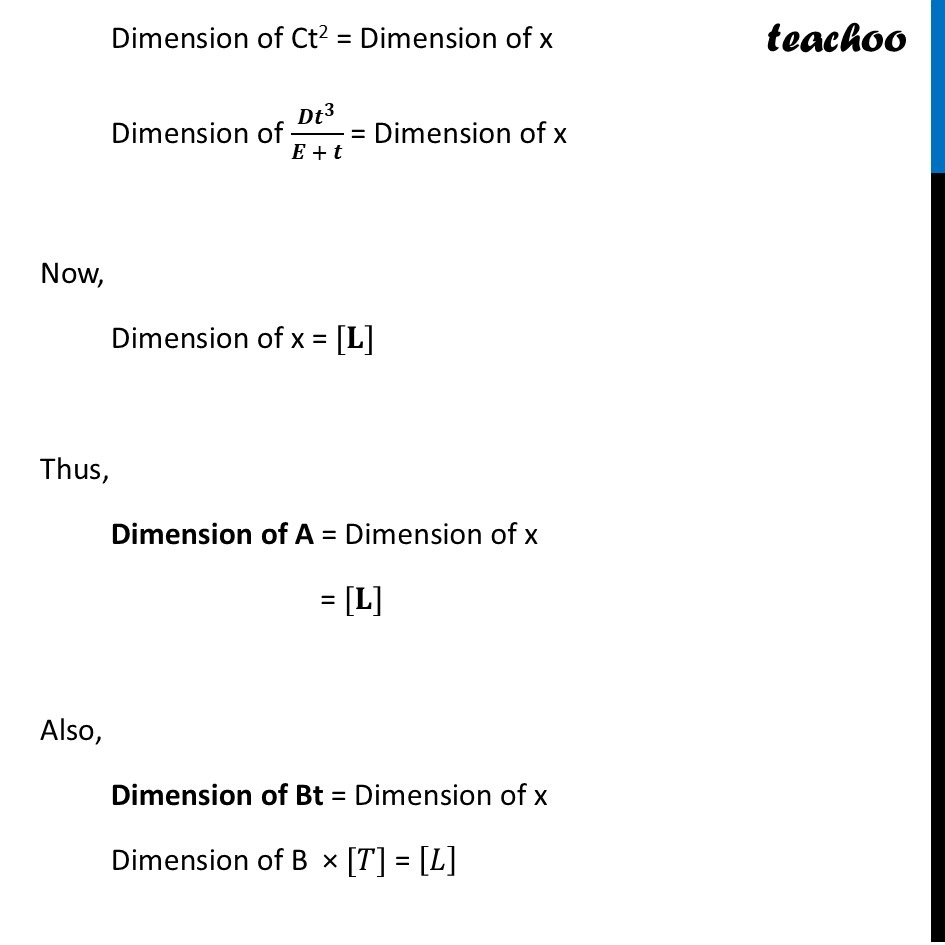
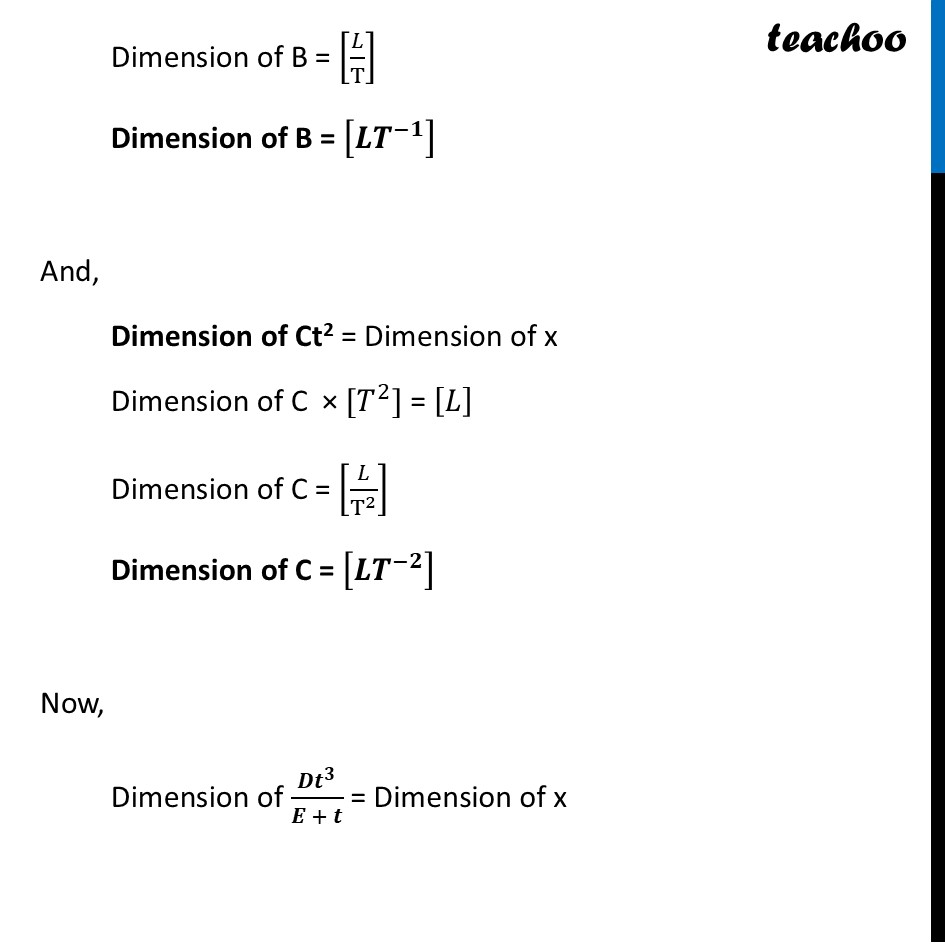
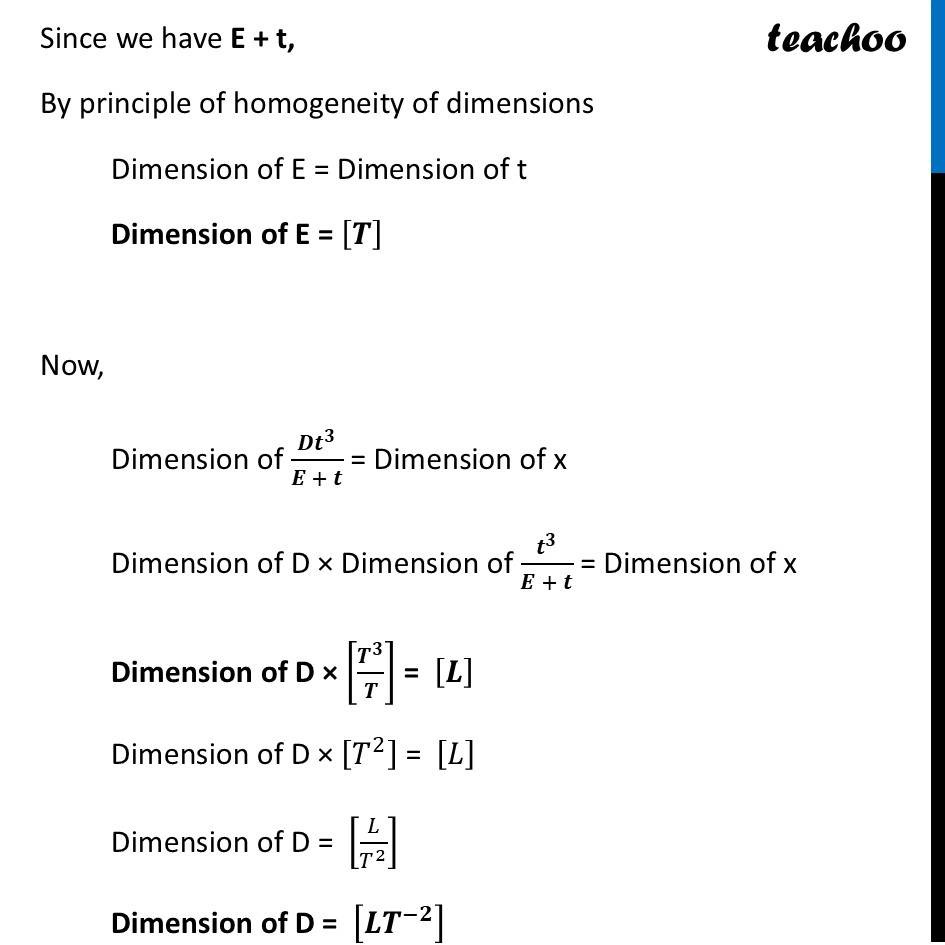
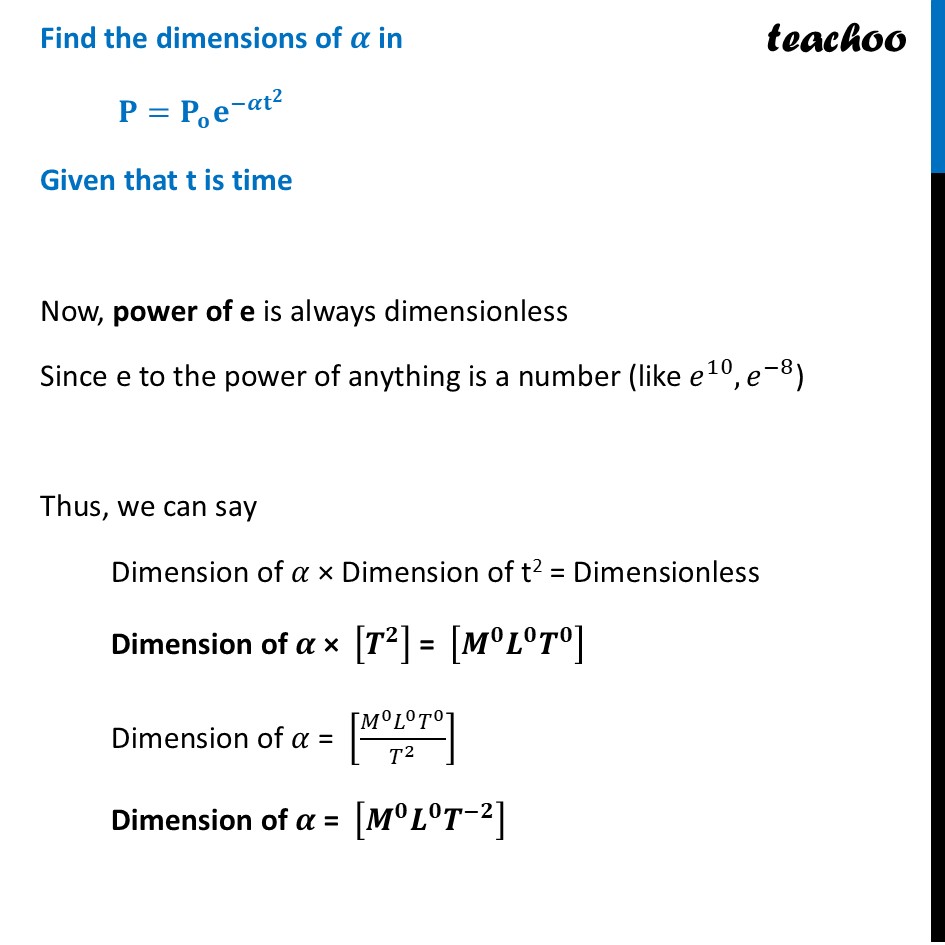
Principle of Homogeneity of Dimensions The principle of homogeneity states that every term added or subtracted in a physical equation must have the same dimensions. The dimensions on both sides of the equation must also match. Examples: 4 m + 10 m is meaningful. 10 N − 2 m is not meaningful. 5 N + 4 kg is not meaningful. EXAMPLE 1 Check: x = ut + (1/2)at² Here: x is displacement. u is initial velocity. a is acceleration. t is time. [x] = [L] [ut] = [LT⁻¹ × T] = [L] [(1/2)at²] = [LT⁻² × T²] = [L] Every term has the dimensions of length. Therefore, the equation is dimensionally homogeneous. EXAMPLE 2 Find the dimensions of A, B, C, D and E in: x = A + Bt + Ct² + Dt³ / (E + t) x is displacement and t is time. Each term must have dimensions [L]. For A: [A] = [L] For Bt: [B][T] = [L] [B] = [LT⁻¹] For Ct²: [C][T²] = [L] [C] = [LT⁻²] Since E and t are added: [E] = [T] For the final term: [D][T³] / [T] = [L] [D][T²] = [L] [D] = [LT⁻²] Therefore: [A] = [L] [B] = [LT⁻¹] [C] = [LT⁻²] [D] = [LT⁻²] [E] = [T] EXAMPLE 3 Find the dimensions of α in: P = P₀e^(−αt²) The exponent of an exponential function must be dimensionless. [αt²] = 1 [α][T²] = 1 Therefore: [α] = [T⁻²]