
Concepts

 You are here
Last updated at October 7, 2026 by Teachoo
Transcript
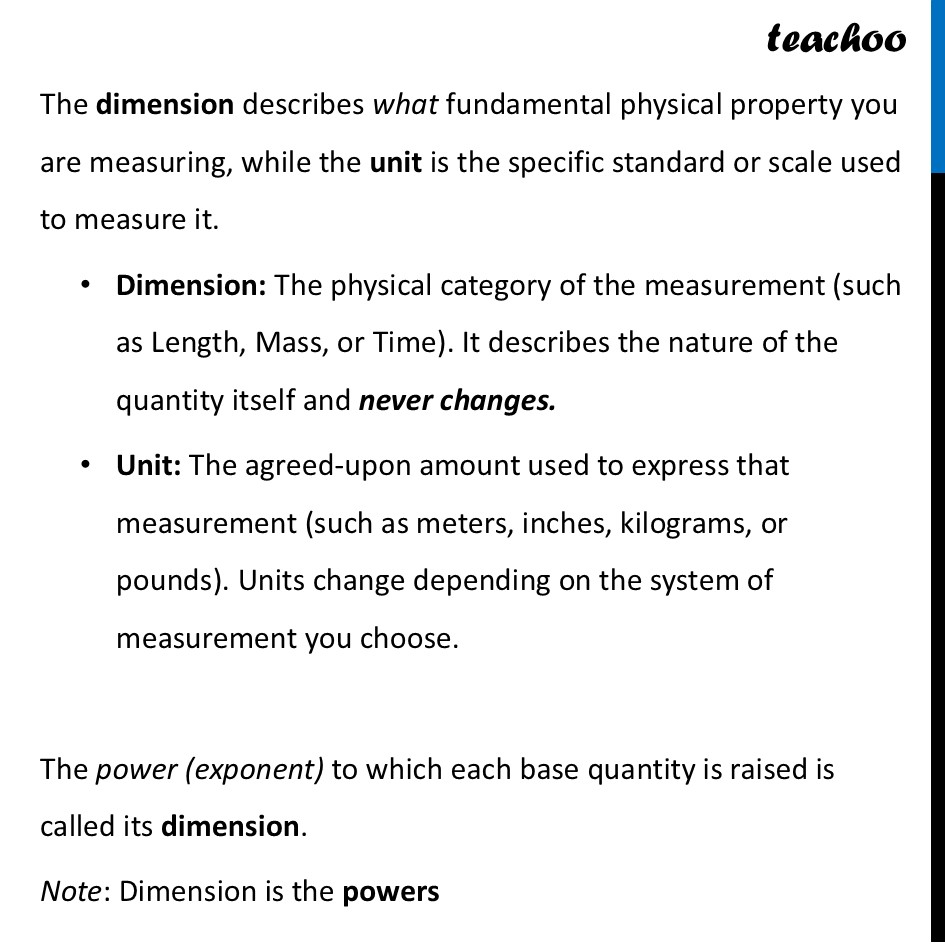
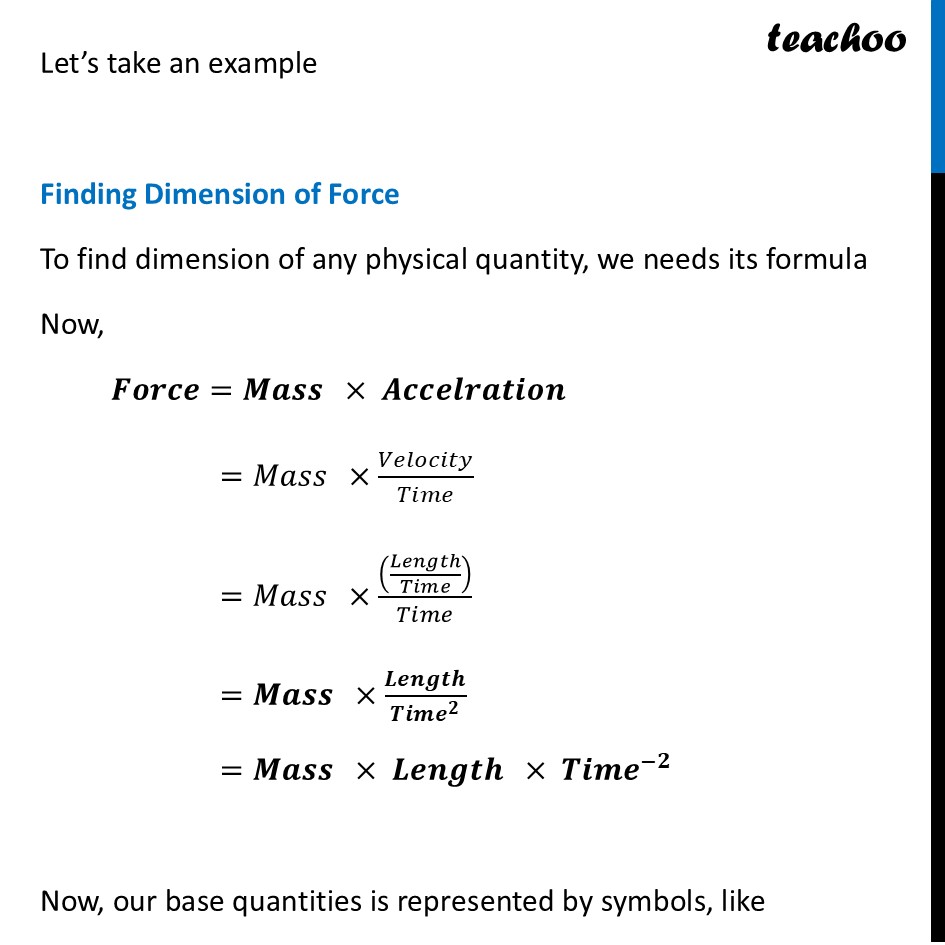
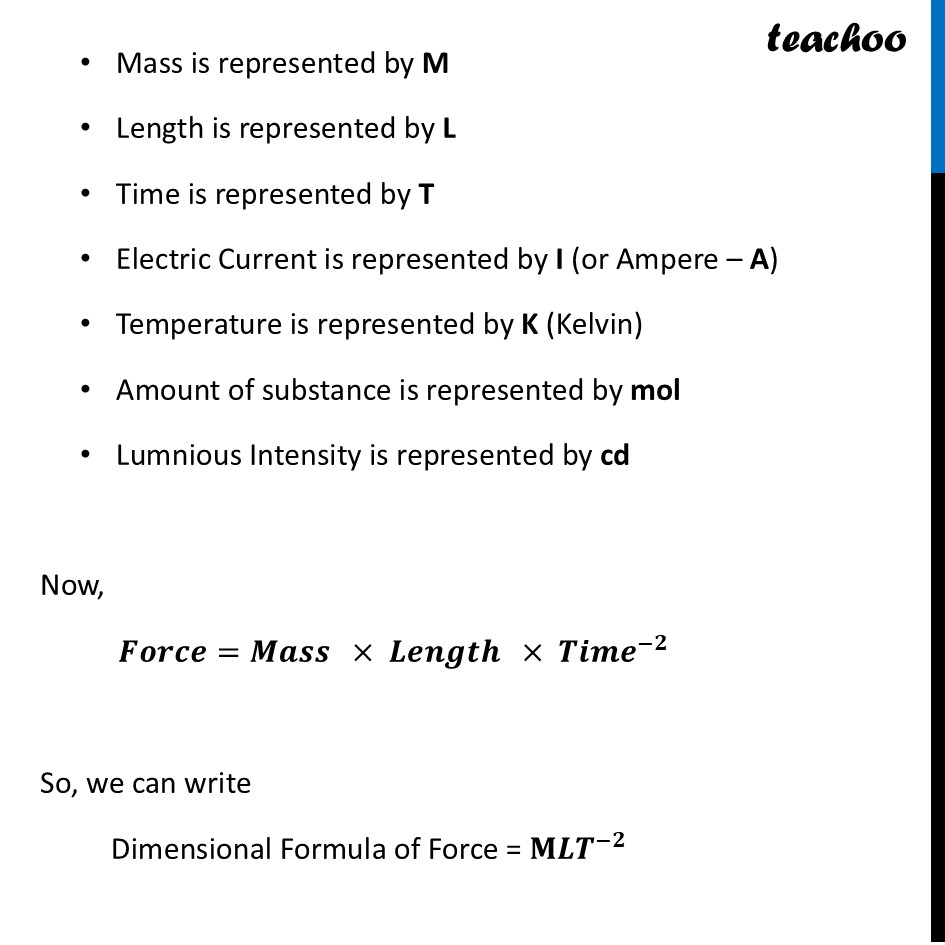
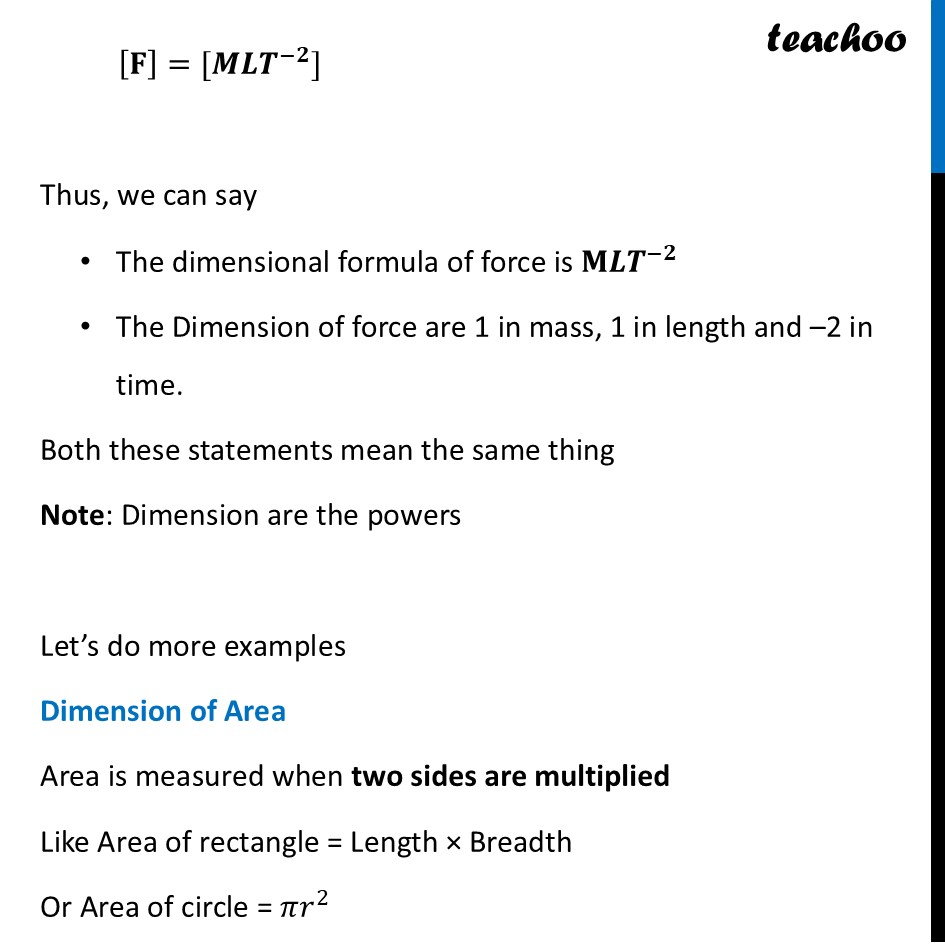
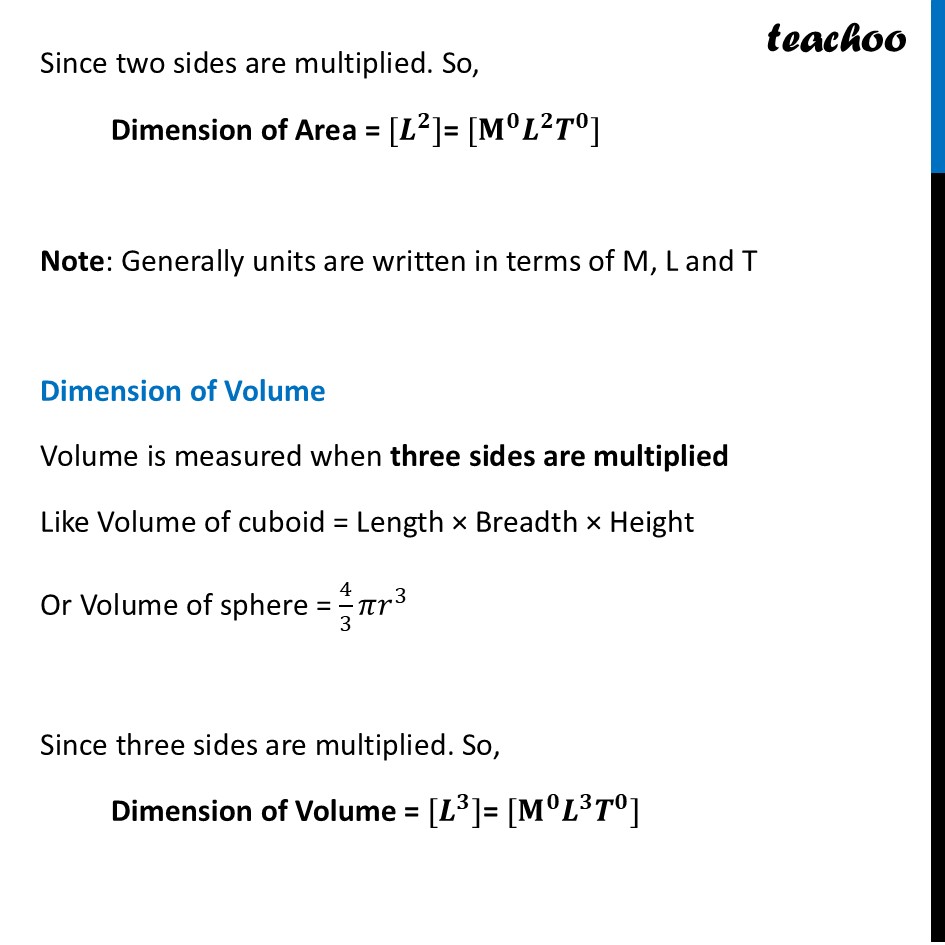
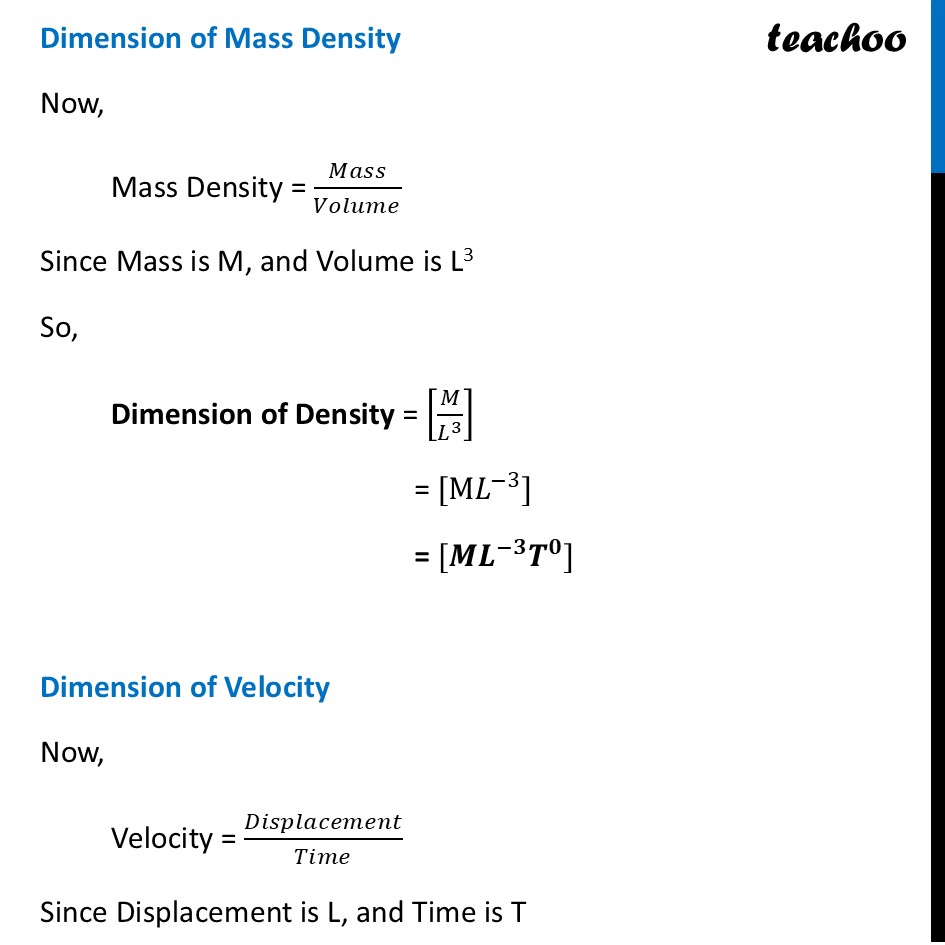
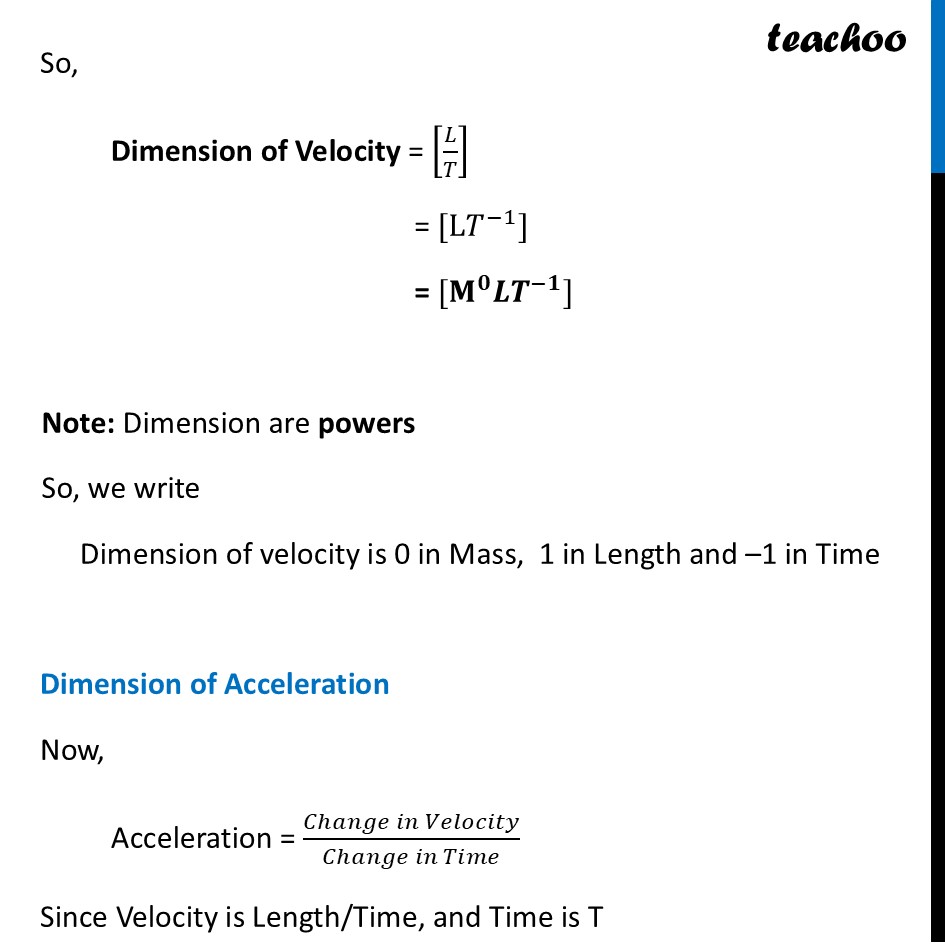
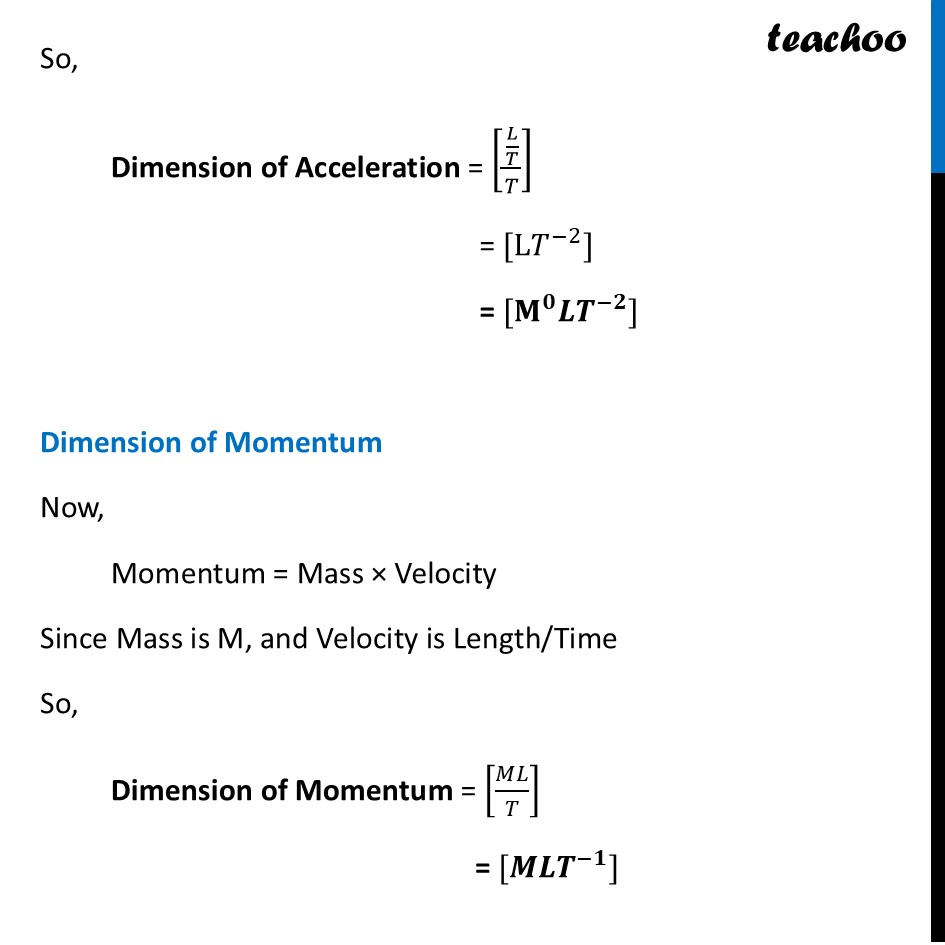
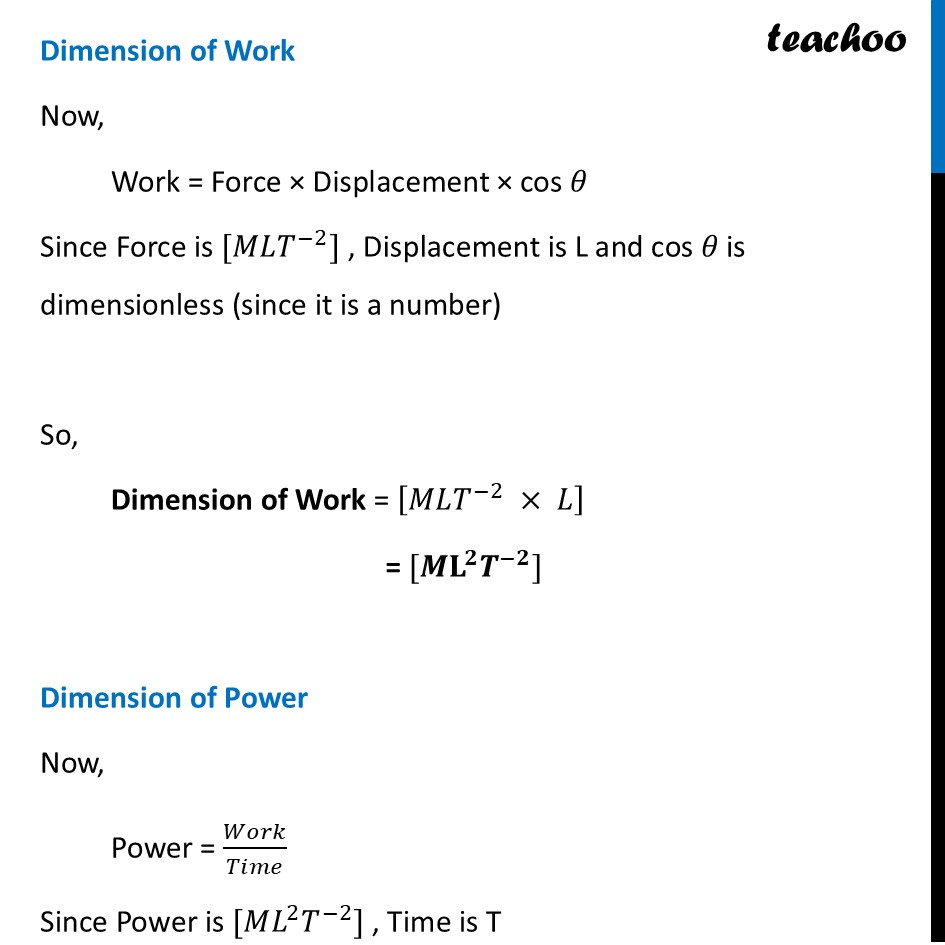
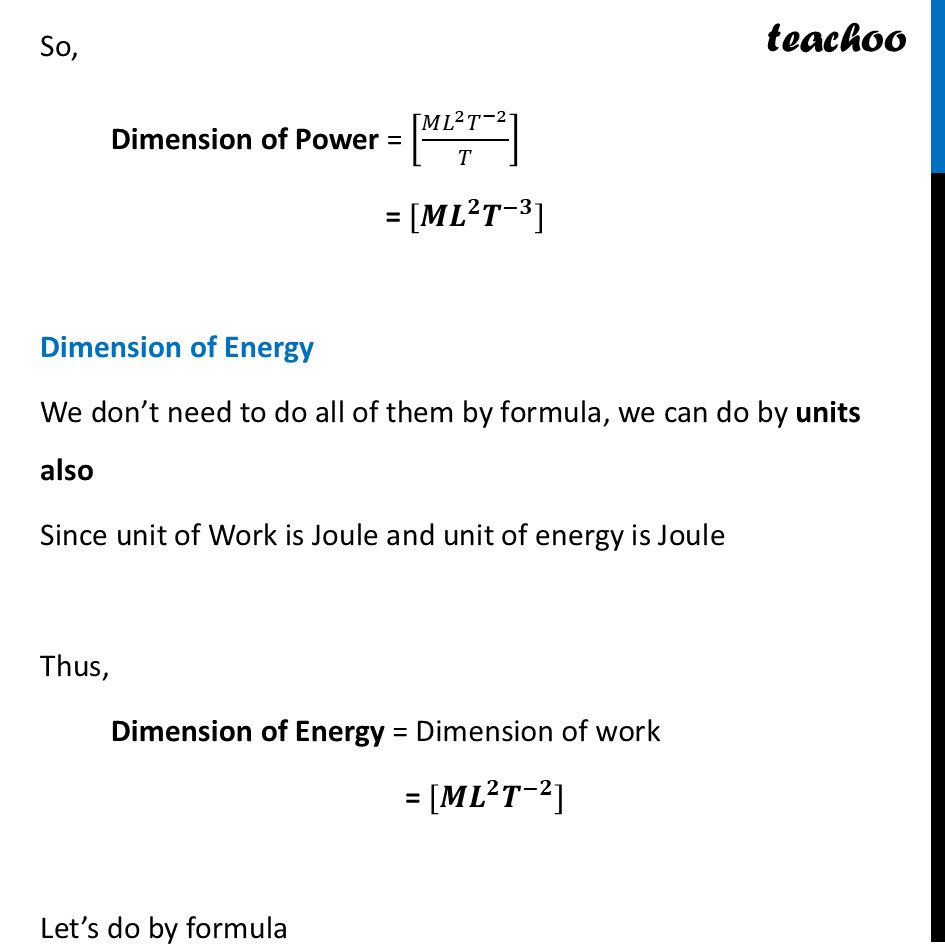
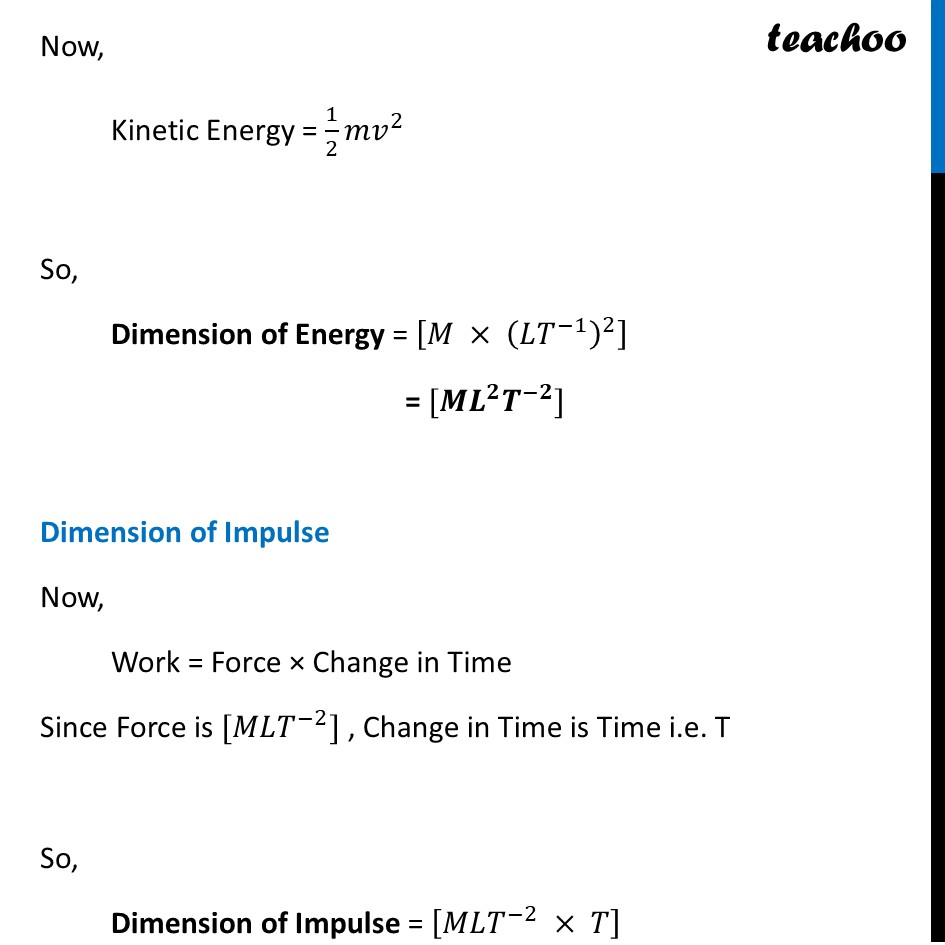
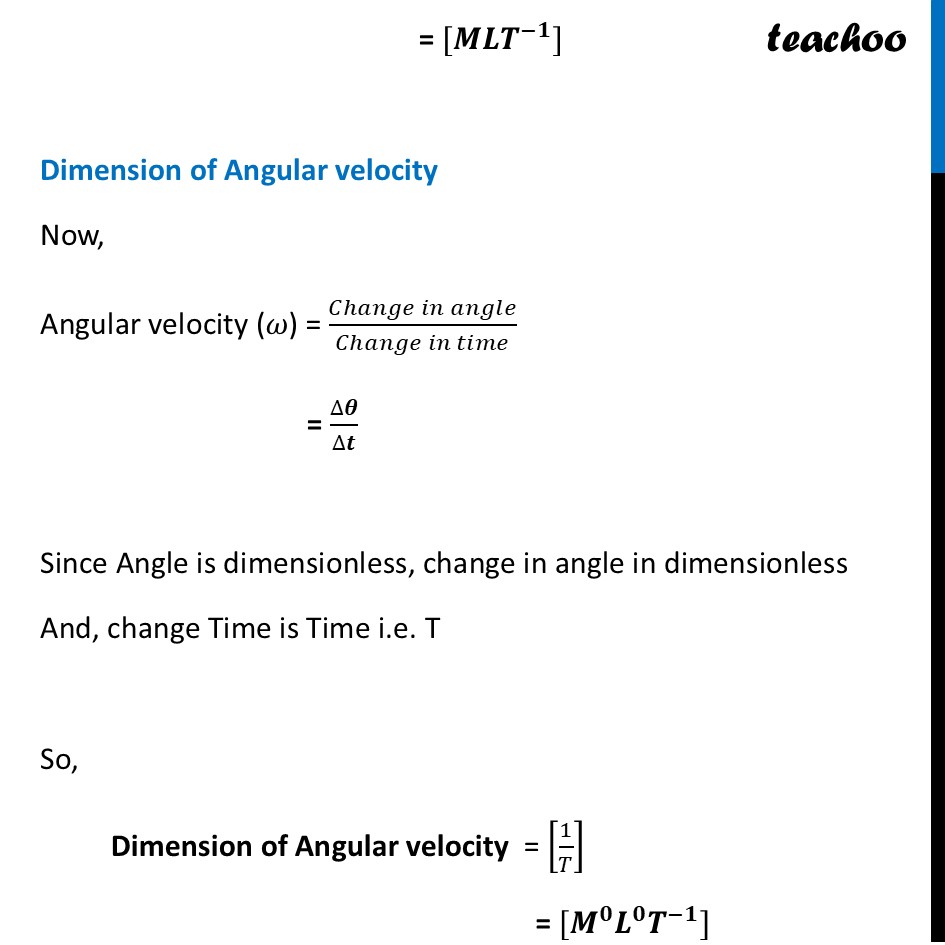
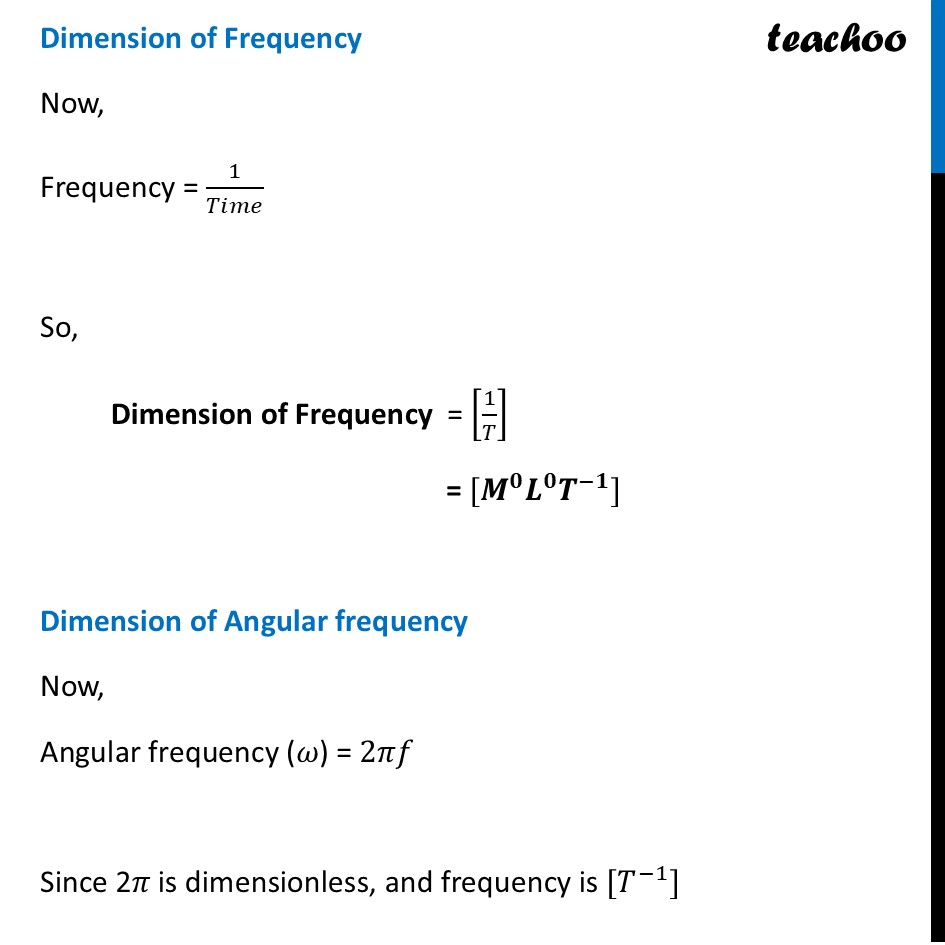
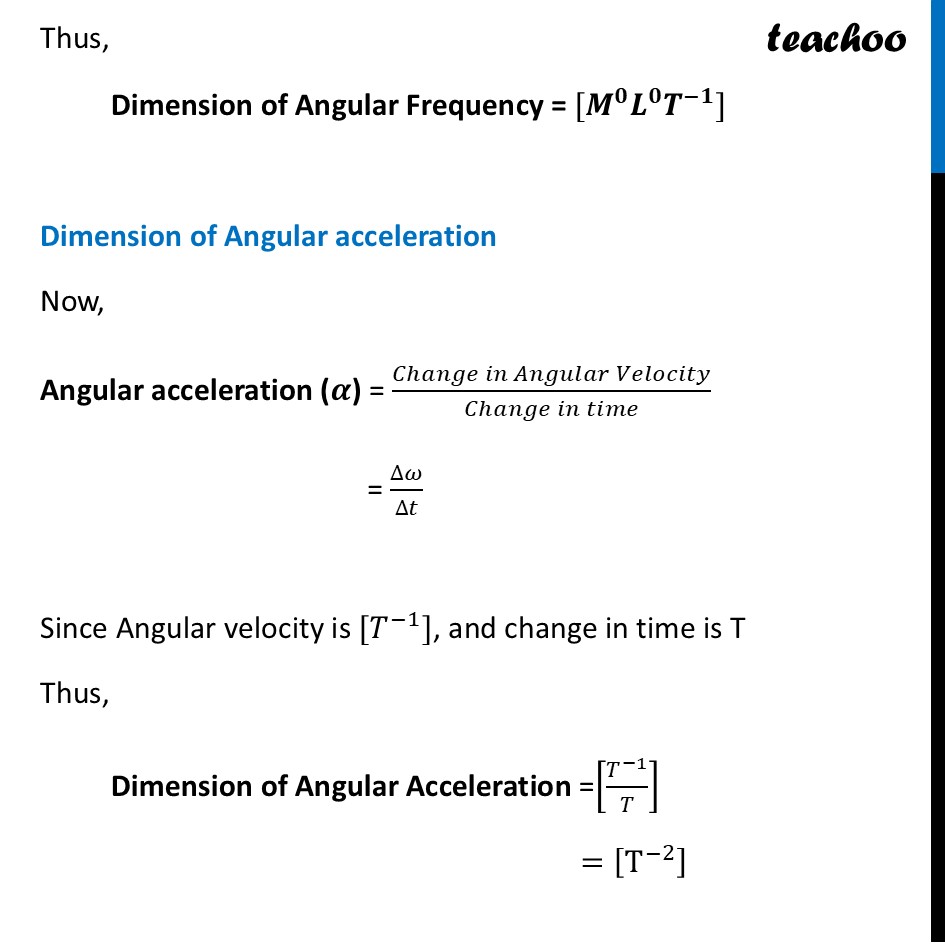
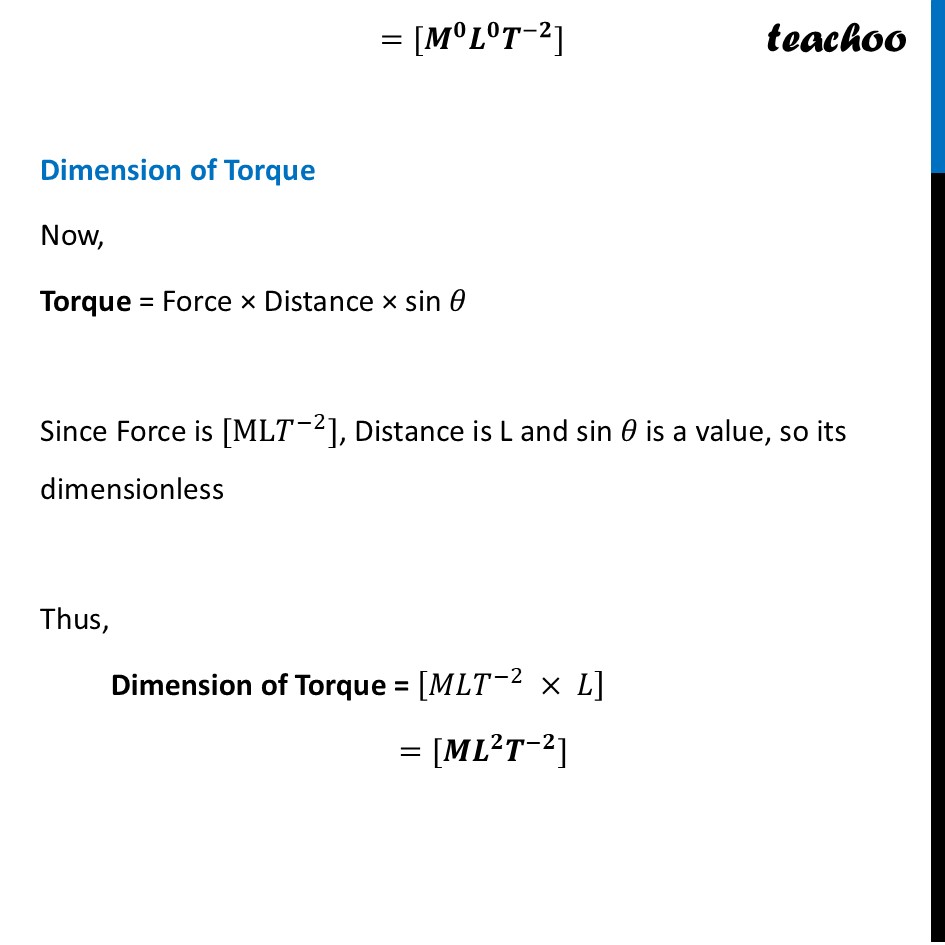
Dimensions of Physical Quantities Dimensions express a physical quantity in terms of powers of base quantities. A dimension describes the physical nature of a quantity. A unit gives the standard used to measure it. Metres and centimetres are different units of length, but both have the dimension of length. Common dimensional symbols: Mass — M Length — L Time — T Electric current — I Thermodynamic temperature — Θ Amount of substance — N Luminous intensity — J Here, N and J are dimensional symbols, distinct from the unit symbols for newton and joule. FORCE Force = Mass × Acceleration Acceleration = Velocity / Time Velocity = Length / Time Therefore: Force = Mass × Length / Time² [F] = [MLT⁻²] The dimensions of force are 1 in mass, 1 in length and −2 in time. AREA Area = Length × Breadth [Area] = [L²] = [M⁰L²T⁰] VOLUME Volume = Length × Breadth × Height [Volume] = [L³] = [M⁰L³T⁰] DENSITY Density = Mass / Volume [ρ] = [M / L³] [ρ] = [ML⁻³] VELOCITY Velocity = Displacement / Time [v] = [L / T] [v] = [LT⁻¹] ACCELERATION Acceleration = Change in velocity / Time [a] = [LT⁻¹ / T] [a] = [LT⁻²] MOMENTUM Momentum = Mass × Velocity [p] = [M × LT⁻¹] [p] = [MLT⁻¹] WORK Work = Force × Displacement × cos θ cos θ is dimensionless. [Work] = [MLT⁻² × L] [Work] = [ML²T⁻²] POWER Power = Work / Time [Power] = [ML²T⁻² / T] [Power] = [ML²T⁻³] ENERGY Energy and work have the same dimensions. Kinetic energy = (1/2)mv² [K] = [M × (LT⁻¹)²] [K] = [ML²T⁻²] IMPULSE Impulse = Force × Time interval [Impulse] = [MLT⁻² × T] [Impulse] = [MLT⁻¹] ANGULAR VELOCITY Angular velocity = Change in angle / Time Angle is dimensionless. [ω] = [T⁻¹] FREQUENCY Frequency = 1 / Time period [f] = [T⁻¹] ANGULAR FREQUENCY Angular frequency = 2πf 2π is dimensionless. [ω] = [T⁻¹] ANGULAR ACCELERATION Angular acceleration = Change in angular velocity / Time [α] = [T⁻¹ / T] [α] = [T⁻²] TORQUE Torque = Force × Distance × sin θ sin θ is dimensionless. [Torque] = [MLT⁻² × L] [Torque] = [ML²T⁻²]