Exercise Questions
 You are here

Last updated at October 12, 2026 by Teachoo
Transcript
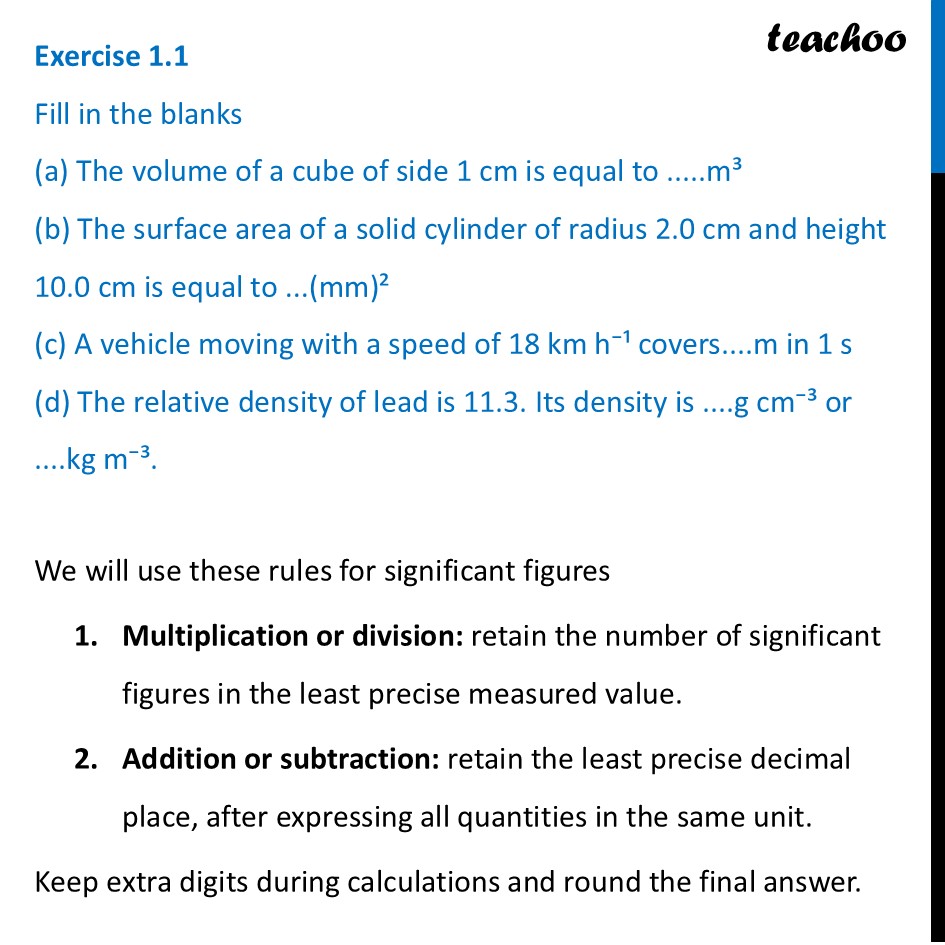
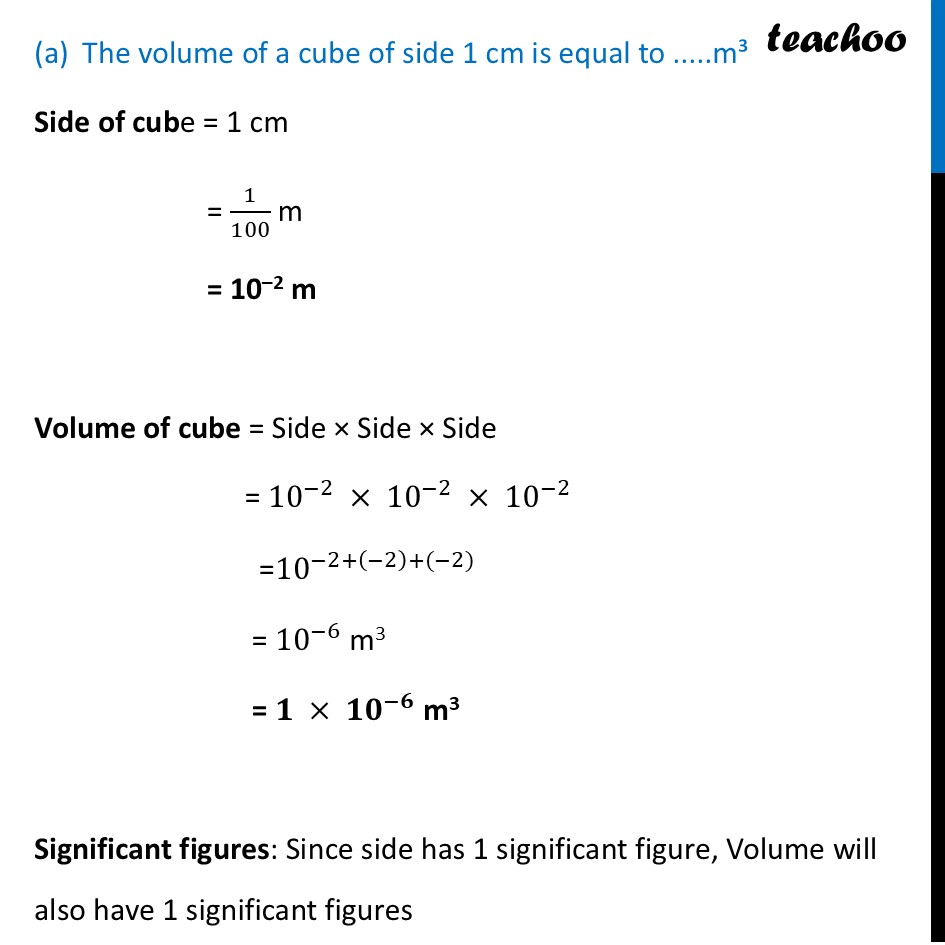
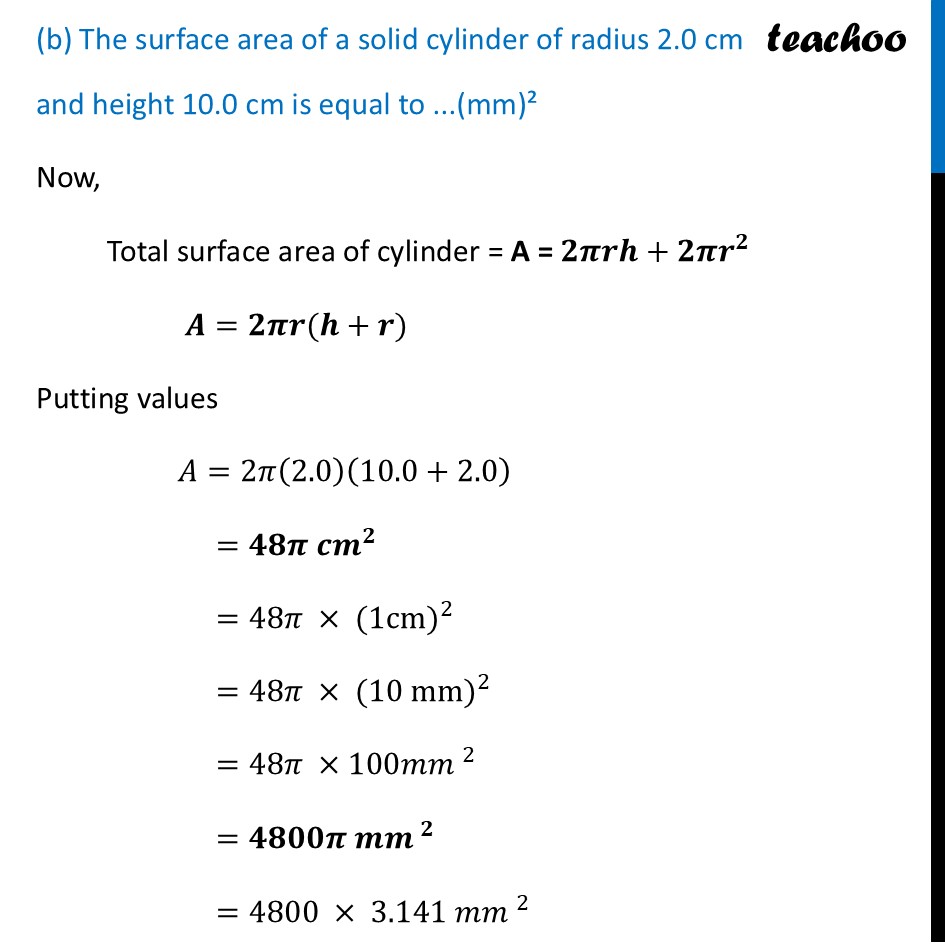
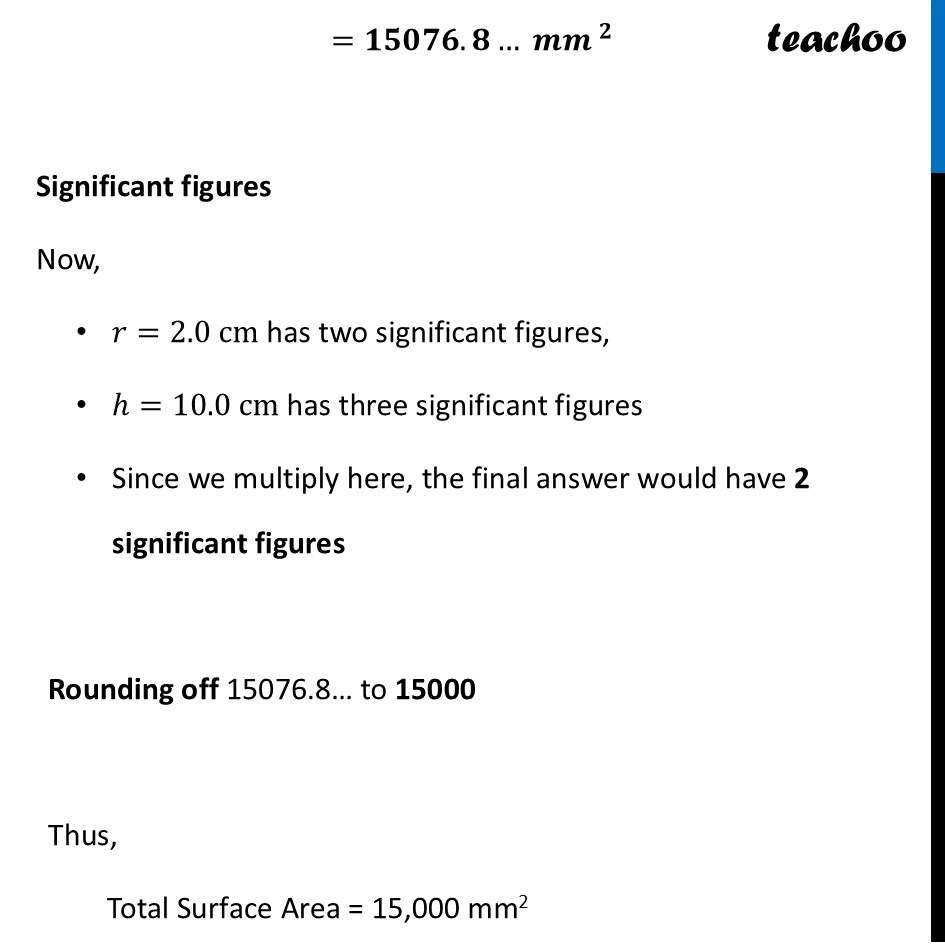
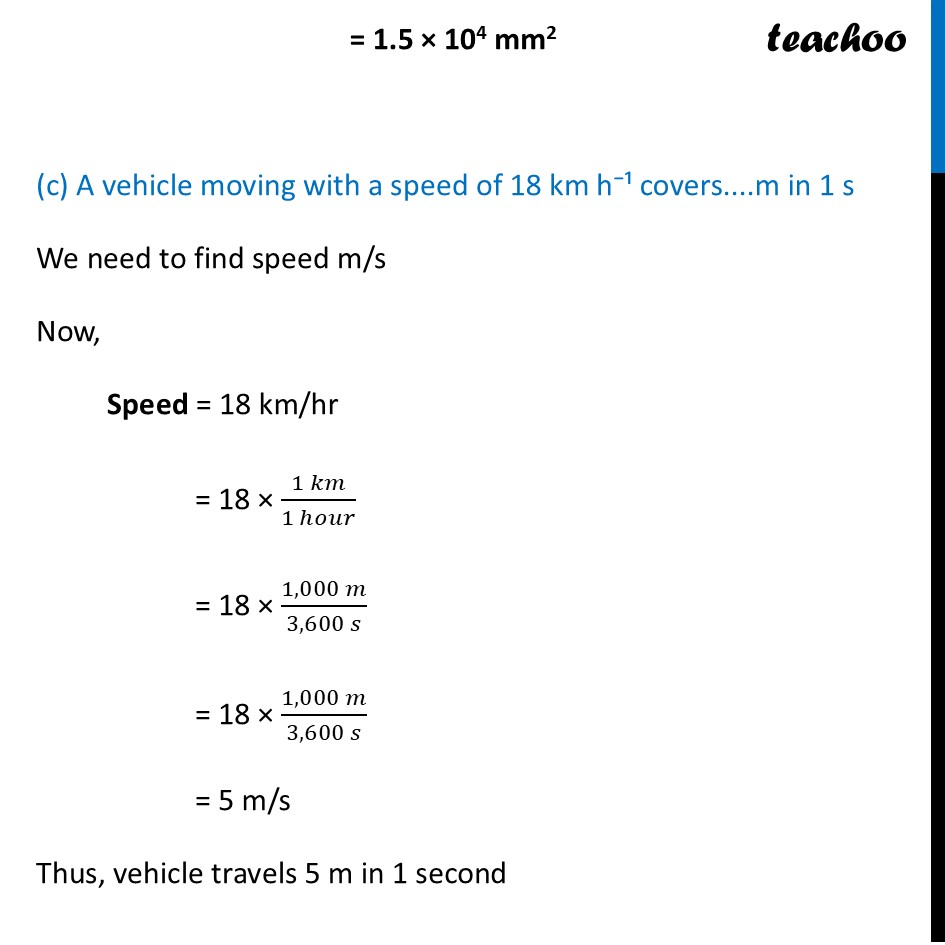
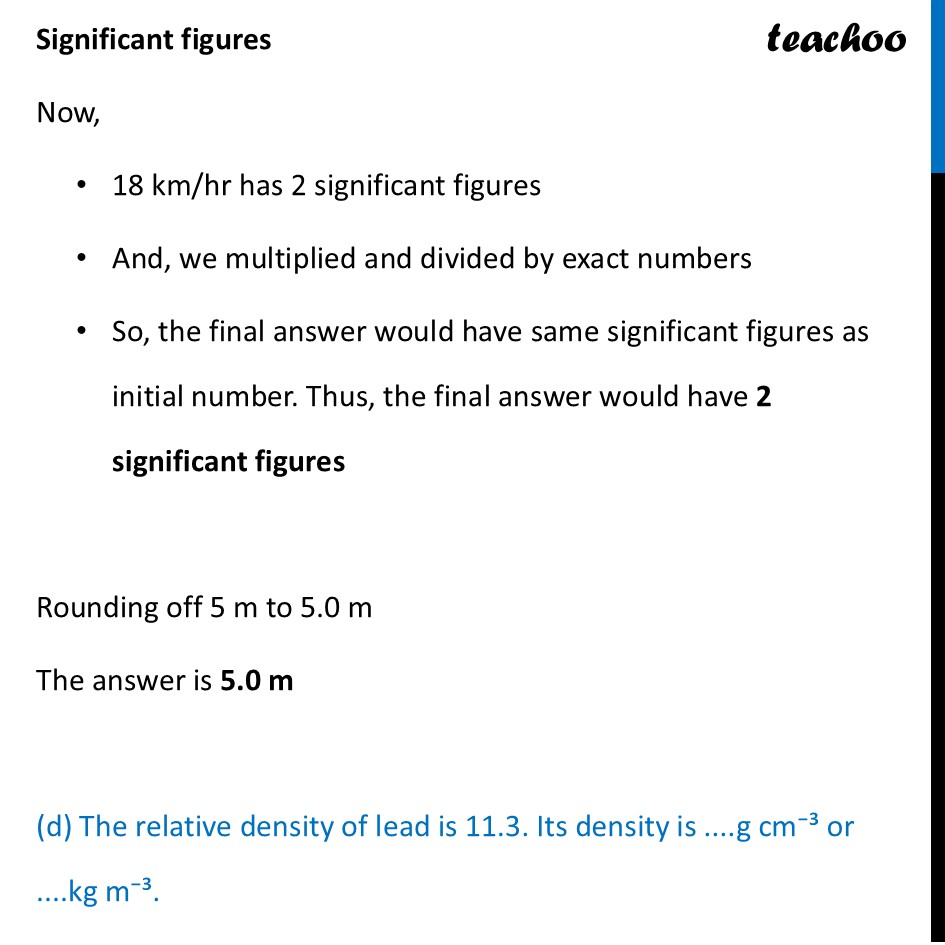
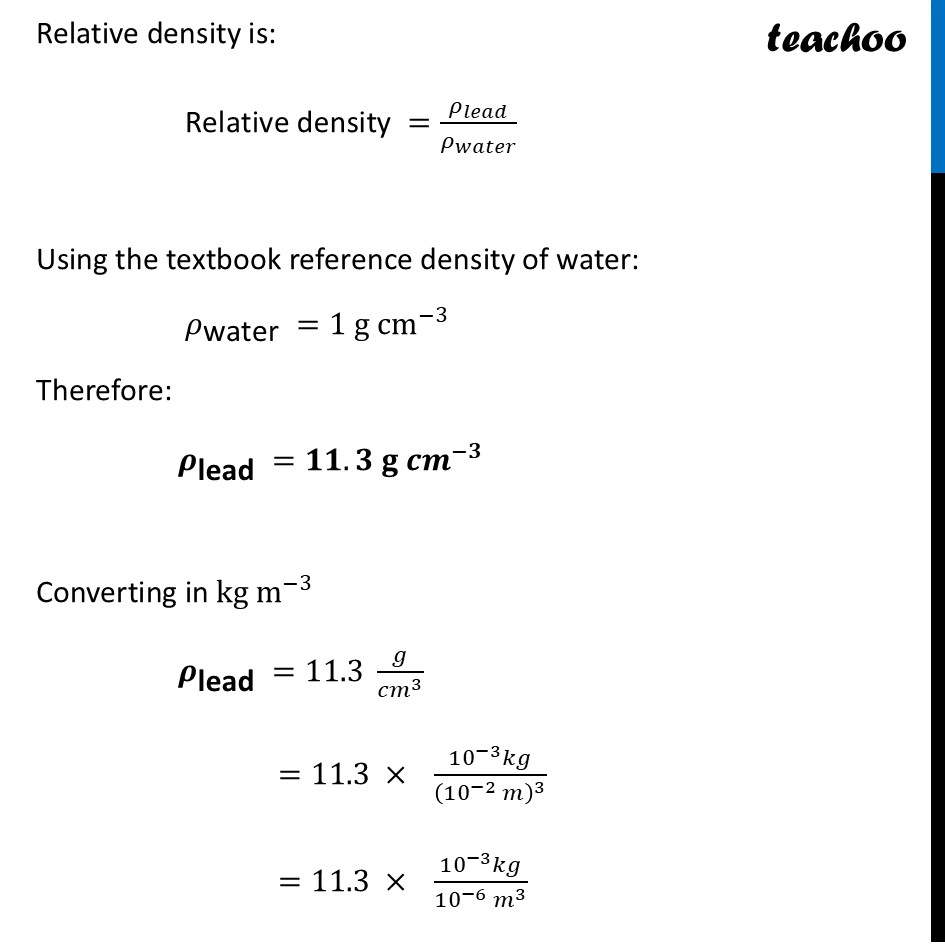
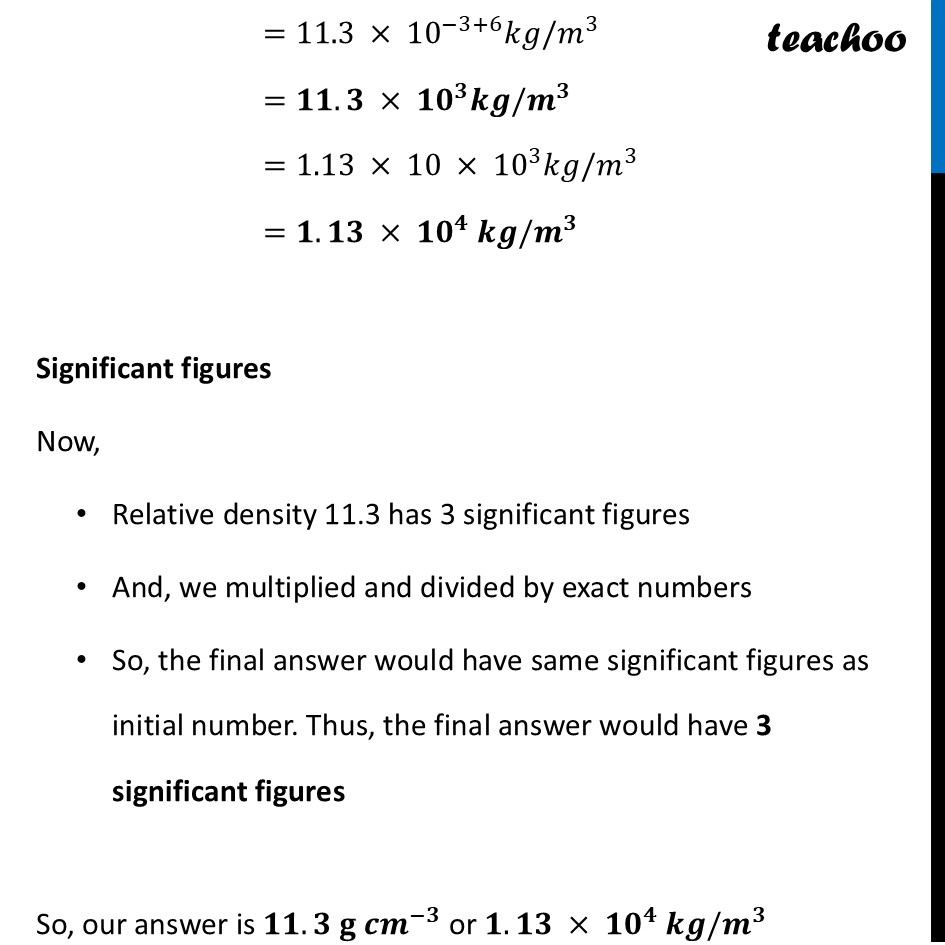
Exercise 1.1 Fill in the blanks (a) The volume of a cube of side 1 cm is equal to .....m³ (b) The surface area of a solid cylinder of radius 2.0 cm and height 10.0 cm is equal to ...(mm)² (c) A vehicle moving with a speed of 18 km h⁻¹ covers....m in 1 s (d) The relative density of lead is 11.3. Its density is ....g cm⁻³ or ....kg m⁻³. We will use these rules for significant figures Multiplication or division: retain the number of significant figures in the least precise measured value. Addition or subtraction: retain the least precise decimal place, after expressing all quantities in the same unit. Keep extra digits during calculations and round the final answer. The volume of a cube of side 1 cm is equal to .....m³ Side of cube = 1 cm = (1)/(100) m = 10^(–2) m Volume of cube = Side × Side × Side = 10^(−2) × 10^(−2) × 10^(−2) = 10^(−2+(−2)+(−2)) = 10^(−6) m^(3) = 𝟏 × 𝟏𝟎^(−𝟔) m^(3) Significant figures: Since side has 1 significant figure, Volume will also have 1 significant figures (b) The surface area of a solid cylinder of radius 2.0 cm and height 10.0 cm is equal to ...(mm)² Now, Total surface area of cylinder = A = 𝟐𝝅𝒓𝒉+𝟐𝝅𝒓^(𝟐) 𝑨=𝟐𝝅𝒓(𝒉+𝒓) Putting values 𝐴=2𝜋(2.0)(10.0+2.0) =𝟒𝟖𝝅 𝒄𝒎^(𝟐) =48𝜋 × (1cm)^(2) =48𝜋 × (10 mm)^(2) =48𝜋 ×100𝑚𝑚 ^(2) =𝟒𝟖𝟎𝟎𝝅 𝒎𝒎 ^(𝟐) =4800 × 3.141 𝑚𝑚 ^(2) =𝟏𝟓𝟎𝟕𝟔.𝟖… 𝒎𝒎 ^(𝟐) Significant figures Now, 𝑟=2.0 cm has two significant figures, ℎ=10.0 cm has three significant figures Since we multiply here, the final answer would have 2 significant figures Rounding off 15076.8… to 15000 Thus, Total Surface Area = 15,000 mm^(2) = 1.5 × 10^(4) mm^(2) =𝟏𝟓𝟎𝟕𝟔.𝟖… 𝒎𝒎 ^(𝟐) Significant figures Now, 𝑟=2.0 cm has two significant figures, ℎ=10.0 cm has three significant figures Since we multiply here, the final answer would have 2 significant figures Rounding off 15076.8… to 15000 Thus, Total Surface Area = 15,000 mm^(2) = 1.5 × 10^(4) mm^(2) = 1.5 × 10^(4) mm^(2) (c) A vehicle moving with a speed of 18 km h⁻¹ covers....m in 1 s We need to find speed m/s Now, Speed = 18 km/hr = 18 × (1 𝑘𝑚)/(1 ℎ𝑜𝑢𝑟) = 18 × (1,000 𝑚)/(3,600 𝑠) = 18 × (1,000 𝑚)/(3,600 𝑠) = 5 m/s Thus, vehicle travels 5 m in 1 second Significant figures Now, 18 km/hr has 2 significant figures And, we multiplied and divided by exact numbers So, the final answer would have same significant figures as initial number. Thus, the final answer would have 2 significant figures Rounding off 5 m to 5.0 m The answer is 5.0 m Significant figures Now, 18 km/hr has 2 significant figures And, we multiplied and divided by exact numbers So, the final answer would have same significant figures as initial number. Thus, the final answer would have 2 significant figures Rounding off 5 m to 5.0 m The answer is 5.0 m (d) The relative density of lead is 11.3. Its density is ....g cm⁻³ or ....kg m⁻³. Relative density is: Relative density =(𝜌_(𝑙𝑒𝑎𝑑))/(𝜌_(𝑤𝑎𝑡𝑒𝑟)) Using the textbook reference density of water: 𝜌_(water )=1 g cm^(−3) Therefore: 𝝆_(lead )=𝟏𝟏.𝟑 𝐠 𝒄𝒎^(−𝟑) Converting in kg m^(−3) 𝝆_(lead )=11.3 (𝑔)/(𝑐𝑚^(3)) =11.3 × (10^(−3)𝑘𝑔)/((10^(−2) 𝑚)^(3)) =11.3 × (10^(−3)𝑘𝑔)/(10^(−6) 𝑚^(3)) =11.3 × (10^(−3+6)𝑘𝑔/𝑚^(3))/(10^(−6) 𝑚^(3)) To convert: [1 g cm^(−3)=(10^(−3) kg)/(10^(−6) m^(3))=10^(3) kg m^(−3); 𝜌_(lead )=11.3 g cm^(−3)=1.13×10^(4) kg m^(−3)] Significant figures: both forms retain the three significant figures in 11.3. Changing units does not change precision. =11.3 × 10^(−3+6)𝑘𝑔/𝑚^(3) =𝟏𝟏.𝟑 × 𝟏𝟎^(𝟑)𝒌𝒈/𝒎^(𝟑) =1.13 × 10 × 10^(3)𝑘𝑔/𝑚^(3) =𝟏.𝟏𝟑 × 𝟏𝟎^(𝟒) 𝒌𝒈/𝒎^(𝟑) Significant figures Now, Relative density 11.3 has 3 significant figures And, we multiplied and divided by exact numbers So, the final answer would have same significant figures as initial number. Thus, the final answer would have 3 significant figures So, our answer is 𝟏𝟏.𝟑 𝐠 𝒄𝒎^(−𝟑) or 𝟏.𝟏𝟑 × 𝟏𝟎^(𝟒) 𝒌𝒈/𝒎^(𝟑)